Here’s What The Ball On The Nose Of UAE’s Block 60 F-16E/F Desert Falcon Does这就是阿联酋Block 60 F-16E/F“沙漠猎鹰”战斗机机头上的球的作用
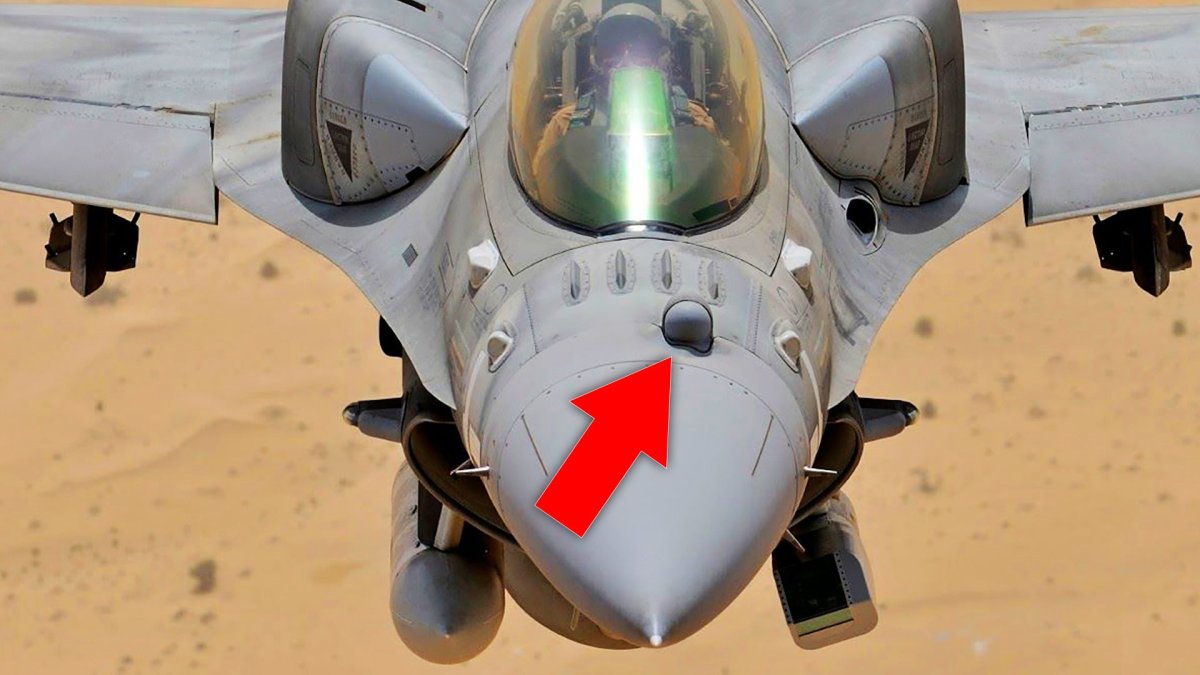
The UAE's unique F-16 variant has a slew of special features, with an installation on its nose being one of its most prominent and puzzling.
新闻视频
Updated Dec 1, 2019 6:00 AM EST
A significant portion of the correspondence and questions I receive have to do with unique physical features on various ships, ground vehicles, and especially aircraft and what they do. One of the most interesting aspects of modern military technology is the slight differences among evolutions and sub-types of a particular weapon system. In some ways, these small alterations tell a rich story of changes in technological know-how, tactics, and the ever-morphing nature of threats. We write in detail about these unique features and subsystems all the time , but one structure on a particular aircraft variant seems to draw a lot of attention and questions, at least based on what readers ask me about. That is the bulbous nub on the nose of the enigmatic Block 60 F-16E/F “Desert Falcon” developed specifically for the United Arab Emirates Air Force.
The F-16E/F is an F-16, but it is one unlike any other F-16 variant in the world. The aircraft is more of a redevelopment of sorts the F-16 than just another incremental upgrade. Originally, when the program spun up in the 1990s, with an order eventually being placed for 80 advanced F-16s in 1998 , the aircraft was going to be an even more drastic redesign of the F-16, similar to how Japan’s F-2 fighter came to be, but with a large delta wing and other aerodynamic tweaks.
Block 60 F-16 test aircraft., Lockheed Martin
That ambitious concept was jettisoned in favor of drastically enhancing the Block 50/52 F-16C/D Viper. In the end, just developing the F-16E/F cost the UAE a whopping $3B, with the first jet taking to the skies in December of 2003. Years of testing and training would follow, with the first aircraft delivered to the UAE beginning in May of 2005. In total, the force consists of 55 single-seat F-16Es and 25 two-seat F-16Fs, the latter of which include fully missionized rear cockpits. Now very mature, the F-16E/F fleet is already undergoing a series of upgrades.
UAE F-16E taking off for a Red Flag sortie. The initial pilot cadre trained in Arizona. , Tyler Rogoway
The Block 60 includes a load of enhancements. It has conformal fuel tanks like some of its late-block predecessors, but its F110-GE-132 General Electric turbofan puts out 32,000lbs of thrust. That’s 3,000lbs more than the Block 50’s F110-GE-129. It was built with Northrop Grumman’s AN/APG-80 Active Electronically Scanned Array (AESA) radar system, which was at the time of introduction into service, and still is, incredibly capable. You can read about the benefits of fighter-sized AESAs in this past piece of ours , but for the F-16, which is something of the hallmark of multi-role fighters, being able to perform multiple modes, such as air-to-air and air-to-ground, simultaneously and seamlessly equals a massive leap in capability and situational awareness.
The brutish and muscular look of a Block 60 F-16 head-on., Lockheed Martin/Code One
The jet also has an advanced defensive countermeasures and situational awareness system called the Falcon Edge Integrated Electronic Warfare Suite (IEWS). It includes an active jamming system and passive electronic support measures that provide enhanced situational awareness of radio-frequency threats in the jet’s vicinity. It can geolocate those threats and allow the F-16E/F to rapidly target them with precision-guided munitions. It has no less than eight expendable countermeasure dispensers that are tied into its self-defense system and it is also capable of controlling towed fiber-optic decoys. It isn’t perfectly clear, but the Block 60 appears to have been built with a missile approach warning system, or at least the ability to be fitted with one, as well.
The Block 60’s cockpit was also a big upgrade over the Block 50/52. Three large flat panel displays replace the old smaller multi-function and analog display layout. A wide-angle HUD with holographic video projection capability is also fitted. The rear cockpits of the F models are built for two-crew combat operations, with displays and interfaces to support it. Advanced data links and highly-secure, beyond-line-of-sight communications systems are also installed on these jets, as well. The Desert Falcon was built with a new and greatly improved environmental control system (ECS) to reliably cool all these electrical systems even in the extreme desert heat.
Finally, a huge array of advanced weaponry can be carried by the F-16E/F, including standoff weapons like the Small Diameter Bomb , Joint Stand-Off Weapon , and Hakim missile .
I could keep going, but you get the idea. These are the most capable F-16s in the world.
F-16F seen during tests with the Hakim-A standoff missile. The pod on the chin is likely a data link pod to connect with the missiles during their flight., Unknown/Public Domain
Yet one of the Desert Falcon’s most unique systems is its infrared targeting and navigation suite. Known as the AN/AAQ-32 Internal FLIR Targeting System (IFTS), it manifests itself externally in two areas. One is the targeting pod that is installed on one of its two intake pylons. It was derived from Northrop Grumman’s AN/AAQ-28 LITENING targeting pod and acts in a similar fashion to other advanced targeting pods, providing stabilized mid-wave infrared and electro-optical video feeds, as well as laser range-finding, spot tracking, pointer, and targeting functions. Although primarily designed for air-to-ground applications, it can be used for air-to-air search, track, and identification purposes, as well. You can read about this capability and how it works in this past article of ours.
Also part of the IFTS is the round nub on the F-16E/F’s nose—the same one that has drawn a lot of interest from readers. Some have posited that this is an infrared search and track system (IRST), but it isn’t. Others thought it was an updated version of Texas Instruments Falcon Eye FLIR system that began development in the 1980s. That system was primarily intended to give pilots the ability to see in the night prior to the integration of night vision goggles into tactical fast jets, which came in the 1990s.
Falcon Eye ads from the late 1980s. , Texas Instruments advertisements
Similar to the Pilot Night Vision Sensor on the AH-64A Apache, Falcon Eye would swivel around to where the pilot was looking and project that video into a helmet-mounted display, which were somewhat ungainly at the time. Falcon Eye was tested extensively and was seen as an especially attractive potential feature for a battlefield interdiction and close air support version of the F-16, but neither it or the “A-16” really caught on. As mentioned a moment ago, night vision goggles and podded systems like the Low Altitude Navigation and Targeting Infrared Red for Night (LANTIRN) system would become commonplace and would satisfy the requirement.
LANTIRN, in its full installation, is really two pods. The AN/AAQ-14 is the targeting pod with similar capabilities as the LITENING pod described above, albeit in an earlier form. The AN/AAQ-13 is the LANTIRN navigation pod, which housed a terrain-following radar and a staring infrared sensor that would be used to project a view of where the aircraft was going on the HUD in the cockpit. Aircraft like the F-15E and the F-16C/D Block 40 had special raster-scan HUDs that could project the video properly. The system works to also project terrain-following steering cue symbology onto the infrared video displayed on the HUD.
AN/AAQ-13 LANTIRN navigational pod on the F-15E. , USAF
The projection from the pod’s staring infrared sensor onto the F-15E’s wide-angle HUD., USAF
Over time, less reliance on all-weather, low-altitude penetration tactics and the widespread use of night vision goggles by fighter crews, along with advanced navigational upgrades and standoff weaponry, has put less of premium on the capability the AN/AAQ-14 provides. For F-15E crews, it is still a highly relevant capability, but for later block F-16 crews, it is added weight for the vast majority of missions or just isn’t needed at all. But that is based on American needs and tactics. Not a foreign military that bets most of its air dominance and attack capabilities on one multi-role fighter.
The novel thing about the Block 60’s IFTS is that it retains all the capability that the LANTIRN system provides and more without having to carry a big second pod on the F-16’s other intake station. The lump on the Block 60’s nose and its AESA radar make this possible.
Full LANTIRN installation on a Block 40 F-16C stationed at Osan AFB in South Korea. , USAF
The lump is a FLIR system that rotates around to point directly forward when in use. The video it takes is then piped into the F-16E/F’s pilot’s HUD and it can also be shown on the displays in the rear cockpit of the F model. It doesn’t move around with the pilot’s head position, but it does give them a far better view forward at night and in poor weather. Sources familiar with the system note that it doesn’t project its feed into the pilot’s helmet, but it could in the future. It would still only show in the forward field of view, just like a virtual HUD in advanced helmet mounted displays , like the one found in the F-35.
A very rare image of the Block 60’s IFTS nose-mounted FLIR out of its stowed position with its aperture pointed forward. Also note the Sniper targeting pod. The F-16E/F fleet has been seen flying with the system from time to time instead of its original pod in recent years., Photo by PETRA via Getty Images
You are probably thinking that the Block 60 is still missing the terrain-following radar functionality that a pod like AN/AAQ-13 provides for all-weather low-level penetration capabilities. The thing about the AN/APG-80 AESA radar—not handcuffed by a mechanically scanned antenna that has to literally point at what it is scanning—is that it can provide this capability seamlessly while executing other modes like air-to-air search and ground mapping. In other words, the addition of the FLIR on the nose and the AN/APG-80 AESA radar has allowed for the F-16E/F to have even better low-level capabilities without the need for a second pod. This saves weight, increasing aerodynamic efficiency, frees up a pylon for other sensors in the future, like an IRST, and saves on maintenance and logistics.
If nothing else, the installation of the navigational FLIR into the Desert Falcon’s nose and its integration with the targeting pod is indicative of just how far the UAE, Lockheed Martin, and its subcontractors went with refining the highly mature C/D into something more exquisite. It is also a clear indication of what capabilities UAE wanted out of its investment into a super-advanced F-16E/F. Having the ability to penetrate into denied airspace at very-low level and in all weather conditions gives the UAE similar capabilities as their Saudi Neighbors that fly F-15 Strike Eagle derivatives .
Combined with the F-16E/F’s advanced defensive suite, these 4.5+ generation fighters are designed with every advantage to survive in contested airspace—aside from stealth. Combined with standoff munitions, like JSOW, SBD, and the Hakim missile, the Block 60 gives the UAE a real ability to reach out and put targets throughout the region in jeopardy.
So, there you have it, now you know what that curious nub is on the nose of UAE’s muscular-looking “Desert Falcons,” which still represent the most advanced operational F-16s in the world.
Contact the author: Tyler@thedrive.com
Here is the best shot I have seen of the IFTS FLIR out of its stowed position.
Another instance of a stripped bare IFTS https://t.co/56Al2nXx7v pic.twitter.com/yOTWTvtbZM — Abd (@blocksixtynine) September 20, 2019
Another instance of a stripped bare IFTS https://t.co/56Al2nXx7v pic.twitter.com/yOTWTvtbZM
Comments couldn’t be loaded. Please refresh the page.
更新于美国东部时间2019年12月1日上午6:00
我收到的来信和问题中,很大一部分都与各种舰船、地面车辆,尤其是飞机的独特物理特征及其功能有关。现代军事技术最引人入胜的方面之一,便是同一武器系统不同版本和子型号之间的细微差别。在某种程度上,这些微小的变化生动地展现了技术知识、战术以及不断变化的威胁本质。我们经常详细介绍这些独特的特征和子系统,但某种特定飞机型号上的一个结构似乎格外引人注目,至少从读者向我咨询的内容来看是如此。那就是专为阿联酋空军研发的神秘Block 60 F-16E/F“沙漠猎鹰”战斗机机头上的球状凸起。
F-16E/F虽然也属于F-16系列,但它与世界上任何其他F-16衍生机型都截然不同。与其说它是F-16的升级版,不如说它更像是F-16的重新研发版本。最初,该项目于上世纪90年代启动,并于1998年最终订购了80架先进的F-16。当时的设想是,F-16E/F将对F-16进行更为彻底的重新设计,类似于日本F-2战斗机的研发过程,但会采用更大的三角翼和其他空气动力学方面的改进。
Block 60 F-16 测试飞机,洛克希德·马丁公司
这一雄心勃勃的构想最终被放弃,转而大幅改进Block 50/52型F-16C/D“蝰蛇”战斗机。最终,仅F-16E/F的研发就耗费了阿联酋高达30亿美元,首架战机于2003年12月首飞。随后进行了多年的测试和训练,首批飞机于2005年5月交付阿联酋。目前,阿联酋共拥有55架单座F-16E和25架双座F-16F,其中双座F-16F配备了功能齐全的后座舱。如今,F-16E/F机队已相当成熟,并正在进行一系列升级改造。
阿联酋F-16E战机起飞执行“红旗”军演任务。首批飞行员在亚利桑那州接受训练。泰勒·罗戈威
Block 60 型号包含诸多改进。它像一些后期型号一样配备了保形油箱,但其搭载的 F110-GE-132 通用电气涡扇发动机可输出 32,000 磅的推力,比 Block 50 型号的 F110-GE-129 发动机高出 3,000 磅。该机配备了诺斯罗普·格鲁曼公司的 AN/APG-80 有源相控阵雷达 (AESA) 系统,该系统在服役之初就性能卓越,至今依然如此。您可以在我们之前的文章中了解战斗机级 AESA 雷达的优势,但对于 F-16 这款多用途战斗机的标志性机型而言,能够同时无缝地执行多种模式(例如空对空和空对地作战)意味着作战能力和态势感知能力的巨大飞跃。
Block 60 F-16 正面照,外观粗犷有力。(洛克希德·马丁/Code One)
该战机还配备了名为“猎鹰边缘综合电子战系统”(IEWS)的先进防御对抗和态势感知系统。该系统包含主动干扰系统和被动电子支援措施,能够增强战机附近射频威胁的态势感知能力。它可以对这些威胁进行地理定位,并使F-16E/F能够使用精确制导武器快速打击目标。该系统配备不少于八个与自卫系统相连的消耗性对抗装置,并且能够控制拖曳式光纤诱饵。虽然尚不完全清楚,但Block 60似乎也配备了导弹逼近告警系统,或者至少具备加装该系统的能力。
Block 60 的座舱相比 Block 50/52 也有了显著的升级。三个大型平板显示器取代了原先较小的多功能模拟显示器布局。此外,还配备了具有全息视频投影功能的广角平视显示器 (HUD)。F 型的后座舱专为双人作战而设计,配备了相应的显示器和接口。这些战机还安装了先进的数据链和高度安全的超视距通信系统。“沙漠之鹰”战机配备了全新且大幅改进的环境控制系统 (ECS),即使在极端沙漠高温下也能可靠地冷却所有电气系统。
最后,F-16E/F 可以携带种类繁多的先进武器,包括小直径炸弹、联合防区外武器和哈基姆导弹等防区外武器。
我还可以继续说下去,但你应该明白我的意思了。这些是世界上性能最强的F-16战斗机。
图中可见F-16F战斗机正在进行哈基姆-A防区外导弹的测试。机头下方的吊舱很可能是数据链吊舱,用于在导弹飞行过程中与其连接。(来源未知/公共领域)
然而,“沙漠之鹰”最独特的系统之一是其红外瞄准和导航套件。这套名为AN/AAQ-32内部前视红外瞄准系统(IFTS)的系统,在外部体现在两个方面。一是安装在两个进气口挂架之一上的瞄准吊舱。它源自诺斯罗普·格鲁曼公司的AN/AAQ-28 LITENING瞄准吊舱,其工作原理与其他先进瞄准吊舱类似,可提供稳定的中波红外和光电视频信号,以及激光测距、点跟踪、指示器和瞄准功能。虽然它主要设计用于空对地作战,但也可用于空对空搜索、跟踪和识别。您可以在我们之前的文章中了解这项功能及其工作原理。
F-16E/F战斗机机头上的圆形凸起也是IFTS系统的一部分,正是这个凸起引起了读者的广泛关注。有人认为这是红外搜索与跟踪系统(IRST),但事实并非如此。也有人认为它是德州仪器公司Falcon Eye FLIR系统的升级版,该系统于20世纪80年代开始研发。Falcon Eye系统的主要目的是在夜视镜集成到战术战斗机之前,为飞行员提供夜间视野,而夜视镜直到20世纪90年代才被应用到战术战斗机上。
20世纪80年代末的Falcon Eye广告,德州仪器广告
与AH-64A“阿帕奇”武装直升机上的飞行员夜视传感器类似,“猎鹰眼”系统会旋转到飞行员的视线方向,并将画面投射到头盔显示器上,尽管当时的头盔显示器略显笨重。“猎鹰眼”系统经过了广泛的测试,并被视为F-16战斗机战场拦截和近距离空中支援版本的一项极具吸引力的潜在功能,但无论是该系统还是“A-16”攻击机,最终都没能真正普及。正如刚才提到的,夜视镜和吊舱式系统,例如低空导航和目标指示红外夜视系统(LANTIRN),将会变得非常普遍,并足以满足需求。
LANTIRN系统完整安装后实际上由两个吊舱组成。AN/AAQ-14是目标指示吊舱,其功能与上文所述的LITENING吊舱类似,但属于早期版本。AN/AAQ-13是LANTIRN导航吊舱,内置地形跟踪雷达和凝视红外传感器,用于将飞机飞行方向的图像投射到驾驶舱的平视显示器(HUD)上。像F-15E和F-16C/D Block 40这样的飞机配备了特殊的栅格扫描HUD,可以正确投射视频。该系统还能将地形跟踪的转向提示符号投射到HUD显示的红外视频上。
美国空军F-15E战斗机上的AN/AAQ-13 LANTIRN导航吊舱。
吊舱凝视红外传感器投射到F-15E广角平视显示器上的图像。(美国空军)
随着时间的推移,对全天候低空突防战术的依赖性降低,战斗机机组人员普遍使用夜视镜,加上先进的导航系统和防区外武器的出现,使得AN/AAQ-14雷达提供的能力不再那么重要。对于F-15E机组人员来说,它仍然是一项非常重要的能力,但对于后期批次的F-16机组人员来说,在绝大多数任务中,它要么会增加飞机重量,要么根本就不需要。但这是基于美国的需求和战术,而不是基于将大部分空中优势和攻击能力押注于单一多用途战斗机的外国军队。
Block 60型战斗机的IFTS系统最新颖之处在于,它保留了LANTIRN系统的所有功能,并且功能更强大,而无需在F-16的另一个进气口挂架上携带大型的第二个吊舱。Block 60型机头上的凸起及其AESA雷达使这一切成为可能。
一架驻扎在韩国乌山空军基地的Block 40 F-16C战斗机已完成LANTIRN系统的完整安装。
这个凸起物是一个前视红外(FLIR)系统,使用时会旋转指向正前方。它拍摄的视频会传输到F-16E/F战斗机飞行员的平视显示器(HUD)上,也可以显示在F型战斗机后座舱的显示屏上。它不会随飞行员的头部位置移动,但确实能让飞行员在夜间和恶劣天气下获得更佳的前方视野。熟悉该系统的消息人士指出,它目前不会将画面投射到飞行员的头盔上,但未来可能会实现。即便如此,它仍然只会显示在前方视野范围内,就像F-35等先进头盔显示器中的虚拟HUD一样。
一张非常罕见的照片,展示了Block 60型F-16战斗机机头安装的IFTS前视红外系统(FLIR)从收起状态伸出,光圈朝前。照片中还可以看到“狙击手”(Sniper)瞄准吊舱。近年来,F-16E/F机队偶尔会使用该系统代替原装吊舱飞行。照片由PETRA通过Getty Images提供。
您可能认为Block 60仍然缺少像AN/AAQ-13吊舱那样的地形跟踪雷达功能,从而无法实现全天候低空突防。但AN/APG-80 AESA雷达的优势在于——它不受机械扫描天线的限制,无需像传统雷达那样精确指向目标——它能够在执行空对空搜索和地面测绘等其他任务的同时,无缝地提供地形跟踪雷达功能。换句话说,机头加装前视红外(FLIR)和AN/APG-80 AESA雷达后,F-16E/F无需第二个吊舱即可拥有更强大的低空作战能力。这不仅减轻了重量,提高了气动效率,还腾出了一个挂架用于未来安装其他传感器,例如红外搜索跟踪系统(IRST),并节省了维护和后勤成本。
即便没有其他意义,将导航前视红外系统安装到“沙漠猎鹰”战斗机的机头并与瞄准吊舱集成,也足以表明阿联酋、洛克希德·马丁公司及其分包商在对高度成熟的C/D型战机进行精细化改进方面投入了多少心血。这也清晰地表明了阿联酋希望通过投资这款超先进的F-16E/F战机获得哪些能力。能够在极低空和全天候条件下突破敌方防空禁区,使阿联酋拥有了与其邻国沙特阿拉伯(装备F-15“攻击鹰”衍生型战机)类似的作战能力。
结合F-16E/F先进的防御系统,这些4.5代以上的战斗机除了隐身能力外,在对抗空域中拥有生存所需的一切优势。配合JSOW、SBD和哈基姆导弹等防区外弹药,Block 60使阿联酋具备了远距离打击和威胁整个地区目标的真正能力。
好了,现在你知道阿联酋肌肉发达的“沙漠猎鹰”战机机头上那个奇怪的凸起是什么了,它们仍然是世界上最先进的现役 F-16 战机。
联系作者:Tyler@thedrive.com
这是我见过的 IFTS FLIR 从收起状态伸出时的最佳照片。
又一个被剥离了所有功能的 IFTS 示例 https://t.co/56Al2nXx7v pic.twitter.com/yOTWTvtbZM — Abd (@blocksixtynine) 2019年9月20日
又一个被剥离了所有功能的 IFTS 示例 https://t.co/56Al2nXx7v pic.twitter.com/yOTWTvtbZM
评论加载失败,请刷新页面。