Here Is How Much Those Decoy Flares Cost That Military Aircraft Fire Off All The Time以下是军用飞机经常发射的那些诱饵弹的成本。
In combat, they are essential to the survivability of the aircraft that carry them, but they don't come as cheap as one may think.
新闻视频
Updated Dec 21, 2019 3:43 PM EST
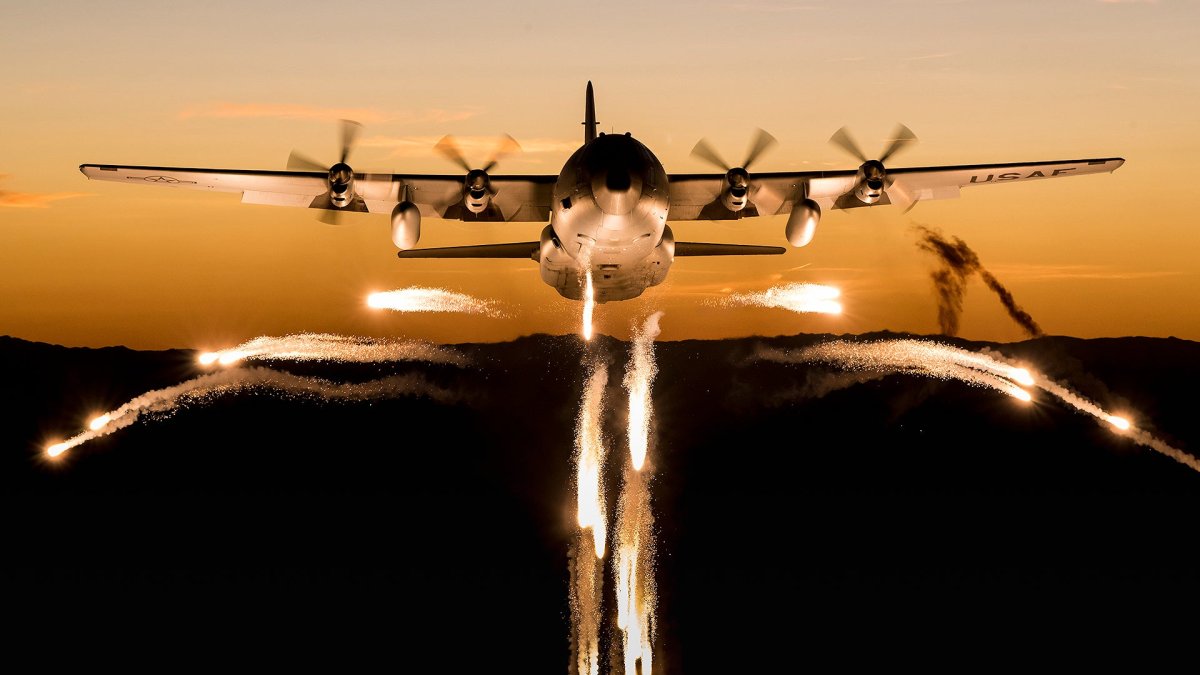
Flares can make any aircraft, no matter how big and lumbering, look dynamic and even beautiful. In reality, they are an essential countermeasure used to confuse enemy heat-seeking missiles. So, how much do these fiery things being pumped out the back of military aircraft actually cost?
Countermeasure flares burn at thousands of degrees and there is a wide variety of types, the vast majority of which ignite when their volatile compound mix is exposed to the air itself. These are can be referred to as pyrophoric flares. Beyond their use in actual combat, even in training, helicopters and ground attack aircraft will practice firing flares off when entering into high-risk areas of their flight envelope and mission where shoulder-fired surface-to-air missiles could be present. Fighters will also pop flares during training dogfights when the adversary is within the firing envelope of their short-range missiles. Sometimes fighters will even thank a tanker boom operator by popping flares. These pyrotechnics also often evoke oohs and ahhs from air show crowds as they ripple off military aircraft performing flying displays.
Youtube GIF/High Flight
With all this in mind, how much is being spent each time a flare pops off? Here are the numbers:
Each M206 flare, a basic type which is launched from A-10, F-16, C-17, C-130, and other aircraft that use the AN/ALE-47 countermeasure dispenser system, costs $35 according to the 2018 Pentagon budget.
In other words, if an aircraft releases a ‘bucket’ full of 30 flares, the cost of doing so is $1,050. But this is among the most basic of expendable infrared countermeasures. The cost climbs for more advanced types and those that are used on fewer types of aircraft or for specific tactical scenarios.
For instance, the F-35’s MJU-68/B that is used to decoy advanced infrared threats costs a whopping $3,000 per unit, according to Pentagon budget documents. Another flare the F-35 is capable of dispensing, the less capable MJU-61/B, cost $75 apiece. This same flare could replace the venerable M206 in the future.
The MJU-7/B, which is used by a wide variety of fighter aircraft, including A-10, F-15, F-16, and F-22, costs $57 each, while the imminent replacement for this flare, the MJU-53/B, cost $75 each. So a single bucket of MJU-53/Bs would run $2,250.
The most recent budget puts the cost of the MJU-66/B flare at the price of $135 each and describes this expendable as such:
MJU-66 decoy Countermeasure Flare is an improved version of the MJU-64 providing increased decoy effectiveness and protection for the A-10, C-130 and F-35 aircraft and HH-53 and HH-60 helicopters and is being evaluated for other aircraft. It is a one-piece aluminum case containing a payload of advanced special material elements, loaded into a multiple jettison unit magazine installed on a countermeasure dispenser. When deployed into the air stream, the special material reacts to emit an infrared signal to decoy infrared seeking missiles.
The MJU-10/B, which is used on the F-15 family of fighters, costs $184 each.
Often times a cocktail of different flare types are used together to cover a broader number of threats across the infrared spectrum and to achieve a better overall countermeasure effect. For instance, the C-5 and C-17 also use the MJU-53/B, which those aircraft can release massive amounts of within a matter of seconds, but they will also fly with MJU-62/B spectral flares that aren’t as visible to the naked eye mixed in. You can see this mix in action in spectacular fashion in the video below:
The DoD’s budget documents describe the MJU-62/B as such:
MJU-62 Flare is a multi-spectral countermeasure designed to be used as part of a flare cocktail pattern to confuse advanced infrared threat missiles. Used primarily on the C-17 and C-5 aircraft which require a 1 inch by 2 inch by 8 inch flare size to accommodate desired cocktail flare mixes. MJU-62 is being evaluated for use on other types of aircraft such as F-16, A-10, and HH-60.
The MJU-62/Bs cost $290 each.
Beyond the F-35, other aircraft seem to have expensive proprietary flares, too. The B-52, for instance, uses an older design that has no commonality with the rest of the force. This flare, the ALA-17C, is being phased out as the B-52 gets upgraded with more modern and common ALE-47 countermeasure systems. In the meantime, each of these expendables has a $1,000 unit cost
ALA-17C used by the B-52., USAF/Mil-Spec-Industries.com
The B-1B also has a unique flare for its upward-firing dispenser arrangement that exists due to its high-speed, low altitude flight profile. Designated the MJU-23/B, we couldn’t find any budget data on this flare within the last couple of years, but in 2013 they cost $623.
The BONE’s flare game is strong! Thank you for the awesome video @raw_sterling #bone #b1 #bomber pic.twitter.com/bL7Gu1losh — Combat Learjet (@Combat_learjet) December 8, 2019
The BONE’s flare game is strong! Thank you for the awesome video @raw_sterling #bone #b1 #bomber pic.twitter.com/bL7Gu1losh
It is possible that some of the unit costs listed, at least the very expensive ones, include all-up packages of multiple flares, but we could not confirm this. Regardless, this gives you a general idea of what these things cost. It’s also worth mentioning that sometimes flares that are close to reaching their expiration date are fired off in training or otherwise, which is likely less expensive than disposing of them formally on the ground.
So, next time you see fighter, bomber, transport, or helicopter spewing flares you can count each one in terms of the dollars and cents literally being lit on fire. But hey, a little perspective here, everything costs huge amounts of money when it comes to aviation, and this is especially so for military aviation. Spewing hundreds of dollars in flares to say thanks for the gas may seem like a waste, but that same tactical fighter costs roughly no less than $20,000 per hour to operate and it goes up from there, way up. The F-22 is basically three times that cost per hour, for instance.
When it comes to Pentagon expenditures, everything is relative.
Author’s note: Updated piece to reflect that flares may be fired off that are close to exceeding their shelf life.
Contact the author: Tyler@thedrive.com
Comments couldn’t be loaded. Please refresh the page.
更新于美国东部时间2019年12月21日下午3:43
干扰弹可以让任何飞机,无论多么庞大笨重,看起来都动感十足,甚至美观。实际上,它们是干扰敌方热寻导弹的重要对抗措施。那么,这些从军用飞机尾部喷射出来的火焰究竟价值几何呢?
反制干扰弹燃烧温度高达数千度,种类繁多,其中绝大多数在易燃化合物暴露于空气中时就会自燃。这些干扰弹可被称为自燃干扰弹。除了在实战中使用外,即使在训练中,直升机和对地攻击机也会在进入飞行包线和任务范围内的高风险区域(例如可能存在肩扛式地对空导弹的区域)时练习发射干扰弹。战斗机在训练空战中,当敌机进入其短程导弹的射程范围时也会发射干扰弹。有时,战斗机甚至会通过发射干扰弹来感谢空中加油机的加油员。这些烟火表演也常常在航展上引起观众的惊叹,当它们从进行飞行表演的军用飞机上飘落时,更是令人叹为观止。
YouTube GIF/高空飞行
考虑到所有这些因素,每次发射信号弹会花费多少钱?以下是相关数据:
根据 2018 年五角大楼预算,每枚 M206 照明弹(一种基本型照明弹,由 A-10、F-16、C-17、C-130 和其他使用 AN/ALE-47 对抗措施投放系统的飞机发射)的成本为 35 美元。
换句话说,如果一架飞机投放一桶30枚干扰弹,成本为1050美元。但这只是最基本的消耗性红外对抗措施之一。更先进的类型,以及那些仅用于少数机型或特定战术场景的干扰弹,成本都会更高。
例如,根据五角大楼的预算文件,F-35战斗机用于诱捕先进红外威胁的MJU-68/B干扰弹,单价高达3000美元。F-35还能投放另一种性能稍逊的MJU-61/B干扰弹,单价仅为75美元。未来,这种干扰弹有望取代老旧的M206干扰弹。
MJU-7/B 干扰弹被包括 A-10、F-15、F-16 和 F-22 在内的多种战斗机使用,每枚售价 57 美元;而即将取代它的 MJU-53/B 干扰弹,每枚售价 75 美元。因此,一桶 MJU-53/B 干扰弹的价格将高达 2250 美元。
最新预算将MJU-66/B型照明弹的成本定为每枚135美元,并如此描述这种消耗品:
MJU-66诱饵对抗弹是MJU-64的改进型,可提高诱饵效果,并为A-10、C-130和F-35飞机以及HH-53和HH-60直升机提供防护,目前正在评估其在其他机型上的适用性。它采用一体式铝制外壳,内装先进特种材料元件,并装入安装在对抗弹投放器上的多联装弹匣中。当投放到气流中时,特种材料会发生反应,发出红外信号,从而诱骗红外制导导弹。
用于 F-15 系列战斗机的 MJU-10/B 发动机,每台售价 184 美元。
为了覆盖更广泛的红外光谱威胁并达到更好的整体对抗效果,通常会将不同类型的干扰弹混合使用。例如,C-5 和 C-17 运输机也使用 MJU-53/B 干扰弹,这种干扰弹可以在几秒钟内大量释放,但它们也会混合使用肉眼不可见的 MJU-62/B 光谱干扰弹。您可以在下面的视频中看到这种混合干扰弹的壮观效果:
美国国防部的预算文件对MJU-62/B的描述如下:
MJU-62干扰弹是一种多光谱对抗措施,设计用于与其他干扰弹混合使用,以干扰先进的红外威胁导弹。它主要用于C-17和C-5运输机,这些飞机需要尺寸为1英寸×2英寸×8英寸的干扰弹,以适应所需的混合干扰弹组合。MJU-62目前正在评估其在其他类型飞机上的应用,例如F-16、A-10和HH-60。
MJU-62/B 型发动机每台售价 290 美元。
除了F-35之外,其他飞机似乎也使用昂贵的专用干扰弹。例如,B-52轰炸机使用的是一种较老的设计,与其他机型没有通用性。这种名为ALA-17C的干扰弹正在逐步淘汰,因为B-52正在升级为更现代化、更通用的ALE-47对抗系统。与此同时,每枚这种消耗品的成本高达1000美元。
B-52轰炸机使用的ALA-17C。(图片来源:美国空军/Mil-Spec-Industries.com)
B-1B轰炸机还配备了一种独特的向上发射式照明弹,这是由于其高速低空飞行特性所致。这种照明弹型号为MJU-23/B,我们未能找到近几年关于其预算数据,但2013年的价格为623美元。
BONE的干扰弹效果真棒!感谢@raw_sterling提供的精彩视频!#bone #b1 #bomber pic.twitter.com/bL7Gu1losh — Combat Learjet (@Combat_learjet) December 8, 2019
BONE的火焰喷射器真厉害!感谢@raw_sterling提供的精彩视频!#bone #b1 #bomber pic.twitter.com/bL7Gu1losh
列出的部分单价,尤其是价格非常昂贵的单价,可能包含多枚信号弹的整套包装,但我们无法证实这一点。无论如何,这能让您大致了解这些信号弹的价格。另外值得一提的是,有时在训练或其他情况下会燃放即将过期的信号弹,这可能比在地面上正式处置它们更经济。
所以,下次当你看到战斗机、轰炸机、运输机或直升机喷射照明弹时,你可以数数每一枚照明弹背后究竟烧了多少美元。不过,我们也要理性看待这个问题,航空领域的一切都耗资巨大,军用航空更是如此。用几百美元的照明弹来感谢燃油似乎是浪费,但一架同样的战术战斗机每小时的运行成本至少要2万美元,而且这还只是冰山一角。例如,F-22战斗机的每小时运行成本几乎是这个数字的三倍。
谈到五角大楼的开支,一切都是相对的。
作者注:更新了文章,以反映发射的信号弹可能接近其保质期。
联系作者:Tyler@thedrive.com
评论加载失败,请刷新页面。