Norway’s elite Arctic soldiers still dig their own snow caves to hide from drones挪威精锐的北极士兵至今仍会自己挖掘雪洞来躲避无人机。
Besides hiding from enemy drones, Norwegian reconnaissance soldiers trial their own unmanned craft to spy on adversaries.
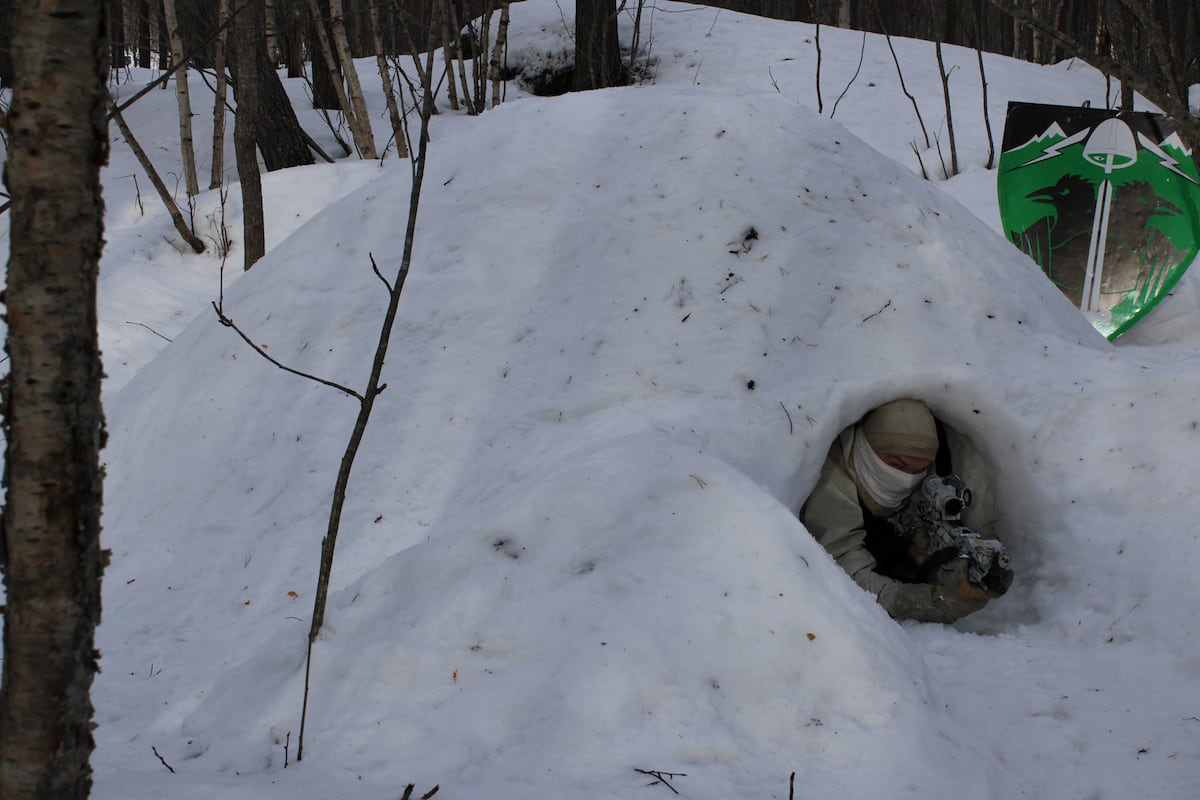
SETERMOEN, Norway — Norway’s elite soldiers for Arctic warfare swear by an old-fashioned method for staying hidden from drones’ sophisticated sensors: quinzhees, or snow caves, carefully dug by hand.
Deep in Norwegian woods, some 400 kilometers away from the Russian border, an officer of the Norwegian Long Range Reconnaissance Squadron is hidden in a snow-made shelter, with only his light-grey firearm peeking out.
The officer, nicknamed Poster Boy, is part of the country’s elite Arctic task force, designed to operate far behind enemy lines to conduct surveillance missions. The snow cave serving as his concealment is known as a quinzhee, 1.5m high and 2m wide, built by piling snow together and allowing it to sinter, or harden, a task force specialty.
“It’s a constant evolution of what works and what doesn’t for us – what worked four years ago might not work today due to all the technology developments of equipment designed to catch us, some years ago a tent and camouflage could’ve been sufficient but not anymore,” the officer, who spoke anonymously because of the sensitivity around the unit, told Defense News.
Training here alongside the Norwegian soldiers were several other nations’ elite unit, including U.K. Royal Marines and soldiers of the Canadian Special Operations Forces Command. Royal Marines told Defense News that, given the speed of modern combat, units that want to stay invisible often have to move every 15 minutes to avoid detection.
Besides hiding from enemy drones, the Norwegian reconnaissance soldiers carry their own unmanned craft to spy on adversaries.
The unit is experimenting with different types of winterized surveillance drones, including the American-made Skydio and first-person-view models, to provide eyes in the sky and enable operations from greater distances on the battlefield.
Poster Boy said those systems will be increasingly relevant, especially in the event of a potential conflict with Russia , where the battle space would consist of vast stretches of icy land.
The Norwegian Army chief, Maj. Gen. Lars Lervik, told Defense News that drones were playing an important role in NATO’s largest Arctic exercise, Cold Response 2026, organized across Norway from March 9-19. He noted that aside from surveillance-type ones, forces are also testing attack drones and several unmanned ground robots in ground-to-ground and air-to-ground roles.
The name of the game for the quinzhee connaisseurs is silence and invisibility, two objectives that are increasingly hard to achieve, as seen in the war in Ukraine, where troops and equipment remain perpetually vulnerable to being located.
One way to mitigate these risks is to focus on tracking avoidance in snow, which relies on minimizing a soldier’s visual, thermal or electronic signatures. The Norwegian Defense Materiel Agency announced last month that recent trials in Denmark confirmed the effectiveness of the Swedish-made Mobile Camouflage System. Developed by Saab, the cloak is intended to greatly reduce detectability by limiting visual, thermal and radar signatures, including in Arctic conditions.
However, amid new technologies, the Norwegian top-tier Arctic unit continues to return to proven basics: using natural camouflage, such as snow, as its best bet for staying hidden.
“Using snow is our absolute best concealment – we move in darkness, foggy conditions, snow falls, where our tracks can be rapidly filled and hard to follow, and in good weather we stay static and concealed,” the officer explained.
Elisabeth Gosselin-Malo was a Europe correspondent for Defense News. She covers a wide range of topics related to military procurement and international security, and specializes in reporting on the aviation sector. She is based in Milan, Italy.
挪威塞特莫恩——挪威的北极作战精英士兵们坚信一种古老的方法来躲避无人机的精密传感器:那就是手工精心挖掘的雪洞。
在距离俄罗斯边境约 400 公里的挪威森林深处,一名挪威远程侦察中队的军官藏身于雪地掩体中,只有他浅灰色的枪支露出一角。
这位绰号“海报男孩”的军官是该国精锐北极特遣部队的一员,该部队的任务是深入敌后执行侦察任务。他藏身的雪洞被称为“昆兹赫”(quinzhee),高1.5米,宽2米,由积雪堆积而成,使其烧结硬化,这是该特遣部队的专长。
“对我们来说,哪些方法有效、哪些无效是一个不断演变的过程——四年前有效的方法,由于旨在抓捕我们的装备的技术发展,今天可能就无效了。几年前,一个帐篷和伪装就足够了,但现在不行了。”这位因部队的敏感性而匿名接受采访的军官告诉《防务新闻》。
与挪威士兵一同在此训练的还有其他几个国家的精锐部队,包括英国皇家海军陆战队和加拿大特种作战部队司令部的士兵。英国皇家海军陆战队告诉《防务新闻》,鉴于现代战争的快节奏,想要保持隐蔽的部队往往需要每15分钟转移一次位置,以避免被发现。
除了躲避敌方无人机外,挪威侦察兵还携带自己的无人飞行器来侦察敌情。
该部队正在试验不同类型的冬季化监视无人机,包括美国制造的 Skydio 和第一人称视角型号,以提供空中之眼,并能够在战场上更远的距离进行作战行动。
Poster Boy表示,这些系统将变得越来越重要,尤其是在与俄罗斯发生潜在冲突的情况下,因为战场将由大片冰原组成。
挪威陆军总司令拉尔斯·勒维克少将告诉《防务新闻》,无人机在北约规模最大的北极演习“寒冷反应2026”中发挥着重要作用。该演习于3月9日至19日在挪威各地举行。他指出,除了侦察型无人机外,部队还在测试攻击型无人机和几种无人地面机器人,用于地对地和空对地作战。
对于昆泽的鉴赏家来说,游戏的关键词是沉默和隐蔽,这两个目标越来越难以实现,正如在乌克兰战争中所看到的,在那里,部队和装备始终容易被发现。
降低这些风险的一种方法是重点关注雪地中的追踪规避,这依赖于最大限度地减少士兵的视觉、热成像或电子特征。挪威国防物资局上个月宣布,近期在丹麦进行的试验证实了瑞典制造的移动伪装系统的有效性。该系统由萨博公司开发,旨在通过限制视觉、热成像和雷达特征,大幅降低被发现的可能性,即使在北极条件下也是如此。
然而,在新技术层出不穷的情况下,挪威顶尖的北极部队仍然回归到行之有效的基本方法:利用雪等天然伪装物作为保持隐蔽的最佳选择。
“利用雪是我们最好的伪装——我们在黑暗、雾天、下雪天行动,这样我们的足迹很快就会被雪覆盖,难以追踪;在天气好的时候,我们则保持静止,隐蔽行动,”这位警官解释说。
伊丽莎白·戈斯林-马洛曾任《防务新闻》欧洲通讯员。她的报道涵盖军事采购和国际安全等广泛领域,尤其擅长航空领域的报道。她常驻意大利米兰。