The Story Behind The Modified Falcon Business Jets That Bring America’s Fallen Heroes Home改装猎鹰公务机背后的故事:这些飞机将美国阵亡英雄带回家
An inside look at how one of the most challenging, heart-wrenching, and critical aviation missions in the country gets done.
Published Oct 1, 2021 1:13 PM EDT
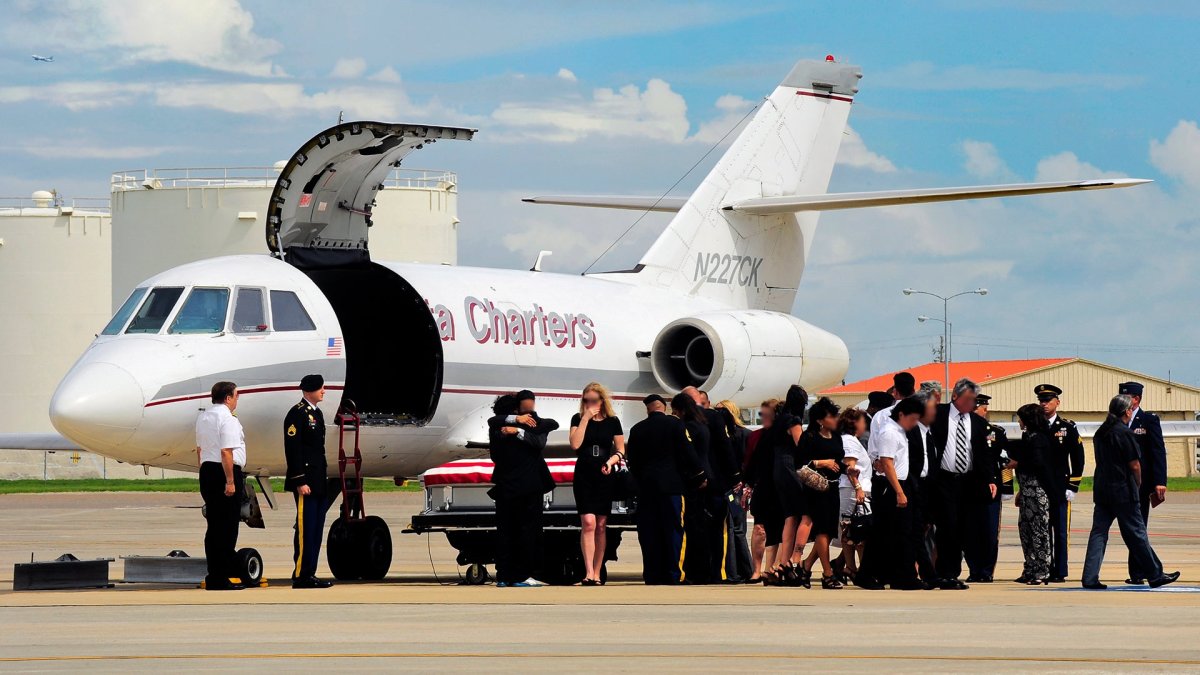
For airplane spotters, it’s always exciting to see a rare plane in a special paint job appear at your hometown airport. But for one cadre of very special aircraft, their arrival comes with a far more solemn realization. The aircraft I am referring to are a handful of modified Falcon 20 business jets operated by a prolific family-owned charter and aviation services company located on Willow Run Airport, in Ypsilanti, Michigan— Kalitta Charters . Over the last decade and a half, these aircraft and their dedicated flight crews have been exclusively tasked with one of the most challenging but critical aviation missions in the country — one that comes with an immense emotional toll — the dignified transfer of America’s fallen heroes.
After 20 years of perpetual war abroad, Americans have become all-too-accustomed to seeing images of flag-draped coffins being offloaded from military transport aircraft at Dover Air Force Base. But what most don’t see is what comes next — how the remains of those service people actually make it to their families and friends, who await their return in emotionally shattered states in small towns and cities scattered around the country. That is where Kalitta’s dedicated crews and their decades-old Falcon jets come in to play.
The remains of Pfc. Tyler Iubelt are lowered from a plane during his dignified transfer ceremony on November 21, 2016, at Scott Air Force Base, Illinois. Iubelt passed away on November 12 while deployed to Bagram, Afghanistan., U.S. Air Force photo by Staff Sgt. Clayton Lenhardt
I reached out to Kalitta to see if the company would be willing to give us a firsthand perspective of these extremely challenging operations, including background on the aircraft that supports it and on how the crews have been able to cope doing it for all these years.
Berry Birurakis, the General Manager of Kalitta Charters, was kind enough to answer our request. Birurakis noted in our correspondence that he “personally flew some of these missions and they were, psychologically, the most difficult missions I ever flew.” He also brought in Steve Green, who had managed the Dignified Transfer mission for the company since its inception up until recently retiring, to best answer all our questions.
Here is our exchange:
When did Kalitta get involved with this mission? How did it happen?
The RFP for the mission was issued in October 2006. The start date for the bridge contract was January 1, 2007. Kalitta had a very short window to retrofit five Falcon 20s (four deployed and one spare) and to design and build five MHE (Materiel Handling Equipment) units.
In mid-November 2006, Kalitta was awarded the initial bridge contract to commence on January 1, 2007, and continue through July 2007. In an unprecedented move, Kalitta Maintenance began working around the clock, seven days per week, up until the morning of December 31, 2006. On that morning, all four Falcons departed YIP (Ypsilanti, MI) and flew to Dover AFB in Delaware to stage. The next day, January 1, 2007 (day one of the mission), all four aircraft left Dover on “Dignified Transfer” missions.
One of Kalitta Charter’s Falcon 20s in the hangar at Dover AFB with its custom MHE for the Dignified Transfer Mission., Kalitta Charters
Why are private charter aircraft used for the Dignified Transfer mission?
Prior to using the Falcons, most caskets were transported using commercial airliners flying into large commercial airports. There was a lack of MHE designed specifically for the task. Caskets were seen by veterans groups being handled with forklifts, belt loaders, and baggage carts in what was considered an undignified manner. DoD then issued an RFP (Request For Proposal) to the air charter community to find a more dignified way of transporting our fallen heroes. Kalitta Charters has decades of experience in retrofitting aircraft and MHE for specific mission requirements and accepted the challenge of complying with all mission requirements. The Falcon was obviously the right aircraft, and Kalitta’s engineering group developed MHE that could be carried aboard the aircraft.
The Falcon 20 requires less runway for takeoff and landing than commercial airliners which opened up hundreds of additional destination airports. In many cases, the Falcon was able to land at the hometown airport of a fallen hero versus landing at a large commercial airport that could be over 100 miles away.
Although the cost of operating the Falcon is higher than that of using commercial aircraft, it is thousands less per mission than any U.S. Air Force platform. The advantages of getting into small airports, carrying mission-specific MHE aboard the aircraft, and crews trained in conducting “Reverse Dignified Transfers” at the destination airport are but a few factors in using charter aircraft.
A U.S. Navy carry team transfers the remains of Navy Capt. Michael Scott Speicher at Dover Air Force Base., U.S. Air Force Photo/Roland Balik
Kalitta Charters always had backup aircraft on standby. On extremely rare occasions, the backup aircraft was flown immediately to continue the mission if a maintenance issue grounded the primary aircraft. This was not the case with commercial airliners, who would cancel a flight with no other means of continuing the mission. In those cases, the commercial airliners would simply state that the flight was canceled, and they would deliver the casket the next day. That scenario was totally unacceptable, when the family and typically a large contingent of sympathizers were gathering at the destination airport. When such cancellations occurred, the DoD would dispatch a Kalitta Falcon to continue the mission.
There are myriad other advantages to using the Falcons, but these are the primary ones that come to mind.
What was needed in terms of hardware and personnel to support the mission?
The Falcon 20 is used because it is the ideal size to transport up to 2 caskets at a time and all of the equipment necessary for the Dignified Transfer and Reverse Dignified Transfer of the fallen heroes. The actual aircraft were already freight-configured and needed no real modifications to fly the missions. All we really had to do was design the system to allow for loading and unloading the fallen heroes in a dignified manner.
Some of the aircraft are former FedEx aircraft. Others started life as passenger aircraft that were later modified to transport cargo. The cargo transportation modification consisted of removing all of the interior behind the cockpit, reinforcing the floor, placing a protective liner on the walls and ceiling, removing the passenger door, and cutting a large part of the left side forward cabin wall out and putting a cargo door there.
National Guard photo by Master Sgt. Kurt Skoglund
These are older airplanes. We have an awesome team of maintenance specialists that do a great job of keeping these planes going. Very rarely do we experience a delay for mechanical reasons and, to date, we have never had a mission failure for any reason.
How many Dignified Transfer missions has Kalitta flown?
We have flown more than 2,600 of these missions. Some of these missions actually carried two fallen heroes.
Can you give us an idea of how one of these operations is executed?
Our dispatch gets a call from the Dover AFB Mortuary Affairs Office when a fallen hero is to be transported. We are advised of where the family would like the fallen hero to end up and the date and time they want the plane to arrive. Our dispatch finds the nearest suitable airport and plans the departure from Dover to allow for the arrival at the desired time.
On the day of the flight, the airplane is prepared, and the Dignified Transfer ceremony is performed to load the casket into the airplane. The fallen hero is always accompanied by an escort, usually from the fallen hero’s unit. There are only two seats in the back of the plane. If we are only moving one fallen hero we can (and have) moved a family member.
The honor guard coordination is all done by the DoD. The honor guard at Dover is well-versed in the Dignified Transfer process. When we first put this program together we set up a “simulated” mission that the DoD filmed. We were told that the honor guard at the drop-off location is given access to the video to allow them to prep for the arrival and the Reverse Dignified Transfer.
The airplane departs a little early to allow for the possibility of unforecast winds and/or air traffic control delays. As the plane nears its destination, the crew adjusts its speed to allow them to arrive as close to the scheduled time as possible.
Once the plane lands, the crew prepares for and conducts the Reverse Dignified Transfer ceremony.
The human toll has to be an issue. How have Kalitta aircrews been impacted by such a solemn but honorable mission?
Interesting question. As the project manager for the mission, I thought we had considered every possible contingency that might affect our performance to a “zero-fail” standard. As NASA likes to say, “failure is not an option.”
On day one, I watched the Dignified Transfers on the ramp at Dover. I watched all four aircraft depart within minutes of each other for various destinations and my own emotions were inevitable. It was then that I became acutely aware of what the crews were going to face at the destination airport. That awareness was confirmed hours later when the first Falcon arrived back at Dover.
An honor guard escort carries the casket of National Guardsman SPC Isaac Johnson., US Army
The Captain of that Falcon was our chief pilot, Bob Newell. Bob climbed down the ladder and began the post-flight inspection of his aircraft. When he finished, I asked how things went at the destination. Without making eye contact, Bob’s exact words were: “Do we have to talk about this right now?”
I was there for the return of the other three aircraft, but I did not ask that question of the crews. Their silence told me all I needed to know.
Early the next morning, I went to the Charles Carson Mortuary on the base to speak to the Chaplain, Major Sparks. I told him that we all—flight crews, maintenance crews, and myself—had encountered emotions on the previous day that were unanticipated and difficult to deal with. Chaplain Sparks understood perfectly. It was his job and that of a clinical psychologist to assist USAF and civilian personnel who were new to mortuary affairs at the base. He advised that there were many personnel who asked to transfer out after one day because of the emotional trauma they had experienced.
As we did not have any flights going out that second day, he asked me to have all Kalitta personnel report an anteroom at the mortuary at 1:00 PM. At that time, eight pilots, two maintenance personnel, and myself were introduced to Major Sparks and the psychologist. They took us through the introduction to Mortuary Affairs the same as if we were newly assigned USAF personnel. We spent about two hours with those guys and we all came away with a better understanding of what we had gotten ourselves into.
What I took away from that meeting was that everyone deals with it differently … but deal with it you must, because you will face it again tomorrow. Kalitta was fortunate to have several former military and National Guardsmen on staff in both the flight and maintenance departments to assist our civilian personnel in understanding the thought processes involving the mission.
The company realizes that this is the most important mission that has ever been undertaken at Kalitta Charters and has proudly carried it out to a “zero-fail” standard from January 1st, 2007, to today.
Where does the mission stand now that both wars have concluded, at least officially?
The contract started out with four airplanes being based at Dover AFB. Now that things have wound down we only have one airplane actually based at Dover and another on standby at our home base in Ypsilanti, Michigan, in case there is a need for two aircraft on the same day.
Members of Air Mobility Command and the 375th Air Mobility Wing render a salute as the hearse transporting U.S. Army Sgt. Holli Bolinski, 657th Transportation Company, 419th Transportation Battalion, 103rd Sustainment Command, Mt. Vernon, Ill., unit administrator, as it departs the flightline at Scott Air Force Base, Ill., March 18, 2019., U.S. Air Force photo by Airman 1st Class Solomon Cook
Author’s note: A huge thanks to Berry Birurakis and Steve Green for making this story happen, as well as to all those who have been involved in this critical mission over the years.
Contact the author: Tyler@thedrive.com
Comments couldn’t be loaded. Please refresh the page.
发布于美国东部时间2021年10月1日下午1:13
对于飞机爱好者来说,看到一架涂装独特的稀有飞机出现在家乡机场总是令人兴奋的。但对于一类非常特殊的飞机而言,它们的到来却承载着更为庄严的意义。我指的是几架改装过的猎鹰20公务机,它们由一家位于密歇根州伊普西兰蒂市柳树溪机场的家族式包机和航空服务公司——卡利塔包机公司运营。在过去的十五年里,这些飞机及其敬业的机组人员一直肩负着一项全国最具挑战性也至关重要的航空任务——这项任务承载着巨大的情感创伤——那就是庄严地运送美国阵亡英雄的遗体。
在经历了20年的海外持续战争后,美国人早已习惯了在多佛空军基地看到覆盖着国旗的棺材从军用运输机上卸下的画面。但大多数人看不到的是接下来的过程——这些军人的遗体如何才能真正送达他们的家人和朋友手中,让他们在全国各地的小城镇里,在悲痛欲绝的等待中归来。而这正是卡利塔公司敬业的机组人员和他们服役数十年的猎鹰喷气式飞机发挥作用的地方。
2016年11月21日,在伊利诺伊州斯科特空军基地举行的庄严遗体移交仪式上,一等兵泰勒·尤贝尔特的遗体从飞机上缓缓放下。尤贝尔特于11月12日在阿富汗巴格拉姆空军基地服役期间不幸殉职。(美国空军照片,由克莱顿·伦哈特中士拍摄)
我联系了卡利塔公司,询问该公司是否愿意为我们提供这些极具挑战性行动的第一手资料,包括支持这些行动的飞机的背景信息,以及机组人员多年来是如何应对这些行动的。
卡利塔包机公司总经理贝瑞·比鲁拉基斯先生非常友好地回应了我们的请求。比鲁拉基斯先生在信中提到,他“亲自执行过其中一些任务,从心理层面来说,这些任务是我执行过的最艰难的任务”。他还邀请了史蒂夫·格林先生前来解答我们所有的问题。格林先生自公司成立以来一直负责尊严转移任务,直到最近退休。
以下是我们的对话:
卡利塔是什么时候参与到这项任务中的?事情是怎么发生的?
该任务的 RFP 于 2006 年 10 月发布。过渡合同的开始日期为 2007 年 1 月 1 日。卡利塔公司需要在很短的时间内对五架猎鹰 20 火箭(四架已部署,一架备用)进行改装,并设计和建造五台物料搬运设备 (MHE) 单元。
2006年11月中旬,卡利塔公司获得了首份过渡合同,合同于2007年1月1日生效,持续至2007年7月。卡利塔维修公司史无前例地开始全天候、每周七天不间断地工作,直至2006年12月31日清晨。当天上午,四架猎鹰飞机从密歇根州伊普西兰蒂国际机场(YIP)起飞,飞往特拉华州多佛空军基地集结。第二天,即2007年1月1日(任务第一天),四架飞机从多佛空军基地起飞,执行“尊严转移”任务。
卡利塔包机公司的一架猎鹰20飞机停在多佛空军基地的机库里,机上配备了为“尊严转移任务”定制的物料搬运设备。
为什么尊严转移任务要使用私人包机?
在使用猎鹰飞机之前,大多数棺材都是通过飞往大型商业机场的商用客机运送的。当时缺乏专门用于此任务的物料搬运设备。退伍军人团体目睹了棺材被叉车、传送带装卸机和行李车以一种被认为有失尊严的方式搬运。随后,美国国防部向包机公司发出征求建议书(RFP),寻求一种更体面的方式来运送阵亡英雄。卡利塔包机公司在飞机和物料搬运设备的改装方面拥有数十年的经验,以满足特定任务需求,并接受了满足所有任务要求的挑战。猎鹰飞机显然是合适的机型,卡利塔的工程团队开发了可以携带在飞机上的物料搬运设备。
猎鹰20型飞机起降所需的跑道比商用客机短,这使得数百个新的目的地机场得以启用。在许多情况下,猎鹰20型飞机能够降落在阵亡英雄的家乡机场,而不是降落在100英里以外的大型商业机场。
虽然猎鹰公务机的运营成本高于商用飞机,但每次任务的成本却比任何美国空军平台都低数千美元。能够降落在小型机场、携带任务专用物料搬运设备以及机组人员接受过目的地机场“反向尊严转移”培训,这些只是使用包机的部分优势。
美国海军一支遗体运送队在多佛空军基地转移海军上校迈克尔·斯科特·斯佩克尔的遗体。(美国空军照片/罗兰·巴利克摄)
卡利塔包机公司始终备有备用飞机。极少数情况下,如果主飞机因维护问题停飞,备用飞机将立即起飞继续执行任务。而商业航空公司则不然,它们会取消航班且没有其他办法继续执行任务。在这种情况下,商业航空公司只会宣布航班取消,并表示会在第二天运送灵柩。当家属和通常一大批慰问者聚集在目的地机场时,这种情况是完全无法接受的。一旦发生此类航班取消,美国国防部就会派遣卡利塔猎鹰飞机继续执行任务。
使用猎鹰还有无数其他优点,但这些是我能想到的主要优点。
为支持此次任务,在硬件和人员方面需要哪些支持?
之所以选择猎鹰20型飞机,是因为它尺寸合适,一次最多可以运送两具灵柩,以及所有必要的设备,用于为阵亡英雄进行尊严转移和反向尊严转移。这些飞机本身就是货机,无需进行任何改装即可执行任务。我们真正需要做的只是设计一套系统,以便以庄严的方式装卸阵亡英雄。
这些飞机中有些是联邦快递的旧飞机,有些则是最初作为客机改装而成的货运飞机。改装过程包括拆除驾驶舱后方的所有内饰,加固地板,在墙壁和天花板上安装保护衬里,拆除客舱门,以及切除左侧前舱壁的大部分,并在那里安装货舱门。
国民警卫队照片,由一级军士长库尔特·斯科格伦德拍摄
这些都是比较老旧的飞机。我们拥有一支非常优秀的维修专家团队,他们尽职尽责地维护着这些飞机。我们极少遇到因机械故障导致的延误,而且迄今为止,我们从未因任何原因导致任务失败。
卡利塔号执行过多少次尊严转移任务?
我们已经执行了超过2600次此类任务。其中一些任务中,我们甚至运送了两名阵亡英雄。
您能给我们简要介绍一下其中一项操作是如何执行的吗?
当有阵亡英雄需要运送遗体时,我们的调度中心会接到多佛空军基地太平间事务办公室的电话。我们会被告知家属希望将英雄遗体运送到哪里,以及飞机抵达的日期和时间。我们的调度中心会找到最近的合适机场,并安排从多佛起飞的航班,以确保遗体能够按时抵达。
飞行当天,飞机做好一切准备,举行庄严的遗体交接仪式,将灵柩装入飞机。阵亡英雄的遗体通常会由一名护卫陪同,这名护卫一般来自英雄所属部队。飞机后部只有两个座位。如果只运送一位阵亡英雄的遗体,我们可以(也确实曾经)运送一位家属。
仪仗队的协调工作全部由美国国防部负责。多佛空军基地的仪仗队对尊严移交流程非常熟悉。我们最初筹备这个项目时,曾安排了一次“模拟”任务,并由国防部拍摄记录。据我们了解,下车地点的仪仗队可以观看这段视频,以便为抵达和反向尊严移交做好准备。
飞机提前起飞,以应对可能出现的意外风向和/或空中交通管制延误。飞机接近目的地时,机组人员会调整飞行速度,力求尽可能准时到达。
飞机着陆后,机组人员准备并进行反向尊严移交仪式。
人员伤亡必须是一个问题。卡利塔号的机组人员在这次庄严肃穆却又光荣的任务中受到了怎样的影响?
这个问题很有意思。作为这项任务的项目经理,我认为我们已经考虑到了所有可能影响任务执行的突发情况,力求达到“零失败”的标准。正如NASA常说的,“失败绝不是一个选项”。
第一天,我在多佛机场的停机坪上观看了庄严的飞机交接仪式。我目睹了四架飞机在几分钟内相继起飞,前往不同的目的地,我的情绪也随之起伏。那时,我深刻地意识到机组人员在目的地机场将要面对的种种挑战。几个小时后,当第一架猎鹰飞机返回多佛机场时,我的这种预感得到了印证。
美国陆军国民警卫队下士艾萨克·约翰逊的灵柩由仪仗队护送。
那架猎鹰飞机的机长是我们的首席飞行员鲍勃·纽厄尔。鲍勃从舷梯上下来,开始对飞机进行飞行后检查。检查完毕后,我问他目的地的情况如何。鲍勃没有看我,而是直截了当地说:“我们现在非得谈这个吗?”
其他三架飞机返航时我也在场,但我没有问机组人员这个问题。他们的沉默已经说明了一切。
第二天一大早,我去了基地里的查尔斯·卡森殡仪馆,找牧师斯帕克斯少校。我告诉他,我们所有人——飞行员、维修人员以及我自己——在前一天都经历了一些意想不到且难以承受的情绪。斯帕克斯牧师完全理解。作为一名临床心理学家,他的职责就是帮助那些初次接触基地殡葬事务的空军人员和文职人员。他告诉我,很多人因为经历了如此巨大的精神创伤,只待了一天就申请调离。
由于第二天没有航班,他让我安排卡利塔空军基地所有人员下午1点到太平间的候机室集合。当时,包括我在内的八名飞行员、两名维修人员被介绍给了斯帕克斯少校和心理学家。他们像对待新入职的空军人员一样,向我们介绍了太平间事务。我们和他们待了大约两个小时,大家都对即将面临的情况有了更清晰的认识。
那次会议让我明白,每个人处理问题的方式都不同……但你必须面对它,因为明天你还会再次面对。卡利塔很幸运,飞行和维护部门都有几位前军人和国民警卫队成员,他们可以帮助我们的文职人员理解任务相关的思路。
公司意识到这是卡利塔包机公司有史以来最重要的任务,并从 2007 年 1 月 1 日至今一直自豪地以“零失败”的标准执行该任务。
现在两场战争都已结束(至少官方意义上如此),那么这项任务的进展如何?
合同最初约定在多佛空军基地部署四架飞机。现在任务已经结束,我们只有一架飞机实际驻扎在多佛,另一架飞机则在位于密歇根州伊普西兰蒂的总部待命,以防同一天需要两架飞机。
2019年3月18日,在伊利诺伊州斯科特空军基地,美国空军机动司令部和第375空军机动联队的成员向载有美国陆军中士霍莉·博林斯基(Holli Bolinski)的灵车致敬。博林斯基中士是驻伊利诺伊州弗农山第103后勤司令部第419运输营第657运输连的一名单位管理员。灵车驶离飞行跑道时,他们向她致敬。(美国空军一等兵所罗门·库克摄)
作者注:非常感谢 Berry Birurakis 和 Steve Green 促成了这个故事的发生,还要感谢多年来参与这项重要任务的所有人。
联系作者:Tyler@thedrive.com
评论加载失败,请刷新页面。