F-16s are no magic bullets in Ukraine, but their armaments will matterF-16战机并非乌克兰战争中的万能武器,但它们的武器装备将发挥重要作用。
Opinion: If Ukraine’s F-16s are expected to strike ground targets, they will require the right munitions.
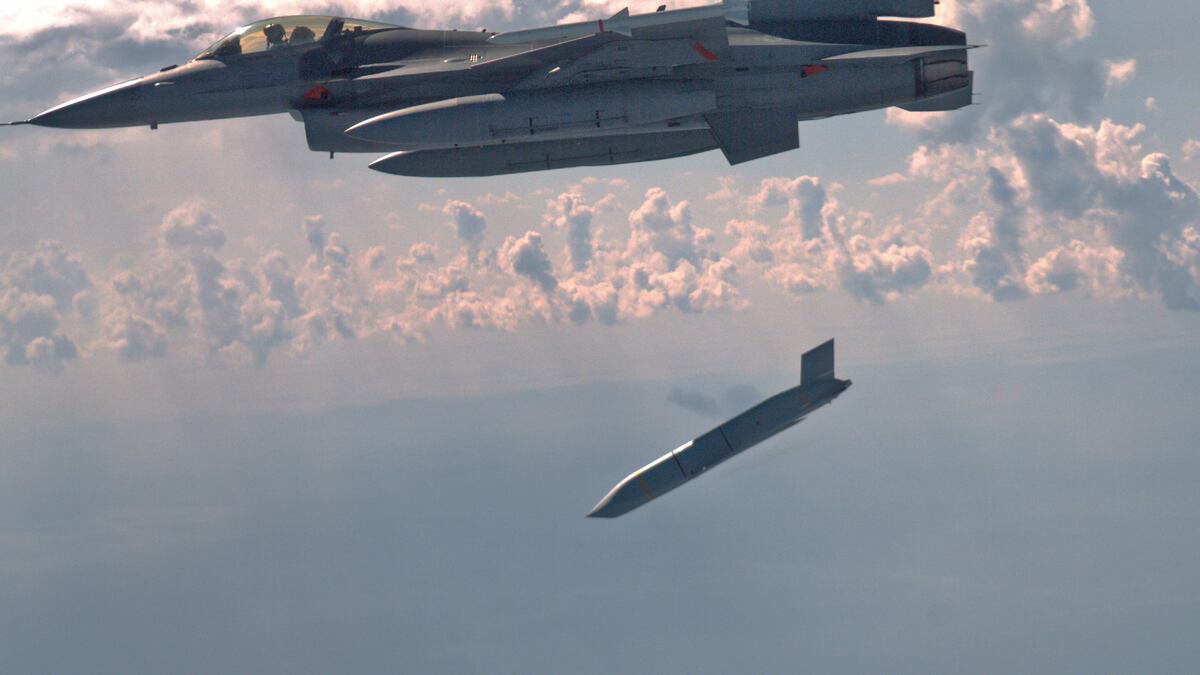
Now that Ukraine is in line to receive F-16s, opinions surrounding their effectiveness span from being counterproductive to war-winning for Ukraine. While most discussions have focused on the fighters’ air-to-air performance and the platform itself, the broader effect of their deployment with the right munitions will be decreased Russian ground strikes.
Neither the Ukrainians nor the Russians have air superiority over the battlefield. Surface-to-air missiles, or SAM, and anti-air artillery provide the majority of air control for both sides. And yet, Ukraine is too vast for SAMs to cover, as most require line-of-sight, limiting maximum ranges at lower altitudes. The mobility and line-of-sight of fighters makes them well suited to defend areas with sparse SAM coverage. Fighters can also avoid adversary SAMs by flying low while also being able to engage aircraft doing the same.
The aircraft’s first role will likely be supporting air defense by intercepting cruise missiles. Given Russia’s low monthly capacity for missile strikes on Ukraine, only a few F-16s are necessary to intercept cruise missiles that enter Ukrainian airspace — providing needed relief to Ukraine’s overtaxed SAMs. Some commentators have highlighted the F-16′s ability to deploy cruise missiles and other munitions for strikes and interdiction such as the Storm Shadow missiles. However, those weapons are scarce, and F-16s provide only limited additional capacity unless Ukraine receives a large influx of air-to-ground munitions.
As Ukraine gains proficiency with F-16s, the next mission will be suppressing Russian SAMs, a mission that is more involved than stand-off strikes. F-16s are well suited to operate the AGM-88s that Ukraine has been supplied to suppress forward Russian SAMs. These destroyed Russian SAMs are expensive and unlikely to be replaced quickly. Attritting these systems is critical for Ukraine to gain local air superiority improving the survivability of its drones and ground forces in the process.
The two missions described are possible with the initial pledged F-16s. Of the approximately 60 F-16s promised , only around a dozen are expected by early next year. As more arrive, higher impact missions become possible.
Russia’s limited capacity of stand-off munitions has not hindered its ground attack aircraft and helicopters from striking Ukraine. Initially, Russia resorted to flying below line-of-sight of Ukrainian SAMs while employing “dumb” bombs. Russia has since adapted to use precision, stand-off glide bombs . Russia has also employed its multi-role aircraft in air-to-ground roles as it faces little resistance in the air. F-16s can target the latter and force the former to air-to-air roles. Whether Russia diverts aircraft to air defense, takes higher risks, or performs fewer strikes, the result is fewer effective Russian air-to-ground strikes.
There will also be downstream effects on Russian operations. Russia has, for example, expended large quantities of its long-range SAMs for ground attacks. Given the high overlap of SAM, ballistic missile and air-launched missile components, increasing production of SAMs for replenishment will likely come at the expense of other missile production, which means even fewer Russian ground strikes against Ukraine.
F-16s alone are not enough. They require training, support crews, communications, early warning, upgraded avionics and munitions. This infrastructure takes years to develop and is not likely to be fully fielded in the conflict timeframe. To date, little public discourse exists on exactly what the pledged F-16s will have in terms of capabilities and supporting infrastructure.
Beyond a high probability that Ukraine will receive more AGM-88s and Joint Direct Attack Munition (JDAM), no other public disclosures of F-16 munitions have been announced. NATO’s most capable long-range, air-to-air missiles (AAMs) are the U.S. AIM-120D and the U.K. Meteor. These are necessary to overcome Russia’s long range AAMs, yet neither has been pledged. Even if Russia has been inefficiently using its R-37′s by firing from long range and leaving the fight, Russia likely retains large quantities of R-77 missiles. It remains uncertain how many of the AIM-120 variants previously provided for air defense are still available . An F-16 with any AAM is still an improvement over Ukraine’s current MIG-29s.
If Ukraine’s F-16s are expected to strike ground targets, they will require the right munitions. F-16 munitions designed for fighting Cold War-era ground formations are the upgraded variants the CBU and Rockeye series. Soon these will need decommissioning and will lack host aircraft. Stand-off glide bombs like the GBU-39 are already being offered as ground-launched variants and the air-launched variant could provide needed survivability for the F-16 to strike ground targets.
Will F-16s win the war for Ukraine? No. Only ground victories and unacceptable Russian losses will force Putin to negotiate. The most important support to Ukraine is still artillery, medical equipment, infantry weapons, ground vehicles, and drones. However, a long-term commitment to supporting a well-equipped, sizable F-16 force will improve the likelihood of Ukrainian success even if an F-16 never shoots a Russian fighter.
Michael Bohnert is a licensed engineer at the think tank Rand. He previously worked as an engineer at a naval nuclear laboratory.
乌克兰即将接收F-16战机,围绕其效能的意见不一,有人认为会适得其反,也有人认为能帮助乌克兰赢得战争。虽然大多数讨论都集中在战机的空对空性能和平台本身,但如果配备合适的弹药,其更广泛的影响将是减少俄罗斯对地面的打击。
乌克兰和俄罗斯双方均未掌握战场制空权。地对空导弹(SAM)和防空炮是双方制空的主要力量。然而,乌克兰地域辽阔,地对空导弹的覆盖范围有限,因为大多数地对空导弹需要视距飞行,这限制了其在低空的最大射程。战斗机的机动性和视距优势使其非常适合防御地对空导弹覆盖稀疏的区域。战斗机可以通过低空飞行来躲避敌方地对空导弹,同时也能拦截同样低空飞行的敌机。
该战机的首要任务很可能是拦截巡航导弹,支援防空。鉴于俄罗斯每月对乌克兰的导弹打击能力有限,只需少量F-16战机即可拦截进入乌克兰领空的巡航导弹,从而缓解乌克兰不堪重负的防空导弹系统的压力。一些评论员强调了F-16战机投放巡航导弹和其他弹药(例如“风暴阴影”导弹)进行打击和拦截的能力。然而,这些武器数量稀少,除非乌克兰获得大量空地弹药,否则F-16战机提供的额外能力十分有限。
随着乌克兰对F-16战机的熟练运用,其下一个任务将是压制俄罗斯的防空导弹系统,这项任务比远程打击更为复杂。F-16战机非常适合操作乌克兰获得的用于压制俄罗斯前沿防空导弹系统的AGM-88导弹。这些被摧毁的俄罗斯防空导弹系统造价昂贵,且短期内难以补充。削弱这些系统对于乌克兰夺取局部制空权至关重要,同时也能提高其无人机和地面部队的生存能力。
利用最初承诺交付的F-16战机,上述两项任务均可实现。在承诺交付的约60架F-16战机中,预计到明年初只能交付十几架左右。随着更多战机的交付,执行更具影响力的任务将成为可能。
俄罗斯防区外弹药能力有限,但这并未阻止其对地攻击机和直升机打击乌克兰。最初,俄罗斯采取的策略是使用“非制导”炸弹,在乌克兰地空导弹的视线范围外飞行。此后,俄罗斯转而使用精确制导滑翔炸弹。由于在空中阻力较小,俄罗斯也将其多用途飞机用于对地攻击。F-16战斗机可以攻击后者,迫使前者转而执行空对空任务。无论俄罗斯是将飞机用于防空、承担更高风险,还是减少打击次数,其结果都是俄罗斯有效的对地打击能力下降。
这也会对俄罗斯的军事行动产生后续影响。例如,俄罗斯已将大量远程地空导弹用于对地攻击。鉴于地空导弹、弹道导弹和空射导弹的部件高度重叠,增加地空导弹的产量以补充库存很可能是以牺牲其他导弹的生产为代价的,这意味着俄罗斯对乌克兰的地面打击行动将会进一步减少。
仅靠F-16战机是不够的。它们还需要训练、后勤保障人员、通信、预警系统、升级后的航空电子设备和弹药。这套基础设施的建设需要数年时间,不太可能在冲突爆发前全面部署。迄今为止,关于承诺交付的F-16战机在能力和配套基础设施方面究竟会具备哪些条件,公众讨论甚少。
除了乌克兰极有可能获得更多AGM-88和联合直接攻击弹药(JDAM)之外,目前尚未公布其他F-16战机弹药的公开信息。北约最强大的远程空空导弹是美国的AIM-120D和英国的“流星”导弹。这些导弹对于对抗俄罗斯的远程空空导弹至关重要,但乌克兰尚未承诺提供这两种导弹。即使俄罗斯一直以来都低效地使用其R-37导弹,例如在远距离发射后便退出战斗,但俄罗斯很可能仍然拥有大量的R-77导弹。目前尚不清楚之前用于防空的AIM-120系列导弹还有多少库存。无论配备何种空空导弹,F-16战机都比乌克兰目前装备的米格-29战机更胜一筹。
如果乌克兰的F-16战机需要执行对地攻击任务,就必须配备合适的弹药。目前F-16战机使用的弹药是冷战时期设计的CBU和Rockeye系列炸弹的升级版,这些弹药原本用于打击地面目标。但这些升级版的弹药即将退役,并且缺乏合适的载机。像GBU-39这样的防区外滑翔炸弹已经有了陆基发射版本,而空基发射版本则可以为F-16战机提供打击对地目标所需的生存能力。
F-16战机能帮助乌克兰赢得战争吗?不能。只有地面作战的胜利和俄方无法接受的损失才能迫使普京进行谈判。对乌克兰而言,最重要的支持仍然是火炮、医疗设备、步兵武器、地面车辆和无人机。然而,长期致力于支持一支装备精良、规模可观的F-16部队,即使F-16战机从未击落过俄军战机,也能提高乌克兰取得胜利的可能性。
迈克尔·博纳特是兰德公司(Rand)的注册工程师。他之前曾在海军核实验室担任工程师。