This Is What A Continental Army Soldier Carried During The Revolutionary War这就是美国独立战争期间大陆军士兵携带的物品
The American Revolutionary War soldier suffered from a chronic lack of supplies and their equipment was anything but ergonomic.
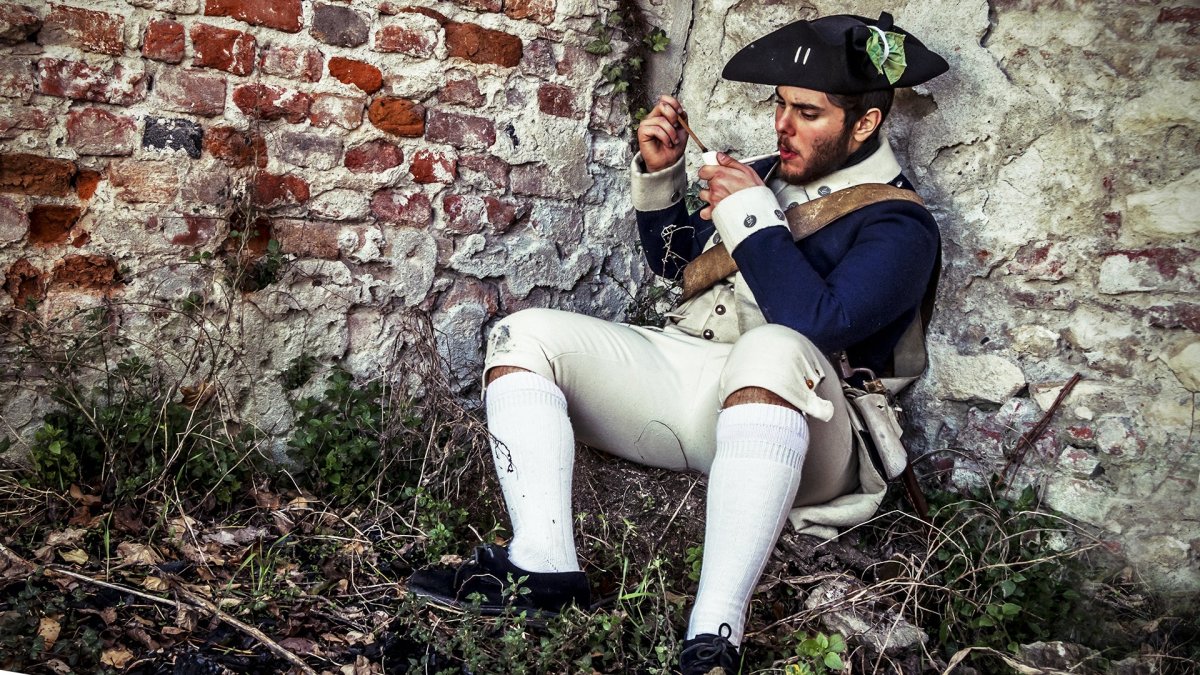
Updated Jun 14, 2019 6:16 AM EDT
It’s July 4th, happy birthday America! It’s amazing to think what our patriot forefathers pulled off 242 years ago, gaining independence from British and executing a world-changing experiment in democracy. But all this came at a heavy price. 25,000 American soldiers and militiamen died during the Revolutionary War and another 25,000 were maimed. But going into combat against the British wasn’t just dangerous, it was also very uncomfortable.
Mobilizing a standing and well-funded army is challenging even in the highly industrialized world we live in today. So you can imagine how hard it would have been when it had to be thrown together quickly in a land with minimal large-scale production capacity for durable goods. But still, a Continental Army soldier required the basics just to survive. Here’s what they were equipped with:
Musket or long rifle, most of which were of European origin and many were commandeered on the battlefield, pilfered from British stocks, or came from private sources. Colonial gunsmiths were ordered to make as many flintlocks as possible once the war began and France provided many arms as the war progressed as well.
Cartridge box made of tin or leather that held approximately 25 rounds of ammunition, flint, and a musket tool.
Socket bayonet in a leather scabbard attached to a leather or fabric strap.
Haversack made of cloth with food rations, utensils, plate, and a cup inside.
Wooden canteen to carry water.
Knapsack that held a blanket, extra clothes, razor, comb, mirror, flint and steel for fire starting, candle holder, and other personal items such as a pipe and tobacco. Fishing line and hooks were common kit as well so that soldiers could catch fish while encamped near water.
Pistols and swords, as well as other edged weapons, were common only among higher-ranking soldiers, cavalry, and other specialized units.
This may seem like a scant affair compared to how even the average grunt is outfitted in America’s Army today, but the gear was far from ergonomic or lightweight. When combined it could weigh nearly 50 pounds. This isn’t much less weight than what soldiers carry on shorter patrols today.
Militiamen had a similar kit but it was even less standardized and most of the time components were cobbled together at home. Imagine going to war where most people in your unit had a different of everything. Very little was common or swappable.
Just a glance at some of the key items both a Continental Army Soldier and a militiaman would have carried., NPS.GOV
As for militiamen’s firearms, they were what you had or could borrow, and some were very old. Hatchets often took the places of knives. It was truly a home-grown affair and made for a tough life on the battlefield.
Reenactors pose as Revolutionary War militia. , Bastiaan Slabbers/NurPhoto via Getty Images
Uniforms were a whole other story. The Hollywood depiction of spick and span Continental Army soldiers fighting famous battles was far from reality. A standard uniform wasn’t even nailed down until 1779, and even then they were slow coming. Units did what they could to match, with commanders finding ways to raise money for basic uniforms. Often times soldiers would have to buy their own garments. The French delivered some uniforms as war aid, but not nearly enough, and without replenishment, it defeated the point to some degree aside from being fresh clothes. Simply put, standardization was far from a reality
Some Revolutionary War reenactors get the reality of the era better than others when it comes to uniforms or the lack thereof., Photo by Visions of America/UIG via Getty Images
The condition of soldiers uniforms also varied greatly as resupply was next to non-existent. Some soldiers had fresh outfits while others had what were equivalent to dirty and torn rags. In fact, many lower-ranking soldiers didn’t even have shoes, making life hell for them on marches and in the freezing cold weather.
Washington depicted at Valley Forge. , Universal History Archive/Getty Images
All this did improve slowly over time, but generally, the guidance of what colors to wear—brown was made the Army’s official color in 1775 but blue and gray were also used—was more of the uniform than actual standardized apparel.
A Continental Army soldier would generally wear:
Cotton or linen shirt (the iconic hunting shirt was popular).
Wool or cotton breeches or overalls.
Wool coat with contrasting cuffs, collar, and lapels.
Leather shoes or boots.
Scarf to be worn around the neck.
Cotton or linen vest.
We have a far more cleanly and aesthetically organized image of the Continental Army soldier than what history really proves., JEWEL SAMAD—AFP/Getty Images
Hopefully, this little less than glamerous snapshot of history can make us appreciate just how rough the first American soldiers had it and how little many of them had to work with when confronting a daunting and highly equipped foe. It was war, and often times it was cold, sickly, and filthy. Yet their determination and grit shone through and solidified the United States as a sovereign power.
Contact the author: Tyler@thedrive.com
Comments couldn’t be loaded. Please refresh the page.
更新于美国东部时间2019年6月14日上午6:16
今天是7月4日,美国生日快乐!想想我们爱国的先辈们242年前的壮举,真是令人惊叹:他们摆脱了英国的统治,赢得了独立,并进行了一场改变世界的民主实验。但这一切都付出了沉重的代价。在独立战争期间,25000名美国士兵和民兵阵亡,另有25000人致残。与英国作战不仅危险,而且极其艰苦。
即使在我们今天所处的这个高度工业化的世界里,组建一支常备且资金充足的军队也是一项挑战。因此,你可以想象,在缺乏大规模耐用品生产能力的地区,迅速组建一支军队是多么困难。但即便如此,大陆军士兵也需要基本的生活必需品才能生存。以下是他们当时的装备:
当时使用的火枪或长步枪大多产自欧洲,许多是在战场上缴获的,或是在英国军火库中偷来的,或是来自私人渠道。战争爆发后,殖民地的枪匠奉命尽可能多地制造燧发枪,随着战争的进行,法国也提供了大量武器。
锡或皮革制成的弹药盒,可容纳约 25 发子弹、燧石和火枪工具。
插口式刺刀,装在皮革刀鞘中,并通过皮革或织物带子固定。
布制背包,内装口粮、餐具、盘子和杯子。
木制水壶,用来盛水。
背包里装着毯子、备用衣物、剃刀、梳子、镜子、用于生火的燧石和钢片、烛台以及其他个人物品,例如烟斗和烟草。鱼线和鱼钩也是常见的装备,以便士兵在水源附近扎营时可以捕鱼。
手枪、刀剑以及其他锋利的武器,只有高级士兵、骑兵和其他特种部队才普遍拥有。
与如今美国陆军普通士兵的装备相比,这似乎只是些微不足道的装备,但当时的装备远称不上符合人体工学或轻便。所有装备加起来重达近50磅。这与如今士兵短途巡逻所携带的装备重量相差无几。
民兵的装备也类似,但更加不统一,大多数部件都是在家拼凑起来的。想象一下,如果你去打仗,部队里大多数人的装备都不一样,几乎没有什么东西是通用的,或者可以互换的。
只需一眼,就能了解大陆军士兵和民兵都会携带的一些关键物品。(NPS.GOV)
至于民兵的枪支,要么是他们自己有的,要么是能借到的,有些还很老旧。斧头常常代替刀具。这完全是自给自足,也使得战场上的生活异常艰辛。
扮演者们摆出美国独立战争民兵的姿势。(图片来源:Bastiaan Slabbers/NurPhoto via Getty Images)
制服的情况则完全不同。好莱坞电影中衣着光鲜的大陆军士兵征战沙场的场景与现实相去甚远。直到1779年,标准制服才最终确定,而且即便如此,普及过程也十分缓慢。各部队只能尽力使制服保持一致,指挥官们也想方设法筹集资金购买基本制服。士兵们常常不得不自掏腰包购买衣物。法国人曾提供一些制服作为战争援助,但数量远远不够,而且由于缺乏补充,除了提供新衣服之外,这些援助在某种程度上失去了意义。简而言之,制服标准化远未实现。
在服装方面,一些美国独立战争重演者比其他人更能还原那个时代的真实面貌,尤其是服装的考究程度。(图片来源:Visions of America/UIG via Getty Images)
由于补给几乎为零,士兵的制服状况也参差不齐。有些士兵穿着崭新的制服,而有些士兵则穿着如同破烂不堪的脏衣服。事实上,许多低级士兵甚至连鞋子都没有,这使得他们在行军途中和严寒天气里苦不堪言。
华盛顿在福吉谷的画像。(图片来源:环球历史档案馆/盖蒂图片社)
随着时间的推移,所有这些情况都逐渐有所改善,但总的来说,关于穿什么颜色的指导——棕色在 1775 年成为军队的官方颜色,但蓝色和灰色也被使用——更多的是制服的象征意义,而不是实际的标准化服装。
大陆军士兵通常会穿:
棉质或亚麻衬衫(标志性的猎装衬衫很受欢迎)。
羊毛或棉质马裤或工装裤。
羊毛大衣,袖口、领子和翻领采用撞色设计。
皮鞋或皮靴。
围在脖子上的围巾。
棉质或亚麻背心。
我们对大陆军士兵的印象远比历史真实情况要干净整洁得多,也更具美感。——朱厄尔·萨马德(法新社/盖蒂图片社)
希望这段略显黯淡的历史片段能让我们体会到早期美国士兵的艰辛,以及他们在面对装备精良、实力强大的敌人时所拥有的匮乏资源。那是一场战争,常常伴随着寒冷、疾病和污秽。然而,他们的决心和毅力最终闪耀光芒,巩固了美国作为主权强国的地位。
联系作者:Tyler@thedrive.com
评论加载失败,请刷新页面。