The Soviet-Era Hurricane High-Speed Missile Boat Had Absolutely Gargantuan Hydrofoils苏联时代的“飓风”高速导弹艇拥有极其巨大的水翼。
Heavily armed and capable of speeds in excess of 60 knots, the Project 1240 Uragan was destined to remain a one-off.
Updated Jun 12, 2021 3:30 PM EDT
Known in the Soviet Union as the Project 1240 Uragan, meaning hurricane, and given the Western codename Sarancha class, only one example of this hydrofoil missile boat was ever built, but it certainly packed a punch and was in many ways a remarkable design from a technical point of view. With enormous hydrofoil surfaces on either side at the front, and another at the rear mounting propellers, the Uragan could race across the surface of the water at an impressive 60-plus knots.
The torpedo attack craft of the early Cold War years had been supplemented by coastal craft armed with anti-ship missiles by the 1960s, with the Soviet Union pioneering much of this effort. It was Soviet-made Komar class missile boats that sank the Israeli destroyer Eilat in 1967, bringing these types of high-speed attack craft to greater prominence.
The Project 1240 Uragan in drydock in Sevastopol with its hydrofoils in the deployed position., Бабкинъ Михаилъ/Wikimedia Commons
In a quest to further increase the performance of missile craft, work began on mating anti-ship missiles with hydrofoil designs, the hulls of which lift out of the water as they increase speed, decreasing drag as they are carried on wing-like surfaces. As well as boosting speed, it also typically improves fuel economy and can improve stability, even in rougher sea states. During the Cold War, the concept was not always a total success, but it certainly produced some interesting designs along the way.
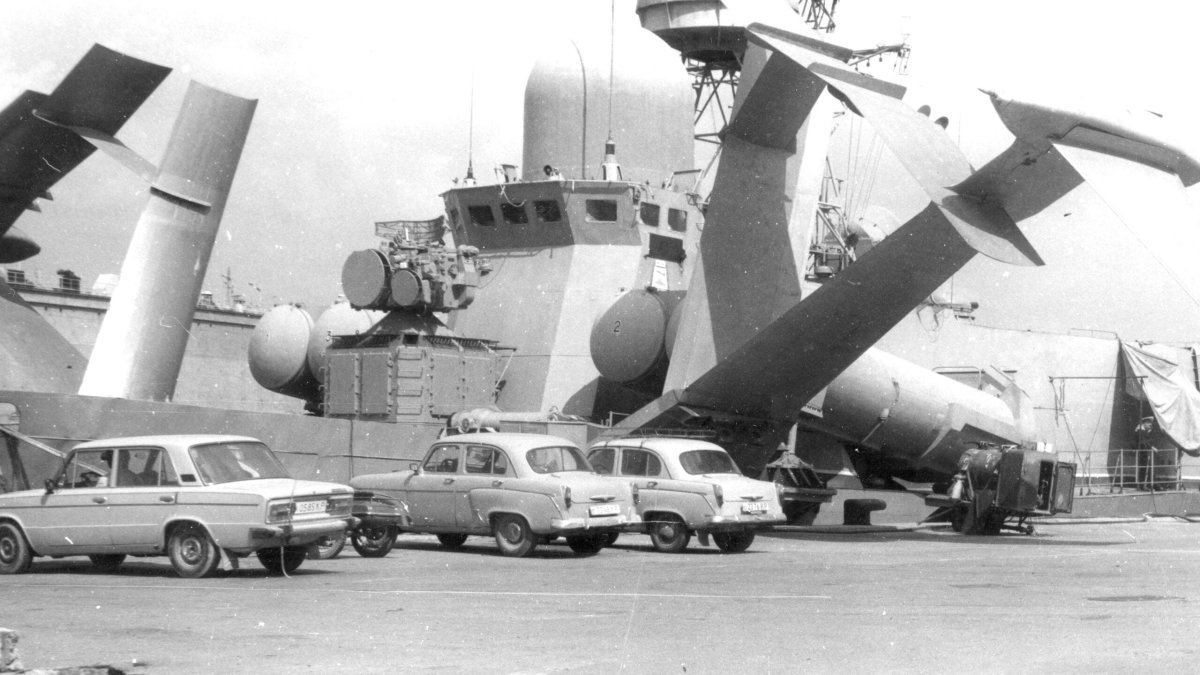
Enter the Uragan , constructed in Leningrad and immediately identified by the sheer size of its titanium-alloy hydrofoils. Those at the front were of the surface-piercing type, which meant they were partly out of the water when foilborne. When not deployed, they projected well clear of the hull at an angle of almost 45 degrees.
The hydrofoil at the rear was of a different type, being fully submerged when foilborne, with vertical struts mounting rudders, plus propulsion pods at the tips. Propulsion came from a pair of gas turbines each developing up to 18,000 horsepower. Reportedly, these were maritime versions of the turboprops that power the Tu-95 Bear strategic bomber , versions of which remain in service today .
The propellers were arranged as pairs on each of the aforementioned propulsion pods, and there were also a pair of diesel engines driving pump-jets, which were used for maneuvering at slow speeds.
The Uragan with its hydrofoils in the water., via Twitter
The Uragan was a big boat, over 160 feet long and with a displacement of over 400 tons when fully loaded, making it the biggest naval hydrofoil of its era. Construction was mainly of aluminum-magnesium alloy.
All that capacity supported an appropriately heavy weapons load : two twin launchers for P-120 Malakhit (SS-N-9 Siren) high-subsonic anti-ship missiles with a range of around 70 miles, one twin Osa-M (SA-N-4 Gecko) surface-to-air missile launcher with a reach of up to 20 missiles, and one 30mm six-barrel AK-630M Gatling-type cannon. Fire-control and navigation radar was supplemented by an electronic countermeasures suite.
МРК-5 in port, with the Osa-M surface-to-air missile ‘dustbin’ launcher visible on the bow., via Twitter
The first and only Uragan was МРК-5, laid down at Leningrad’s Primorsky Shipyard in 1973 and beginning trials in the Baltic Sea in 1977. Two years later, the vessel was moved by inland waterway to the Black Sea, the other major area of operations for Soviet (and later Russian) military hydrofoils. It seems that МРК-5 was at least a qualified success in its trials since it remained in use at Sevastopol until being decommissioned in 1990. Reportedly , the P-120 anti-ship missiles were test-fired on two occasions and the vessel displayed “excellent seaworthiness.”
The Uragan at speed., via Twitter
Overall, however, the design unsurprisingly proved highly complex, tricky to operate, and no doubt also expensive. It’s probable that the size and cost of the Uragan compared unfavorably to more versatile corvette and frigate designs.
Crew lend scale to one of the enormous forward hydroplanes., via Twitter
Sadly, the one-off Uragan is no more: it was damaged by a fire in 1992 and then sank. After recovery, the wreck was scrapped.
With hydrofoils raised, the Uragan cut a truly unique appearance., via Twitter
The idea of the military hydrofoil has not gone away, however, with Russia in particular continuing to use these craft, including some of the Cold War-era counterparts to the Uragan. In the United States, meanwhile, smaller hydrofoil boats were still being tested recently, more than 25 years after the U.S. Navy retired its six Pegasus class missile boats, the last of its operational hydrofoils. You can read about both of those U.S. concepts in this previous article .
As for the Uragan, today, we have only period photos from the Soviet-era to give us an idea as to what it must have been like to see this 400-ton, missile-armed monster slicing through the waves of the Black Sea.
Hat-tip to one of our favorite Twitter follows @Saturnax for bringing this topic to our attention.
Contact the author: thomas@thedrive.com
Comments couldn’t be loaded. Please refresh the page.
更新于美国东部时间2021年6月12日下午3:30
这款水翼导弹艇在苏联被称为1240型“飓风”(Uragan),西方则称之为“萨兰查级”(Sarancha class)。虽然仅建造了一艘,但它火力强大,从技术角度来看,其设计也堪称卓越。艇首两侧巨大的水翼以及艇尾安装螺旋桨的水翼,使得“飓风”号能够在水面上以超过60节的惊人速度疾驰。
冷战初期鱼雷攻击艇的装备,在20世纪60年代被装备反舰导弹的近岸艇所取代,而苏联在这方面做出了诸多开创性贡献。正是苏联制造的科马尔级导弹艇在1967年击沉了以色列驱逐舰“埃拉特”号,使这类高速攻击艇声名鹊起。
1240型“飓风”级潜艇在塞瓦斯托波尔干船坞进行维修,水翼处于展开状态。(图片来源:Бабкинъ Михаилъ/Wikimedia Commons)
为了进一步提升导弹艇的性能,人们开始研究将反舰导弹与水翼艇相结合的设计。水翼艇的艇体在高速航行时会抬离水面,利用类似机翼的表面降低阻力。除了提升速度外,这种设计通常还能提高燃油效率,并增强稳定性,即使在恶劣海况下也能保持稳定。冷战期间,这一概念并非总是完全成功,但在此过程中确实涌现出了一些有趣的设计。
“飓风”号战列舰在列宁格勒建造,其钛合金水翼的巨大尺寸使其极具辨识度。舰首的水翼为穿水式,这意味着在水翼展开时,它们的一部分会露出水面。未展开时,它们会以近45度角从船体伸出。
尾部的水翼类型不同,在水翼飞行时完全浸没在水中,垂直支柱上安装有舵,翼尖装有推进吊舱。动力来自两台燃气轮机,每台功率高达18000马力。据报道,这些燃气轮机是图-95“熊”式战略轰炸机所用涡轮螺旋桨发动机的舰载版本,该型发动机的部分型号至今仍在服役。
上述每个推进舱上都成对布置了螺旋桨,此外还有一对柴油发动机驱动泵喷式推进器,用于低速机动。
乌拉甘号水上飞机及其水翼在水中航行。(图片来自推特)
“乌拉甘”号是一艘大型舰艇,长超过160英尺,满载排水量超过400吨,是当时最大的海军水翼艇。其主要结构材料为铝镁合金。
如此强大的火力足以支撑相应的重型武器载荷:两座双联装P-120“马拉赫特”(SS-N-9“海妖”)高亚音速反舰导弹发射器,射程约70英里;一座双联装“奥萨-M”(SA-N-4“壁虎”)地对空导弹发射器,最多可携带20枚导弹;以及一门30毫米六管AK-630M加特林式舰炮。火控和导航雷达辅以一套电子对抗系统。
停泊在港口的 МРК-5 型驱逐舰,舰艏可见 Osa-M 地对空导弹“垃圾桶”发射器。(图片来自推特)
第一艘也是唯一一艘“飓风”级水翼艇是МРК-5,于1973年在列宁格勒滨海边疆区造船厂开工建造,并于1977年在波罗的海开始试航。两年后,该艇经内河航道转移至黑海,黑海是苏联(后来的俄罗斯)军用水翼艇的另一主要作战区域。МРК-5的试航似乎至少取得了一定的成功,因为它一直服役于塞瓦斯托波尔,直至1990年退役。据报道,该艇曾两次试射P-120反舰导弹,并展现出“优异的适航性”。
高速飞行的Uragan,来自推特
然而,总体而言,不出所料,该设计极其复杂,操作棘手,而且无疑也十分昂贵。与用途更广泛的轻型护卫舰和护卫舰设计相比,“乌拉甘”号的尺寸和成本可能都处于劣势。
船员们为其中一架巨大的前部水上飞机增添了规模感。(图片来自推特)
可惜的是,独一无二的“乌拉甘”号已不复存在:它在1992年被一场大火烧毁后沉没。打捞上来后,残骸被拆解了。
水翼升起后,Uragan 的外观独具一格。(来自 Twitter)
军用水翼艇的概念并未消失,尤其是俄罗斯仍在继续使用这类艇型,包括一些冷战时期与“飓风”级战舰类似的型号。与此同时,在美国,小型水翼艇仍在进行测试,而此时距离美国海军退役其最后一批现役水翼艇——六艘“飞马”级导弹艇——已过去了25年之久。您可以在之前的文章中了解这两种美国水翼艇的概念。
至于“飓风”号,如今我们只能通过苏联时期的老照片来了解,当年看到这艘重达 400 吨、装备导弹的巨兽劈开黑海波涛的景象是怎样的。
感谢我们最喜欢的推特关注者之一 @Saturnax 让我们注意到这个话题。
联系作者:thomas@thedrive.com
评论加载失败,请刷新页面。