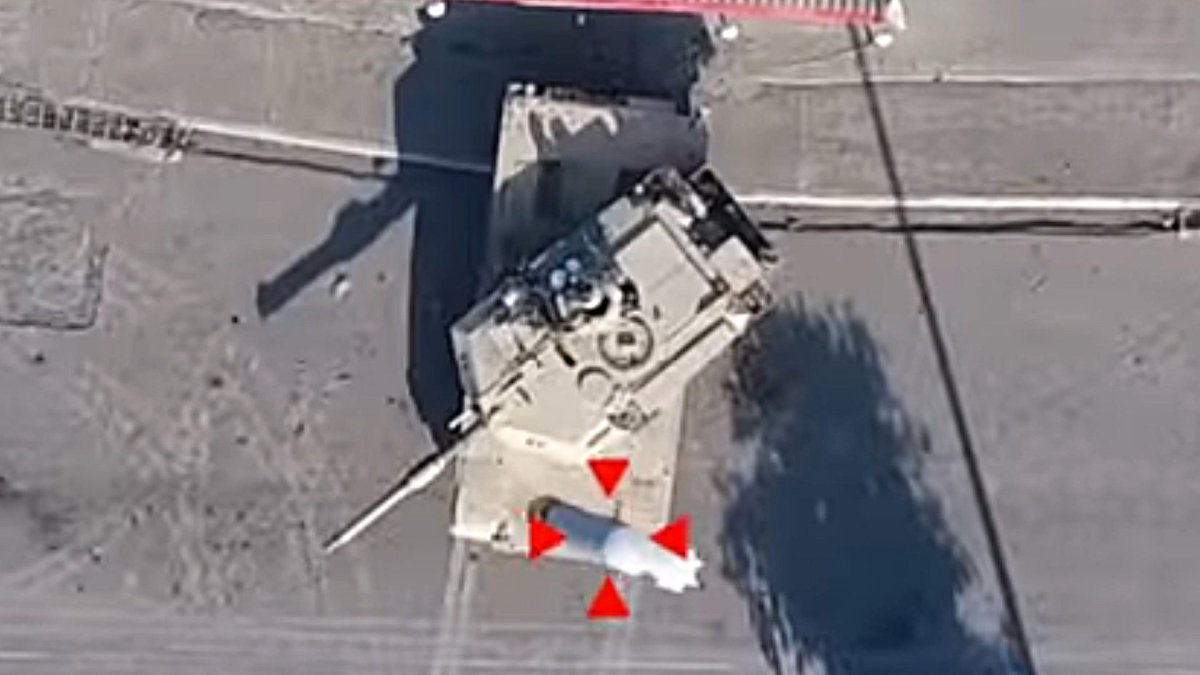
ISIS Drone Dropping Bomblet On Abrams Tank Is A Sign Of What’s To ComeISIS无人机向艾布拉姆斯坦克投掷炸弹,预示着未来可能发生的事件。
This is a threat that has been building for years and it’s just the beginning.
新闻视频
Updated Jul 3, 2020 3:45 AM EDT
One of the major tactical developments during the war against ISIS in Syria and Iraq has been the deployment of hobbyist and even homemade remote controlled aircraft—often referred to as “drones”—armed with small explosive charges. During the Battle of Mosul especially , Iraqi forces have experienced a threat from aerial bombardment by low-end drones on a level never seen before in combat. Meanwhile US forces in Iraq and Syria have also scrambled to adapt to and counter this growing capability.
Yet the hard truth is that the Department of Defense has had plenty of time and warning to do just that. In fact, they spent many millions of dollars looking at the problem , but no hard action was really taken to develop countermeasures, which makes their scramble for countermeasures now all that more frustrating.
The weaponizing of these increasingly prevalent and cheap hobbyist drones has been warned about for years by many of us outside the Pentagon’s five walls, and likely by some on the inside as well. Meanwhile, the DoD seemed focused on countering the problem with very high-end systems, such as emerging solid-state laser capabilities , which are more suited for the protection of extremely high-value targets than for providing a shield for soldiers on the battlefield. Some counter-rocket and mortar (C-RAM) systems, which use kinetic means to kill, with cannon shells or missiles, have also been adapted for this use to a limited degree, but these are also geared to defending fixed positions and can be horrifically expensive to use.
Videos like the ones below, from various militant groups in the Middle East, have become increasingly common, although taking on a M1 Abrams main battle tank, and the tanker standing in its hatch, certainly is one of the most sensational we have seen.
Warning, this is graphic video. The tanker supposedly died in the attack. The second video is a compilation of many similar strikes:
Photo of drones captured in Iraq—Presumably the same type that drops the bomblets in the videos above (photos via defense-blog.com ):
Now, the industry is rushing to develop “squad level” solutions for the hobby-drone threat. These largely include directional jamming systems that cut off a drone’s radio control and GPS signal, and thus hopefully defeat it entirely. This concept is being advanced, and even deployed to a limited degree, in a couple forms. The first as a rifle-like system , where the user visually acquires the drone, and then aims the emitter at it just as if they would a long gun. The other type is more cumbersome , and uses high-frequency radar, infrared and/or electronic surveillance to detect and track the drone. A turreted directional jammer then cues on the target. This type of setup is more of an area solution than the shouldered version which has no automated detection and targeting capability.
Eventually versions of this more elaborate system will likely be deployed on moving vehicles, just as other medium and heavy weapons would be.
On the higher end, directed energy systems (solid state lasers) have taken small unmanned aircraft up as their primary intended targets as they still lack the power and range to take on larger targets at range effectively. These systems can provide other functions than just anti-drone capabilities and are becoming more powerful and less cumbersome as years go by. Eventually they will find themselves on the front lines, but even their utility is limited against large quantities of small, cheap drones attacking at one time.
Still, these countermeasures don’t take into account that in the future, these cheap, highly available tool/toys turned into weapons will be used in greater numbers and, eventually, will feature autonomous flight coordination, also known as swarm technology . As such, solutions need to migrate from taking down one enemy drone at a time, to denying their use, even in large quantities, seamlessly over an entire area.
Omnidirectional broadband jamming is an issue because the US military uses a wide range of the same frequencies. Not only that, but small hobby-like drones are increasingly used by the America’s own land forces , including suicidal ones that work just as well as guided missiles than as surveillance systems. Jamming yourself and neutering your own drone capability doesn’t help the situation for allied troops fighting on the ground.
One possible solution for what will be one of the most pressing tactical issues of the near future is countering low-end drone swarms with low-end drone swarms. Basically sicking one flock on another, with the ability to work as a team to home in on an enemy swarm and to knock it out of the sky.
Clearly this is going to become a much more complicated business than anyone would like imagine, especially as these “over-the-counter” drone systems become smaller and more autonomous . Even here at home, as time passes, murder by drone is likely to become a very real thing. The police have already killed a suspect using a robotic system , and criminals may find that the drone is far better tool for taking out one’s enemies from afar than a gun’s bullet, especially consider that said bullet cannot turn corners.
As our lives become more encompassed by these buzzing craft, distinguishing friend from foe will be all but impossible. Washington DC and its surroundings is already a drone free zone , as are other sensitive areas . Expect many others to follow especially if the technology cannot be regulated to the point where it can’t be so easily abused. This is a problem pro-drone industries should confront head-on as the future of the technology and its applications likely depends on it.
The thing is that we have rapidly moved from small but deadly and expensive suicide drones capable of inflicting lethal force, to even simpler and cheaper ones that drop expendable munitions and can be quickly reused again. What’s most concerning is that the majority of the innovation in this field has been achieved by the enemy in a warzone. This is both an amazing achievement and a horrific one that is a harbinger of things to come. Meanwhile it seems as if the exploding low-end drone industry, the US government—including the Pentagon—are in denial of just what this all means for the future of warfare and quite frankly, humanity.
Contact the author at Tyler@thedrive.com
Comments couldn’t be loaded. Please refresh the page.
更新于美国东部时间2020年7月3日凌晨3:45
在叙利亚和伊拉克打击“伊斯兰国”的战争中,一项重要的战术发展是业余爱好者甚至自制遥控飞机(通常被称为“无人机”)的部署,这些无人机通常携带小型爆炸装置。尤其是在摩苏尔战役期间,伊拉克军队遭受了前所未有的低端无人机空中轰炸威胁。与此同时,驻伊拉克和叙利亚的美军也紧急调整策略,以应对并反制这种日益增长的无人机攻击能力。
然而,残酷的现实是,国防部其实有充足的时间和预警时间来采取行动。事实上,他们花费了数百万美元研究这个问题,但却没有真正采取任何切实有效的措施来制定应对方案,这使得他们现在仓促寻找应对方案的做法更加令人沮丧。
多年来,许多身处五角大楼之外的人士,以及可能包括一些五角大楼内部人士,都曾警告过这些日益普及且价格低廉的业余无人机被武器化的可能性。与此同时,国防部似乎专注于使用高端系统来应对这一问题,例如新兴的固态激光武器系统。这些系统更适合保护价值极高的目标,而非为战场上的士兵提供掩护。一些反火箭弹和反迫击炮(C-RAM)系统,即使用炮弹或导弹进行动能攻击的系统,也在一定程度上被改造用于此用途,但这些系统同样是为防御固定阵地而设计的,而且使用成本极其高昂。
像下面这样的视频,来自中东的各种武装组织,已经变得越来越常见,尽管与 M1 艾布拉姆斯主战坦克对抗,以及坦克兵站在坦克舱盖里,无疑是我们见过的最耸人听闻的视频之一。
警告:此视频画面可能令人不适。据称,油轮在袭击中损毁。第二个视频是多起类似袭击的合集:
在伊拉克拍摄到的无人机照片——据推测与上述视频中投放子炸弹的无人机是同一类型(照片来自defense-blog.com):
如今,业界正竞相开发针对业余无人机威胁的“班组级”解决方案。这些方案主要包括定向干扰系统,该系统能够切断无人机的无线电控制和GPS信号,从而有望彻底击败它。这项技术正在以两种形式得到推进,甚至已在一定范围内投入使用。第一种形式类似于步枪,用户目视锁定无人机,然后像使用长枪一样将发射器瞄准它。另一种形式则更为笨重,它利用高频雷达、红外线和/或电子监视来探测和跟踪无人机。然后,炮塔式定向干扰器会锁定目标。与不具备自动探测和瞄准能力的肩扛式系统相比,这种配置更偏向于区域性解决方案。
最终,这种更复杂的系统的各种版本可能会像其他中型和重型武器一样,部署在移动车辆上。
在高端领域,定向能系统(固态激光器)已将小型无人机作为其主要目标,因为它们目前仍缺乏有效打击远距离大型目标所需的功率和射程。这些系统除了反无人机功能外,还能提供其他功能,并且随着时间的推移,它们的性能越来越强大,体积也越来越小巧。最终,它们将出现在前线战场,但即便如此,面对大量小型、廉价无人机的同时攻击,它们的效用也十分有限。
然而,这些应对措施并未考虑到,未来这些廉价易得的工具/玩具一旦被改造成武器,将会被大量使用,并最终具备自主飞行协调能力,也就是所谓的集群技术。因此,解决方案需要从逐个击落敌方无人机,转变为在整个区域内无缝地阻止其使用,即使数量庞大也不例外。
全方位宽带干扰之所以构成威胁,是因为美军使用了大量相同的频率。不仅如此,美国陆军也越来越多地使用小型无人机,其中一些无人机甚至具备自杀式攻击能力,其性能堪比制导导弹而非侦察系统。干扰自身并削弱无人机作战能力,对地面作战的盟军部队来说无疑是雪上加霜。
针对近期最紧迫的战术问题之一,一个可能的解决方案是用低端无人机群对抗低端无人机群。简单来说,就是派出一群无人机攻击另一群,这些无人机能够协同作战,锁定敌方无人机群并将其击落。
显然,这将会比任何人想象的都要复杂得多,尤其随着这些“现成”的无人机系统变得越来越小巧、越来越自主。即使在国内,随着时间的推移,无人机杀人也可能成为现实。警方已经使用无人机系统击毙了一名嫌疑人,而犯罪分子可能会发现,无人机比枪支子弹更适合远距离消灭敌人,尤其考虑到子弹无法转弯。
随着这些嗡嗡作响的飞行器日益渗透到我们的生活,区分敌友将变得几乎不可能。华盛顿特区及其周边地区以及其他一些敏感区域已经划定了无人机禁飞区。预计未来会有更多地区效仿,尤其是在无人机技术无法得到有效监管,使其不易被滥用的情况下。支持无人机发展的行业应该正视这个问题,因为这项技术的未来及其应用很可能取决于此。
问题在于,我们已经迅速从小型但致命且昂贵的自杀式无人机(能够造成致命打击)过渡到更简单、更便宜的无人机(投放一次性弹药,可以快速重复使用)。最令人担忧的是,该领域的大部分创新都是敌方在战区取得的。这既是一项惊人的成就,也是一个可怕的预兆,预示着未来将发生的事情。与此同时,似乎蓬勃发展的低端无人机产业、美国政府(包括五角大楼)都在否认这一切对未来战争乃至整个人类意味着什么。
请通过Tyler@thedrive.com联系作者。
评论加载失败,请刷新页面。