Russian jet, US drone crash over Black Sea, US military says美国军方称,俄罗斯战机和美国无人机在黑海上空相撞。
The incident marked the first time that an unsafe interaction with Russian aircraft caused a U.S. drone to crash.
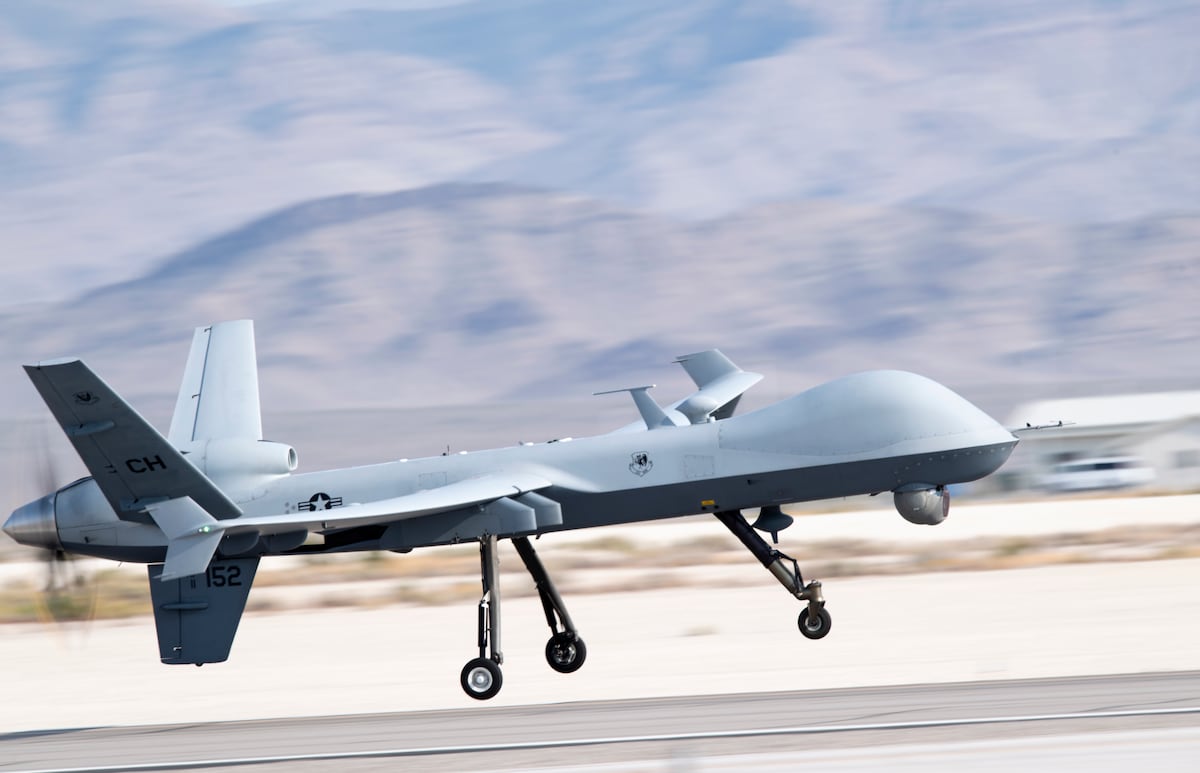
An American intelligence drone crashed after colliding with a Russian fighter over the Black Sea on Tuesday, the U.S. Air Force’s European headquarters said in a release.
The MQ-9 Reaper drone was flying a routine surveillance mission in international airspace when it crossed paths with two Su-27 fighters around 7 a.m. local time, according to U.S. Air Forces in Europe.
The Russian jets began antagonizing the unmanned aircraft, repeatedly dumping fuel on and buzzing in front of the much smaller Reaper, the Air Force said. One Su-27 drew close enough to hit the drone’s tail propeller, causing its remote operators to lose control of the plane.
“Because of the damage, we were in a position to have to essentially crash it into the Black Sea,” Pentagon spokesperson Brig. Gen. Patrick Ryder told reporters at a briefing Tuesday afternoon. “It was unflyable and uncontrollable, and we took it down.”
He declined to answer whether the drone was armed at the time.
The incident resulted in a “complete loss” of the MQ-9 and nearly caused the Su-27 to crash as well, USAFE Commander Gen. James Hecker said in a release. The command declined to answer further questions on Tuesday.
Ryder said the Russians have not recovered the MQ-9, referring questions about American efforts to find the aircraft to the U.S. Navy. The Navy referred questions to U.S. European Command, which said it had no further details to offer.
Ryder confirmed that the Russian pilot landed after the collision, but did not say where. The Defense Department is working to declassify imagery of the incident.
It’s the first time an unsafe interaction with Russian aircraft has downed a U.S. drone, according to John Kirby, a spokesman for the White House National Security Council.
“U.S. and allied aircraft will continue to operate in international airspace and we call on the Russians to conduct themselves professionally and safely,” he said.
American and European air forces routinely intercept Russian aircraft that encroach on NATO airspace and push the limits of risky maneuvers. MQ-9 drones — known for their “eye in the sky” role in counterterrorism operations — have been a key part of U.S. efforts to surveil Russia’s war in Ukraine for more than a year. The U.S. has flown Reapers from Poland, Romania, Greece and Estonia.
“These aggressive actions by Russian aircrew are dangerous and could lead to miscalculation and unintended escalation,” USAFE said.
Defense Secretary Lloyd Austin has not talked to his Russian counterpart, Sergei Shoigu, about the collision, Ryder told reporters. The State Department said it would personally complain to Anatoly Antanov, Russia’s ambassador to the United States.
President Joe Biden was briefed on the incident by National Security Adviser Jake Sullivan earlier in the day, Kirby told reporters.
“This MQ-9 was operating in international airspace over international waters and posed a threat to nobody,” Kirby said.
While Kirby acknowledged that intercepts between American and Russian aircraft over the Black Sea are common, especially in recent weeks, he said Tuesday’s run-in was “unique” and “noteworthy” for its disregard for safety and professionalism.
The U.S. has been consistently flying over the Black Sea’s international airspace and will continue to do so, Kirby said.
In 2019, Iran shot down a U.S. Navy Broad Area Maritime Surveillance—Demonstrator drone , a version of the Air Force’s RQ-4 Global Hawk, in the Strait of Hormuz, prompting then-U.S. President Donald Trump to consider a retaliatory strike. He later backtracked, citing potential civilian casualties. The two countries made contradictory claims, and U.S. military officials ultimately downplayed the incident.
The same year, the U.S. military alleged Libyan forces using Russian air defenses brought down a drone near Tripoli.
Rachel Cohen is the editor of Air Force Times. She joined the publication as its senior reporter in March 2021. Her work has appeared in the Washington Post, the Frederick News-Post (Md.), Air and Space Forces Magazine, Inside Defense, Inside Health Policy and elsewhere.
Joe Gould was the senior Pentagon reporter for Defense News, covering the intersection of national security policy, politics and the defense industry. He had previously served as Congress reporter.
美国空军欧洲司令部在一份声明中表示,周二,一架美国情报无人机在黑海上空与一架俄罗斯战斗机相撞后坠毁。
据美国驻欧洲空军称,当地时间早上 7 点左右,一架 MQ-9“死神”无人机在国际空域执行例行监视任务时,与两架苏-27 战斗机相遇。
俄罗斯空军称,俄军战机开始挑衅这架无人机,反复向体型小得多的“死神”无人机倾倒燃料,并在其前方低空盘旋。一架苏-27战机甚至接近到足以击中无人机的尾桨,导致远程操作员失去对飞机的控制。
五角大楼发言人帕特里克·赖德准将在周二下午的新闻发布会上告诉记者:“由于受损严重,我们不得不让它坠入黑海。它已经无法飞行和控制,所以我们把它击落了。”
他拒绝回答无人机当时是否携带武器。
美国空军驻欧洲司令部司令詹姆斯·赫克尔将军在一份声明中表示,此次事件导致MQ-9无人机“完全损毁”,并险些导致苏-27战斗机坠毁。该司令部周二拒绝回答进一步的问题。
莱德表示,俄罗斯方面尚未回收MQ-9无人机,并将有关美国搜寻行动的问题转给了美国海军。海军方面则将问题转给了美国欧洲司令部,后者表示没有更多细节可以提供。
莱德证实,俄罗斯飞行员在碰撞后成功着陆,但没有透露着陆地点。美国国防部正在努力解密此次事件的图像资料。
据白宫国家安全委员会发言人约翰·柯比称,这是美国无人机首次因与俄罗斯飞机发生不安全互动而被击落。
他说:“美国及其盟国的飞机将继续在国际空域飞行,我们呼吁俄罗斯方面以专业和安全的方式行事。”
美国和欧洲空军经常拦截侵犯北约领空并进行危险机动的俄罗斯飞机。MQ-9无人机因其在反恐行动中扮演的“空中之眼”角色而闻名,一年多来一直是美国监视俄罗斯在乌克兰战争的关键力量。美国已从波兰、罗马尼亚、希腊和爱沙尼亚等地起飞了MQ-9“死神”无人机。
美国空军驻欧部队表示:“俄罗斯机组人员的这些挑衅行为是危险的,可能导致误判和意外升级。”
莱德告诉记者,国防部长劳埃德·奥斯汀尚未就此次碰撞事件与俄罗斯国防部长谢尔盖·绍伊古进行沟通。国务院表示,将亲自向俄罗斯驻美国大使阿纳托利·安塔诺夫提出抗议。
柯比告诉记者,当天早些时候,国家安全顾问杰克·沙利文向乔·拜登总统汇报了这起事件。
“这架MQ-9无人机在国际空域和国际水域上空飞行,没有对任何人构成威胁,”柯比说。
柯比承认,美国和俄罗斯飞机在黑海上空发生拦截事件很常见,尤其是在最近几周,但他表示,周二的这次遭遇是“独特的”和“值得注意的”,因为它无视安全和专业精神。
柯比表示,美国一直以来都在黑海国际空域上空进行飞行,并将继续这样做。
2019年,伊朗在霍尔木兹海峡击落了一架美国海军广域海上监视演示无人机(RQ-4“全球鹰”的改进型),这促使时任美国总统唐纳德·特朗普考虑进行报复性打击。但他后来以可能造成平民伤亡为由放弃了这一想法。两国就此事发表了相互矛盾的说法,而美国军方官员最终淡化了这一事件。
同年,美国军方声称利比亚军队使用俄罗斯防空系统在的黎波里附近击落了一架无人机。
瑞秋·科恩是《空军时报》的编辑。她于2021年3月加入该刊物,担任高级记者。她的作品曾发表在《华盛顿邮报》、《弗雷德里克新闻邮报》(马里兰州)、《空军与太空部队杂志》、《国防内幕》、《卫生政策内幕》等刊物上。
乔·古尔德是《防务新闻》的资深五角大楼记者,负责报道国家安全政策、政治和国防工业的交汇点。他此前曾担任国会记者。