The Air Force May Have Retired The Predator, But It was the Army That Blazed Its Trail空军或许已经退役了“捕食者”无人机,但正是陆军开创了它的先河。
An obscure Army military intelligence outfit dominated the early years of the program, helping demonstrate the drone in a host of different roles.
By Joseph Trevithick
Updated Jun 30, 2019 3:07 PM EDT
The U.S. Air Force has officially retired the MQ-1 Predator , which had come to be an icon of important if often controversial impact in how American prosecutes war around the world. But often lost in the discussions of how the drone changed the face of warfare, both in the air and on the ground , is its early history with an entirely different service, the U.S. Army.
The program officially began in January 1994 as a so-called “Advanced Concept Technology Demonstration,” or ACTD, to explore the potential of a long-endurance, medium-altitude unmanned aircraft. For more than two years, the U.S. military’s only operational Predators, originally known as RQ-1s, were attached to a unique and obscure Army unit called the Military Intelligence Battalion (Low Intensity) situated in Orlando, Florida.
And though a Joint Program Office that included representatives from all the U.S. military services managed this effort in cooperation with the Pentagon’s Defense Reconnaissance Office (DARO), the Army dominated the project overall. Before the Air Force took control in September 1996, that service “had no significant involvement in the ACTD process other than sending one pilot to fly the air vehicle,” according to Dr. Thomas Ehrhard’s official 2010 monograph
Air Force UAVs: The Secret History .
At first glance, it might seem odd for the Army, focused on ground operations, to have been so proactive in the Predator’s early history, but it is less so when one considers the service’s contemporary history. By 1994, it had spent the better part of the last three decades both preparing to fight a large-scale conventional conflict in Europe against the Soviet Union, supporting quasi-covert counter-insurgency operations against Communist rebels in Latin America, and becoming increasingly involved in the War on Drugs at home and abroad.
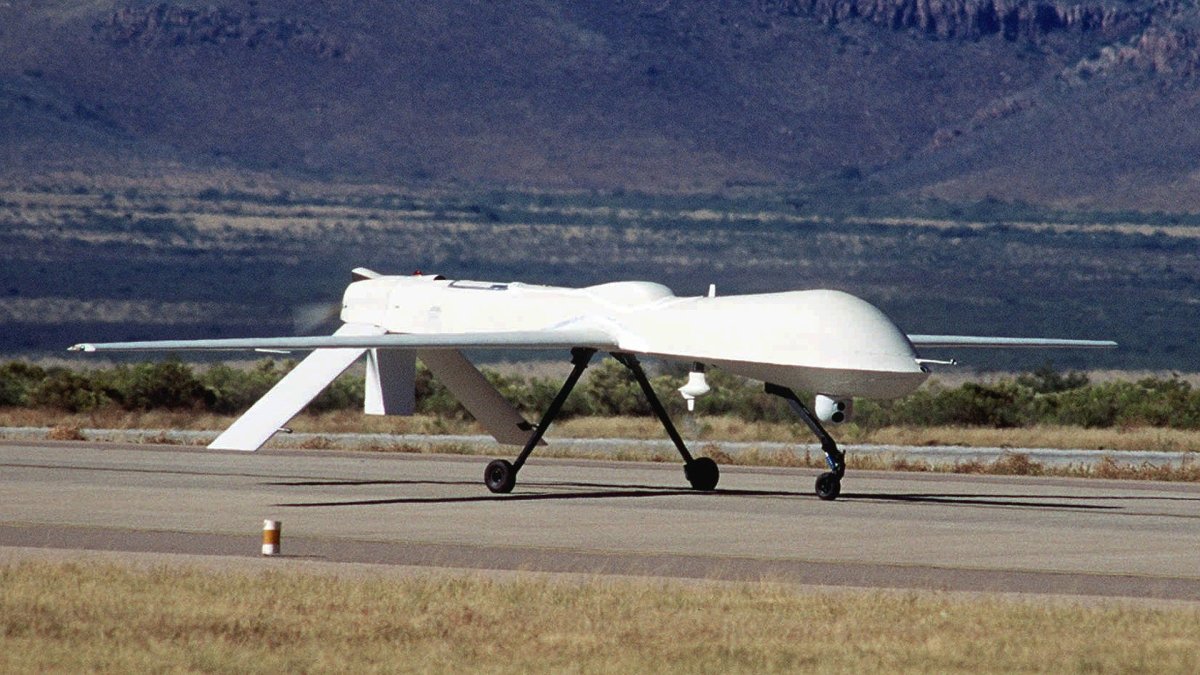
An early RQ-1 Predator., USAF
Then in 1991, it had helped eject Saddam Hussein from Kuwait and crushed Iraq’s military in the first Gulf War. But during that conflict, Iraqi forces had still been able to use mobile transporter-erector-launchers, or TELs, along decoys and other tactics, to rapidly move Scud short-range ballistic missiles around and launch them into neighboring countries with virtual impunity.
“There is no technical evidence that a single TEL was actually destroyed during the war,” U.S. Air Force Colonel Mark Kipphut noted in research report that the service re-published as an official monograph in 2003. “Iraqi launch operations never stopped.”
So the service had long had clear and demonstrable requirements for persistent aerial surveillance capabilities, particularly to help monitor enemy movements and direct air and artillery strikes, all in support of friendly operations on the ground. These same realities, combined with its then relatively recent experience of hunting guerrilla forces in Southeast Asia , had led the Army to begin laying the groundwork for Military Intelligence Battalion (Low Intensity) all the way back 1985.
That year, the service established what it then called the U.S. Army Echelon Above Corps Aviation Company at the Naval Air Engineering Center, Lakehurst in New Jersey . This unit was supposed to form a single home for various aerial intelligence gathering platforms, including the RG-8A powered glider, which you can read more about here , and a drone project nicknamed Gray Wolf , with its primary focus being on ongoing operations in Latin America.
One of the Army’s RG-8A powered glider., US Army via FOIA
Gray Wolf – not to be confused with the Air Force’s new project of the same name – was the name given to a small number of Development Sciences R4E-40 Sky Eye drones, which could carry early generation electro-optical or infrared video cameras or traditional 35mm cameras. Though relatively advanced for their time and able to fly pre-programmed routes, these unmanned aircraft needed to be within 80 miles of the ground control station to receive commands or send back video in near-real time.
In the late 1980s, the Army had also helped DARPA test the capabilities of Leading Systems, Inc.’s Amber drone, which offered significant more range, could fly at a much higher altitude, and for much longer periods than older systems such as the Sky Eye. Amber evolved into the Gnat-750 , which in turn served as the basis for the Predator. In 1990, General Atomics purchased Leading Systems, becoming the name most associated with the iconic unmanned aerial vehicle.
One of Predator’s most important enhancements over the early designs was the addition of a two-way satellite datalink. This allowed operators on the ground to directly control the aircraft throughout its mission and get video, imagery, and other information in near-real time, even at extended ranges.
With its own prior experience with unmanned aircraft, the Predator was in many ways a natural fit for Military Intelligence Battalion (Low Intensity), even though it was primarily flying manned surveillance aircraft, including specialized versions of the four engine de Havilland Canada DHC-7 and twin-engine Beechcraft King Air , when the drones first arrived in 1994. Army Warrant Officers with backgrounds flying helicopters joined a smaller number of Navy reserve aviators with intelligence experience to form the initial cadre of pilots, along with the single individual from the Air Force.
A US Army EO-5C aircraft, based on the de Havilland DHC-7, similar to the O-5A and EO-5B that the Military Intelligence Battalion (Low Intensity) operated in the 1990s., US Army
Formal training on the Predator did not start until October 1994 and ran through January 1995. For the next year, though, the Army-led team showed off the new drone as an important capability for both conventional and other more specialized operations.
Between February and March 1995, the unmanned aircraft flew simulated border patrol and counter-drug missions in and around the United States. Then, in April, the pilotless planes headed to Fort Bliss, Texas to take part in a routine air and missile defense drill nicknamed Roving Sands .
There they practiced hunting for mock Scuds, demonstrating their ability to potentially help the U.S. military avoid the debacle it had experienced in Iraq four years earlier. With the Predators working together with other aerial intelligence assets, including U-2 spy planes , friendly forces were able to destroy 85 percent of the simulated ballistic launchers during the exercise.
US Army troops, playing the role of the opposing force, set up an actual captured Scud transporter-erector-launcher during the Roving Sands exercise in 1997., DOD
In June 1995, foreshadowing things to come, Military Intelligence Battalion (Low Intensity) demoed the Predator to the secretive Joint Special Operations Command and other special operations forces. There is little information available about what those flights involvement, but they almost certainly would have shown the drone’s value as a tool to help hunt terrorists.
Lastly in 1995, the Predators flew together with one of the U.S. Customs Service P-3 Orions on more mock border patrol and counter-narcotics operations and then took part in an unspecified Navy Carrier Strike Group’s Composite Training Unit Exercise . The Navy elements in the program likely coordinated that latter demonstration, which foreshadowed the service’s still ongoing
on-again-off-again relationship with unmanned carrier aviation .
US Customs and Border Protection P-3 Orions. The US Customs Service operated these aircraft until 2003, at which time the US government merged that organization with various others to form CBP., CBP
But most importantly, civil conflict was raging in the Balkans and the Predators presented an ideal way to monitor the situation in support of internationally-backed observer and peacekeeping missions. In 1993, the Pentagon has initiated a crash program to purchase a pair of the older Gnat-750s for this mission, but the process dragged out and the U.S. military eventually turned those drones over to the Central Intelligence Agency.
CIA did deploy them for missions over Bosnia and Herzegovina from to a base in neighboring Albania in February 1994, but had difficulty with their line-of-sight control systems. Attempts to use an old RG-8A powered glider as a radio relay only made the situation more complicated and at least one of the Gnat-750s crashed during the operation.
So, from July and October 1995, the Military Intelligence Battalion (Low Intensity) sent a joint service team to fly the Predators over the region instead in support Operation Deliberate Force . This mission involved a broader aerial campaign against Bosnian Serb forces, which had attacked U.N.-designated safe areas and committed major atrocities, including the infamous massacres of thousands of ethnic Bosniak men and boys in Srebrenica and Markale .
The video below is from a press conference during Operation Deliberate Force that includes strike footage.
In November 1995, the warring parties began negotiating what became known as the Dayton Accords , a U.S.-backed agreement that formally ended the civil war in Bosnia and Herzegovina. A NATO-led force subsequently deployed to the country to help enforce the settlement .
In March 1996, the drones from Military Intelligence Battalion (Low Intensity), along with another Army-led group, which also contained Air Force, Navy, and Marine Corps personnel, returned to the region to support that peacekeeping effort as part of Operation Joint Endeavor . Separately, elements of the unit took other Predators to explore the possibility of a submerged submarine controlling or otherwise communicating with the drone, another demonstration that we unfortunately know little about but that the Navy members of the program almost certainly organized.
However, by that time and after some amount of bureaucratic wrangling, the Pentagon had already decided to shift final control of the Predators to the Air Force once the ACTD program ended. The formal handover came in September 1996, when the Air Force’s 11th Reconnaissance Squadron took over the drones and the mission in the Balkans entirely. Under that service’s new leadership, the aircraft would evolve from just a surveillance platform into the multi-purpose MQ-1 armed reconnaissance asset.
By the end of 1997, the Military Intelligence Battalion (Low Intensity) had ceased to exist, as well, with the 204th Military Intelligence Battalion taking over much of its duties. The service never quite forgot about its experience with the Predator, though, and in 2003, it procured three Improved Gnats, or I-Gnats, from General Atomics for operations in Iraq.
A General Atomics I-Gnat., General Atomics.
Also known as the RQ-1L, these aircraft are a sort of hybrid between the Gnat and the Predator, using the former’s line-of-sight control system and other central components, but tucked inside a Predator fuselage with a more powerful Rotax 912 or turbocharged 914 engine at the rear. The finicky radio links again proved to be unreliable and in March 2005 one of the drones lost contact with the ground control station while flying at between 6,000 and 7,000 feet, spun out of control, and smashed into the ground in a ball of fire, according to an accident report we at The War Zone obtained via the Freedom of Information Act.
So, in 2005, the Army hired General Atomics to build the service a more capable design . Two years later it also created a new unit very similar to the old Military Intelligence Battalion (Low Intensity) specifically to conduct persistent aerial surveillance operations in Iraq to help both spot insurgents planting deadly roadside bombs and monitor their movements, developing so-called “ patterns of life ” in order to trace them back to their workshops.
That organization was known formally as the U.S. Army Composite Aerial Operations Activity and more commonly referred to as Task Force Observe, Detect, Identify, and Neutralize ( TF ODIN ). As with its predecessor, it operated a mix of modified Beechcraft King Airs and unmanned aircraft, including the RQ-7 Shadow and pre-production versions of the new pilotless plane from General Atomics, called the Warrior Alpha. The Army eventually stood up a second, similar unit in Afghanistan in 2008.
In 2009, more than a decade after losing control of the Predators to the Air Force, the Army began fielding its own replacements in earnest. The final production aircraft, the MQ-1C Gray Eagle , is similar visually to the Predator, but is actually something of another hybrid design that shares more with the larger MQ-9 Reaper, including a strengthened main wing with the ability to carrying AGM-114 Hellfire missiles and other stores on four pylons.
A US Army MQ-1C carrying a wide-area persistent surveillance system under its wings., US Army
Since then, it has been steadily adding Gray Eagle drones into all of its combat aviation brigades to provide the required persistent battlefield surveillance capability it first identified more than 20 years before, but now with the added ability to strike at the targets it finds directly.
And in something of another twist of fate, there is a distinct possibility that the Predator may actually continue to serve the U.S. military, but with the other two services that had originally took part in the program, the Navy and Marine Corps . When all is said and done, the MQ-1 may actually turn out to be the joint service aircraft that the Pentagon had originally envisioned, a process that began in large part thanks to the Army.
Contact the author: joe@thedrive.com
Comments couldn’t be loaded. Please refresh the page.
作者:约瑟夫·特雷维西克
更新于美国东部时间2019年6月30日下午3:07
美国空军已正式退役MQ-1“捕食者”无人机。这款无人机曾是美国在全球战争中发挥重要作用(尽管也常常引发争议)的标志性装备。然而,在讨论无人机如何改变空战和地面战争格局时,人们往往忽略了它早期与另一个截然不同的军种——美国陆军——的渊源。
该项目于1994年1月正式启动,最初名为“先进概念技术演示”(ACTD),旨在探索长航时、中空无人机的潜力。在两年多的时间里,美军唯一服役的“捕食者”无人机(最初名为RQ-1)隶属于驻扎在佛罗里达州奥兰多的一支鲜为人知的陆军部队——军事情报营(低强度)。
尽管由美国各军种代表组成的联合项目办公室与五角大楼国防侦察办公室(DARO)合作管理这项工作,但陆军在整个项目中占据主导地位。根据托马斯·埃尔哈德博士2010年的官方专著,在空军于1996年9月接管之前,空军“除了派遣一名飞行员驾驶飞行器外,并未在ACTD过程中进行任何实质性参与”。
空军无人机:不为人知的历史。
乍一看,以地面作战为主的陆军在“捕食者”无人机早期发展阶段如此积极主动似乎有些奇怪,但考虑到陆军的近代史,这一点就显得不那么令人费解了。到1994年,陆军在过去近三十年的大部分时间里,都在忙于三件事:一是为在欧洲与苏联进行大规模常规战争做准备;二是支持在拉丁美洲开展针对共产主义叛乱分子的准秘密反叛乱行动;三是日益深入地参与国内外的禁毒战争。
早期的RQ-1“捕食者”无人机,美国空军
1991年,它帮助将萨达姆·侯赛因赶出科威特,并在第一次海湾战争中击溃了伊拉克军队。但在那场冲突中,伊拉克军队仍然能够利用移动式运输-起竖-发射车(TEL),配合诱饵和其他战术,快速转移飞毛腿短程弹道导弹,并几乎不受惩罚地将其发射到邻国。
“没有技术证据表明战争期间确实摧毁过任何一架发射车,”美国空军上校马克·基普特在一份研究报告中指出,该报告于 2003 年由空军重新出版,作为官方专著。“伊拉克的发射行动从未停止过。”
因此,该军种长期以来对持续空中监视能力有着明确且可证明的需求,尤其是在协助监视敌军动向和引导空袭及炮击方面,所有这些都是为了支援地面友军作战。正是基于这些现实情况,再加上当时该军种在东南亚打击游击队方面积累的相对较新的经验,促使陆军早在1985年就开始着手组建军事情报营(低强度)。
那一年,美国陆军在新泽西州莱克赫斯特海军航空工程中心成立了当时名为“美国陆军梯队上层航空连”的单位。该单位旨在为各种空中情报收集平台提供统一的基地,其中包括RG-8A动力滑翔机(您可以在这里了解更多信息)以及代号为“灰狼”的无人机项目,该项目的主要任务是参与拉丁美洲的持续行动。
这是美国陆军的一架RG-8A动力滑翔机。(图片来自美国陆军信息自由法案)
“灰狼”(Gray Wolf)——不要与空军同名的新项目混淆——是少量由发展科学公司(Development Sciences)生产的R4E-40“天眼”(Sky Eye)无人机的代号。这些无人机可以搭载早期的光电或红外摄像机,或传统的35毫米摄像机。尽管在当时算是相对先进的,并且能够按照预先设定的路线飞行,但这些无人机必须在距离地面控制站80英里(约130公里)的范围内才能接收指令或近乎实时地传回视频。
20世纪80年代末,美国陆军曾协助DARPA测试领先系统公司(Leading Systems, Inc.)的Amber无人机的性能。与Sky Eye等老旧系统相比,Amber无人机航程更远、飞行高度更高、续航时间更长。Amber后来发展成为Gnat-750,而Gnat-750又成为Predator无人机的基础。1990年,通用原子公司(General Atomics)收购了领先系统公司,从此成为与这款标志性无人机联系最为紧密的公司。
“捕食者”无人机相比早期设计最重要的改进之一是增加了双向卫星数据链。这使得地面操作人员能够在任务全程直接控制无人机,并近乎实时地获取视频、图像和其他信息,即使在远距离也是如此。
由于自身拥有无人机方面的经验,尽管“捕食者”无人机在1994年首次抵达时,主要驾驶的是有人驾驶的侦察机,包括加拿大德哈维兰DHC-7四引擎飞机和比奇空中国王双引擎飞机的特制版本,但从很多方面来看,“捕食者”无人机都非常适合军事情报营(低强度)。一些拥有直升机飞行经验的陆军准尉,加上少数具有情报经验的海军预备役飞行员,以及一名来自空军的人员,组成了最初的飞行员队伍。
美国陆军EO-5C型飞机,基于德哈维兰DHC-7型飞机,与军事情报营(低强度)在20世纪90年代使用的O-5A和EO-5B型飞机类似。
“捕食者”无人机的正式训练直到 1994 年 10 月才开始,一直持续到 1995 年 1 月。不过,在接下来的一年里,由陆军领导的团队展示了这款新型无人机,将其作为常规作战和其他更专业化作战的重要能力。
1995年2月至3月间,这些无人机在美国境内及周边地区进行了模拟边境巡逻和缉毒任务。随后,在4月,这些无人驾驶飞机前往德克萨斯州布利斯堡,参加了代号为“漫游沙丘”的例行防空和导弹防御演习。
在那里,他们演练了搜寻模拟飞毛腿导弹的行动,展示了其帮助美军避免四年前在伊拉克遭遇惨败的能力。在捕食者无人机与其他空中情报力量(包括U-2侦察机)协同作战的情况下,友军在演习中摧毁了85%的模拟弹道导弹发射器。
1997年“漫游沙地”演习期间,扮演假想敌的美军部队架设了一套缴获的飞毛腿导弹运输-起竖-发射装置。(美国国防部)
1995年6月,军事情报营(低强度)向秘密的联合特种作战司令部和其他特种作战部队演示了“捕食者”无人机,这预示着未来将发生的事情。关于这些飞行演示的具体内容鲜为人知,但几乎可以肯定的是,它们展示了无人机作为打击恐怖分子工具的价值。
最后,在1995年,捕食者无人机与美国海关的一架P-3猎户座反潜巡逻机一同执行了更多模拟边境巡逻和缉毒行动,随后参加了海军航母打击群的一次未公开的综合训练单元演习。参与该项目的海军部门很可能协调了后一次演示,这预示着海军至今仍在进行的类似演习。
与无人航母航空的关系时好时坏。
美国海关与边境保护局的P-3猎户座反潜巡逻机。美国海关总署一直运营这些飞机,直到2003年,美国政府将该机构与其他机构合并,成立了美国海关与边境保护局(CBP)。
但最重要的是,巴尔干地区内战正酣,而“捕食者”无人机为支持国际支持的观察员和维和行动提供了理想的监测手段。1993年,五角大楼启动了一项紧急计划,采购两架较老的“蚊蚋-750”无人机用于这项任务,但采购过程拖延不决,最终美军将这些无人机移交给了中央情报局。
1994年2月,中央情报局确实部署了这些无人机,从波斯尼亚和黑塞哥维那境内的一个基地飞往邻国阿尔巴尼亚执行任务,但它们的视距控制系统出现了问题。尝试使用一架老旧的RG-8A动力滑翔机作为无线电中继,反而使情况更加复杂,而且至少有一架Gnat-750无人机在行动中坠毁。
因此,从1995年7月到10月,军事情报营(低强度)派遣了一支联合部队,驾驶“捕食者”无人机飞越该地区,支援“审慎力量行动”。这项任务涉及对波斯尼亚塞族部队发起的大规模空中打击,这些部队曾袭击联合国指定的安全区,并犯下包括臭名昭著的斯雷布雷尼察和马尔卡莱大屠杀在内的重大暴行,屠杀了数千名波斯尼亚族男子和男孩。
以下视频来自“蓄意武力行动”期间举行的新闻发布会,其中包含打击画面。
1995年11月,交战各方开始谈判,最终达成了后来被称为《代顿协议》的协议。这项由美国支持的协议正式结束了波斯尼亚和黑塞哥维那的内战。随后,一支由北约领导的部队部署到该国,以帮助执行该协议。
1996年3月,来自军事情报营(低强度)的无人机,连同另一个由陆军领导、空军、海军和海军陆战队人员组成的小组,重返该地区,支援“联合努力行动”的维和行动。与此同时,该部队的部分成员还携带其他“捕食者”无人机,探索潜艇控制无人机或与其进行通信的可能性。我们对此知之甚少,但几乎可以肯定,这项演示是由海军成员组织的。
然而,经过一番官僚主义的周旋,五角大楼当时已经决定,一旦ACTD项目结束,就将“捕食者”无人机的最终控制权移交给空军。正式的移交工作于1996年9月完成,当时空军第11侦察中队全面接管了这些无人机以及在巴尔干地区的任务。在空军新领导层的带领下,这些无人机将从单纯的侦察平台发展成为多用途的MQ-1武装侦察机。
到1997年底,军事情报营(低强度)也已不复存在,其大部分职责由第204军事情报营接管。不过,美军始终没有忘记使用“捕食者”无人机的经历,并于2003年从通用原子公司采购了三架改进型“蚊蚋”(I-Gnat)无人机,用于伊拉克战争。
通用原子公司 I-Gnat.,通用原子公司。
这些飞机也被称为RQ-1L,是“蚊蚋”(Gnat)和“捕食者”(Predator)的混合体,采用了前者的视距控制系统和其他核心部件,但机身却采用了“捕食者”的设计,并在尾部配备了动力更强劲的Rotax 912或涡轮增压914发动机。然而,其不稳定的无线电链路再次被证明是不可靠的。据我们“战区”(The War Zone)通过《信息自由法》获得的一份事故报告显示,2005年3月,一架无人机在6000至7000英尺(约1800至2100米)的高空飞行时与地面控制站失去联系,随后失控旋转,最终坠毁并燃起熊熊大火。
因此,在2005年,陆军聘请通用原子公司为其打造更强大的空中侦察系统。两年后,陆军又组建了一支与之前的军事情报营(低强度)非常相似的新部队,专门负责在伊拉克执行持续的空中侦察行动,以帮助发现叛乱分子埋设致命路边炸弹的行为,并监控他们的动向,摸清他们的“生活模式”,从而追踪到他们的作坊。
该组织正式名称为美国陆军综合空中作战行动处,更常用的名称是观察、探测、识别和中止特遣队(TF ODIN)。与其前身一样,它使用改装过的比奇空中国王飞机和无人机,包括RQ-7“影子”无人机和通用原子公司新型无人驾驶飞机“勇士阿尔法”的预生产版本。2008年,陆军最终在阿富汗组建了第二个类似的部队。
2009年,在失去“捕食者”无人机的控制权十多年后,陆军开始认真地部署自己的替代机型。最终量产型MQ-1C“灰鹰”无人机在外观上与“捕食者”相似,但实际上它采用了一种混合设计,更多地借鉴了尺寸更大的MQ-9“死神”无人机,包括加强型主翼,能够在四个挂架上携带AGM-114“地狱火”导弹和其他武器。
一架美国陆军MQ-1C无人机,机翼下挂载着广域持续监视系统。
从那时起,美国一直在稳步地向其所有作战航空旅添加“灰鹰”无人机,以提供其在 20 多年前首次确定的所需的持续战场监视能力,但现在又增加了直接打击发现目标的能力。
而命运似乎又一次捉弄人,捕食者无人机很有可能继续为美军效力,但这次将由最初参与该项目的另外两个军种——海军和海军陆战队——负责。最终,MQ-1或许真的会成为五角大楼最初设想的联合军种飞机,而这一进程在很大程度上要归功于陆军的推动。
联系作者:joe@thedrive.com
评论加载失败,请刷新页面。