Ukraine’s F-16s are being worn out from intercepting Russian drones乌克兰的F-16战机因拦截俄罗斯无人机而损耗严重。
Ukrainian F-16s have destroyed more than 2,500 one-way attack drones, but repeated interceptions are wearing out the country's small fleet.
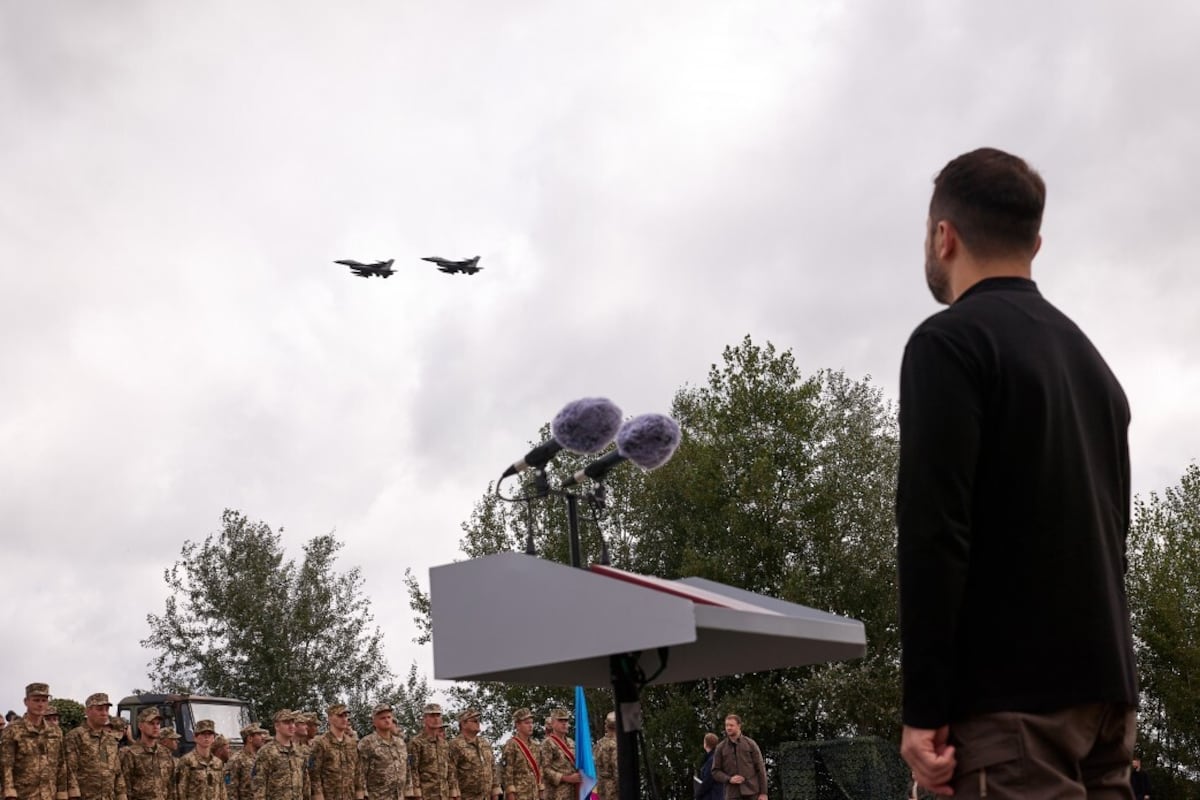
Ukraine’s F-16 fighters have become a crucial defense against Russian drones, but repeated interceptions are wearing out the country’s small fleet.
Ukrainian F-16s have destroyed more than 2,500 Geran and Gerbera one-way attack drones, wrote airpower expert Justin Bronk in an analysis of the Ukraine air war for the Royal United Services Institute, a British think tank.
“[The] use of fighters against such drones has consumed an unsustainable number of airframe flying hours and air-to-air missiles ... since mid-2024, when the Ukrainian Air Force received its first Western aircraft and trained crews,” the analysis reads.
“Russian industry produces more than 6,000 [one-way attack] drones per month, and fighter aircraft have only a finite number of airframe hours available before they need time consuming deep maintenance cycles to be performed at a factory by expert technicians.”
Ukraine’s fleet currently operates an estimated 39 F-16s, out of about 79 promised by various Western European nations. Ukraine also flies an estimated four Mirage 2000-5 fighters, out of up to 20 promised by France, plus a few Soviet-era Su-27 and MiG-29 fighters.
The F-16s have been a game changer in the Ukraine air war. They enable Ukraine’s small air force to launch stand-off attacks against ground targets using American-made JDAM and French-made AASM Hammer glide bombs. The threat they pose to Russia’s air force became evident earlier this month, when a Ukrainian F-16 reportedly downed an Su-35 over eastern Ukraine.
Ironically, the F-16 has proven such a capable aircraft that it has become a victim of its own success.
“The F-16 fleet has been over-tasked, mostly by C-UAS [counter-drone] interception duties, for which there is almost unlimited demand over time,” Bronk told Defense News.
The root of the dilemmas is that Ukraine is squeezed between multiple aerial threats.
In addition to drone strikes, Russia has launched numerous cruise and ballistic missiles at Ukrainian cities. Russia has become adept at launching massive combined strikes that begin with waves of drones, followed by cruise missiles, such as the Kh-101, and then ballistic missiles, such as the Iskander-M and Kinzhal.
Ukraine has managed to at least partially tame the drone threat by creating dense belts of short-range air defenses, or SHORAD. These SHORAD belts combine short-range anti-aircraft missiles, anti-aircraft guns, mobile machine gun teams and a variety of homegrown interceptor-drones .
The drawback there is maintaining dense SHORAD coverage along the 745-mile front line — plus defending cities in the rear — with short-range weapons.
A Ukrainian military member stands next to one of the first General Dynamics F-16s received by Ukraine on August 4, 2024. (Vitalii Nosach/Global Images Ukraine via Getty Images)
“What unites all these mobile air defense teams and counter-drone teams is that their equipment and ammunition is relatively cheap and thus their operations are sustainable,” the RUSI analysis noted. “However, they are relatively personnel intensive to deploy at scale and require both force density and geographical depth to be effective.”
These limitations also point to the difficulties NATO would face in creating its own Ukrainian-style SHORAD system.
“NATO cannot replicate the density of SHORAD defenses that Ukraine deploys for C-UAS coverage, due to the huge personnel requirements of doing so on a sustainable basis,” Bronk told Defense News.
However, NATO could invest in radar-guided anti-aircraft guns to protect key installations, such as airbases and headquarters, and develop cheaper drone-killing munitions for aircraft such as the APKWS II rocket.
Nonetheless, this still leaves Russia’s cruise and ballistic missiles, against which SHORAD is largely ineffective.
As with the U.S. and Israel versus Iran’s missiles, Ukraine must carefully manage limited stockpiles of air defense interceptors like the American-made Patriot and the European-made SAMP/T.
Ideally, Ukraine should rely on SHORAD to stop the drones, while reserving its F-16s for other missions, Bronk argues.
“Other systems need to be used wherever possible for [one-way attack] drones so that F-16 capacity can be used to intercept cruise missiles and deliver strike missions,” Bronk explained. “Within the Ukrainian Air Force inventory, it is by far the most efficient asset for this.”
Bronk believes that F-16 stand-off ground attacks could be even more effective — if Ukraine’s high command was less rigid.
“There is potential for the Ukrainian Air Force to have greater effects if squadrons and wings are given more authority to plan strikes themselves rather than being centrally tasked by Army-centric headquarters elements,” he said.
Michael Peck is a correspondent for Defense News and a columnist for the Center for European Policy Analysis. He holds an M.A. in political science from Rutgers University. Find him at theuncommondefense.com. His email is mikedefense1@gmail.com.
乌克兰的 F-16 战斗机已成为抵御俄罗斯无人机的关键防御力量,但反复的拦截正在消耗该国数量不多的机队。
英国皇家联合军种研究所(一家英国智库)的空军专家贾斯汀·布朗克在一篇关于乌克兰空战的分析文章中写道,乌克兰的F-16战斗机摧毁了超过2500架Geran和Gerbera单向攻击无人机。
分析指出,“自 2024 年年中乌克兰空军接收第一架西方飞机并训练机组人员以来,使用战斗机对抗此类无人机已经消耗了不可持续的飞机飞行时间和空空导弹数量……
“俄罗斯工业每月生产超过 6000 架(单向攻击)无人机,而战斗机的机身飞行小时数是有限的,之后就需要由专业技术人员在工厂进行耗时的深度维护。”
乌克兰空军目前拥有约39架F-16战斗机,而西欧各国承诺向其提供约79架。乌克兰还拥有约4架幻影2000-5战斗机,而法国承诺向其提供多达20架,此外还有少量苏联时代的苏-27和米格-29战斗机。
F-16战机在乌克兰空战中发挥了至关重要的作用。它们使乌克兰这支规模较小的空军能够使用美制JDAM和法制AASM“铁锤”滑翔炸弹对地面目标发动防区外攻击。本月初,一架乌克兰F-16战机在乌克兰东部击落一架苏-35战机,F-16对俄罗斯空军构成的威胁由此显现。
具有讽刺意味的是,F-16 战机已经证明了它是一款非常优秀的战机,以至于它成为了自身成功的受害者。
布朗克告诉《防务新闻》:“F-16 机队的任务已经超负荷,主要是反无人机拦截任务,而随着时间的推移,这方面的需求几乎是无限的。”
问题的根源在于乌克兰受到多重空中威胁的挤压。
除了无人机袭击外,俄罗斯还向乌克兰城市发射了多枚巡航导弹和弹道导弹。俄罗斯已经非常擅长发动大规模联合打击,这种打击通常以多波无人机为开端,随后发射巡航导弹(例如Kh-101),最后发射弹道导弹(例如伊斯坎德尔-M和匕首)。
乌克兰通过建立密集的短程防空带(SHORAD),至少在一定程度上遏制了无人机的威胁。这些短程防空带结合了短程防空导弹、防空炮、机动机枪组和各种国产拦截无人机。
缺点在于,要用短程武器在 745 英里的前线保持密集的近程防空覆盖,还要保卫后方的城市。
2024年8月4日,一名乌克兰军人站在乌克兰接收的首批通用动力F-16战斗机之一旁。(Vitalii Nosach/Global Images Ukraine via Getty Images)
皇家联合军种研究所(RUSI)的分析指出:“所有这些机动防空小组和反无人机小组的共同之处在于,它们的装备和弹药相对便宜,因此它们的行动具有可持续性。然而,大规模部署这些小组需要相对大量的人员,并且需要兵力密度和地理纵深才能有效发挥作用。”
这些限制也表明北约在创建自己的乌克兰式近程防空系统时将面临诸多困难。
布朗克告诉《防务新闻》:“由于持续部署乌克兰为反无人机系统部署的近程防空系统密度巨大,北约无法复制这种密度,因为这样做需要大量的人员。”
然而,北约可以投资雷达制导防空炮来保护关键设施,如空军基地和总部,并为飞机开发更便宜的无人机拦截弹药,如 APKWS II 火箭。
然而,这仍然无法阻止俄罗斯的巡航导弹和弹道导弹,而近程防空系统对它们基本上无效。
就像美国和以色列对抗伊朗的导弹一样,乌克兰必须谨慎管理有限的防空拦截器库存,例如美国制造的“爱国者”导弹和欧洲制造的SAMP/T导弹。
布朗克认为,理想情况下,乌克兰应该依靠近程防空系统来阻止无人机,同时将 F-16 战机用于其他任务。
布朗克解释说:“应尽可能使用其他系统来操控单向攻击无人机,以便F-16能够用于拦截巡航导弹和执行打击任务。在乌克兰空军的装备中,F-16无疑是执行这项任务最有效的装备。”
布朗克认为,如果乌克兰高层指挥部不那么僵化,F-16 的远程地面攻击可能会更加有效。
他说:“如果赋予乌克兰空军中队和联队更大的自主权来计划打击行动,而不是由以陆军为中心的总部部门集中指挥,那么乌克兰空军就有可能发挥更大的作用。”
迈克尔·佩克是《防务新闻》的通讯员,也是欧洲政策分析中心的专栏作家。他拥有罗格斯大学政治学硕士学位。您可以在theuncommondefense.com找到他。他的邮箱是mikedefense1@gmail.com。