Dueling Victory Day ceasefires for war in Ukraine collapse almost immediately乌克兰战争中双方在胜利日达成的停火协议几乎立即破裂
Both sides had proclaimed a ceasefire surrounding the important celebration marking the Soviet Union’s contribution to victory over Nazi Germany.
VIENNA — Dueling ceasefire proposals by Ukraine and Russia surrounding Victory Day seem to have all but collapsed amid escalating air strikes and rhetoric of a “massive missile strike” on central Kyiv.
Both sides had proclaimed a ceasefire surrounding the important celebration marking the capitulation of Nazi Germany, but said that it was incumbent on the other side not to break the truce or there would have to be a response.
Russia officially declared a ceasefire for 8 and 9 May, timed to coincide with the Victory Day celebrations, though it added that should there be any strikes on Russia during that period, the response would be a “massive missile strike on the center of Kyiv.” On its Telegram channel, the Russian ministry of defense issued an evacuation warning, telling residents of the Ukrainian capital and embassy staff to leave the city.
Ukraine countered the Russian proposal with its own unilateral ceasefire declaration that was supposed to start at midnight on 6 May, with Zelensky adding that he had not received any form of official proposal from the Russian side. Ukraine would, however, have to mirror Russian actions should there be any breach of the likewise unilateral ceasefire.
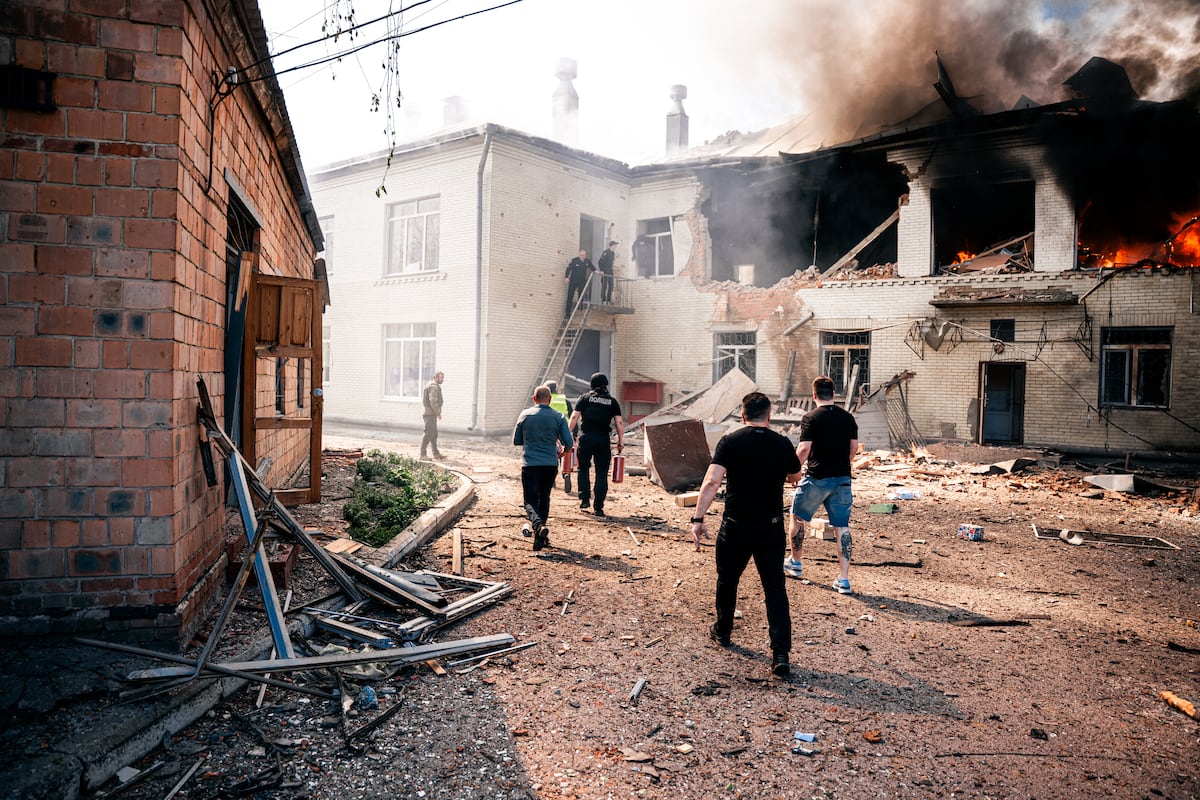
The ceasefire collapsed almost immediately, with Russia launching 108 combat drones and three missiles overnight between 5 and 6 May, striking major cities including Kharkiv. By 10:00 a.m. on May 6, Zelenskyy reported 1,820 ceasefire violations by Russian forces, including nearly 30 assault operations and more than 20 airstrikes using over 70 guided glide bombs. A kindergarten in the Sumy border region was struck, reportedly killing two people.
Russian soldiers march during a rehearsal of the Victory Day military parade in Moscow, Russia, May 4, 2026. (Alexander Zemlianichenko Jr/Xinhua via Getty Images)
The dueling, one-sided declarations of ceasefires are by now an established pattern and a key play in the information warfare that both Kyiv and Moscow are engaged in surrounding the war. Authorities in both capitals are able to use them to prove that the other side isn’t serious about peace. A 32-hour ceasefire surrounding Orthodox Easter collapsed similarly, with Ukraine accusing Russia of 2,299 violations and Moscow accusing Kyiv of 1,971 by the end. Kyiv has since revised its number up to 10,721 violations by Russia.
The Victory Day parade in Moscow, which takes place annually on May 9 on the city’s iconic Red Square, will go ahead but in a much reduced format. For the first time, armored vehicles, tanks and missile carriers will be absent, and even the participation by military academies will be scaled back. Russian authorities said this was due to the “operational situation” and “terrorist threats.” An aircraft flyby will still take place.
The parade in St. Petersburg has similarly been scaled back.
Last year, 29 heads of government came to Moscow to marvel at the parade, including Xi Jinping of China, Lula da Silva of Brazil, and Nicolas Maduro, the now-deposed Venezuelan president. This year, so far, only a handful of leaders are expected to attend. Robert Fico, the Russia-friendly premier of Slovakia, an EU and NATO member, is confirmed to travel to Moscow, although he contradicted earlier Russian statements in saying he will not attend the parade. Alexander Lukashenko of Belarus is also confirmed to attend.
Meanwhile, internet restrictions, anti-drone systems and heightened security measures have gone up around Moscow in an attempt to shield the highly symbolic parade from any possible Ukrainian interference.
Zelensky has said that Russia “cannot hold a parade in Moscow without Ukraine’s goodwill.”
Linus Höller is Defense News' Europe correspondent and OSINT investigator. He reports on the arms deals, sanctions, and geopolitics shaping Europe and the world. He holds master’s degrees in WMD nonproliferation, terrorism studies, and international relations, and works in four languages: English, German, Russian, and Spanish.
维也纳——在乌克兰和俄罗斯围绕胜利日提出的相互对立的停火提议中,随着空袭升级和对基辅市中心发动“大规模导弹袭击”的言论,双方似乎都已彻底崩溃。
双方都宣布在纪念纳粹德国投降的重要庆祝活动期间停火,但同时表示,对方有义务不违反停战协议,否则将面临报复。
俄罗斯正式宣布5月8日至9日停火,时间恰逢胜利日庆祝活动。但俄罗斯同时表示,如果在此期间发生任何针对俄罗斯的袭击,俄罗斯将以“对基辅市中心的大规模导弹袭击”作为回应。俄罗斯国防部在其Telegram频道上发布了疏散警告,要求乌克兰首都居民和使馆工作人员撤离该市。
乌克兰以单方面停火声明回应俄罗斯的提议,该声明原定于5月6日午夜生效。泽连斯基补充说,他没有收到俄方任何正式提议。然而,如果乌克兰单方面停火遭到任何破坏,乌克兰也必须采取与俄罗斯相同的行动。
停火协议几乎立即破裂。5月5日至6日夜间,俄罗斯出动108架作战无人机和3枚导弹,袭击了包括哈尔科夫在内的多个主要城市。截至5月6日上午10点,泽连斯基报告称,俄军违反停火协议1820次,其中包括近30次突击行动和20多次空袭,使用了70多枚制导滑翔炸弹。苏梅边境地区的一所幼儿园遭到袭击,据报道造成两人死亡。
2026年5月4日,俄罗斯士兵在莫斯科参加胜利日阅兵彩排。(Alexander Zemlianichenko Jr/新华社 via Getty Images)
双方单方面宣布停火已成为一种既定模式,也是基辅和莫斯科围绕这场战争展开的信息战中的关键一环。两国首都当局都利用这些停火声明来证明对方对和平缺乏诚意。此前,在东正教复活节期间达成的32小时停火协议也以类似的方式破裂,乌克兰指责俄罗斯违反停火协议2299次,而莫斯科则指责基辅违反1971次。此后,基辅将俄罗斯违反停火协议的次数修正为10721次。
每年5月9日在莫斯科标志性红场举行的胜利日阅兵式将如期举行,但规模将大幅缩减。装甲车、坦克和导弹发射车将首次缺席,就连军事院校的参与规模也将缩减。俄罗斯当局表示,此举是出于“战时形势”和“恐怖主义威胁”的考虑。不过,飞机飞行表演仍将照常进行。
圣彼得堡的游行规模也同样缩减了。
去年,包括中国国家主席习近平、巴西总统卢拉·达席尔瓦和委内瑞拉前总统尼古拉斯·马杜罗在内的29位国家元首齐聚莫斯科观看阅兵式。而今年,目前预计只有少数几位领导人会出席。与俄罗斯关系密切的斯洛伐克总理罗伯特·菲佐已确认前往莫斯科,尽管他此前曾表示不会出席阅兵式,这与俄罗斯早前的声明相矛盾。斯洛伐克是欧盟和北约成员国。白俄罗斯总统亚历山大·卢卡申科也已确认出席。
与此同时,莫斯科周边地区加强了互联网限制、部署了反无人机系统并提高了安保措施,以保护这场具有高度象征意义的阅兵式免受乌克兰的任何可能干扰。
泽连斯基曾表示,没有乌克兰的善意,俄罗斯“无法在莫斯科举行阅兵式”。
林努斯·霍勒是《防务新闻》的欧洲记者和开源情报调查员。他报道影响欧洲乃至全球的军火交易、制裁和地缘政治。他拥有大规模杀伤性武器不扩散、恐怖主义研究和国际关系三个硕士学位,并精通英语、德语、俄语和西班牙语四种语言。