Watch This CV-22 Osprey’s Rotor Downwash Absolutely Demolish A Hospital’s Helipad观看这架CV-22鱼鹰倾转旋翼机的下洗气流如何彻底摧毁医院的直升机停机坪。
The Osprey's beastly rotor blast is notoriously powerful, as is showcased in this crazy video clip.
新闻视频
By Joseph Trevithick
Published Apr 22, 2021 1:14 PM EDT
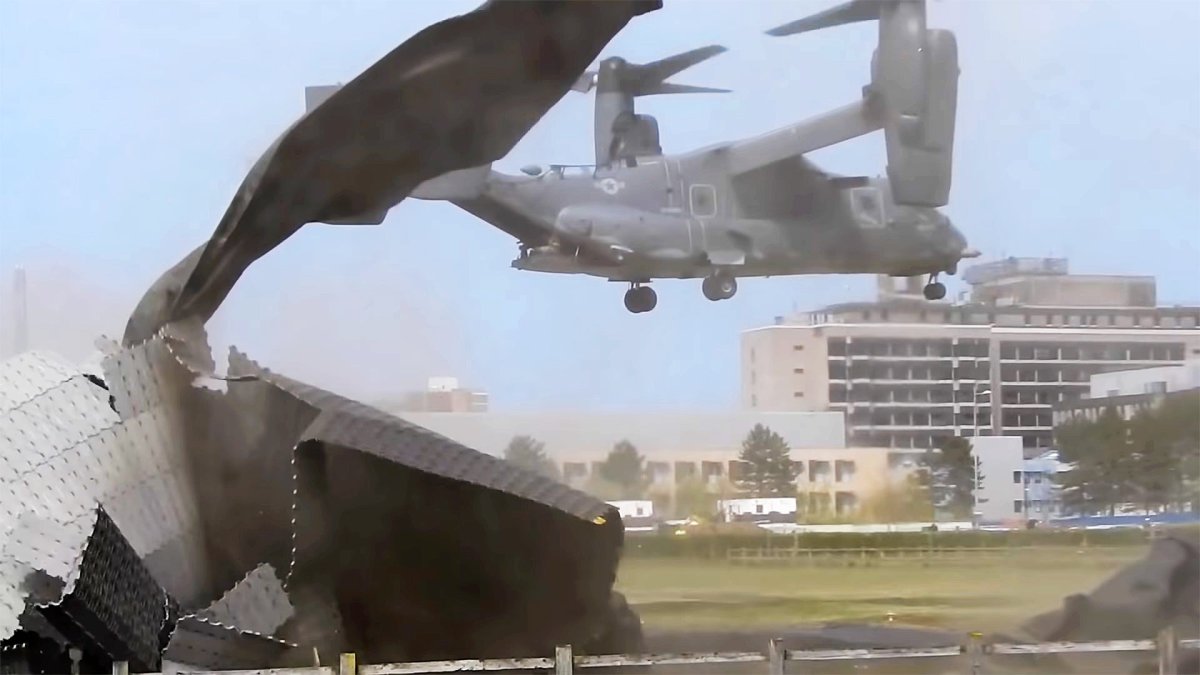
A hospital in the United Kingdom is currently unable to receive patients directly via air ambulance helicopters after the powerful downwash from a U.S. Air Force CV-22B Osprey tiltrotor destroyed its helipad. The Osprey had touched down at Addenbrooke’s Hospital in Cambridge yesterday as part of a training exercise.
Spokespersons for the Air Force, Cambridge University Hospitals , which includes Addenbrooke’s, and East Anglian Air Ambulance (EAAA), one of a number of air ambulance services that regularly flies to this particular hospital, all confirmed the incident , which occurred on April 21, 2021, and did not cause any injuries. A video, seen below, has appeared online showing the CV-22B landing vertically, without incident, on the grass next to Addenbrooke’s helipad, which consisted of rubber matting. It was during takeoff that downward force from the aircraft’s rotors sent the matting, along with other debris, flying.
“The area was surveyed according to our policies and procedures and some damage did occur,” a spokesperson for the Air Force’s 48th Fighter Wing at RAF Mildenhall, told ITV News . “We are taking steps to rectify as soon as possible.”
RAF Mildenhall is also home to the Air Force’s 352nd Special Operations Wing . That Wing includes the 7th Special Operations Squadron, which is equipped with the CV-22B.
“While our normal helipad is being repaired air ambulances will temporarily land at nearby Cambridge City Airport and patients are then transferred to the hospital in road ambulances with critical care staff on board, meaning we can continue to see and treat them as normal,” a Cambridge University Hospitals spokesperson also told ITV .
“Due to an incident at the Cambridge University Hospitals helipad involving a military aircraft on Wednesday 21 April the helipad [at Addenbrooke’s] is temporarily unavailable to air ambulances,” Dr. Victor Inyang, EAAA’s Medical Director, added in a statement to that outlet. “It will be possible for the EAAA helipad [at Cambridge City Airport] to be used as an alternative landing site during this time and have patients transferred to Addenbrooke’s from there by land ambulance.”
Despite the statements from Cambridge University Hospitals and EAAA, the loss of the helipad at Addenbrooke’s could be cause for concern. Medical professionals often refer to the “ golden hour ,” the first 60 minutes after someone experiences a traumatic and potentially life-threatening episode of some kind, during which there is the best chance to save, as well as avoid any serious complications. While there is an ongoing debate about the exact length of this treatment window , not being able to fly air ambulances directly to the hospital can only add time before a critically injured patient begins receiving care in an actual hospital, at least to some degree.
“Addenbrooke’s is the major trauma center for the region, therefore quick and efficient transfer of critically ill or injured patients to the hospital is vital,” EAAA Medical Director Dr. Inyang noted.
Plane spotters on the ground during the incident were also worried that the flying debris could have damaged the Osprey or hit bystanders on the ground. These are very real concerns, as The War Zone
explored in depth as part of our reporting regarding the misuse of U.S. Army National Guard helicopters to fly very low over protesters in Washington, D.C., last year, something you can read about in more detail here .
“I saw debris flying up in the air, my biggest fear was the helicopter. The worry was if the debris went above the roter [sic] it could have damaged the aircraft or, even worse, the people,” Elliot Langran, a plane spotter who witnessed the incident, told ITV . “I’ve been all over the place across the world, but I’ve never seen anything like this.”
This is, however, not the first time an Osprey has been involved in a similar incident. A U.S. Marine Corps MV-22B Osprey injured 10 people during an event on Memorial Day in 2010 in Clove Lakes Park on Staten Island in New York City, when its downwash sent tree branches and other debris flying into a crowd as it came in to land.
The potential risks posed by the immense downward force from the Osprey’s rotors during vertical takeoffs and landings are well established at this point. Marine MV-22s were notably restricted in where they could operate from during disaster relief operations in Nepal following a massive earthquake in that country in 2015 in part due to concerns that their downwash could knock down already structurally weakened buildings.
The heat from the downward-facing engine exhausts when Ospreys operate in their vertical takeoff and landing mode also requires that landing areas, both on land and on ships , be strengthened to mitigate wear and tear. This does not appear to have been an immediate factor in this incident, though.
Thankfully in this particular incident, no one was injured. Hopefully, Addenbrooke’s Hospital’s helipad will be back in operation soon.
Contact the author: joe@thedrive.com
Comments couldn’t be loaded. Please refresh the page.
作者:约瑟夫·特雷维西克
发布于美国东部时间2021年4月22日下午1:14
英国一家医院目前无法通过空中救护直升机直接接收病人,原因是美军一架CV-22B“鱼鹰”倾转旋翼机的强大下洗气流摧毁了该医院的直升机停机坪。这架“鱼鹰”昨天在剑桥的阿登布鲁克医院降落,当时正在进行训练演习。
空军、剑桥大学医院(包括阿登布鲁克医院)以及东安格利亚空中救护队(EAAA,多家定期飞往该医院的空中救护服务机构之一)的发言人均证实了这起事件。事件发生在2021年4月21日,未造成人员伤亡。一段视频(如下所示)已在网上流传,视频显示CV-22B直升机在阿登布鲁克医院直升机停机坪旁的草坪上垂直降落,过程未发生任何事故。停机坪由橡胶垫铺成。起飞过程中,飞机旋翼产生的向下推力将橡胶垫和其他碎片吹飞。
英国皇家空军米尔登霍尔基地第48战斗机联队的一位发言人告诉ITV新闻:“我们已按照相关政策和程序对该区域进行了勘察,确实出现了一些损坏。我们正在采取措施尽快进行修复。”
米尔登霍尔皇家空军基地也是空军第352特种作战联队的驻地。该联队下辖第7特种作战中队,该中队装备有CV-22B飞机。
剑桥大学医院的一位发言人还告诉ITV:“在我们正常的直升机停机坪维修期间,空中救护车将暂时降落在附近的剑桥城市机场,然后由配备重症监护人员的陆路救护车将病人转移到医院,这意味着我们可以像往常一样继续接诊和治疗他们。”
“由于4月21日星期三剑桥大学医院直升机停机坪发生一起涉及军用飞机的事故,阿登布鲁克医院的直升机停机坪暂时无法供空中救护车使用,”东安格利亚空中救护协会(EAAA)医疗主任维克多·伊尼扬医生在一份声明中补充道。“在此期间,剑桥城市机场的EAAA直升机停机坪可作为备用降落点,患者可从那里通过陆路救护车转运至阿登布鲁克医院。”
尽管剑桥大学医院和EAAA都发表了声明,但阿登布鲁克医院直升机停机坪的关闭仍然令人担忧。医疗专业人士经常提到“黄金一小时”,指的是患者经历某种创伤性且可能危及生命的事件后的前60分钟,这段时间内是挽救患者生命并避免任何严重并发症的最佳时机。虽然关于这一治疗窗口期的确切时长仍存在争议,但无法将空中救护车直接送往医院,至少在某种程度上,会延长危重伤员在医院接受治疗的时间。
“Addenbrooke医院是该地区的主要创伤中心,因此,将危重病人或受伤病人快速有效地转移到该医院至关重要,”EAAA医疗主任Inyang博士指出。
事件发生时,地面上的飞机观察员也担心飞溅的碎片可能会损坏鱼鹰运输机或击中地面上的旁观者。这些担忧并非杞人忧天,正如《战区》杂志所报道的那样。
去年,美国陆军国民警卫队直升机在华盛顿特区低空飞越抗议者,我们在相关报道中对此进行了深入探讨,您可以在这里阅读更多详细信息。
“我看到碎片飞向空中,我最担心的是直升机。我担心如果碎片飞到旋翼上方,可能会损坏飞机,甚至更糟,伤及机上人员,”目击事件的飞机观察员埃利奥特·朗格伦告诉英国独立电视台。“我去过世界各地,但从未见过这样的景象。”
然而,这并非鱼鹰运输机首次卷入类似事件。2010年阵亡将士纪念日,一架美国海军陆战队的MV-22B鱼鹰运输机在纽约市史坦顿岛的克洛夫湖公园降落时,其下洗气流将树枝和其他碎片卷入人群,造成10人受伤。
目前,鱼鹰旋翼机在垂直起降过程中产生的巨大下压力所带来的潜在风险已得到充分证实。2015年尼泊尔发生强烈地震后,海军陆战队的MV-22倾转旋翼机在救灾行动中的作业范围受到了显著限制,部分原因就是担心其下洗气流会摧毁本已结构脆弱的建筑物。
当鱼鹰式倾转旋翼机进行垂直起降作业时,向下喷射的发动机尾气会产生大量热量,因此无论是在陆地还是在舰船上,着陆区域都需要加固以减少磨损。不过,这似乎并非此次事故的直接原因。
值得庆幸的是,这次事件中无人受伤。希望阿登布鲁克医院的直升机停机坪能尽快恢复使用。
联系作者:joe@thedrive.com
评论加载失败,请刷新页面。