This U.S. Navy ‘Yellow Submarine’ Was A Target Shaped Like A North Korean Sub这艘美国海军的“黄色潜水艇”是一个外形酷似朝鲜潜艇的靶子。
The Navy now has a much-improved, remote-controlled submarine target for testing all-new anti-submarine warfare capabilities.
By Joseph Trevithick
Updated Dec 1, 2019 6:36 AM EST
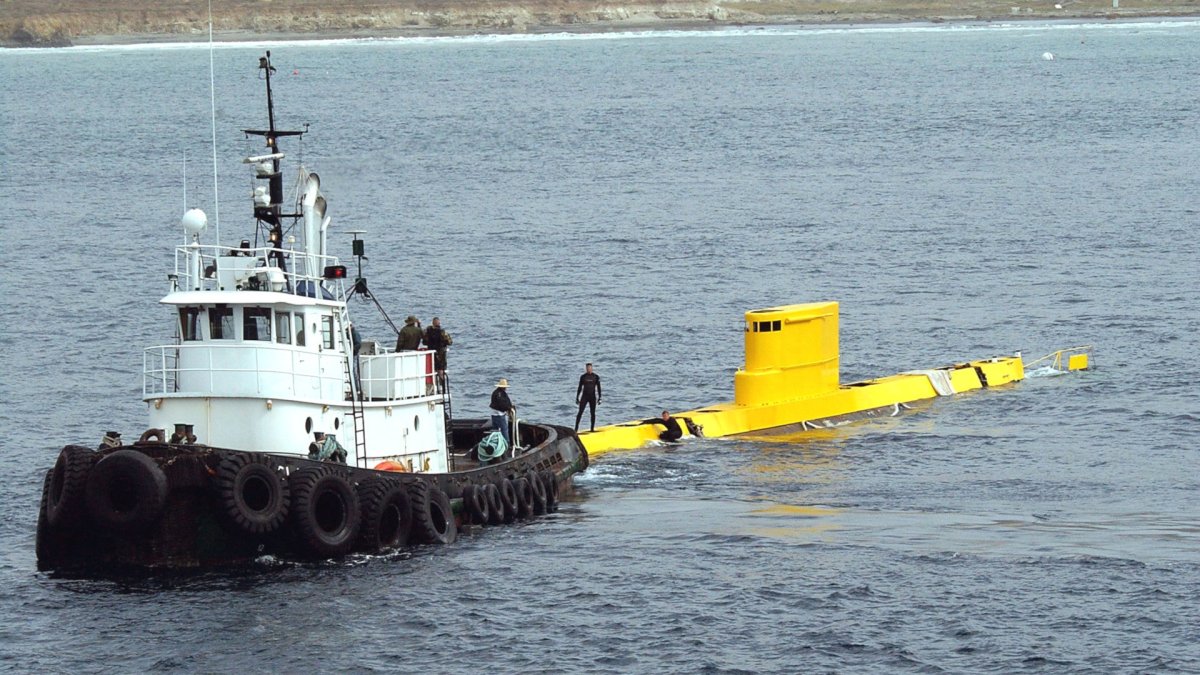
Images of what appeared to be a bright yellow submarine – with no sign of any Beatles on board – under tow off San Clemente Island, near San Diego, California, have recently been making the rounds online . As it turns out, the craft in question was actually a unique U.S. Navy test target with the same general size and shape as a North Korean Sang-O -class submarine.
H.I. Sutton, author and expert on all things military that operate underwater, originally suggested that the target submarine might have been an actual captured Sang-O that had outlived its usefulness for technical exploitation and ended up in a destructive test in a post on his website on Feb. 6, 2019. He has since corrected that piece, replacing it with a great, in-depth profile of what was actually known as the Weapon Set-To-hit Threat Target (WSTTT).
The Navy began work on the WSTTT in San Diego in the 2002 Fiscal Year and had the mock submarine completed and delivered to the service’s Operational Test and Evaluation Force ( OPTEVFOR ) sometime between 2003 and 2004. The resulting craft was a full-size steel surrogate of a diesel-electric submarine, with the full program costing approximately $11 million in total, according to Sutton .
The immediate impetus for building the target submarine was to support the development of the Mk 54 lightweight torpedo , as well as improvements to the Mk 48 heavyweight torpedo . Personnel could submerge the craft for testing and then raise it back up to recover it afterward. In 2004, the Navy released a pair of pictures showing a tug towing the WSTTT into position and crews then submerging it in place for just such a test in the Pacific Ocean near San Clemente Island .
Navy personnel work to submerge the WSTTT ahead of a test in 2004., USN
“The platform allows unarmed ASW [anti-submarine warfare] torpedos to impact it without any explosion,” a caption for one of the pictures in the October 2004 edition of All Hands , the Navy’s official magazine, explained. It’s not clear how much damage the target would still sustain from the physical impact of a warhead-less torpedo.
By every indication, the approximately 115-feet long target submarine is a dead ringer for a Sang-O , but it is unclear why the Navy chose this particular design to base the target on. It’s certainly not a bad choice as it is the most numerous type in North Korean service and is capable of operating as a small, littoral attack submarine, as well as a platform for inserting special operations forces and clandestine operatives.
In 1996, South Korea had captured one of these boats after it ran aground near the coastal town of Gangneung . The incident touched off a nearly 50-day manhunt. South Korean police captured one North Korean commando, who later defected.
The North Korean Sang-O -class submarine that South Korea captured in 1996., Idobi via Wikimedia
The rest of the infiltration team on the submarine apparently executed the boat’s crew, before attempting to continue with their mission. South Korean troops killed 13 more North Koreans in nine separate incidents, losing eight of their own in the process, while a 14th individual apparently escaped back to North Korea. The Sang-O is now on public display at Tongil Park near Gangneung.
North Korean submarines continue to represent a significant threat to the South Koreans, as well as their American allies. One of North Korea’s submarines, such as one of the Sang-O -class boats, was likely responsible for the sinking of the South Korean Navy’s Pohang -class corvette
Cheonan in 2010, which resulted in the deaths of 46 of the ship’s crew.
Basing the WSTTT on a known threat would have certainly have given the U.S. Navy an opportunity to make the evaluations of the Mk 54 and improved Mk 48s more representative of potential real-world operations, as well as offer a chance to simply see how well either weapon might work against a Sang-O -sized target.
The WSTTT pierside in San Diego in 2005., Bill Word via Flickr
Whatever the case, the Navy’s time experimenting with the WSTTT turned out to be relatively brief. In 2006, she sank for real within the Southern California Offshore Range (SCORE) near San Clemente due to an unspecified malfunction during a test of a Mk 54 torpedo, according to Sutton. The next year, the Navy made plans to salvage it, but scrapped those plans due to budgetary constraints, according to an article in the July 2009 issue of Faceplate , the official newsletter of U.S. Navy divers and salvors.
In January 2009, a Navy salvage team aboard the USNS Navajo had used the Deep Drone remotely operated vehicle (ROV) to inspect the wreck and assess its material condition in case the service wanted to make another attempt to raise it. There’s no indication the Navy has made any attempt to retrieve the WSTTT.
A grainy screen capture of video that the Deep Drone ROV took of the sunken WSTTT in 2009., USN
In 2011, the Navy took delivery of an entirely new target submarine called the Mobile Anti-Submarine Training Target ( MASTT ) from U.K. firm MSubs , which is now part of the U.S.-based Submergence Group . Around 75-feet long and weighting 65 tons, the electrically-powered MASTT is the largest known unmanned underwater vessel and is superior to the WSTTT in almost every respect and notably has the ability to operate under its own power.
Personnel can maneuver it and change its depth remotely, making it even more flexible. With its lead-acid batteries fully charged, the unmanned target submarine has a maximum underwater range of more than 65 miles and a submerged cruising speed of around three-and-a-half miles per hour.
MSubs’ Mobile Anti-Submarine Training Target., MSubs
After receiving the MASTT, the Navy first sent it to the Acoustic Research Detachment (ARD), which is situated along a lake in landlocked Bayview, Idaho, for 11 months of testing and evaluation. This unusual and secretive facility is a key facility for the development of new Navy surface ships and submarines and you can read about it in more depth here . In 2012, the MASTT went to the Naval Undersea Warfare Center (NUWC) in San Diego for additional tests, which is where the Navy had kept the WSTTT before it sank.
The MASTT completed its final assessment in 2015. The unmanned submarine spent seven hours underwater during that 12-day evaluation, the longest it had ever been submerged, according to an article from CRUSER News , the newsletter of the Naval Postgraduate School. It also performed its longest single trip on the surface, covering approximately 15 miles.
“This was the first time MASTT was operated without Original Equipment Manufacturer support,” the test director for the Fleet Assessment, who the article did not name, told CRUSER News . “The team demonstrated the ability to independently operate, maintain, and troubleshoot the MASTT system while at-sea. They also showed they could rapidly reprogram the vehicle and change run parameters to meet customer requirements.”
During the evaluation, an Arleigh Burke -class guided-missile destroyer and P-3C Orion patrol aircraft both demonstrated their ability to track the MASTT as if it were an actual threat submarine. There is no indication that they launched any practice or live weapon at the unmanned submarine during this testing, though.
MASTT under test at the ARD in Bayview, Idaho. At left you can see the bow of the Sea Jet Advanced Electric Ship Demonstrator (AESD), a quarter-scale functioning model of a DDG-1000 Zumwalt -class stealth destroyer ., MSubs
The Navy does not appear to have purchased any more target submarines since then, but this could change in the near future. The service is growing increasingly concerned about submarine developments around the world, especially among potential opponents such as Russian and China . Both of those countries are developing increasingly hard to detect diesel-electric designs with advanced air-independent propulsion systems , as well as nuclear-powered types . Many of these submarines are also available for export , expanding the potential pool of future submarine threats.
In November 2018, U.S. Navy Vice Admiral Charles Richards, the Navy’s Commander, Submarine Forces, announced his intention to establish a dedicated aggressor submarine squadron to focus on mimicking those potential threats in order to help train American attack submarine crews . Since the Navy does not presently operate any diesel-electric submarines of its own anymore , it might decide to purchase new manned or unmanned types to support these training exercises down the road. It could also hire firms such as MSubs and the Submergence Group to actually operate these submarines during drills, akin to the U.S. military’s growing use of contractor-owned and operated aircraft in aerial training exercises .
The Navy’s yellow target submarine, however, looks set to stay right where it lies on the bottom of the Pacific Ocean near San Clemente Island.
Contact the author: joe@thedrive.com
Comments couldn’t be loaded. Please refresh the page.
作者:约瑟夫·特雷维西克
更新于美国东部时间2019年12月1日上午6:36
最近,一组疑似亮黄色潜艇的照片在网上流传开来,照片显示一艘潜艇在加利福尼亚州圣地亚哥附近的圣克莱门特岛被拖曳,艇上并没有任何披头士乐队成员的踪迹。但事实证明,这艘潜艇实际上是美国海军的一艘特殊测试目标,其尺寸和形状与朝鲜的桑戈级潜艇大致相同。
HI Sutton 是一位作家,也是水下军事领域的专家。他最初在 2019 年 2 月 6 日发表于其网站上的一篇文章中提出,目标潜艇可能是一艘被俘获的桑戈号潜艇,由于其技术利用价值已过时,最终被用于破坏性测试。此后,他更正了那篇文章,并用一篇精彩、深入的介绍文章取而代之,该文章实际上描述了所谓的“武器设定命中威胁目标”(WSTTT)。
海军于 2002 财年在圣地亚哥开始建造 WSTTT,并在 2003 年至 2004 年期间完成了这艘模拟潜艇的建造,并将其交付给了海军作战测试与评估部队 (OPTEVFOR)。据萨顿称,最终建成的这艘潜艇是一艘全尺寸的柴电潜艇钢制替代品,整个项目的总成本约为 1100 万美元。
建造这艘目标潜艇的直接目的是为了支持Mk 54轻型鱼雷的研发,以及对Mk 48重型鱼雷的改进。人员可以将潜艇下潜进行测试,测试结束后再将其回收。2004年,美国海军公布了两张照片,照片显示一艘拖船将WSTTT潜艇拖至指定位置,随后艇员将其下潜至指定位置,在圣克莱门特岛附近的太平洋海域进行此类测试。
美国海军人员正在为2004年的一次测试做准备,将WSTTT潜艇下水。
“该平台允许不带弹头的反潜鱼雷撞击自身而不发生爆炸,”海军官方杂志《全体人员》(All Hands)2004年10月刊的一张图片说明文字解释道。目前尚不清楚目标在遭受无弹头鱼雷的物理撞击后仍会受到多大的损害。
种种迹象表明,这艘长约115英尺的靶艇与“桑戈”级潜艇几乎一模一样,但尚不清楚海军为何选择这种特定型号作为靶艇的原型。不过,这并非一个糟糕的选择,因为“桑戈”级潜艇是朝鲜海军中数量最多的型号,既可以作为小型近海攻击潜艇使用,也可以作为特种作战部队和秘密行动人员的登陆平台。
1996年,韩国在江陵附近海域截获了一艘搁浅的朝鲜船只。该事件引发了近50天的搜捕行动。韩国警方抓获了一名朝鲜特种部队成员,此人后来叛逃。
1996年韩国俘获的朝鲜“桑戈”级潜艇。(图片来自Wikimedia,作者:Idobi)
潜艇上其余渗透小组成员显然处决了艇员,然后试图继续执行任务。韩国军队在九起不同的事件中击毙了13名朝鲜人,自身也损失了8人,另有14人显然逃回了朝鲜。“尚五”号潜艇目前在江陵附近的统一公园公开展出。
朝鲜潜艇继续对韩国及其美国盟友构成重大威胁。朝鲜的某艘潜艇,例如桑吴级潜艇,很可能是击沉韩国海军浦项级轻型护卫舰的罪魁祸首。
2010 年的“天安舰”沉没,导致舰上 46 名船员丧生。
如果 WSTTT 是基于已知的威胁进行的,那么美国海军就有机会对 Mk 54 和改进型 Mk 48 进行评估,使其更能代表潜在的现实世界作战情况,同时也有机会看看这两种武器对付桑奥大小的目标效果如何。
2005年圣地亚哥WSTTT码头,图片来自Flickr用户Bill Word。
无论如何,海军对WSTTT的试验时间相对短暂。据萨顿称,2006年,该艇在圣克莱门特附近的南加州近海靶场(SCORE)进行Mk 54鱼雷测试时发生不明故障,最终沉没。次年,海军曾计划打捞该艇,但据美国海军潜水员和打捞人员官方通讯《Faceplate》2009年7月刊的一篇文章报道,由于预算限制,该计划最终被取消。
2009年1月,美国海军“纳瓦霍”号补给舰上的打捞小组曾使用深海无人机(ROV)对沉船残骸进行检查,评估其物质状况,以便海军日后可能再次尝试打捞。目前没有任何迹象表明海军曾尝试打捞WSTTT。
这是美国海军深海无人机(Deep Drone ROV)于2009年拍摄的沉没的WSTTT号潜艇的视频截图,画面略显模糊。
2011年,美国海军从英国MSubs公司接收了一艘名为“移动反潜训练目标”(MASTT)的全新目标潜艇。MSubs公司现已并入美国潜艇集团(Submergence Group)。这艘电动目标潜艇长约75英尺(约23米),重65吨,是目前已知最大的无人水下航行器,几乎在所有方面都优于WSTTT,尤其值得一提的是,它具备自主航行能力。
人员可以远程操控它并改变其深度,使其更加灵活。在铅酸电池充满电的情况下,这艘无人靶艇的最大水下航程超过65英里,水下巡航速度约为每小时3.5英里。
MSubs的移动式反潜训练靶标。
海军收到MASTT后,首先将其送往位于爱达荷州内陆城市贝维尤湖畔的声学研究分遣队(ARD),进行为期11个月的测试和评估。这个不同寻常且高度保密的设施是海军新型水面舰艇和潜艇研发的关键基地,您可以在这里阅读更多相关信息。2012年,MASTT被送往位于圣地亚哥的海军水下作战中心(NUWC)进行进一步测试,海军此前也曾将WSTTT存放于此,直至其沉没。
MASTT于2015年完成了最终评估。据海军研究生院通讯《CRUSER新闻》报道,在为期12天的评估中,这艘无人潜艇在水下停留了7个小时,创下了其潜水时间最长的纪录。此外,它还完成了单次最长水面航行,航程约15英里。
“这是MASTT首次在没有原始设备制造商支持的情况下运行,”舰队评估测试主管(文章中未透露其姓名)告诉CRUSER新闻。“团队展示了在海上独立操作、维护和排除MASTT系统故障的能力。他们还展示了能够快速重新编程车辆并更改运行参数以满足客户要求。”
在评估过程中,一艘阿利·伯克级导弹驱逐舰和一架P-3C“猎户座”巡逻机都展示了它们追踪MASTT系统的能力,如同追踪一艘真正的威胁潜艇一样。不过,没有迹象表明它们在测试期间向这艘无人潜艇发射了任何实弹或训练弹。
MASTT正在爱达荷州湾景的ARD进行测试。左侧可以看到Sea Jet先进电动舰艇演示器(AESD)的舰艏,它是DDG-1000“朱姆沃尔特”级隐形驱逐舰的四分之一比例功能模型。
自那以后,海军似乎没有再采购任何靶潜艇,但这种情况在不久的将来可能会改变。海军越来越关注世界各地的潜艇发展,尤其是来自俄罗斯和中国等潜在对手的潜艇发展。这两个国家都在研发越来越难以探测的柴电潜艇,这些潜艇配备了先进的不依赖空气推进系统,此外还有核动力潜艇。其中许多潜艇还可以出口,这进一步扩大了未来潜艇威胁的范围。
2018年11月,美国海军潜艇部队司令查尔斯·理查兹中将宣布计划组建一支专门的假想敌潜艇中队,旨在模拟潜在威胁,从而帮助训练美国攻击型潜艇艇员。由于美国海军目前已不再拥有任何柴电潜艇,未来可能会采购新型有人或无人潜艇来支持这些训练演习。此外,美国海军还可以聘请MSubs和Submergence Group等公司在演习中实际操作这些潜艇,类似于美军在空中训练演习中越来越多地使用承包商拥有和运营的飞机。
然而,海军的黄色靶潜艇似乎注定要继续待在圣克莱门特岛附近太平洋海底的原地。
联系作者:joe@thedrive.com
评论加载失败,请刷新页面。