The Oddly Shaped USS Grayback Was A Cold War Submarine Like No Other外形奇特的“灰背”号潜艇是一艘与众不同的冷战时期潜艇。
The remarkable sub's story includes launching fighter-sized cruise missiles, attempting to rescue Vietnam War PoWs, and getting painted bright orange.
Updated Feb 14, 2021 5:54 AM EST
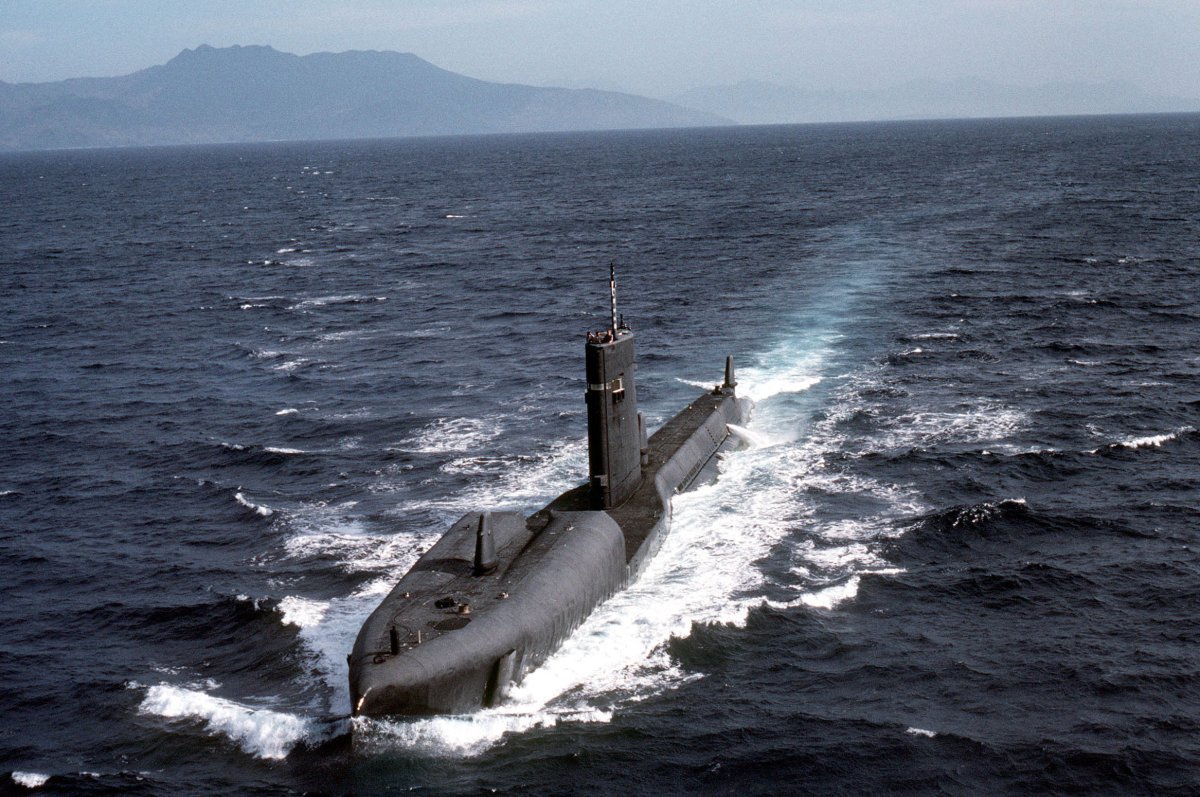
Few of the U.S. Navy’s post-World War II submarines had such an unusual career as the USS Grayback. It went from carrying some of the United States’ first strategic missiles to stealthily delivering naval special forces to the coast of North Vietnam during the war in Southeast Asia. It was truly a fascinating and bizarrely-shaped boat whose multiple lives underscored how she was able to change along with a morphing Cold War. Here’s her story.
Laid down on July 1, 1954, at Mare Island Naval Shipyard in San Francisco Bay, California, the first of the Grayback -class missile submarines was, like its sister, the USS Growler , built as a conventionally powered submarine that would have a primary armament of cruise missiles. The pair were the first submarines to be designed around an armament of subsonic Vought SSM-N-8 Regulus I strategic missiles. Four of these nuclear-armed, turbojet-powered weapons were carried in a pair of huge cylindrical hangars located above the bow.
An SSM-N-9 Regulus II missile is maneuvered aboard the USS Grayback ., U.S. Navy
The second submarine to carry the name, the USS Grayback was launched on July 2, 1957, and commissioned on March 7, 1958, as SSG-574. Ultimately, the submarine was one of five equipped to launch the Regulus I that were in service by 1960. To launch the airplane-sized missile, the submarine first had to surface, before the rear of the hangar was opened, and the Regulus I disgorged onto a trainable ramp that was recessed into the top of the hull, forward of the sail. The ramp was then turned sideways, and the missile blasted off under the power of a pair of solid-fuel rockets before the Allison J33 turbojet kicked in. The missile had a range of around 575 miles.
The USS Grayback is waterborne after being launched at Mare Island Naval Shipyard on July 2, 1957., U.S. Navy
The USS Grayback made history as the first submarine to carry Vought’s next-generation SSM-N-9 Regulus II and undertook trials with this Mach-2-capable weapon off the U.S. West Coast. Two of these weapons could be carried, compared to four of the previous Regulus Is and the first successful launch of the missile took place on September 16, 1958, while the Grayback was operating out of Naval Base Ventura County, California. However, the Regulus II was canceled later the same year, by which point the concept of the submarine-launched cruise missile had been overtaken by the development of the Polaris submarine-launched ballistic missile, which promised much greater range, speed, and reliability.
On February 9, 1959, the USS Grayback departed Mare Island for Pearl Harbor in Hawaii, arriving at what would become its permanent home base on March 7. Between September and November of 1959, the submarine completed the first of nine deterrent missions, patrolling the Pacific with an armament of Regulus I missiles. In the course of these patrols, the Grayback spent more than 20 months at sea and logged well over 130,000 miles.
Another view of a Regulus II on USS Grayback emphasizes the scale of these early strategic missiles., U.S. Navy
The USS Grayback served in its strategic missile role until it was decommissioned on May 25, 1964, as the cruise-missile submarines divested their deterrence duties to the new Polaris boats.
A new lease of life then began when the USS Grayback was converted as a submarine transport, initially under the pennant number APSS-574. The ability of submarines to transport personnel and materiel, as well as launch raiding parties ashore, while using its inherent capabilities to help avoid detection, was well established by the end of World War II, and would continue into the Cold War and beyond. It is a fascinating subset of underwater warfare that you can read all about in this previous War Zone article.
The conversion work for the new role was authorized in 1967 and was undertaken at the Mare Island Naval Shipyard between November 1967 and May 1969. This included removing the Regulus equipment and lengthening the hull from 322 feet 4 inches to 334 feet. Mess and sleeping quarters now provided accommodation for up to 67 troops. The missile hangars were converted to carry six swimmer delivery vehicles (SDVs) and a diver’s decompression chamber. The SDVs and scuba-equipped divers could be launched and recovered while the submarine submerged. The height of the sail was increased by around 10 feet and a Sperry BQG-4 Passive Underwater Fire Control Feasibility System (PUFFS) was fitted.
A poor-quality but rare image of a swimmer delivery vehicle engaged in daytime launch and recovery operations by the USS Grayback . , National Archives
The role of the “new” USS Grayback was carrying commando and other covert forces on special missions against targets that required a stealthy approach from the sea. Members of the U.S. Navy’s SEAL teams and Naval Underwater Demolition Teams (UDT) were certainly carried onboard the submarine, as were, in all likelihood, U.S. Army Green Berets. UDTs would be used for example, for undertaking reconnaissance of possible landing zones ahead of an amphibious assault, or to clear the approaches to a beach.
As well as its amphibious role, the USS Grayback could also perform similar duties as an attack submarine, for which it was armed with the thermal-powered Mk 14 anti-ship torpedo of World War II vintage and the electric-powered Mk 37 anti-submarine torpedo. These were operated using the Mk 106 Model 12 torpedo fire-control system.
From August 1968 the submarine’s designation was changed again, to LPSS, indicating an amphibious transport submarine, and the new-look USS Grayback was commissioned for a second time on May 9, 1969. Thereafter, it was operated by the Pacific Fleet and based at Subic Bay in the Philippines.
By the time of the Vietnam War, the Navy was using specially configured submarines to support special operations, the USS Grayback and the Gato class USS Tunny working along the coast of North Vietnam, and also helping gather intelligence.
The submarine’s most dramatic — and secretive — mission took place in June 1972, during the conflict in Southeast Asia. This was Operation Thunderhead , an attempt to rescue U.S. prisoners of war that were planning to escape from North Vietnam’s notorious “ Hanoi Hilton ” prison. The two PoWs, both aviators, planned to steal a boat and make their escape by river to the Gulf of Tonkin, where they would be picked up by elite troops from the U.S. Navy’s SEAL Team One, Platoon A, and Underwater Demolition Team 11 (UDT-11). Exactly how communications were run between PoWs and rescuers while planning this daring mission has not been explained.
The USS Grayback departed Subic Bay to transport the special forces into the coastal waters off North Vietnam, where plans called for one or more Mk 7 SDVs to be launched under cover of darkness. Piloted by two operators from UDT-11, each SDV would deliver four SEALs from Platoon A to an island at the mouth of the Red River, which flowed into the Gulf of Tonkin. The Grayback was on station around 4,000 yards from the mouth of the river and at a depth of around 65 feet.
SEALs on board Grayback ahead of Operation Thunderhead. Lieutenant Melvin Spence Dry is seated at center with papers in his hands., U.S. Navy
A first attempt to launch a reconnaissance mission on June 3, 1972, ended in failure after the four-man team became lost, struggling with navigation errors and tidal currents that were much stronger than expected. Unable to relocate the USS Grayback , the team had to abandon their SDV after the vehicles’ batteries ran out. After eight hours they were rescued by a helicopter around 10 miles south of the submarine’s position and were then flown to the nuclear-powered guided-missile cruiser USS Long Beach , which was stationed approximately 15 miles offshore, serving as the command ship for the mission. You can read all about that particular warship here .
Two days later, the team was to be returned to the submarine by helicopter, with the aim of dropping them into the water alongside the USS Grayback , at night. Again, however, the submarine proved hard to find. Once it seemed the infrared locator beacon had been found, the operators jumped from the helicopter, but the chopper was flying too high and too fast for a safe jump and was downwind, meaning the jumpers hit the water with even much greater velocity. Lieutenant Melvin “Spence” Dry was killed immediately, and one other member of the team was seriously injured.
Support divers from USS Grayback ready an SDV for launch operations at a depth of 35 feet. The vehicle was manned by personnel from Underwater Demolition Team 12., National Archives
Meanwhile, the USS Grayback had launched another SDV, but this mission was abandoned too after its crew ran out of air. The second team came to the surface and it was their locator beacon that the first team had inadvertently found. The two teams rendezvoused before both were picked up by helicopter and returned to the USS Long Beach . After the United States began sowing mines in North Vietnamese ports and rivers, the chances of mission success were further reduced, and it was decided to abandon the PoW escape effort altogether.
Operation Thunderhead remained classified for many years and it was not until 2008 that Lieutenant Dry’s death was finally acknowledged as a combat loss , and he was posthumously awarded the Bronze Star for Valor.
High-angle stern view of the USS Grayback underway. You can see two of the “sharkfin” sonar domes associated with the PUFFS system on the hull., National Archives
From 1975 the USS Grayback was reclassified yet again, this time as an attack submarine, or SS, for administrative reasons, to ensure continued funding from the U.S. Congress for what was now a true niche capability.
USS Grayback underway in the South China Sea in 1982., National Archives
Exactly what, if any covert missions, the USS Grayback was involved in during the years that followed is not known, but the Navy undoubtedly appreciated the submarine’s utility and it remained in service until decommissioned for a second and final time at Subic Bay on June 16, 1984.
The Powhatan class fleet ocean tug USNS Catawba (ATF-168) towing the former Grayback out of Subic Bay in August 1986., U.S. Navy
Befitting a boat with a less-than-conventional history, the USS Grayback received a bright orange paint scheme to increase its conspicuity before it was sunk as a target near Subic Bay on April 13, 1986. It brought to an end the story of a unique submarine — a guided-missile pioneer and a covert amphibious transport with a harrowing Vietnam combat record.
Today, the legacy of the little-known amphibious transport submarines is kept alive by the Navy’s four Ohio class nuclear-powered guided-missile submarines . They traded their strategic nuclear missile armament and now carry diverse cargoes ranging from Tomahawk cruise missiles to Navy SEALs. In this way, they continue the tradition of the USS Grayback , with capabilities befitting the demands of 21st-century warfare.
Contact the author: thomas@thedrive.com
Comments couldn’t be loaded. Please refresh the page.
更新于美国东部时间2021年2月14日凌晨5:54。
二战后美国海军的潜艇中,很少有像“灰背”号这样经历如此不寻常的。它曾运载美国最早的战略导弹,后来又在东南亚战争期间秘密向北越海岸运送海军特种部队。这艘外形奇特、引人入胜的潜艇,其多重身份也体现了它如何随着冷战的演变而不断调整。以下是它的故事。
1954年7月1日,首艘“灰背”级导弹潜艇在加利福尼亚州旧金山湾的马雷岛海军造船厂开工建造。与姊妹舰“咆哮者”号一样,该艇最初设计为常规动力潜艇,主武器为巡航导弹。这两艘潜艇是首批围绕亚音速沃特SSM-N-8“雷古勒斯”I型战略导弹而设计的潜艇。四枚这种核弹头、涡轮喷气发动机驱动的导弹被放置在艇艏上方的两个巨大的圆柱形弹库中。
美国海军“灰背”号两栖攻击舰上正在进行SSM-N-9“雷古勒斯II”型导弹的机动演练。
第二艘以“灰背”命名的潜艇“灰背”号(USS Grayback)于1957年7月2日下水,并于1958年3月7日正式服役,舷号为SSG-574。最终,到1960年,共有五艘潜艇配备了发射“雷古勒斯I”型导弹的装置,而“灰背”号便是其中之一。发射这种飞机大小的导弹时,潜艇首先要浮出水面,然后打开后部机库,导弹“雷古勒斯I”会落到位于指挥塔前方、船体顶部的可旋转舷梯上。舷梯随后侧向旋转,导弹在两枚固体燃料火箭的推力下发射升空,之后艾利逊J33涡轮喷气发动机启动。该导弹的射程约为575英里。
1957年7月2日,美国海军“灰背”号潜艇在马雷岛海军造船厂下水后,已进入水中。
“灰背”号潜艇创造了历史,成为第一艘搭载沃特公司下一代SSM-N-9“雷古勒斯II”型潜艇的舰艇,并在美国西海岸进行了这种速度可达2马赫的武器的试验。与之前的“雷古勒斯I”型导弹可携带四枚相比,“雷古勒斯II”型导弹可携带两枚。1958年9月16日,“灰背”号在加利福尼亚州文图拉县海军基地执行任务期间,首次成功发射了该导弹。然而,“雷古勒斯II”型导弹项目于同年晚些时候被取消,此时潜射巡航导弹的概念已被“北极星”潜射弹道导弹的研发所取代,后者拥有更远的射程、更快的速度和更高的可靠性。
1959年2月9日,灰背号潜艇从马雷岛启程前往夏威夷珍珠港,并于3月7日抵达其永久母港。1959年9月至11月间,该潜艇完成了九次威慑任务中的第一次,携带雷古勒斯I型导弹在太平洋巡逻。在这些巡逻任务中,灰背号在海上航行超过20个月,总航程超过13万英里。
另一张从“灰背”号两栖攻击舰上拍摄的“雷古勒斯II”型导弹照片,突显了这些早期战略导弹的规模。(美国海军)
“灰背”号潜艇一直承担着战略导弹任务,直到 1964 年 5 月 25 日退役,因为巡航导弹潜艇将威慑任务移交给了新的北极星潜艇。
“灰背”号潜艇(USS Grayback)被改装为潜艇运输舰后,焕发了新的生机,最初的舷号是APSS-574。二战结束时,潜艇运送人员和物资、向岸上派遣突击队,并利用其固有的隐蔽能力进行攻击的能力已经得到充分证实,这种能力一直延续到冷战及之后。这是水下作战中一个引人入胜的分支,您可以在之前的“战区”文章中了解更多详情。
新用途的改装工作于1967年获得批准,并于1967年11月至1969年5月在马雷岛海军造船厂进行。改装内容包括拆除“雷古勒斯”导弹系统设备,并将船体长度从322英尺4英寸加长至334英尺。餐厅和宿舍可容纳多达67名官兵。导弹库被改装,用于搭载六艘潜水员运载艇(SDV)和一个潜水员减压舱。潜水员运载艇和配备水肺装备的潜水员可在潜艇潜航期间进行投放和回收。指挥塔的高度增加了约10英尺,并安装了斯佩里BQG-4型被动水下火控可行性系统(PUFFS)。
一张质量不高但十分罕见的照片,展示了“灰背”号潜艇上一艘游泳员运输艇正在进行白天的投放和回收作业。(美国国家档案馆)
“新”的“灰背”号潜艇的任务是搭载突击队和其他秘密部队,执行针对需要从海上隐蔽接近目标的特种任务。美国海军海豹突击队和海军水下爆破队(UDT)的成员肯定都搭载在这艘潜艇上,美国陆军特种部队“绿色贝雷帽”成员也极有可能在列。例如,水下爆破队会被用来侦察可能的登陆区域,为两栖登陆作战做准备,或者清理通往海滩的通道。
除了两栖作战能力外,“灰背”号两栖攻击舰还能执行类似的攻击潜艇任务,为此它装备了二战时期的热动力Mk 14反舰鱼雷和电动Mk 37反潜鱼雷。这些鱼雷均由Mk 106型12鱼雷火控系统操控。
1968 年 8 月,该潜艇的编号再次更改,改为 LPSS,表示两栖运输潜艇。焕然一新的“灰背”号于 1969 年 5 月 9 日第二次服役。此后,它由太平洋舰队运营,并以菲律宾苏比克湾为基地。
到越南战争时期,海军开始使用特制潜艇支援特种作战,例如“灰背”号潜艇和“金枪鱼”号加托级潜艇在北越沿海活动,并协助收集情报。
这艘潜艇最惊险也最神秘的任务发生在1972年6月东南亚冲突期间。这就是“雷霆行动”,旨在营救计划从臭名昭著的北越“河内希尔顿”监狱逃脱的美国战俘。两名战俘都是飞行员,他们计划偷一艘船,沿河逃往北部湾,在那里与美国海军海豹突击队第一分队A排和第11水下爆破队(UDT-11)的精锐部队会合。在策划这次大胆行动的过程中,战俘和救援人员之间究竟是如何进行通信的,至今仍是个谜。
“灰背”号潜艇从苏比克湾出发,将特种部队运送到北越沿海海域。计划在夜幕掩护下,从那里投放一架或多架Mk 7型水下推进器(SDV)。每架SDV由来自第11水下爆破队(UDT-11)的两名操作员驾驶,将A排的四名海豹突击队员送至红河河口的一个岛屿。红河注入北部湾。“灰背”号当时位于距离河口约4000码(约3600米)、水深约65英尺(约20米)处。
在“雷霆行动”开始前,海豹突击队员们登上“灰背”号潜艇。梅尔文·斯宾塞·德莱中尉坐在中间,手里拿着文件。(美国海军)
1972年6月3日,首次侦察任务尝试以失败告终。四人小组迷失方向,导航错误频出,且遭遇远超预期的强劲潮汐流。由于无法找到“灰背”号潜艇,小组在水下航行器(SDV)电池耗尽后被迫弃船。八小时后,他们在潜艇位置以南约10英里处被一架直升机救起,随后被送往停泊在离岸约15英里处的核动力导弹巡洋舰“长滩”号,该舰是此次任务的指挥舰。您可以在这里阅读有关这艘军舰的全部信息。
两天后,队员们计划乘坐直升机返回潜艇,并在夜间跳入“灰背”号潜艇旁的水中。然而,潜艇再次难以找到。当红外定位信标似乎被找到后,队员们从直升机上跳下,但直升机飞行高度和速度都过高,且处于下风位置,这意味着跳伞者以更大的速度落入水中。梅尔文·“斯宾塞”·德莱中尉当场身亡,另一名队员身负重伤。
来自“灰背”号潜艇的支援潜水员在35英尺(约10.7米)深的水下准备一艘水下爆破艇(SDV)进行发射作业。该艇由第12水下爆破队的队员操作。(图片来源:美国国家档案馆)
与此同时,“灰背”号潜艇也发射了另一艘水下航行器,但由于船员氧气耗尽,这次任务也被迫中止。第二支小队浮出水面,发现第一支小队无意中发现了他们的定位信标。两支小队会合后,均由直升机接走,返回“长滩”号潜艇。由于美国开始在北越港口和河流布雷,任务成功的几率进一步降低,最终决定彻底放弃营救战俘的行动。
“雷霆行动”多年来一直处于保密状态,直到 2008 年,德莱中尉的死亡才最终被确认为战斗损失,并被追授铜星勋章以表彰其英勇行为。
从高角度拍摄的“灰背”号潜艇航行中的艇尾照片。可以看到艇体上与PUFFS系统相关的两个“鲨鱼鳍”声呐罩。(美国国家档案馆)
从 1975 年开始,由于行政原因,美国国会继续为“灰背”号潜艇提供资金,因此该潜艇再次被重新分类为攻击型潜艇(SS),这在当时是一种真正的利基能力。
1982年,美国海军“灰背”号两栖攻击舰在南海航行。(图片来源:美国国家档案馆)
在接下来的几年里,USS Grayback 究竟参与了哪些秘密任务(如果有的话)尚不得而知,但海军无疑非常重视这艘潜艇的实用性,它一直服役到 1984 年 6 月 16 日在苏比克湾第二次也是最后一次退役为止。
1986年8月,波瓦坦级远洋拖船“卡托巴”号(ATF-168)将前“灰背”号拖出苏比克湾。(美国海军)
与这艘有着非同寻常历史的潜艇相符,灰背号潜艇在1986年4月13日于苏比克湾附近被击沉作为靶舰之前,被涂上了鲜艳的橙色涂装,以提高其可见度。这艘独特的潜艇的故事就此结束——它既是导弹先驱,又是秘密两栖运输舰,在越南战争中有着令人胆寒的作战记录。
如今,鲜为人知的两栖运输潜艇的传奇故事,由海军的四艘俄亥俄级核动力导弹潜艇延续至今。它们已卸下战略核导弹武器,转而运载从战斧巡航导弹到海豹突击队等各种货物。它们以这种方式传承了“灰背”号潜艇的传统,并具备了满足21世纪战争需求的能力。
联系作者:thomas@thedrive.com
评论加载失败,请刷新页面。