The Navy Experimented With Turning Its Attack Jets Into Submarine Hunters 50 Years Ago50年前,海军曾试验过将攻击机改装成反潜战机。
The experiment was far ahead of its time in many ways and came in part as a result of the Navy looking to fit every mission onto its supercarriers.
Published Mar 18, 2021 7:00 PM EDT
Each time I manned my S-3A Viking , back in 1987, I walked past A-6E Intruders and A-7E Corsair IIs parked in various spots on the flight deck of the USS Nimitz . If you had been walking with me and told me that these classic tactical air, or TACAIR, aircraft had once dropped sonobuoys in the hunt for submarines , I would have stopped, given you a sideways glance with a dumbfounded look, and laughed. Thirty years later, had you been sitting across the table from me, you would have laughed at that astonished look I got when I first read about Intruders, Corsair IIs, Hawkeyes, and Electric Intruders doing Anti-Submarine Warfare, or ASW. It was true. And it was all a part of a period of great turbulence and adjustment that forced the US Navy to rethink how to effectively utilize the aircraft carrier and the aircraft that flew from her deck.
The year was 1971 and summer was just arriving amid an onslaught of change that was occurring across the U.S. military. The Vietnam War remained the central focus of the nation as ‘Vietnamization’ of the conflict was underway and incremental U.S. troop withdrawals were being realized. Congress, reeling from domestic turmoil, had been seeking ways to pay the exorbitant bill incurred from the unpopular war and found them through reduction of the unpopular military’s annual budget. Unnoticed by the press and the general public, an aircraft carrier battle group (CVBG) slipped its moorings and set out from Mayport, Florida to fight another battle in that other war being waged around the globe: the Cold War.
On June 7th, 1971, the USS Saratoga (CVA-60), along with her escorts and support ships, first made their way into the North Atlantic before turning south and then east into the Mediterranean Sea for what would be a very odd and special deployment – a four-month experiment that would test a new concept in ASW and introduce a remodeled way of thinking about what “aircraft carrier” could mean to the United States Navy. It turns out, these tests may very well have been decades ahead of their time.
U.S. Navy tugs maneuver the aircraft carrier USS Saratoga (CVA-60) into her berth at Mayport, Florida (USA), circa 1971. , USN
A Very Brief History Of A Changing Concept
In the first full year after the United States declared war on the Axis in December 1941, the U.S. and British navies conceptualized the use of small escort carriers (CVE) and their handful of aircraft as a consistent solution to fill the “air-gap” in the U-boat-infested mid-Atlantic and provide desperately needed air defense for convoys fighting the relentless attacks by the Luftwaffe along the run to the Soviet port of Murmansk. Just as this approach was being fully fleshed out in early 1943, the United States changed its strategy.
While the British chose to keep their escort carriers with the convoys, knowing the U-Boats would come to them, the American Navy decided to build hunter-killer groups around the CVE and venture off into the broad expanse of the Atlantic Ocean in search of the notoriously elusive prey. The U.S. Navy, hoping to capitalize on the successful efforts of the codebreakers and exploit German submarines’ over-reliance on excessive communication with their naval commands, rolled the dice in an offensive gambit to catch the U-boats at their most vulnerable moments.
By the war’s end, both navies felt their use of the CVE was the better option.
Surfacing after a depth charge attack, this Nazi submarine, which tried to sneak into the midst of an Atlantic Convoy, has had its conning tower blasted open by gunfire., AP
As the post-war adversarial relationship with the Soviet Union was fully realized, the need for a dedicated ASW aircraft carrier task force grew as a counter to the perceived “1,000 submarines” the Russians were believed to be building. The Navy decided its war-time concept of a hunter-killer group, once again centered around a CVE, was the only solution.
With North Korea’s crossing of the 38th Parallel on June 25th, 1950, the Navy felt it was ready to counter the anticipated Soviet submarine operations against allied aircraft carriers deployed to Korean waters. The handful of escort carriers still in service, each loaded down with a squadron of the newly minted Grumman Guardian team of the AF-2W ‘hunter’ and AF-2S ‘killer’ aircraft, were deployed to meet the threat. However, the Russians never showed.
The U.S. Navy anti-submarine “hunter-killer-team” of the early 1950s: A Grumman AF-2W Guardian “hunter” (with APS-20-radar, in the foreground), and an AF-2S “killer” (background), both from Anti-Submarine Squadron 25 (VS-25)., USN
The Guardians were off-loaded in Japan and F4U Corsair fighters were embarked to fly close air support missions in support of U.S. Marine Corps operations for the remainder of the war, primarily off the west coast of Korea. Although ASW missions were still flown by a small handful of aircraft patrols from the decks of the larger allied fleet carriers, no confirmed subsurface threat materialized.
After the Armistice was signed in 1953, the “baby flattops” were returned to reluctant ASW aircrews who were in the process of exchanging their two-ship Guardians for the Grumman S-2 Tracker that singularly embodied both hunter and killer. However, the twin-engine aircraft’s unfolded wings spanned 72 feet in contrast to the Guardian’s 60-foot span. The pilots and enlisted aircrew complained that the slow, aging, and diminutive CVEs could not truly accommodate this new aircraft and effectively engage the once-again worrisome Soviet submarine threat.
USS Block Island (CVE-106) in 1953 with Grumman AF-2W and AF-2S Guardian hunter-killer teams on deck., USN
Facing the realities of limited wars that required conventional forces, the advent of the supercarrier, the inevitable merging of nuclear power with both U.S. and Soviet submarines, and the concerns of the ASW aircrews, the Navy was forced to reconsider its beliefs about what an aircraft carrier should be. The solution? Simply add some letters after the “CV” designation and work out the complicated, but essential changes that those additional letters would bring to the aircraft carrier.
The “attack carrier,” or CVA, would embark the fleet’s fighter and attack aircraft, while the “anti-submarine carrier,” or CVS, would continue the much-loved hunter-killer concept and embark both fixed-wing and rotary-wing ASW aircraft. The CVEs were decommissioned and 19 of the battle-hardened Essex class aircraft carriers would be converted to the anti-submarine role. Three Essex class boats would retain their fighter and attack aircraft and be included in the redesignation of the Midway and Forrestal class carriers as CVAs.
The High Cost And Evolution Of Concepts
In the absence of fiscal restraint and in light of its increasingly complicated role as leader of the free world that marked the 1950s and early 1960s, Washington found many uses for its growing carrier fleet. To counter Soviet expansion, two attack carrier battle groups and at least one anti-submarine carrier battle group (CVSG) maintained an influential presence in the Mediterranean Sea to support U.S. diplomatic strategies and respond to varying flashpoints as the land and seascape of the Cold War world drastically changed. The 7th Fleet maintained a wary eye on a stirring China and a growing Soviet Pacific Fleet as both communist countries played the Southeast and Central Asian chessboard. At least one CVBG and one CVSG checked the clever and aggressive communist moves.
Then, once again in Asia, the Cold War turned hot.
The U.S. Navy aircraft carrier USS Ticonderoga (CVA-14) refueling from the fleet oiler USS Ashtabula (AO-51), while operating off the coast of Vietnam, circa in January 1966., USN
Amid technological arrogance, governmental fear, and micromanagement, the Vietnam War drained the national purse and bled the military of its trust in unlimited resources, its certainty of containing the Communist threat, and its tenuous faith in the single-mission weapon system. The era of the multi-role aircraft, warship, and aircraft carrier fell into the Navy’s lap as it no longer made sense to have two carriers where one would do.
When America’s war in Vietnam really kicked off in 1964, the Navy had around 24 aircraft carriers available from the Essex , Midway , Forrestal , Kitty Hawk , and Enterprise classes. However, as it progressed and the purse strings tightened, the Navy had no choice but to once again rethink what an aircraft carrier should be in the face of continuing action in Vietnam, the growing blue water threat of the Soviet Navy, and the simple fact that it cost an enormous amount of money to build, maintain and operate a carrier battle group.
S-2E Tracker display of weapons and sonobuoys, USN
In the mid-to-late 1960s, one major cost-cutting solution enacted was to begin decommissioning the Essex class aircraft carriers. Another cut came with the decision to replace and eventually retire the aging and increasingly ineffective S-2 Tracker. The emergence of Soviet anti-ship cruise missile submarines (SSGs) and the development and deployment of this lethal weapon system combined with nuclear power (SSGNs) a few years later, the Tracker quickly became obsolete.
In the mid-1960s, the Navy proposed a jet-powered replacement, initially referred to as the VSX. This stood for “fixed-wing, carrier-based, anti-submarine warfare, experimental” aircraft – what would eventually become the S-3 Viking . At the time, the Navy had planned to fly the VSX aircraft from the Essex class CVS, that was, until fiscal priorities targeted these legacy carriers.
The Past Is Prologue
Sergey Gorshkov, Admiral of the Fleet of the Soviet Union, most likely didn’t blink with the announced decommissioning of the Essex class carriers. While his primary focus for his naval forces had shifted to the detection and destruction of NATO and French ballistic missile submarines and the protection of his own, he still felt the aircraft carrier to be a threat of major proportion. And much to his liking, I’m sure, his deployment of second-generation Charlie and Papa class SSGNs and the relatively new Juliett class SSGs did nothing to ease the furrowed brows of U.S. Navy admirals.
In light of this threat that simply wouldn’t go away, the worried admirals had to figure out a way to protect the remaining CVA supercarriers, find a suitable home for the ASW aircraft and crews orphaned by the dying CVS concept, satisfy the number crunchers in Washington and appease a TACAIR community that would have to live with their solution. What was that solution? Simply remove a letter from the “CVA” designation and work out the complicated, but essential changes that one less letter would bring to the aircraft carrier.
The multi-role carrier, or “CV,” would fit nicely into the definition of the Navy’s latest buzz-phrase: Sea Control .
The lone example of the carrier-killer Papa class SSGN ever built, which, to this day, holds the record as the world’s fastest submarine., USN
“The sea control concept is based on ‘generalized’ Fleet task units capable of conducting any type of combat operation required to maintain control of the seas, whether against surface, air, or submarine threat. This tactical reorientation from more specialized ships and task units provides greater flexibility of naval forces and more naval power for defense dollar spent.” From the “Notebook” in USNI Proceedings , September 1973.
“The sea control concept is based on ‘generalized’ Fleet task units capable of conducting any type of combat operation required to maintain control of the seas, whether against surface, air, or submarine threat. This tactical reorientation from more specialized ships and task units provides greater flexibility of naval forces and more naval power for defense dollar spent.”
Certainly, ASW was not the only focus of the multi-role carrier and sea control, but it was to be its most significant focal point of change for the CVAs and their air wings.
Making Space For New Ideas And The Ugly Stepkid
As any sailor knows, one of the greatest difficulties on any ship is finding space for new ideas. Carving out deck space for large, ungainly ASW aircraft would require the sacrifice of other aircraft normally used by an Attack Carrier Navy focused on putting bombs on land-targets and missiles into the tailpipes of MiGs. They needed all the aircraft they could get to perform and support those missions. The loss of their precious commodities would be a painful change in mindset and practice for everyone involved.
What would it cost a TACAIR-centric air wing to add ten S-2 Trackers and up to eight additional SH-3 Sea Kings , their crews and squadron members, squadron offices and maintenance shops, squadron berthing, larger aviation gas (AVGAS) storage tanks, anti-submarine torpedoes, depth charges and sonobuoys aboard the newly conceptualized CV? According to Norman Friedman, in his US Aircraft Carriers: An Illustrated Design History , the expensive price paid would be four F-4 Phantom IIs from the two fighter squadrons and four attack aircraft from the two A-7 squadrons.
SH-3 Sea King ASW helicopter and its dipping sonoar., Public Domain
Worse still, the carrier would have no strike reconnaissance aircraft essential to accurate planning and assessment of combat missions. The RA-5C Vigilante , the primary reconnaissance asset at the time, was too large to remain on the flight deck and would have to fly from a shore base, severely limiting its usefulness to the CVBG.
But finding space above and below deck wasn’t the only dilemma. Room had to be made in the TACAIR mindset for ASW to fit, be accepted, and be successful.
The Trouble With Sexy
ASW is not fast. ASW is not popular. And, this being a most important point to many in Naval Aviation, ASW is not sexy.
Unlike the constant subsurface threat to the aircraft carrier during World War II, the TACAIR jocks enjoyed almost three decades of progressively diminishing awareness of what a submarine could do to their home on the sea. Why worry about something they could not see, feel, taste or smell? Such ASW geekery was left to the escorts and the CVSGs.
Unfortunately for the jocks, Admiral Gorshkov and his submarine skippers continued to consider the CVA a primary target. Thankfully, senior US Navy officers, including older and wiser jocks, realized this.
Sexy or not, it would be TACAIR that played a major role in developing what, at first, was offered as a possible final air-ASW solution for the multi-role carrier.
An F-4 launches of the deck of the USS Roosevelt . The fast-jet community within the Navy has always dominated the conversation. , USN
An Unlikely Someone Had Already Thought The Thought
In January of 1967, a short article was published in Proceedings, written by an S-2 Tracker pilot who also happened to be the commanding officer of Air Anti-Submarine Squadron 35 (VS-35). Commander Robert Harlow expressed concern that the VSX program aircraft being developed was in danger of becoming a miniature version of the P-3 Orion. In a drip of carrier-based sarcasm, he wrote that “The VS concept can be killed by simply allowing the [VSX] specifications to grow to patrol plane proportions; the VSX will not fit or P-3 Orions would be practicing carrier landings.” He went on to suggest discarding VSX altogether and going to a “VA/S” concept:
“The A-6 Intruder is the aircraft: the A-6 has a favorable load factor, reasonable weight, excellent deck cycle time, outstanding range, adequate speed, slow carrier approach, wing store stations and all weather capability…”
Harlow’s idea turned out to be rather prophetic.
Ready Or Not, Here Come The Jocks!
In the ASW role, the CV concept imagined using the latest version of the Airborne Early Warning Hawkeye , the E-2B, and the combat-proven Electronic Warfare EA-6A ‘Electric Intruder’ to generate a submarine contact. Once a line-of-bearing, or a much more desired fix , was established, properly configured A-6 and/or A-7s would be sent out to lay a sonobuoy pattern and act as signal relay platforms. If the acoustic data confirmed the presence of a submarine, the TACAIR aircraft would be instructed to drop more sonobuoys to begin tracking the target until ASW aircraft could arrive on the scene.
A “properly configured” Intruder and Corsair II required them to mount a sonobuoy pod similar to the Aero 2A Sonobuoy/Flare Dispenser carried by the early 1950s-era Douglas AD Skyraider and Grumman AF Guardian hunter-killer teams. The pod carried by the A-6 and A-7 could easily be mistaken for a 300-gallon fuel tank. A relatively large number of sonobuoys could be stored in a pod that size and both attack jets had several hard-points where multiple pods could be mounted.
A drawing of an Aero 2A Sonobuoy/Flare Dispenser used by the AD Skyraiders and AF Guardians., USN/NAVEDTRA Ordnance Manual
The pod was a clever way to carry the primary or complementary loadout of acoustic sensors. So much so that the concept would be resurrected in the 1980s and again in the 21st Century. Before the P-8 Poseidon, the first proposed replacement for the P-3 Orion was the Lockheed P-7A Long Range Air Anti-submarine warfare Capable Aircraft (LRAACA). In an effort to bring many more sensors to the hunt, a single P-7A would mount sonobuoy pods on several hardpoints and increase the number carried to an astounding 300 standard-sized buoys. Today, the unmanned ASW concept aircraft being developed uses externally mounted sonobuoy pods in a similar fashion. You can read all about this here .
Another aspect of the “properly configured” TACAIR ASW aircraft required the sending of sonobuoy data back to the ship for analysis. Because the A-6 and the A-7 could not internally process or analyze the acoustic signals sent from the sonobuoys, another pod would be required to relay the data back to the aircraft carrier or one of the escorts. With a flip of a switch in the cockpit, the pilot applied power and the data would go automatically to an Anti-Submarine Classification and Analysis Center (ASCAC) aboard the carrier and possibly some of the escorts. Analysts in the ASCAC would then determine whether or not the contact was a submarine.
A U.S. Navy Grumman A-6B Intruder (BuNo. 149957) of Attack Squadron 75 (VA-75) “Sunday Punchers” on the aircraft carrier USS Saratoga (CVA-60) in the summer of 1971 , USN
Finally, a natural benefit of having the Intruder and Corsair II take part in ASW was their remarkable weapons loadout capacity. The multiple hardpoints on both aircraft not only allowed them to drop sonobuoys and relay data, but they also provided the aircraft with the means to carry the weapons needed to disable or sink a first-generation Echo II SSGN or any variation of the Soviet SSG, all of which could not launch their anti-ship missiles without first surfacing and exposing themselves to attack. It’s worth adding that to my knowledge, no one had considered hanging ASW torpedoes on either aircraft.
At the end of June, 1971, the Navy decided to try out this re-imagining of the carrier and its air wing and the Saratoga battle group entered the Mediterranean Sea carrying the dream of a multi-role aircraft carrier with it.
The Dream Becomes A Reality
Although details of the evaluation of the TACAIR ASW aspect of the CV concept are extremely limited, there are two sources that shed the best light on how the missions were performed. An excellent overview can be found in an article in the March 1972 issue of Proceedings: “The ‘CV’: Capable Vigilance or Continued Vulnerability,” written by Navy Lieutenant James Coogan, the Intelligence Officer of the S-2 Tracker squadron (VS-28, the Gamblers ) embarked aboard the Saratoga during the experiment. Another important source could be found in the book Intruder , written by Mark and Rick Morgan, offering a real-time glimpse into the carrier-level operations of this very odd mission set.
Once the Saratoga relieved the USS Forrestal (CVA-59), which had been on her Mediterranean deployment since January, work began in earnest to flesh-out the CV concept. Planned ASW exercises were conducted to evaluate whether or not the addition of TACAIR aircraft could contribute to the successful detection, classification, tracking, and destruction of a submarine.
If the exercise submarine raised its periscope or other masts to obtain targeting data, an E-2B from the Screwtops of Airborne Command and Control Squadron 123 (VAW-123) would be looking for a “radar pop-up.” If the presence of the masts were missed, then any energy sent by the submarine’s radar, even a single sweep, was at risk of being captured by a USMC EA-6A Electric Intruder that had joined the experiment utilizing their state-of-the art electronic support measures (ESM) suite.
An EA-6A Electric Intruder from Marine Composite Reconnaissance Squadron Two (VMCJ-2), the “Playboys,” aboard the USS America (CVA-66) in 1974., USN
Initially deployed on the Forrestal , the Playboys of Marine Composite Reconnaissance Squadron Two (VMCJ-2) cross-decked their small detachment of EA-6As to the Sara when she entered the Med. ASW was nothing new to the Corps, they just hadn’t flown regular patrols against a submarine since they hunted U-boats in their Douglas SBD Dauntless over the Caribbean Sea and Imperial Japanese Navy submarines in their PBJ Mitchell’s over the Pacific. In fact, even today, the USMC is developing plans to join the hunt for Russian and Chinese submarines.
If an Intruder from the Attack Squadron 75 (VA-75), the Sunday Punchers , or a Corsair II from either the VA-37, the Bulls, or the VA-105, the Gunslingers, were airborne with a sonobuoy and communication pod, they would be vectored to a radar fix or suspect ESM hit line-of-bearing. Controlled by the ASCAC, an A-7, for example, would fly out to the possible submarine location, also known as a datum . The Corsair II pilot would receive expanding search coordinates for the sonobuoy pattern on a secure voice link and enter each point of data into his Navigation/Weapons Delivery System (NWDS). This flight computer could also display these fly-to-points (FTPs) on the A-7’s revolutionary Heads-Up Display (HUD) , aiding the pilot in capturing each FTP and automatically releasing a sonobuoy in the best geographic position for detection.
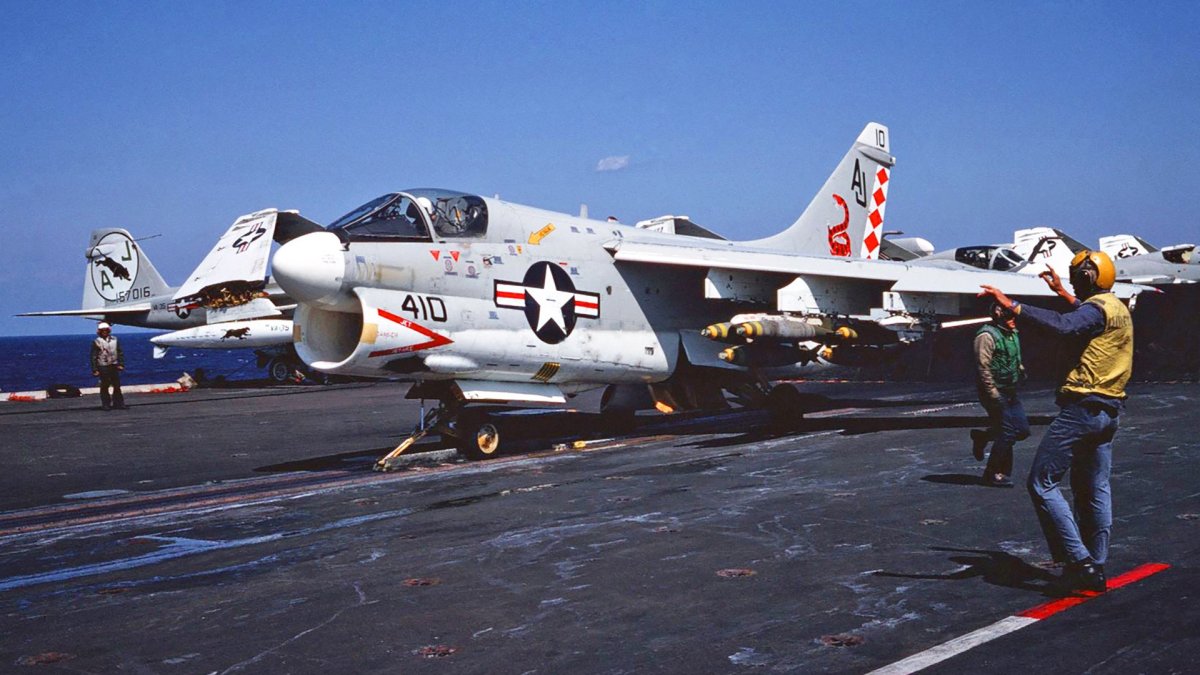
An A-7E Corsair II from VA-105, the Gunslingers , aboard the USS Saratoga (CVA-60)., USN
Once the pattern was laid and no visual indication of a submarine was present, the A-7 pilot would climb up to an altitude that would allow the sonobuoy signals to be relayed to the ASCAC through the communication pod and acoustic analysis would begin. Once a contact was obtained, airborne ASW assets would be vectored to the datum. If not airborne at the moment, then the alert submarine-hunting aircraft would be launched.
In Lieutenant Coogan’s 1972 Proceedings article, he warned against drawing “hasty conclusions,” while alluding to “the release of a fully detailed study…” I’m sure that study was classified and might still be. I hope, one day, to get my hands on it for my research so we can understand just exactly what did and did not occur. Coogan did provide some hints that there were measured successes. He also clearly addressed inherent deficiencies that came to light as a result of the experiment.
The first is one I’ve touched upon above, but let me let you hear it in his expert voice:
“Perhaps the most disappointing aspect of the evaluation was the inability of the S-2E to successfully convert a submarine datum [into contact] with any degree of predictable confidence. The venerable S-2, long the backbone of the anti-submarine carrier force, proved far too slow to provide a reasonable ‘time-late’ arrival at the submarine datum. With a maximum of three S-2 aircraft airborne for a particular operational cycle, there was not the necessary coverage for quick conversion of a datum that it required for a successful localization and hold-down tactic .”
During the different exercises that the Saratoga participated in, problems in planning and communication presented themselves in ways that none of the ASW professionals could have foreseen because, as Coogan wrote, “US destroyers [escorting the CVA] have had little opportunity to work with carrier air wings in a coordinated ASW role.”
F-4s waiting to launch and an A-7 blasting off the Saratoga ‘s deck., USN
As for the fixed and rotary-wing ASW assets now flying from the attack carrier’s deck, they had to shift to a defensive ASW mentality whose sole mission was to keep cruise missiles or torpedoes from ever being fired against the carrier. An even larger problem reared its ugly head: the carrier battle group admiral and carrier captain enjoyed the added rotary-wing logistical assets and used them excessively for duties other than ASW.
During my time aboard the USS Nimitz and Theodore Roosevelt , the Helicopter Anti-Submarine Squadron Nine (HS-9) aviators would express their frustration at having to haul cargo, VIPs, and chaplains around while their ASW skills atrophied. In his article, Lieutenant Coogan recommended that utility helicopters (SH-3G models) be utilized to handle all logistics and SAR/plane guard duties. Obviously, as history shows, the common sense of such a smart idea was lost on the Pentagon and Capitol Hill.
In their book Intruder , the Morgans provide insight into a real-time problem faced by the Saratoga during this period of operations:
“…while anchored off Athens the Sara started taking water through a massive failure of a gasket in the No. 3 Main Machinery Room (MMR). The ship went to General Quarters and was able to stop the sea’s inrush, although the ship reportedly took up to 49 feet of water before it was stopped. Ten aircraft were launched from anchor to lighten the ship, which had assumed a nasty list, and at least one F-4J almost went into the water…Ten days later, the No.4 MMR flooded in a similar fashion, and for a period the ship was limited to only one-screw ops out of four…Despite the problem – particularly in gaining adequate wind over the deck – Saratoga continued the ASW operations on a limited basis through the remainder of the deployment.”
An F-4B launches from the USS Ranger (CVA-61) while moored in Yokosuka, Japan in 1963. While not a photo of the Saratoga incident, it’s a depiction of how fixed-wing fighters can launch even while the carrier is pier-side, let alone at anchor., USN. Robert L. Lawson Photograph Collection via Peter Greengrass. With thanks to Tommy Thomason
Just An Interim Solution
The TACAIR ASW experiment came to an end with the arrival of the S-3 Viking in 1974. On the 30th of June, 1975, all Navy aircraft carriers were redesignated “CV.” As the final two decades of the Cold War made clear, the multi-role carrier concept was a crucial success in performing the ever-widening range of missions assigned to it, including attack and ASW.
Today’s Carrier Strike Groups, limited by the over-utilized helicopter squadrons and the uncertain coverage provided by the land-based
P-8 Poseidon , seem to hearken back to this turbulent time of inadequate budgets and barely acceptable ASW assets. There simply isn’t enough money or platforms available to adequately maintain control of the sea in the face of a resurgent Russian Navy and the much more troubling rise of the formidable Chinese Navy. One might be tempted to ask: should we consider placing sonobuoy pods on Super Hornets or the new MQ-25 Stingrays and introducing the F-35C Lightning II to ASW? Come to think of it, the Stingray could not only drop sonobuoys, but also relay the acoustic data back to the carrier and her escorts. This is definitely the concept of operations that is emerging for some existing land-based and even sea-based unmanned aircraft .
The MQ-25 Stingray with its refueling pod during a flight test. , Boeing
Perhaps history does repeat itself. These new distributed ASW ideas are strikingly similar to those tested aboard the Sara 50 years ago. Since there is no long-range ASW aircraft currently flying from our aircraft carrier decks and if we’re not going to introduce an ASW version of the MV-22 Osprey (which we should seriously reconsider), then maybe it’s time to go back to the future and have TACAIR do ASW once again.
The Q-9/Predator-B series of aircraft are being tested for distributed ASW operations that are remarkably similar to what the Navy tested with manned tactical aircraft in the early 1970s. , General Atomics
Contact the editor: Tyler@thedrive.com
Comments couldn’t be loaded. Please refresh the page.
发布于美国东部时间2021年3月18日晚上7:00
1987年,每次我驾驶S-3A“维京”反潜巡逻机时,都会经过停泊在“尼米兹”号航空母舰飞行甲板上的A-6E“入侵者”和A-7E“海盗II”攻击机。如果你当时和我同行,告诉我这些经典的战术飞机曾经投放过声呐浮标来搜寻潜艇,我肯定会停下来,一脸茫然地斜眼看着你,然后哈哈大笑。三十年后,如果你坐在我对面,你也会像我一样,看到我第一次读到“入侵者”、“海盗II”、“鹰眼”和“电动入侵者”执行反潜作战任务时的震惊表情而开怀大笑。这的确是事实。而这一切都发生在美国海军经历一段剧烈动荡和调整的时期,迫使他们重新思考如何有效地利用航空母舰及其舰载机。
1971年,盛夏伊始,美国军方正经历着翻天覆地的变革。越南战争依然是举国关注的焦点,这场冲突的“越南化”进程正在进行,美军也逐步撤离。国会深陷国内动荡,苦于如何支付这场不得人心的战争所带来的巨额开支,最终通过削减同样不受欢迎的军方年度预算找到了解决办法。就在媒体和公众几乎毫无察觉的情况下,一支航空母舰战斗群(CVBG)从佛罗里达州梅波特港起航,驶向另一场席卷全球的战争:冷战。
1971年6月7日,萨拉托加号航空母舰(CVA-60)及其护航舰艇和支援舰艇首先驶入北大西洋,随后转向南方,再向东进入地中海,开始了一次非常特殊且罕见的部署——为期四个月的实验,旨在检验反潜作战的新概念,并重新定义“航空母舰”对美国海军的意义。事实证明,这些测试或许超前了数十年。
大约在1971年,美国海军拖船将航空母舰“萨拉托加”号(CVA-60)拖入位于佛罗里达州梅波特港的泊位。
概念演变简史
在1941年12月美国对轴心国宣战后的第一个完整年度,美英海军设想利用小型护航航母(CVE)及其少量舰载机,作为填补受德国潜艇侵扰的大西洋中部“空中缺口”的有效方案,并为沿途抵御德国空军持续攻击、前往苏联摩尔曼斯克港的护航船队提供急需的防空力量。然而,就在这一方案于1943年初逐渐完善之际,美国却改变了战略。
英国人选择让护航航母始终伴随船队,因为他们知道德国潜艇会主动攻击他们;而美国海军则决定围绕护航航母组建猎杀群,冒险进入广阔的大西洋,搜寻这些出了名的难以捉摸的猎物。美国海军希望利用密码破译者取得的成功,并利用德国潜艇过度依赖与海军指挥部通信的弱点,孤注一掷地采取进攻策略,力图在德国潜艇最脆弱的时刻将其击溃。
战争结束时,两国海军都认为使用护航航母是更好的选择。
这艘纳粹潜艇在遭到深水炸弹袭击后浮出水面,它曾试图潜入大西洋护航舰队,其指挥塔已被炮火炸开。(美联社)
随着战后与苏联的敌对关系日益明朗,为了应对苏联被认为正在建造的“1000艘潜艇”,美国海军迫切需要一支专门的反潜航母特遣部队。海军最终认定,以护航航母为核心的“猎杀群”战时构想是唯一的解决方案。
1950年6月25日,朝鲜越过三八线后,美国海军认为已做好应对苏联潜艇对部署在朝鲜水域的盟军航母发动攻击的准备。当时仍在服役的几艘护航航母,每艘都搭载了一个中队的新型格鲁曼“卫士”战斗机,包括AF-2W“猎手”和AF-2S“杀手”战斗机,被部署到朝鲜海域以应对威胁。然而,苏联潜艇最终并未出现。
20世纪50年代初美国海军反潜“猎杀”小组:一架格鲁曼AF-2W“守护者”猎机(前景,配备APS-20雷达)和一架AF-2S“杀手”机(背景),均隶属于第25反潜中队(VS-25)。
“守护者”级潜艇在日本卸载后,F4U“海盗”战斗机被装载到该舰上,在战争剩余时间里,主要在朝鲜西海岸附近,为美国海军陆战队的作战行动提供近距离空中支援。尽管盟军大型航母的甲板上仍有少量飞机执行反潜巡逻任务,但并未发现任何确凿的水下威胁。
1953年停战协定签署后,这些“小型平顶飞机”被归还给了不情愿的反潜飞行员。当时,他们正忙于用双机“守护者”级护航航母换装格鲁曼S-2“追踪者”反潜机,后者堪称猎杀型反潜机的典范。然而,这架双引擎飞机的展开翼展达72英尺,远超“守护者”级护航航母的60英尺。飞行员和士兵们抱怨说,这些老旧、缓慢且尺寸较小的护航航母根本无法容纳这种新型飞机,也无法有效应对再次令人担忧的苏联潜艇威胁。
1953年,美国海军“布洛克岛”号航空母舰(CVE-106)甲板上搭载着格鲁曼AF-2W和AF-2S“守护者”攻击机中队。
面对需要常规部队参与的有限战争的现实、超级航母的出现、核动力与美苏潜艇不可避免的融合,以及反潜作战人员的担忧,海军被迫重新思考其对航空母舰的固有认知。解决方案是什么?只需在“CV”后添加几个字母,并仔细研究这些新增字母将给航空母舰带来的复杂但至关重要的变化。
“攻击型航母”(CVA)将搭载舰队的战斗机和攻击机,而“反潜航母”(CVS)则延续了备受青睐的猎杀型航母概念,搭载固定翼和旋翼反潜飞机。CVE航母已退役,19艘身经百战的埃塞克斯级航空母舰将被改装为反潜航母。另有三艘埃塞克斯级航母将保留其战斗机和攻击机,并被纳入重新命名为CVA的“中途岛”级和“福莱斯特”级航母的计划中。
高昂的成本和概念的演变
在财政约束缺失以及其作为自由世界领导者的角色日益复杂的背景下(这标志着20世纪50年代和60年代初的标志),华盛顿为其不断壮大的航母舰队找到了多种用途。为了遏制苏联的扩张,两个攻击型航母战斗群和至少一个反潜航母战斗群在地中海保持着强大的存在,以支持美国的外交战略,并应对冷战时期陆地和海洋格局剧烈变化带来的各种冲突热点。第七舰队密切关注着日渐活跃的中国和日益壮大的苏联太平洋舰队,这两个共产主义国家都在东南亚和中亚棋局中博弈。至少有一个攻击型航母战斗群和一个反潜航母战斗群遏制了共产主义狡猾而咄咄逼人的举动。
然后,冷战再次在亚洲演变为热战。
1966年1月左右,美国海军航空母舰“提康德罗加”号(CVA-14)在越南沿海执行任务期间,从舰队油轮“阿什塔布拉”号(AO-51)处进行空中加油。
在科技傲慢、政府恐惧和微观管理的背景下,越南战争耗尽了国家财政,也使军队丧失了对无限资源的信任、对遏制共产主义威胁的信心,以及对单一用途武器系统的脆弱信念。多用途飞机、军舰和航空母舰的时代自然而然地降临到海军身上,因为一艘航母就能满足需求,而两艘航母却显得多余。
1964年美国正式卷入越南战争时,海军拥有约24艘航空母舰,包括埃塞克斯级、中途岛级、福莱斯特级、小鹰级和企业级。然而,随着战事的推进和预算的紧缩,面对越南持续不断的战事、苏联海军日益增长的远洋威胁,以及建造、维护和运营航母战斗群耗资巨大的现实,海军别无选择,只能再次重新思考航空母舰的定位。
美国海军S-2E跟踪器显示武器和声呐浮标
20世纪60年代中后期,一项重要的成本削减措施是开始退役埃塞克斯级航空母舰。另一项削减措施是决定更换并最终退役老旧且日益失效的S-2“追踪者”导弹系统。几年后,苏联反舰巡航导弹潜艇(SSG)的出现,以及这种致命武器系统与核动力相结合的巡航导弹核潜艇(SSGN)的研发和部署,使得“追踪者”导弹系统迅速过时。
20世纪60年代中期,海军提出了一种喷气式飞机替代方案,最初代号为VSX。VSX代表“固定翼舰载反潜作战实验型”飞机——最终发展成为S-3“维京”反潜机。当时,海军计划让VSX飞机在埃塞克斯级航母上服役,但后来由于财政优先事项调整,这些老旧航母的维护计划被迫搁置。
过去是序章
苏联海军元帅谢尔盖·戈尔什科夫对埃塞克斯级航母退役的消息很可能毫不在意。尽管他海军的主要任务已转向探测和摧毁北约及法国的弹道导弹潜艇以及保护己方潜艇,但他仍然认为航母构成重大威胁。而且,我确信,他部署的第二代查理级和帕帕级核动力巡航导弹核潜艇以及相对较新的朱丽叶级核动力攻击潜艇,丝毫没有缓解美国海军将领们的担忧。
鉴于这一威胁始终挥之不去,忧心忡忡的海军将领们不得不另辟蹊径,既要保护剩余的CVA超级航母,又要为那些因CVS概念夭折而失去的反潜飞机和机组人员找到合适的归宿,还要满足华盛顿那些精于算计的官员的要求,并安抚那些不得不接受这一方案的战术航空兵部队。那么,这个方案究竟是什么呢?很简单,就是从“CVA”的命名中去掉一个字母,然后仔细研究一下少了一个字母会给航母带来哪些复杂但至关重要的变化。
多用途航母(简称“CV”)非常符合海军最新流行语“海上控制”的定义。
这是唯一一艘建造过的“爸爸”级航母杀手核潜艇,至今仍保持着世界最快潜艇的纪录。(美国海军)
“海上控制概念基于‘通用’舰队特遣部队,这些部队能够执行维持海上控制所需的任何类型的作战行动,无论面对水面、空中还是水下威胁。这种从更专业化的舰艇和特遣部队向更灵活的海军力量转型,使海军力量拥有更大的灵活性,并能以更少的国防开支获得更强的海军实力。”摘自1973年9月《美国海军学会会刊》的“笔记”。
“海上控制概念基于‘通用’舰队特遣部队,这些部队能够执行维持海上控制所需的任何类型的作战行动,无论面对水面、空中还是水下威胁。这种从更专业化的舰艇和特遣部队向通用舰队的战术转变,能够提高海军力量的灵活性,并使国防开支发挥更大的作用。”
当然,反潜作战并不是多用途航母和海上控制的唯一重点,但它却是航母及其舰载机联队最重要的变革焦点。
为新思想和丑陋的继子腾出空间
任何水手都知道,舰上最大的难题之一就是如何为新想法腾出空间。为体型庞大、笨重的反潜飞机腾出甲板空间,就意味着要牺牲其他通常由攻击航母舰载机使用的飞机,因为攻击航母舰载机的用途主要是轰炸陆上目标和拦截米格战斗机。他们需要尽可能多的飞机来执行和支援这些任务。失去这些宝贵的资源,对所有相关人员来说,都将是思维方式和操作方式上的一次痛苦转变。
如果以战术空中作战(TACAIR)为核心的航空联队要在新设计的航母上增加十架S-2“追踪者”反潜巡逻机和至多八架SH-3“海王”直升机,以及它们的机组人员和中队成员、中队办公室和维修车间、中队营房、更大的航空汽油(AVGAS)储罐、反潜鱼雷、深水炸弹和声呐浮标,需要花费多少钱?根据诺曼·弗里德曼在其著作《美国航空母舰:图解设计史》中的描述,这笔昂贵的代价相当于两个战斗机中队的四架F-4“鬼怪II”战斗机和两个A-7攻击机中队的四架攻击机。
SH-3“海王”反潜直升机及其吊放式声呐。(公共领域)
更糟糕的是,这艘航母将没有打击侦察机,而这对于准确规划和评估作战任务至关重要。当时的主力侦察机RA-5C“警戒者”体积过大,无法停放在飞行甲板上,只能从岸基起飞,这严重限制了它对航母战斗群的效用。
但寻找甲板上下空间并非唯一的难题。战术航空兵的思维模式也必须做出调整,才能让反潜作战融入其中,被接受并取得成功。
性感的麻烦
反潜作战速度不快,也不流行。而且,对于许多海军航空兵来说,这一点至关重要:反潜作战并不吸引人。
与二战期间航母时刻面临的水下威胁不同,战术空中作战人员在近三十年的时间里,对潜艇可能对他们海上家园造成的威胁的认识逐渐减弱。他们又何必担心那些看不见、摸不着、尝不出味儿、闻不到的东西呢?这种反潜作战方面的专业知识就留给了护航舰艇和航母打击群吧。
对那些海军陆战队员来说不幸的是,戈尔什科夫海军上将和他的潜艇艇长们仍然将CVA视为主要目标。值得庆幸的是,包括一些经验丰富、头脑更成熟的海军陆战队员在内的美国海军高级军官们意识到了这一点。
不管它是否引人注目,TACAIR 在开发最初被认为是多用途航母最终空中反潜解决方案的方案中发挥了重要作用。
一架F-4战斗机从“罗斯福”号航空母舰的甲板上起飞。海军内部的快速喷气式战斗机领域一直是人们讨论的焦点。
不太可能有人已经想到了这一点
1967年1月,《海军学会会刊》(Proceedings)刊登了一篇短文,作者是一位S-2“追踪者”反潜机飞行员,同时也是第35反潜航空中队(VS-35)的指挥官。罗伯特·哈洛指挥官表达了对正在研发的VSX项目飞机可能沦为P-3“猎户座”小型机的担忧。他以航母舰载机特有的讽刺口吻写道:“只要允许VSX的规格参数增长到巡逻机的水平,VS的概念就会彻底夭折;VSX根本装不下,否则P-3‘猎户座’就得去练习航母着舰了。” 他接着建议干脆放弃VSX,转而采用“空中/空中支援”(VA/S)概念。
“A-6入侵者攻击机是一款理想的飞机:A-6具有良好的载荷系数、合理的重量、优秀的甲板作业周期、出色的航程、足够的速度、缓慢的航母进近速度、机翼挂载点以及全天候作战能力……”
哈洛的想法后来被证明颇具预见性。
准备好了吗?运动健将们来了!
在反潜作战方面,航母概念设想使用最新版本的“鹰眼”预警机E-2B和久经实战考验的电子战飞机EA-6A“电子入侵者”来探测潜艇。一旦确定了方位线或更精确的定位,就会派出配置合适的A-6和/或A-7飞机投放声呐浮标,并作为信号中继平台。如果声学数据确认存在潜艇,战术空中侦察机(TACAIR)将被指示投放更多声呐浮标,开始跟踪目标,直到反潜飞机抵达现场。
“入侵者”和“海盗II”战斗机“正确配置”后,需要安装一种类似于20世纪50年代初道格拉斯AD“空中袭击者”和格鲁曼AF“守护者”攻击机所使用的Aero 2A声呐浮标/干扰弹投放器的声呐浮标吊舱。A-6和A-7携带的这种吊舱很容易被误认为是300加仑的油箱。这种尺寸的吊舱可以容纳相当数量的声呐浮标,而且这两款攻击机都有多个挂点可以安装多个吊舱。
美国海军空中袭击者(AD Skyraiders)和空军守护者(AF Guardians)使用的Aero 2A声呐浮标/照明弹投放器的图纸,出自美国海军/海军航空兵武器手册。
这种吊舱是携带主要或辅助声学传感器的巧妙方式。这一概念在20世纪80年代和21世纪都曾被重新启用。在P-8“海神”反潜巡逻机之前,P-3“猎户座”反潜巡逻机的首个替代方案是洛克希德P-7A远程空中反潜作战飞机(LRAACA)。为了携带更多传感器进行搜索,一架P-7A会在多个挂点上安装声呐浮标吊舱,使其携带数量惊人地达到300个标准尺寸的浮标。如今,正在研发的无人反潜概念飞机也以类似的方式使用外挂式声呐浮标吊舱。您可以在这里阅读更多相关信息。
“配置正确”的战术空中反潜飞机还需要将声呐浮标数据传回舰艇进行分析。由于A-6和A-7飞机本身无法处理或分析声呐浮标发出的声学信号,因此需要另一个吊舱将数据中继回航母或护航舰艇。飞行员只需在驾驶舱内拨动一个开关,接通电源,数据就会自动传输到航母上的反潜分类与分析中心(ASCAC),也可能传输到部分护航舰艇上。ASCAC的分析人员随后会判断目标是否为潜艇。
1971年夏季,美国海军第75攻击机中队(VA-75)“周日重拳手”的一架格鲁曼A-6B“入侵者”(BuNo. 149957)驻扎在萨拉托加号航空母舰(CVA-60)上。
最后,入侵者(Intruder)和海盗II(Corsair II)参与反潜作战的一大优势在于其卓越的武器挂载能力。这两款飞机上的多个外挂点不仅使其能够投放声呐浮标和中继数据,还能携带足以瘫痪或击沉第一代Echo II SSGN或任何苏联SSG系列潜艇的武器。这些潜艇若要发射反舰导弹,必须先浮出水面,暴露自身,否则将面临攻击。值得一提的是,据我所知,此前从未有人考虑过在这两款飞机上挂载反潜鱼雷。
1971 年 6 月底,海军决定尝试这种对航母及其舰载机联队的重新构想,萨拉托加号战斗群带着多用途航空母舰的梦想进入了地中海。
梦想成真
尽管关于航母概念中战术空中反潜作战(TACAIR ASW)方面的评估细节极其有限,但有两个资料来源对任务的执行方式提供了最佳的阐释。一篇优秀的概述文章发表于1972年3月的《海军学会会刊》(Proceedings)上,题为《“航母”:强大的警戒能力还是持续的脆弱性》(The 'CV': Capable Vigilance or Continued Vulnerability),作者是海军中尉詹姆斯·库根(James Coogan),他是S-2“追踪者”中队(VS-28,“赌徒”)的情报官,该中队在萨拉托加号航母上执行了这项实验。另一个重要的资料来源是马克·摩根(Mark Morgan)和里克·摩根(Rick Morgan)合著的《入侵者》(Intruder)一书,该书提供了对这一非常特殊的航母级任务的实时观察。
萨拉托加号航母接替自一月以来一直在地中海部署的福莱斯特号航空母舰(CVA-59)后,航母概念的完善工作便正式展开。计划中的反潜演习旨在评估增加战术空中作战飞机是否能够提高对潜艇的探测、识别、跟踪和摧毁能力。
如果演习潜艇升起潜望镜或其他桅杆以获取目标数据,来自第123空中指挥控制中队(VAW-123)“螺丝钉”的E-2B预警机就会寻找“雷达弹出”。如果未能发现桅杆,那么潜艇雷达发出的任何能量,哪怕只是一次扫描,都有可能被参与此次演习的美国海军陆战队EA-6A“电子入侵者”电子战飞机截获,该飞机配备了最先进的电子支援措施(ESM)系统。
1974年,美国海军第二海军陆战队综合侦察中队(VMCJ-2,绰号“花花公子”)的一架EA-6A电子入侵者电子战飞机在“美国”号航空母舰(CVA-66)上。
最初部署在“福莱斯特”号航母上的海军陆战队第二综合侦察中队(VMCJ-2)的“花花公子”电子战飞机分队,在“萨拉”号进入地中海时,从该航母上转移了他们的小型EA-6A电子战飞机分队。反潜作战对海军陆战队来说并不陌生,只是自从他们在加勒比海驾驶道格拉斯SBD“无畏”俯冲轰炸机猎杀U型潜艇,以及在太平洋驾驶PBJ“米切尔”俯冲轰炸机猎杀日本帝国海军潜艇以来,他们就再也没有进行过常规的反潜巡逻任务了。事实上,即使在今天,美国海军陆战队仍在制定计划,准备加入猎杀俄罗斯和中国潜艇的行列。
如果来自第75攻击中队(VA-75,绰号“周日重击者”)的入侵者战斗机,或来自VA-37中队(绰号“公牛”)或VA-105中队(绰号“枪手”)的海盗II战斗机携带声呐浮标和通信吊舱升空,它们将被引导至雷达定位点或疑似电子支援措施(ESM)命中方位线。例如,在空中作战指挥中心(ASCAC)的控制下,一架A-7攻击机将飞往可能的潜艇位置,也称为基准点。海盗II战斗机的飞行员将通过安全语音链路接收声呐浮标阵列不断扩展的搜索坐标,并将每个数据点输入到其导航/武器投放系统(NWDS)中。该飞行计算机还可以将这些飞行目标点(FTP)显示在A-7革命性的抬头显示器(HUD)上,帮助飞行员捕获每个飞行目标点,并自动在最佳探测位置释放声呐浮标。
一架来自 VA-105 枪手号的 A-7E Corsair II,位于 USS Saratoga (CVA-60) 上。, USN
一旦布设完毕且未发现潜艇的踪迹,A-7飞行员将爬升至一定高度,以便通过通信吊舱将声呐浮标信号转发至反潜作战指挥中心(ASCAC),并开始声学分析。一旦发现目标,空中反潜力量将立即飞往目标位置。如果此时空中力量尚未升空,则立即派出警戒状态的反潜飞机。
库根中尉在1972年发表于《海军学会会刊》的文章中警告不要“仓促下结论”,同时暗示“一份详尽的研究报告即将发布……”。我相信那份研究报告当时是机密文件,现在可能仍然是。我希望有一天能拿到这份报告用于我的研究,以便我们能够确切地了解究竟发生了什么,又有哪些事情没有发生。库根确实提供了一些线索,表明实验取得了一定的成功。他也明确指出了实验过程中暴露出的固有缺陷。
第一点我前面已经提到过了,但还是让你们听听他专业的声音吧:
“评估中最令人失望的或许是S-2E无法以任何可预测的可靠性将潜艇目标点转化为接触目标点。作为反潜航母部队的中坚力量,久经考验的S-2E速度太慢,无法在合理情况下‘迟到’地抵达潜艇目标点。在特定的作战周期内,最多只有三架S-2飞机在空中飞行,这不足以提供快速转化目标点点所需的覆盖范围,而这对于成功定位和压制目标点的战术至关重要。”
在萨拉托加号参加的各种演习中,计划和沟通方面出现了一些问题,这是反潜作战专业人员都无法预料的,因为正如库根所写,“美国驱逐舰(护送CVA)很少有机会与航母舰载机联队进行协调的反潜作战。”
两架F-4战斗机正等待起飞,一架A-7攻击机从“萨拉托加”号航母甲板上腾空而起。(美国海军)
至于现在从攻击型航母甲板上起飞的固定翼和旋翼反潜战机,它们必须转变反潜作战思路,其唯一任务是阻止巡航导弹或鱼雷攻击航母。然而,一个更大的问题浮出水面:航母战斗群指挥官和航母舰长过于享受这些新增的旋翼后勤保障力量,并过度将其用于反潜以外的其他任务。
我在“尼米兹”号和“西奥多·罗斯福”号航母上服役期间,第九反潜直升机中队(HS-9)的飞行员们常常抱怨,他们不得不承担运送货物、贵宾和牧师的任务,而反潜技能却因此生疏。库根中尉在他的文章中建议,应该使用通用直升机(SH-3G型)来承担所有后勤和搜救/护航任务。显然,正如历史所证明的那样,五角大楼和国会山并没有采纳这种明智的建议。
在他们的著作《入侵者》中,摩根夫妇深入剖析了萨拉托加号在这一作战时期面临的一个实际问题:
“……萨拉托加号在雅典附近抛锚时,由于3号主机舱(MMR)的一个密封垫圈严重失效,开始进水。该舰进入战斗状态,并成功阻止了海水涌入,但据报道,在止水前,舰体进水深度达到了49英尺。为了减轻严重倾斜的舰体重量,舰上起飞了10架飞机,其中至少有一架F-4J战斗机险些落水……10天后,4号主机舱也以类似的方式进水,一段时间内,该舰的四个螺旋桨只能使用一个……尽管存在这些问题——尤其是在甲板上获得足够风力方面——萨拉托加号在剩余的部署期间仍然有限地继续执行反潜作战任务。”
1963年,一架F-4B战斗机从停泊在日本横须贺的“游骑兵”号航空母舰(CVA-61)上起飞。虽然这张照片并非萨拉托加事件的实物照片,但它展现了固定翼战斗机即使在航母停靠码头(更不用说抛锚停泊)的情况下也能起飞的场景。照片来自美国海军罗伯特·L·劳森摄影收藏,由彼得·格林格拉斯提供。感谢汤米·托马森提供照片。
只是一个临时解决方案
随着1974年S-3“维京”反潜机的服役,战术空中反潜试验宣告结束。1975年6月30日,所有海军航空母舰都被重新命名为“CV”。正如冷战最后二十年所表明的那样,多用途航母的概念在执行其不断扩大的任务范围(包括攻击和反潜)方面取得了至关重要的成功。
如今的航母打击群受限于过度使用的直升机中队以及陆基直升机提供的覆盖范围的不确定性。
P-8“海神”反潜巡逻机似乎让人回想起预算不足、反潜装备勉强够用的动荡时期。面对复兴的俄罗斯海军和更加令人担忧的中国海军的崛起,我们根本没有足够的资金或平台来有效控制海洋。人们不禁会问:我们是否应该考虑在“超级大黄蜂”或新型MQ-25“黄貂鱼”无人机上安装声呐浮标吊舱,并将F-35C“闪电II”战斗机引入反潜作战?仔细想想,“黄貂鱼”不仅可以投放声呐浮标,还可以将声学数据传回航母及其护航舰艇。这无疑是目前一些陆基甚至海基无人机正在探索的作战理念。
MQ-25“黄貂鱼”无人机及其空中加油吊舱在飞行测试中。(波音公司)
或许历史真的会重演。这些新的分布式反潜作战理念与50年前在“萨拉”号航母上测试的理念惊人地相似。鉴于目前我们的航母甲板上没有远程反潜飞机,而且如果我们不打算引进MV-22“鱼鹰”的反潜版本(我们应该认真考虑一下),那么或许是时候回到过去,让战术空中作战部队再次承担反潜任务了。
Q-9/捕食者-B系列飞机正在进行分布式反潜作战测试,其作战方式与海军在20世纪70年代初用有人驾驶战术飞机进行的测试极为相似。——通用原子公司
联系编辑:Tyler@thedrive.com
评论加载失败,请刷新页面。