Can And Should B-1B Bomber Crews’ Low-Level Flying Skills Be Saved?B-1B轰炸机机组人员的低空飞行技能能否以及是否应该保留?
Low-level flying puts great stress on the airframe, but it also serves a tactical purpose. There may be a compromise that would satisfy both issues.
新闻视频
Updated Mar 5, 2020 7:40 PM EST
Just three weeks ago, The War Zone published an expose on the current woes facing the Air Force’s tired B-1B Lancer bomber fleet. We were first to report the details of new measures aimed at prolonging the bomber’s life as much as possible. These included flight hour restrictions and an end to low-level terrain-following certification requirements, which was a staple of the training syllabus for its crews that enabled a major capability of the bomber to be used. This major change within the B-1B community definitely has its detractors, as well as its champions. Here’s where the debate currently stands, according to our sources.
There is a fair argument to be made that low-level training, which has been the source of great airframe resource depletion, has been necessary and valid. Weapons School graduates and others who develop tactics for combat aircraft think beyond weapons delivery and look at the bigger picture, including asking themselves “How can a combat aircraft be used for effect beyond dropping weapons?” There are two common ways.
Global Power As A Deterrent
The first way happens in times of peace or heightened tension, or any time the presence of bombers is needed to make a statement.
Bombers such as the B-1 have a long history of being pre-positioned overseas. The Air Force has historically referred to these bomber movements as “global power” deployments or exercises.
The presence of bombers has an effect on regional geopolitics and military decision making. Generals and politicians alike understand this and send bombers to Andersen Air Force Base on Guam, RAF Fairford in the United Kingdom, Al Udeid Air Base in Qatar, and Diego Garcia in the Indian Ocean from time to time to achieve various objectives beyond normal training and deployment requirements.
After being pulled from continuous deployments to Al Udeid in 2018, the B-1 fleet was recommitted to semi-regular global power missions.
The Show Of Force: The Main Argument For Why Low-Level Training Existed
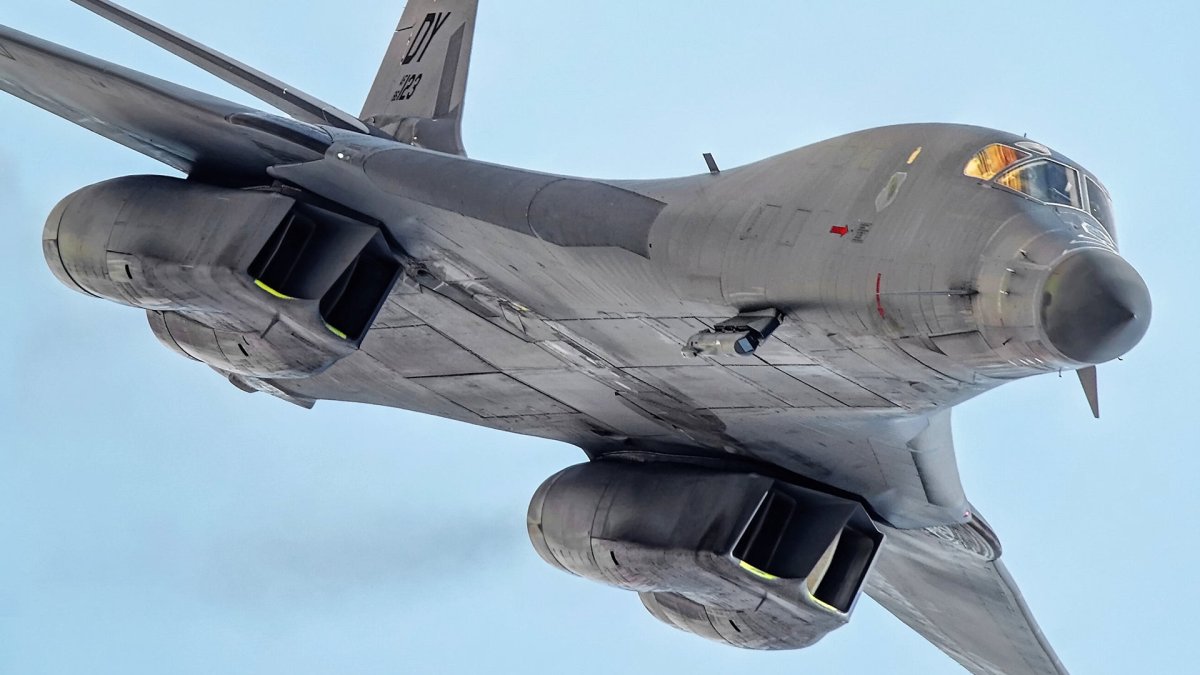
Even in times of war, a B-1 has non-kinetic capabilities, such as being able to conduct shows of force , the reason for which B-1 aircrews and combatant commanders justify low-level training. A show of force is essentially a short, low-altitude, high-speed flyby, not unlike the ones B-1s perform at air shows . During a show of force, the aircrew maximizes the impression the B-1 leaves by making the flyby as loud and abrasive as possible, usually in full afterburner and sometimes popping MJU 23/B infrared decoy flares.
The objective is to threaten, intimidate, and ultimately force enemies who don’t want to be bombed into fleeing or at least ceasing fire. Shows are force are becoming more and more popular because they still save lives, but the justification and authorization threshold is much lower than that for dropping kinetic weapons. In 2015, the United States Air Force conducted 18,019 combat aircraft sorties in Afghanistan, but only employed weapons during 3,330 of them.
Shows of force have been used by B-1s in maritime interdiction operations , as well. The bombers conduct these missions in collaboration with the joint interagency effort to confront cartel narcotics trafficking.
Various provisions within U.S. law and the Law of Armed Conflict mean that the U.S. military can’t attack Latin American drug smugglers except in self-defense and prohibit military personnel from carrying out certain law enforcement tasks, but B-1s certainly can make their presence acutely known to traffickers. Fast-moving drug-smuggling boats from Peru, Columbia, and Bolivia have been stopped in their tracks by a B-1 show of force without a shot being fired.
If you’re a smuggler on a loud boat you may not know you’re being tailed by Customs and Border Patrol, the United States Coast Guard, or even military jets. A single show of force pass from a 146-foot-long B-1 in full afterburner low over the waves has been known to make smugglers hastily abandon ship. In that eventuality, the Coast Guard moves in and picks the smugglers up out of the water, commonly without incident.
In 2016, the Combined Air Operations Center at Al Udeid tried to limit B-1 shows of force to 2,000 feet above ground level. The deployed B-1 community there prepared an extensive and comprehensive presentation illustrating that 1,000 feet above ground level was the optimal altitude for shows of force. They narrowly won that debate.
The Argument For Real-Life Low-Level Training
B-1 operators further justify low-level training by pointing out that simulator training is insufficient. They say the simulator is ideal for crews training on complex procedures while not expending actual flight hours, but it can’t adequately prepare crews for doing a terrain-following check (preparing the AN/APQ-164 radar for terrain-following flight operations) in a combat environment, then doing a ‘letdown’ to a show of force through clouds and around terrain.
Aircrews express that the sensation of executing that letdown at night is like descending into a black hole, which requires confidence, experience, and awareness to pull off in combat.
There’s nothing like the real thing . The terrain-following check and letdown are occasional prerequisites for the show of force and if that show of force ends up causing insurgents to retreat, cease fire, or surrender, B-1 aircrews affirm the years of low-level training and expense of the airframe B-1B fleet’s collective airframe life were worth it.
The Argument Against Traditional Low-Level Training
The detractors of low-level training don’t contest how valuable shows of force are as a capability. They offer the proposition that legacy low-level training has been excessive.
Case in point: In 2018, Dyess Air Force Base proposed lengthening its frequent low-level training route , known as Instrument Route (IR) 178, to 544 nautical miles long. In 35 years and 12,000 combat sorties, no B-1 has ever flown a low-level ingress to contested or denied airspace.
In our previous article, we outlined how the B-1 Systems Program Office, along with B-1 maintainers and engineers, generally agree that low-level training has been one of the if not the biggest source of fleet wear and tear. With these factors considered, you can’t deny the detractors have a point. Especially considering that low-level show of force maneuvers are generally conducted over a single location, not along some long meandering route.
A Compromise Solution
What if B-1 crews continued to be trained and certified on low-level flight for the preservation of their show of force capability, but drastically shortened the length of their training routes? More specifically, can B-1 aircrews accomplish and satisfy show of force training with a terrain-following check and letdown as described above upon returning to base and a flyby before entering the traffic pattern?
Dyess Air Force Base already has an operating control tower and protected Class C airspace that can’t be intruded upon by aircraft that aren’t speaking with local controllers. Ellsworth Air Force Base is similar, but has Class D airspace . There are protections and increased safety offered near the B-1’s home airfields that aren’t offered on long low-level training routes.
Alternatively, this training could be executed periodically in secure airspace, such as bombing ranges and other areas away from populated areas.
The Risks Posed By Traditional Low-Level Training
There are other problems with legacy low-level training beyond airframe wear and tear. These problems are not unique to B-1s, either. Low-level training routes, such as IR 178, are depicted on civil aeronautical charts, but no airspace is reserved or set aside for them specifically. Civil and military aircraft share the airspace and they don’t have to talk to each other or controllers. In most cases, they can’t because the majority of civil aircraft don’t have UHF band radios that the military does. Previously, collisions between military aircraft conducting low-level training and civil aircraft have happened and are a risk that must be mitigated .
In addition, low-altitude high-speed flight gives aircrews fewer chances to egress a failing or crashing aircraft and increases chances of colliding with terrain or obstructions . Over the years, the statistics have caught up. Of the eight B-1 crashes , four of them, tail numbers 84-0052 , 86-0106 , 85-0078 , and 85-0091 crashed during low-level training.
84-0052 had six crew on board and three of them died. The second two crashes were fatal for all aircrew members. The final, 85-0091 in 2013 , crashed in Montana as it was exiting a low-level training route. Thankfully, all crew members survived, but it was only one of two out of the four B-1 crashes involving low-levels with no fatalities. The four other B-1 crashes resulted from various situations not related to low-level training.
Eliminating traditional low-level training in the B-1 community immediately decreases the risk of losses of life, which is paramount. A distant, but still important second consideration is the risk of losing the aircraft themselves. If we crash our nation’s military assets in training they can’t be employed in actual defense of our national interests.
It Doesn’t Have To Be All Or Nothing, Does It?
Performing short flybys for show of force training may reduce the readiness of aircrews for long-range low-level missions, and as a result, remove that capability from the bomber’s portfolio, but the concept would potentially allow aircrews to perform show of force maneuvers with confidence over the battlefield. It’s hard for anyone to justify flying a B-1 at low altitude for 544 nautical miles just to train for show of force maneuvers.
There can be no doubt this conversation has been had in formal meetings many times by those who are in charge of and develop the tactics for the B-1 program. They were brilliant enough to foster the B-1’s evolution from a nuclear deterrent into a precision strike close air support platform, and they were thoughtful enough to integrate the show of force concept soon after. Whatever transpired in those meetings, the decision was made for the entire life of the B-1 to continue training for and certifying aircrews on long-duration low-level flights, and now the bill for those decisions has come due.
Yet it seems odd that this has come down to an all or nothing proposition. Training for show of force operations can still be accomplished with far less impact on the B-1’s longevity by simply tailoring low-level training to that tactic specifically and not to low-level interdiction, which was originally meant for use during World War III.
With any luck, the Air Force will get creative about this issue and allow for the B-1 force to retain a highly useful tactic while also preserving the B-1’s airframe life for as long as possible.
Contact the editor: Tyler@thedrive.com
Comments couldn’t be loaded. Please refresh the page.
更新于美国东部时间2020年3月5日晚上7:40。
就在三周前,《战区》(The War Zone)网站发表了一篇揭露空军老旧B-1B“枪骑兵”轰炸机机队当前困境的文章。我们率先报道了旨在尽可能延长轰炸机寿命的新措施的细节。这些措施包括飞行小时限制,以及取消低空地形跟踪飞行认证要求。低空地形跟踪飞行曾是B-1B机组人员训练课程的重要组成部分,也是该轰炸机一项重要能力得以发挥的关键。B-1B机队内部的这项重大变革无疑既有反对者,也有支持者。以下是根据我们的消息来源,目前争论的焦点所在。
有人认为,低空训练虽然会造成飞机机体资源的大量损耗,但却是必要且合理的。武器学校的毕业生以及其他参与战斗机战术制定的人员,他们的思考超越了武器投放的范畴,着眼于更宏观的层面,他们会问自己:“除了投放武器之外,战斗机还能发挥哪些其他作用?” 通常有两种方法。
全球实力作为一种威慑力量
第一种情况发生在和平时期或局势高度紧张时期,或者任何需要炸弹袭击者出现以表明立场的时候。
像B-1这样的轰炸机有着悠久的海外预先部署历史。美国空军历来将这些轰炸机调动称为“全球力量”部署或演习。
轰炸机的存在对地区地缘政治和军事决策产生影响。将军和政客们都明白这一点,因此他们会不时派遣轰炸机前往关岛的安德森空军基地、英国的费尔福德皇家空军基地、卡塔尔的乌代德空军基地以及印度洋的迪戈加西亚岛,以实现超出正常训练和部署需求的各种目标。
2018 年,B-1 机队从持续部署到乌代德空军基地的任务中撤出,重新投入到半定期的全球力量任务中。
武力展示:低级别训练存在的主要理由
即使在战时,B-1轰炸机也具备非动能作战能力,例如进行武力展示,这也是B-1机组人员和作战指挥官进行低空训练的理由。武力展示本质上是一种短距离、低空、高速的飞行表演,类似于B-1在航展上的表演。在武力展示过程中,机组人员会尽可能地提高B-1的飞行声势,使其尽可能地震耳欲聋、引人注目,通常会开启加力燃烧室,有时还会发射MJU 23/B红外诱饵弹。
其目的是威胁、恐吓,并最终迫使不愿遭受轰炸的敌人逃离或至少停止射击。展示武力越来越受欢迎,因为它们仍然能够挽救生命,但其正当性和授权门槛远低于投放动能武器。2015年,美国空军在阿富汗执行了18019架次作战飞行任务,但仅在其中3330架次中使用了武器。
B-1轰炸机也曾在海上拦截行动中展示武力。这些轰炸机与打击贩毒集团的联合跨部门行动合作执行这些任务。
美国法律和《武装冲突法》中的多项条款规定,美军除自卫外不得攻击拉丁美洲的毒品走私者,并禁止军事人员执行某些执法任务,但B-1轰炸机无疑能让毒贩们清楚地意识到自身的存在。来自秘鲁、哥伦比亚和玻利维亚的快速毒品走私船曾多次在B-1轰炸机的武力展示下被拦截,而未发一枪一弹。
如果你是走私犯,乘坐一艘噪音很大的船,你可能根本不知道自己正被海关和边境保护局、美国海岸警卫队,甚至是军用飞机跟踪。一架146英尺长的B-1轰炸机低空开启加力燃烧室进行一次威慑性飞行,就足以让走私犯仓皇弃船。在这种情况下,海岸警卫队会立即出动,将走私犯从水中救起,通常不会发生任何意外。
2016年,驻扎在乌代德空军基地的联合空中作战中心试图将B-1轰炸机的武力展示飞行高度限制在地面以上2000英尺。驻扎在那里的B-1轰炸机部队准备了一份详尽全面的演示文稿,论证了地面以上1000英尺才是武力展示的最佳高度。他们最终以微弱优势赢得了这场辩论。
支持开展真实生活低级别训练的论点
B-1轰炸机操作员进一步论证低空训练的必要性,指出模拟器训练不足以应对实际飞行。他们认为,模拟器非常适合机组人员在不消耗实际飞行时间的情况下训练复杂的飞行程序,但它无法充分训练机组人员在作战环境中进行地形跟踪检查(即为地形跟踪飞行操作准备AN/APQ-164雷达),然后进行穿越云层和绕地飞行以展示武力的“低空降落”训练。
机组人员表示,在夜间执行这种放空操作的感觉就像坠入黑洞,这需要在战斗中具备自信、经验和意识才能成功。
没有什么比得上实战。地形跟踪检查和降落是武力展示的必要前提,如果武力展示最终迫使叛乱分子撤退、停火或投降,B-1机组人员会肯定,多年来的低空训练以及B-1B机队整个机体寿命所耗费的巨资都是值得的。
反对传统低水平培训的论点
反对低级别训练的人并不否认武力展示作为一种能力的重要性。他们提出的观点是,传统的低级别训练已经过度了。
举例来说:2018年,戴斯空军基地提议将其常用的低空训练航线(即仪表航线178)延长至544海里。在过去35年和12000架次的战斗飞行中,没有一架B-1轰炸机低空进入过敌对或禁飞空域。
我们在之前的文章中概述了B-1系统项目办公室以及B-1维护人员和工程师普遍认为,低空训练是机队损耗的主要原因之一,甚至可能是最大的损耗来源。考虑到这些因素,批评者的观点也不无道理。尤其值得注意的是,低空武力展示演习通常是在单一地点进行,而不是沿着漫长曲折的航线飞行。
折衷方案
如果B-1机组人员继续接受低空飞行训练和认证以保持其武力展示能力,但大幅缩短训练航线,会怎么样?更具体地说,B-1机组人员能否在返回基地后进行如上所述的地形跟踪检查和降落,并在进入航线前进行一次低空通场,以此完成并满足武力展示训练的要求?
戴斯空军基地已设有运行中的管制塔台和受保护的C级空域,未经当地管制员联络的飞机不得擅自闯入。埃尔斯沃思空军基地的情况类似,但其空域为D级空域。B-1轰炸机的母港机场附近享有的保护措施和安全保障,在长途低空训练航线上则不具备。
或者,这种训练可以定期在安全的空域进行,例如轰炸靶场和其他远离人口稠密地区的区域。
传统低水平培训带来的风险
除了机身磨损之外,传统的低空训练还存在其他问题。这些问题并非B-1轰炸机独有。低空训练航线,例如IR 178航线,虽然在民用航空图上有所标注,但并没有专门为它们预留或划定空域。民用和军用飞机共享空域,它们无需相互通信或与管制员通信。在大多数情况下,它们无法通信,因为大多数民用飞机没有军用飞机所配备的超高频(UHF)无线电。此前,军用飞机进行低空训练时与民用飞机发生碰撞的事故时有发生,这种风险必须加以降低。
此外,低空高速飞行会减少机组人员在飞机发生故障或坠毁时逃生的机会,并增加与地形或障碍物相撞的风险。多年来的统计数据也印证了这一点。在八起B-1轰炸机坠毁事故中,有四起(尾号分别为84-0052、86-0106、85-0078和85-0091)是在低空训练期间坠毁的。
84-0052号飞机机上共有六名机组人员,其中三人遇难。接下来的两起坠机事故中,所有机组人员全部遇难。最后一架B-1轰炸机,85-0091号,于2013年在蒙大拿州坠毁,当时它正结束低空训练航线。所幸所有机组人员都幸存了下来,但这起事故是四起涉及低空飞行且无人员伤亡的B-1坠机事故中的两起之一。其他四起B-1坠机事故均由与低空训练无关的各种情况造成。
取消B-1轰炸机部队传统的低空训练,能立即降低人员伤亡的风险,这至关重要。其次,虽然影响较小,但同样重要的考虑因素是飞机本身的损失风险。如果我们国家的军事资产在训练中坠毁,它们就无法用于实际捍卫国家利益。
不必非此即彼,对吧?
进行短距离低空飞行以进行武力展示训练可能会降低机组人员执行远程低空任务的战备水平,从而导致轰炸机失去这项能力。但这种理念或许能让机组人员更有信心地在战场上进行武力展示演练。毕竟,很难有人会认为驾驶B-1轰炸机低空飞行544海里仅仅是为了进行武力展示演练是合理的。
毫无疑问,负责B-1项目战术制定和执行的人员已经在正式会议上多次讨论过这个问题。他们极具远见,推动了B-1从核威慑力量向精确打击近距离空中支援平台的演变,并且他们也颇具远见地在不久后融入了武力展示的概念。无论那些会议的内容如何,B-1的整个服役周期都决定继续训练和认证机组人员进行长时间低空飞行,而现在,这些决定的代价已经到来。
然而,令人费解的是,这件事竟然演变成非此即彼的选择。其实,只要将低空训练专门针对武力展示作战战术,而不是最初为第三次世界大战设计的低空拦截作战,就能在对B-1轰炸机寿命影响更小的前提下完成此类训练。
如果运气好的话,空军会想出一个有创意的办法来解决这个问题,既能让 B-1 部队保留一种非常有用的战术,又能尽可能延长 B-1 的机身寿命。
联系编辑:Tyler@thedrive.com
评论加载失败,请刷新页面。