NParks seizes 101 illegally kept wildlife in islandwide raid; 14 animals dead国家公园局在全岛范围内的突击行动中查获101只非法饲养的野生动物;其中14只动物死亡
Six individuals face probe over illegal sale and possession of wildlife in one of NParks' largest seizures in recent years.
Six individuals face probe over illegal sale and possession of wildlife in one of NParks' largest seizures in recent years.
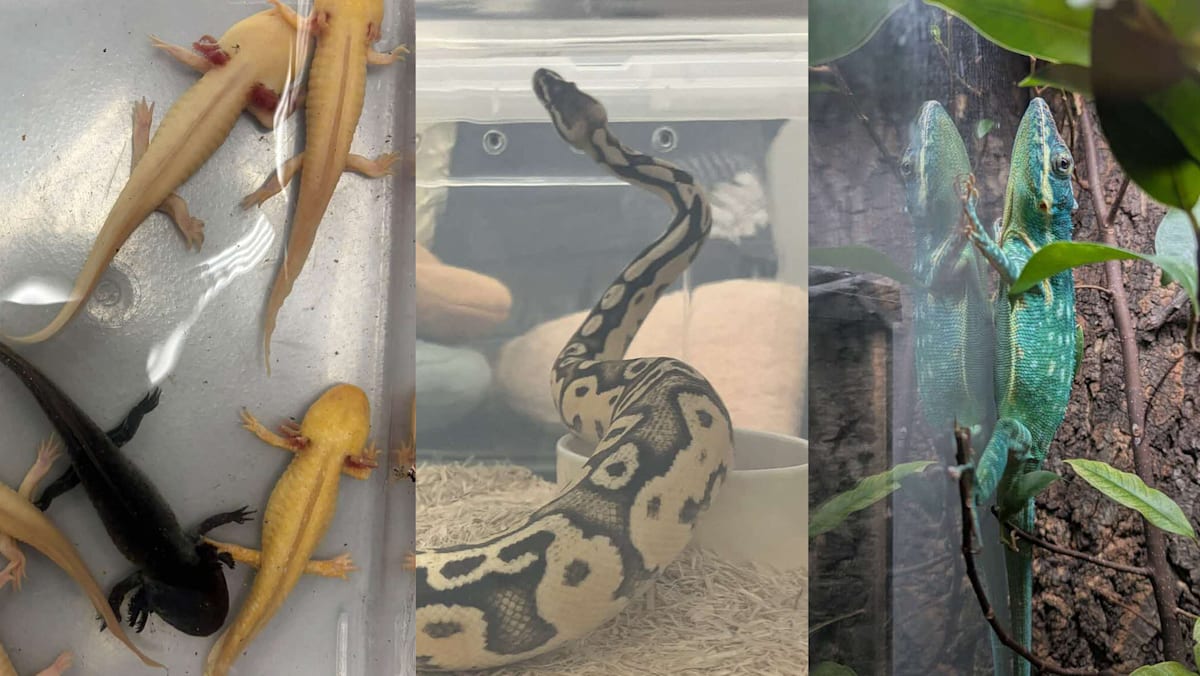
Seized axolotls (left), a ball python (centre), and a blue beauty anole. (Photos: National Parks Board)
This audio is generated by an AI tool.
SINGAPORE: A total of 101 non-native wildlife species were seized in a series of raids across Singapore on Monday (Sep 14), with 13 animals found dead at the premises and one needing to be euthanised due to poor health.
The National Parks Board (NParks) conducted simultaneous raids on the residences of six individuals believed to be involved in the sale or possession of wildlife. They had also advertised the wildlife species for sale, or posted about the animals on online platforms.
The six are currently under investigation. NParks did not say if their cases are linked to each other.
The operation marks one of NParks' largest seizures of illegally kept wildlife in recent years, the authority said on Wednesday. It is the largest haul in a single operation since 2021, when about 120 wild animals were seized.
The seizure included newts, lizards, pythons, tarantulas and turtles. None were allowed to be sold, offered for sale or kept as pets in Singapore.
CNA Games Guess Word Crack the word, one row at a time Buzzword Create words using the given letters Mini Sudoku Tiny puzzle, mighty brain teaser Mini Crossword Small grid, big challenge Word Search Spot as many words as you can Show More Show Less
On September 14, 2026, NParks officers simultaneously raided the residential units of six individuals suspected of illegal sale and possession of wildlife. (Photo: NParks)
Some of the wildlife were kept in poor living conditions such as cramped containers with insufficient ventilation and lack of food and water, resulting in 13 found dead on site and one leopard gecko having to be euthanised on animal welfare grounds. (Photo: NParks)
Several of the species found are protected under the Convention on International Trade in Endangered Species of Wild Fauna and Flora (CITES), including the armadillo girdled lizard, axolotl, ball python, pig-nosed turtle and rosy boa.
NParks said the deaths of 13 animals were possibly due to poor or unsuitable living conditions, such as insufficient space and ventilation, as well as inadequate access to food and water.
Many of the animals were in poor health, with one leopard gecko found with a ruptured and infected eye. It was also unable to fully shed its skin.
"These conditions are highly indicative of a long period of time captive under poor conditions. A few other leopard geckos and axolotls were also found to be very lethargic and in poor body condition,” NParks said.
“As a result, one leopard gecko had to be euthanised on animal welfare grounds.”
A leopard gecko in poor condition with ruptured, infected eye and retained shed, which had to be euthanised on welfare grounds. (Photo: NParks)
The 87 remaining animals are being housed and cared for at NParks’ Centre for Wildlife Rehabilitation.
As their origins are unknown and may carry diseases that can infect other animals or humans, each animal will undergo a mandatory quarantine period before being evaluated for repatriation to their native countries . They may also be donated to animal establishments, such as zoos.
As a last resort, the animals may also be euthanised, said NParks.
“Smuggled animals are also often kept and transported in cramped, poorly ventilated conditions. In some cases, they are heavily sedated to minimise noise and movement to avoid detection by the authorities, and such conditions may cause death,” said NParks.
“Even if the animals survive, they may have to be euthanised on welfare grounds, due to poor health or injury.”
NParks seized 16 wildlife specimens from six premises across Singapore in a similar operation in 2025. In 2022, the agency seized around 60 wildlife specimens.
A blue beauty anole at the Centre for Wildlife Rehabilitation on Sep 16, 2026. (Photo: CNA/Alyssa Tan)
A ball python at the Centre for Wildlife Rehabilitation on Sep 16, 2026. (Photo: CNA/Alyssa Tan)
The operation is part of NParks' ongoing efforts to combat the illegal wildlife trade. Nevertheless, enforcement alone is not enough as public education plays an equally important role, it said.
NParks Director of Enforcement and Investigation Joshua Teoh said buying illegally imported or smuggled wildlife fuels demand and could eventually push endangered species to extinction.
He added that smuggled animals may carry zoonotic diseases that can be transmitted to humans, posing significant public health risks.
If released, these illegally imported species could have a serious impact to the local biodiversity and the damage could be permanent, Mr Teoh said.
Mr Teoh said animal welfare is another concern, as smuggled wildlife is often kept and conveyed in cramped and poorly ventilated conditions. Outlining its “zero tolerance” approach to tackle the illegal sale and possession of wildlife, NParks said it works with other agencies to conduct security checks at Singapore’s borders, monitors physical and online marketplaces and carries out operations and enforcement action against illegal trade activities.
“Illegal wildlife trade threatens the survival of endangered species and contributes to habitat destruction around the world. Singapore is a signatory to CITES and is committed to curbing illegal wildlife trade to ensure the long-term survival of these animals,” said NParks.
Under the Wildlife Act, offenders who illegally sell or export wildlife may be fined up to S$50,000 (US$39,300), jailed up to two years or both.
Those who illegally import wildlife may be fined up to S$10,000, jailed up to a year or both.
In addition, under the Endangered Species (Import and Export) Act, offenders convicted of illegally importing CITES species that are threatened with extinction face a fine of up to S$100,000 per specimen - capped at S$500,000 or the total market value, whichever is higher - and up to six years’ jail.
For other CITES species that are currently not threatened with extinction or are identified as being in need of international trade controls, the maximum penalty is a S$50,000 fine per specimen and four years’ imprisonment.
Get our pick of top stories and thought-provoking articles in your inbox
Stay updated with notifications for breaking news and our best stories
Join our channel for the top reads for the day on your preferred chat app
六名涉嫌非法出售和持有野生动物的人员将接受调查,这是国家公园局近年来查获的最大规模的案件之一。
图中可见被查获的墨西哥钝口螈(左)、球蟒(中)和蓝美人蜥。(图片:国家公园管理局)
这段音频是由人工智能工具生成的。
新加坡:周一(9月14日),新加坡各地展开一系列突击行动,共查获101种非本土野生动物,其中13只动物在现场死亡,另有1只动物因健康状况不佳而被实施安乐死。
国家公园局(NParks)同时突击搜查了六名涉嫌贩卖或持有野生动物的人员的住所。他们还曾在网络平台上发布野生动物出售广告或相关信息。
目前这六人正在接受调查。国家公园局并未说明他们的案件是否彼此关联。
国家公园局周三表示,此次行动是近年来该局查获非法饲养野生动物数量最多的一次。这也是自2021年以来单次行动中查获数量最多的一次,当年查获了约120只野生动物。
查获的动物包括蝾螈、蜥蜴、蟒蛇、狼蛛和乌龟。在新加坡,这些动物均不得出售、提供出售或作为宠物饲养。
CNA游戏 猜词游戏 逐行破解单词 流行词游戏 用给定的字母组成单词 迷你数独 小小谜题,挑战你的大脑 迷你填字游戏 小方格,大挑战 单词搜索 尽可能多地找出单词 显示更多 显示更少
2026年9月14日,国家公园局官员同时突击搜查了六名涉嫌非法买卖和持有野生动物的个人住所。(图片:国家公园局)
部分野生动物被饲养在恶劣的环境中,例如狭小的容器,通风不良,缺乏食物和水,导致13只动物当场死亡,另有一只豹纹守宫因动物福利原因被实施安乐死。(图片:国家公园局)
发现的几种物种受到《濒危野生动植物种国际贸易公约》(CITES)的保护,包括犰狳蜥蜴、墨西哥钝口螈、球蟒、猪鼻龟和玫瑰蟒。
国家公园局表示,13只动物的死亡可能是由于生活条件恶劣或不适宜造成的,例如空间和通风不足,以及食物和水供应不足。
许多动物健康状况不佳,其中一只豹纹守宫的眼睛破裂并感染,而且无法完全蜕皮。
“这些情况强烈表明它们长期被囚禁在恶劣的环境中。此外,还发现一些其他的豹纹守宫和墨西哥钝口螈也十分嗜睡,身体状况很差,”国家公园局表示。
“因此,出于动物福利的考虑,不得不对一只豹纹守宫实施安乐死。”
一只豹纹守宫状况不佳,眼睛破裂感染,蜕皮未干,出于动物福利考虑,不得不实施安乐死。(图片:国家公园局)
其余 87 只动物目前被安置在国家公园局野生动物康复中心接受照料。
由于这些动物的来源不明,且可能携带可感染其他动物或人类的疾病,因此每只动物在被评估是否符合遣返回原籍国的条件之前,都必须经过强制隔离期。它们也可能被捐赠给动物机构,例如动物园。
国家公园局表示,作为最后的手段,这些动物也可能被实施安乐死。
“走私动物通常被关押和运输在狭小、通风不良的环境中。在某些情况下,为了减少噪音和活动,避免被当局发现,它们会被大量注射镇静剂,这种情况可能导致死亡,”国家公园局表示。
“即使动物能够存活下来,但由于健康状况不佳或受伤,出于动物福利的考虑,它们也可能不得不被实施安乐死。”
2025年,国家公园局在新加坡各地的六个场所开展类似行动,查获了16只野生动物标本。2022年,该机构查获了约60只野生动物标本。
2026年9月16日,一只蓝美蜥蜴在野生动物救助中心。(图片:CNA/Alyssa Tan)
2026年9月16日,野生动物救助中心的一条球蟒。(图片:CNA/Alyssa Tan)
此次行动是国家公园局持续打击非法野生动物贸易工作的一部分。不过,国家公园局表示,仅靠执法是不够的,公众教育也发挥着同样重要的作用。
国家公园局执法与调查主任张耀华表示,购买非法进口或走私的野生动物会助长需求,并最终可能导致濒危物种灭绝。
他还补充说,走私动物可能携带人畜共患病,这些疾病可以传染给人类,从而构成严重的公共卫生风险。
张先生表示,如果这些非法进口物种被释放,可能会对当地生物多样性造成严重影响,而且这种损害可能是永久性的。
张先生表示,动物福利是另一个令人担忧的问题,因为走私野生动物通常被关押和运输在狭小且通风不良的环境中。国家公园局强调其对非法买卖和持有野生动物采取“零容忍”态度,并表示将与其他机构合作,在新加坡边境进行安全检查,监控线上线下市场,并开展打击非法贸易活动的行动和执法行动。
“非法野生动物贸易威胁着濒危物种的生存,并加剧了世界各地的栖息地破坏。新加坡是《濒危野生动植物种国际贸易公约》(CITES)的缔约国,致力于遏制非法野生动物贸易,以确保这些动物的长期生存,”国家公园局表示。
根据《野生动物法》,非法出售或出口野生动物的违法者可被处以最高 50,000 新元(39,300 美元)的罚款、最高两年的监禁或两者并罚。
非法进口野生动物者可被处以最高 1 万新元的罚款、最高一年的监禁,或两者并罚。
此外,根据《濒危物种(进出口)法》,非法进口濒危物种的违法者,每件标本最高可被处以 10 万新元的罚款(上限为 50 万新元或总市场价值,以较高者为准),并可被判处最高六年监禁。
对于目前没有灭绝威胁或被认定需要国际贸易管制的其他 CITES 物种,最高处罚是每件标本罚款 5 万新加坡元和四年监禁。
订阅我们的邮件,即可获取精选热点新闻和引人深思的文章。
订阅通知,第一时间获取突发新闻和精彩报道。
加入我们的频道,即可在您常用的聊天应用上获取当日热门文章。