EU chief calls for new hybrid response protocol, increased defense ties to non-members欧盟秘书长呼吁制定新的混合应对协议,并加强与非成员国的防务联系
The security protocol could offer a solution when a state faces a significant security threat that is not clearly armed aggression, including cyberattacks, the severing of undersea cables, or the protection of critical infrastructure.
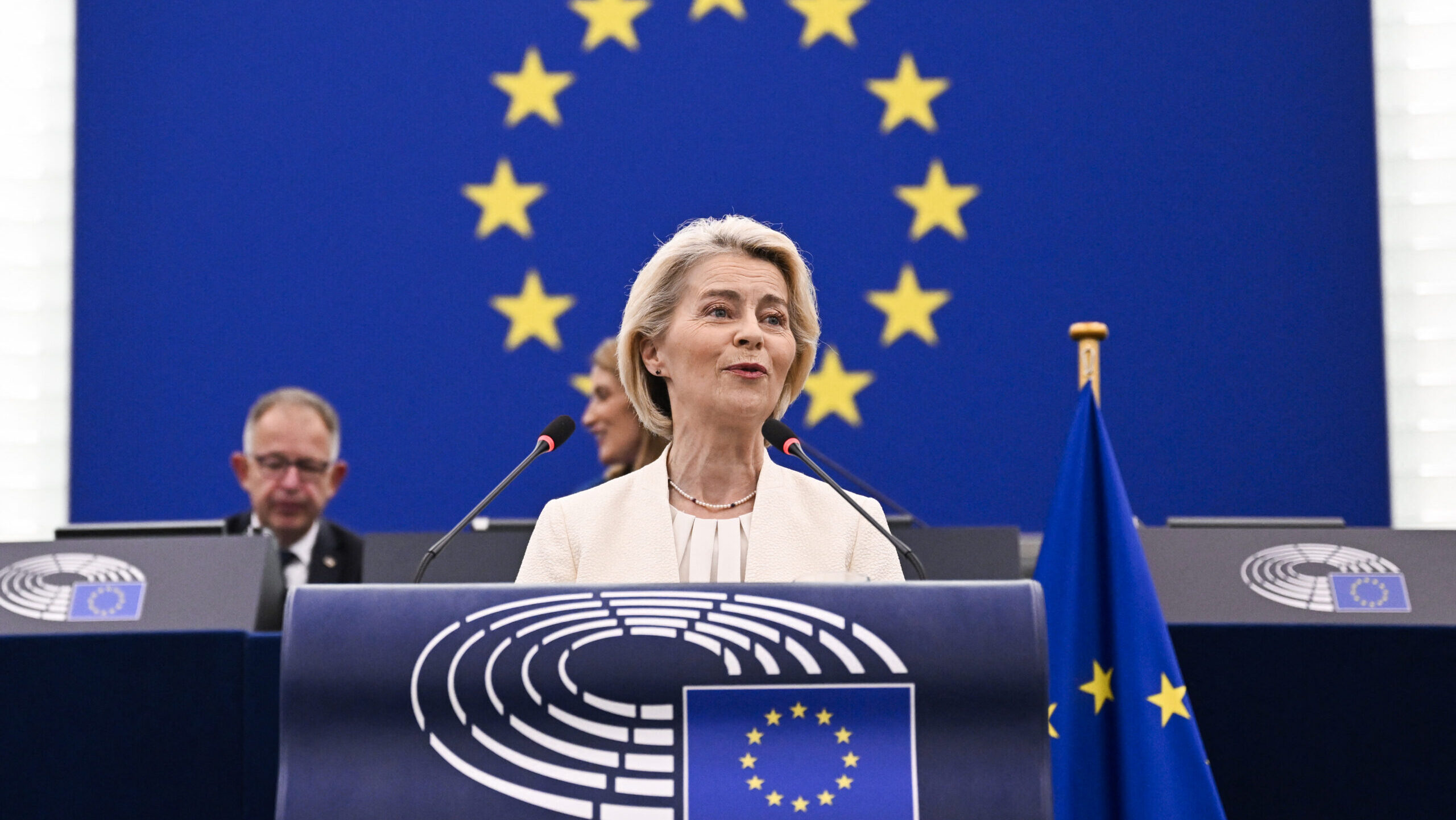
European Commission President Ursula von der Leyen delivers a speech during her annual State of the Union address at a plenary session of the European Parliament in Strasbourg, eastern France on September 16, 2026. (Photo by Jean-Christophe VERHAEGEN / AFP via Getty Images)
MILAN — The head of the European Commission today called for the urgent creation of a new EU-wide security response mechanism for hybrid attacks, which could be triggered without military aggression and complement existing NATO procedures.
During her annual State of the Union Address today, the bloc’s leader, Ursula von der Leyen, also pushed for the creation of a new security council that would involve Canada, Norway, Ukraine and the United Kingdom — all non-EU states.
“We urgently need a consensus on how to respond to certain incidents. Those which fall below armed aggression but clearly threaten our national security…It is time for Europe’s own Article 4 – or an Emergency Security Protocol,” she said in her speech .
While Article 5 is the best-known NATO standard and has been invoked only once (by the US after the 9/11 attacks), Article 4 , which von der Leyen referenced, results in a meeting of NATO members for a “consultation” about the security issue, sending a political message to the world that the alliance stands together without triggering military activity.
At this stage, this new EU mechanism is still in the pipeline, and its legal basis and powers are unknown. Questions include how the decision-making authority of the protocol would work once activated, whether it would require every member-state government to agree on what an appropriate response would be- for instance, coordinated sanctions imposed- or automatic intelligence-sharing or other predefined responses.
Von der Leyen said one member state would trigger it, and all member states would need to convene to “coordinate a European response and deter further escalation.”
The EU already has a similar clause in Article 42(7), but it concerns mutual defense — if a member state suffers armed aggression, the rest of the bloc is obligated to assist. Thus far, it has only been triggered once by France, in 2015, following terrorist attacks.
Localizing tactical communications for sovereign, NATO-ready C3I
Beyond foreign sales, Rafael’s model enables tech transfer, local engineering, and is a template for NATO partners.
Von der Leyen’s proposal follows a recent large increase in the number of sabotage threats and attacks , as well as drone incursions across Europe. The security protocol could offer a solution when a state faces a significant security threat that is not clearly armed aggression, including cyberattacks, the severing of undersea cables, or the protection of critical infrastructure.
A New European Security Council?
Another plan put forward by the EU chief was to create a new political leader forum focused on security issues.
“For a long time we have discussed a leaders’ format focused on the security of our continent. With partners like Canada, Norway, Ukraine, the UK, and others involved… This is even more urgent now,” von der Leyen said. “This is why we will set out our ideas to make a European Security Council (ESC) a reality.”
This idea has been floated several times previously, including a few years ago as an initiative that would have been Franco-German led. However, it ultimately never gained enough traction, mainly because of a lack of agreement on its structure, Luigi Scazzieri, a senior policy analyst at the European Union Institute for Security Studies, told Breaking Defense.
“Would it be a new body or an informal forum? Who would the members be? There was no appetite to set up a new body, and informal coordination frameworks outside the EU already exist… The questions of how the ESC would relate to the EU and how broad or narrow membership would be were also divisive,” Scazzieri said.
Based on details laid out in the Union Address, the expert noted that the model currently envisioned for the ESC appears to be “an inclusive and informal model” with regular dedicated meetings of the European Council, with partners also involved in conversations.
He argued that it would complement rather than rival NATO, as the topics discussed would be of a widely different nature.
“This would not be about military planning and operational command — instead the idea would be to give strategic direction to EU efforts to provide momentum and coherence to Europe’s defense build-up in terms of production and resilience across the board,” he said.
While not directly defense-related, von der Leyen had one more announcement in her speech , telling Canadian Prime Minister Mark Carney, who was in attendance , that “I would like to work with you on opening the door for Canada to be the first associate member of the EU.” That could have potential defense industrial implications down the road, as Carney has already shown a desire to increase ties across the Atlantic — though, like much of von der Leyen’s speech today, there are many questions remaining about what this might end up looking like.
2026年9月16日,欧盟委员会主席乌尔苏拉·冯德莱恩在法国东部城市斯特拉斯堡举行的欧洲议会全体会议上发表年度欧盟国情咨文。(图片来源:Jean-Christophe VERHAEGEN / AFP via Getty Images)
米兰——欧盟委员会主席今天呼吁紧急建立一种新的欧盟范围内的混合攻击安全应对机制,该机制无需军事侵略即可启动,并可作为北约现有程序的补充。
在今天发表的年度国情咨文中,欧盟领导人乌尔苏拉·冯德莱恩还推动成立一个新的安全理事会,成员包括加拿大、挪威、乌克兰和英国——所有这些国家都不是欧盟成员国。
“我们迫切需要就如何应对某些事件达成共识。这些事件虽然不属于武装侵略,但显然威胁到我们的国家安全……现在是时候制定欧洲自己的《里斯本条约》第四条——或者说紧急安全议定书了,”她在演讲中说道。
虽然第 5 条是北约最广为人知的标准,并且只被援引过一次(美国在 9/11 袭击后援引),但冯德莱恩提到的第 4 条会导致北约成员国召开会议,就安全问题进行“磋商”,向世界发出联盟团结一致的政治信号,而不会引发军事行动。
目前,这项新的欧盟机制仍在筹备阶段,其法律依据和权力尚不明确。问题包括:该议定书一旦启动,其决策权将如何运作?是否需要每个成员国政府就适当的应对措施达成一致——例如,实施协调一致的制裁,还是自动共享情报或其他预先设定的应对措施?
冯德莱恩表示,一个成员国即可触发该机制,所有成员国都需要召开会议,“协调欧洲的应对措施,并阻止事态进一步升级”。
欧盟已有类似条款,即《欧盟条约》第42条第7款,但该条款涉及共同防御——如果一个成员国遭受武装侵略,其他成员国有义务提供援助。迄今为止,该条款仅被法国在2015年恐怖袭击后启动过一次。
为主权、符合北约标准的C3I系统实现战术通信本地化
除了对外销售,拉斐尔的模式还实现了技术转让和本地工程,并为北约合作伙伴提供了一个模板。
冯德莱恩的提议源于近期欧洲范围内破坏威胁和袭击事件以及无人机入侵事件的大幅增加。该安全协议可为一国面临并非明确武装侵略的重大安全威胁(例如网络攻击、海底电缆断裂或关键基础设施保护)提供解决方案。
新的欧洲安全理事会?
欧盟主席提出的另一项计划是创建一个专注于安全问题的新政治领导人论坛。
冯德莱恩表示:“长期以来,我们一直在讨论建立一个以欧洲大陆安全为重点的领导人机制。加拿大、挪威、乌克兰、英国等伙伴国都参与其中……现在,这项工作变得更加紧迫。因此,我们将阐述我们的构想,力争使欧洲安全理事会(ESC)成为现实。”
这个想法此前曾多次被提出,包括几年前由法德两国牵头的一项倡议。然而,欧盟安全研究所高级政策分析师路易吉·斯卡齐耶里告诉《防务新闻》,该倡议最终未能获得足够的支持,主要原因是各方在组织架构方面缺乏共识。
“它会是一个新机构还是一个非正式论坛?成员会是谁?没有人愿意成立一个新机构,而且欧盟以外已经存在非正式的协调框架……欧洲社会委员会将如何与欧盟建立联系,以及成员范围是广泛还是狭窄,这些问题也存在分歧,”斯卡齐耶里说。
根据欧盟讲话中阐述的细节,专家指出,目前设想的欧洲社会委员会模式似乎是“一种包容性和非正式的模式”,欧洲理事会定期举行专门会议,合作伙伴也参与对话。
他认为,这将与北约形成互补而非竞争关系,因为讨论的主题性质截然不同。
他说:“这并非关乎军事计划和作战指挥,而是旨在为欧盟的努力提供战略方向,从而在生产和韧性方面全面推动和协调欧洲的国防建设。”
虽然与国防没有直接关联,但冯德莱恩在演讲中还宣布了另一项内容。她告诉在场的加拿大总理马克·卡尼:“我希望与您合作,为加拿大成为欧盟首个准成员国敞开大门。” 这可能会对未来的国防工业产生潜在影响,因为卡尼已经表现出加强跨大西洋联系的意愿——不过,就像冯德莱恩今天演讲中的许多其他内容一样,最终结果如何仍有很多疑问。