Apache Crew Rescue Highlights Need For AI In Combat Says Joint Chiefs Chairman参谋长联席会议主席表示,阿帕奇直升机机组人员救援行动凸显了人工智能在战斗中的必要性。
AI enabled troops to manage networks of unmanned systems across thousands of miles of water and to pull assets together for a quick rescue.
Published Sep 16, 2026 3:36 PM EDT
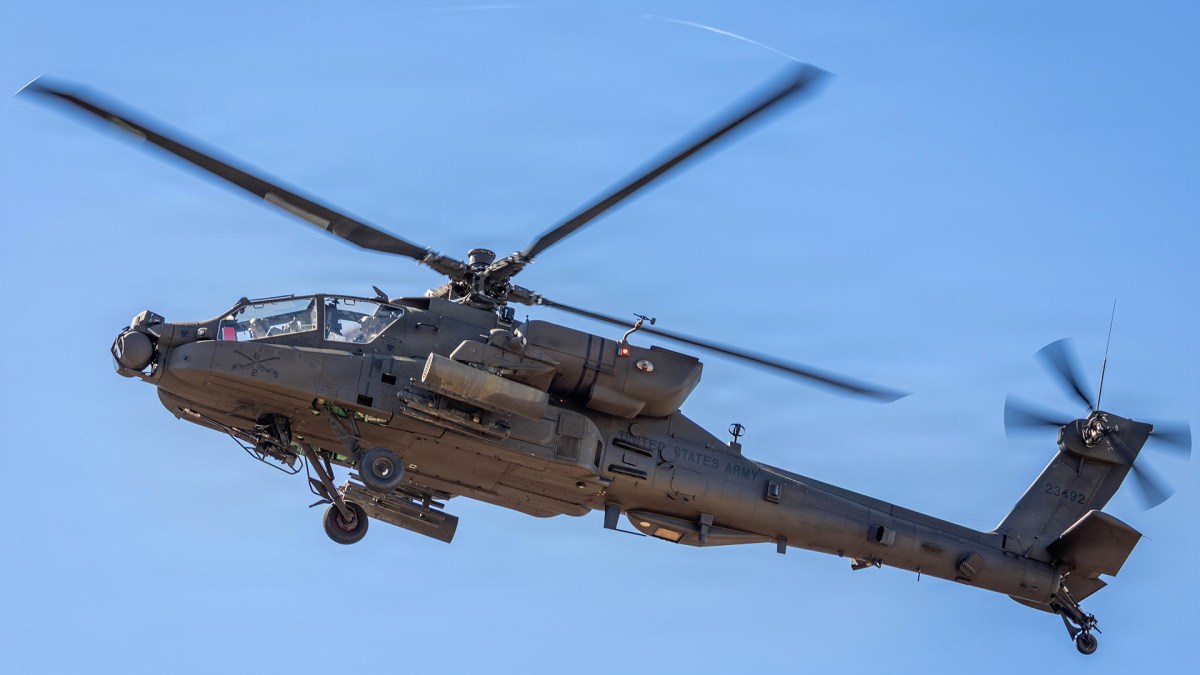
(U.S. Army Photo by Sgt. Olivia Cowart)
The U.S. military’s top officer on Wednesday talked about how AI is changing the character of warfare and offered two examples to illustrate his points. His comments included new insights into how two U.S. Army AH-64 Apache crew members were rescued after being shot down by an Iranian drone near the coast of Oman in June. The recovery effort involved America’s first known use of an uncrewed surface vessel (USV) executing a personnel recovery action as part of a military search and rescue operation.
“Information moves so fast that leader decision times have compressed from weeks down to days down to seconds,” explained Air Force Gen. Dan Caine, chairman of the Joint Chiefs of Staff, during his keynote speech at the Air & Space Forces Air, Space and Cyber Conference that TWZ is attending. “In the future fight, advantage will go to the side who can see first, who can understand first, decide first, and act first, and along the way, be a learning organization, and no factor is accelerating change as fast as artificial intelligence and advancing cyber capabilities.”
“AI is here now, and it’s already changing the way militaries see, sense, decide, and act across the joint force,” the chairman proclaimed.
The first example Caine used to highlight these changes took place on June 8. After the Apache went down, “U.S. CENTCOM launched a rapid, responsive joint search and rescue effort to recover the crew. That response drew on the totality of the joint force, and ultimately was required to use enabled unmanned vessels to participate in the rescue of downed U.S. service members for the first time ever.”
A flight of U.S. Army AH-64 Apache attack helicopters, armed with rockets and Hellfire missiles, taxi out to conduct a scheduled flight in the U.S. Central Command area of responsibility. In addition to rockets and missiles, the Apache is additionally armed with a 30mm chain gun. (U.S. Army photo) U.S. Army Central
As we noted in our previous coverage , CENTCOM deployed “a U.S. Navy Corsair unmanned surface vessel,” the command’s spokesman told us at the time.
The Corsair uncrewed surface vessel (USV) (Saronic)
The ability to pull off that rescue mission “did not appear overnight,” Caine pointed out. “It came from the men and women of Task Force 59 , CENTCOM’s forward-leaning unmanned joint maritime unit who spent the last several years testing, integrating, and operationalizing unmanned systems and AI in one of the most demanding and kinetic environments on Earth right now.”
“What helped make this possible was not a bunch of general officers and flag officers,” Caine continued. “What made this possible was a bunch of entrepreneurial sailors and members of the joint force on watch floors, at piers, managing networks of unmanned systems across thousands of miles of water, and using AI to turn massive amounts of data into a crisp, clear, perfect maritime picture that allowed us to go grab those two soldiers in the water.”
A top-down view of the Saronic Corsair USV. (Saronic)
The second example Caine shared about the use of AI “points in the other direction, not how quickly we are using these tools, but how quickly these tools are changing the threat.”
In Ukraine, “we see first-person view drones operating in heavily contested EMI [ electromagnetic interference ] environments. Some now using AI-enabled computer vision to continue to drive towards targets, even when there’s no GPS or the links are cut. That gives small units affordable precision and shows how quickly software and autonomy are changing what is possible at the tactical edge, and the results are stark.”
The use of AI to enable lower-end drone warfare is a topic TWZ has been among the first to point out .
“In certain locations on the front line of troops right now, the life expectancy of a new Russian recruit arriving on the front lines is as little as 20 to 30 minutes,” Caine added. “Think about that. This is what happens when low-cost precision is fielded fast, adapted quickly, and scaled across the battlefield.”
“The price of lethal exchange is decreasing day over day,” the chairman noted. “One wonders what the future of close air support looks like, but I am comforted by the fact that each and every one of you are in this room thinking about that. Taken together, these examples from the Straits of Hormuz to the front lines in Ukraine show how quickly technology is changing the character of war, and this means our joint force needs to do two things at one time.”
“[w]e need to prepare the joint force to win in this kind of conflict,” the general stated. “We have to assume from now on that our formations will be hunted by autonomous systems, jammed across the spectrum, and tracked in real time, and we have to transition the joint force to be prepared to fight and win our future war by generating and delivering lethality at scale with an agile, optimized, high-low mix of combat capabilities to give the young members of the 2.8-million member all volunteer joint force the tools that they need before they need them.”
Contact the author: howard@twz.com
Comments couldn’t be loaded. Please refresh the page.
发布于美国东部时间2026年9月16日下午3:36
(美国陆军中士奥利维亚·考沃特摄)
美国军方最高指挥官周三谈到人工智能如何改变战争的性质,并举了两个例子来说明他的观点。他的发言中包含了关于两名美国陆军AH-64“阿帕奇”武装直升机机组人员在6月份于阿曼海岸附近被伊朗无人机击落后获救的最新进展。此次救援行动是美国首次使用无人水面艇(USV)执行人员营救任务,作为军事搜救行动的一部分。
“信息传播速度如此之快,以至于领导者的决策时间已经从数周缩短到数天,甚至缩短到数秒,”美国参谋长联席会议主席、空军上将丹·凯恩在TWZ出席的空军与太空部队空中、太空和网络会议上发表主旨演讲时解释道。“在未来的战争中,优势将属于那些能够先人一步洞察、先人一步理解、先人一步决策和先人一步行动的一方,并且在此过程中,还要成为一个不断学习的组织。没有任何因素比人工智能和不断提升的网络能力更能加速变革。”
“人工智能已经到来,它正在改变军队在整个联合部队中观察、感知、决策和行动的方式,”主席宣称。
凯恩用来强调这些变化的第一个例子发生在6月8日。阿帕奇直升机坠毁后,“美国中央司令部迅速启动了联合搜救行动,营救机组人员。这次行动动用了联合部队的全部力量,并最终首次动用了具备作战能力的无人船艇参与营救被击落的美国军人。”
一队装备火箭弹和地狱火导弹的美国陆军AH-64“阿帕奇”攻击直升机滑行至美国中央司令部责任区,准备执行例行飞行任务。除了火箭弹和导弹外,“阿帕奇”还配备了一门30毫米链式机炮。(美国陆军照片)美国陆军中央司令部
正如我们在之前的报道中提到的,中央司令部部署了“一艘美国海军海盗式无人水面舰艇”,该司令部发言人当时告诉我们。
海盗号无人水面艇(USV)(萨罗尼克)
凯恩指出,成功完成那次救援任务的能力“并非一朝一夕就能取得”。“这要归功于第59特遣部队的官兵们,这是中央司令部一支前瞻性的无人联合海上部队,他们在过去几年里一直在地球上最严苛、最瞬息万变的环境之一中测试、整合和部署无人系统和人工智能。”
凯恩继续说道:“促成此事的并非一群将军和高级军官,而是一群富有进取心的水兵和联合部队成员,他们在值班室、码头,管理着横跨数千英里水域的无人系统网络,并利用人工智能将海量数据转化为清晰、完美的海洋图像,使我们能够救起落水的两名士兵。”
萨罗尼克海盗无人水面艇的俯视图。(萨罗尼克公司)
凯恩分享的第二个关于人工智能应用的例子“指向了另一个方向,不是我们使用这些工具的速度有多快,而是这些工具改变威胁的速度有多快。”
在乌克兰,“我们看到第一人称视角无人机在电磁干扰严重的环境中运行。一些无人机现在使用人工智能计算机视觉技术,即使在没有GPS或链路中断的情况下也能继续向目标飞行。这使得小型单位能够以较低的成本实现精确打击,并表明软件和自主技术正在以惊人的速度改变战术前沿的可能性,其结果令人瞩目。”
利用人工智能实现低端无人机作战是 TWZ 最早指出的一个话题。
凯恩补充道:“目前在某些前线地区,一名新兵抵达前线后的平均寿命只有20到30分钟。想想看,这就是低成本、高精度武器快速部署、迅速调整并在整个战场上推广应用的结果。”
“致命性交火的代价正在逐日降低,”主席指出。“人们不禁会思考近距离空中支援的未来走向,但令我感到欣慰的是,在座的各位都在思考这个问题。从霍尔木兹海峡到乌克兰前线,这些例子共同表明,科技正在以惊人的速度改变战争的性质,这意味着我们的联合部队需要同时做好两件事。”
“我们需要让联合部队做好准备,赢得这类冲突,”这位将军说道。“从现在开始,我们必须假设我们的部队将受到自主系统的猎杀、全方位的干扰和实时跟踪。我们必须让联合部队做好准备,通过敏捷、优化、高低结合的作战能力,大规模地生成和提供杀伤力,从而赢得未来的战争。这样,我们才能让这支拥有280万成员的全志愿联合部队的年轻成员在需要之前就掌握所需的工具。”
联系作者:howard@twz.com
评论加载失败,请刷新页面。