3 days on track, 362 days behind the scenes: Meet the team running the Singapore F1 race赛道上3天,幕后362天:认识新加坡F1赛事运营团队
The year-round operation covers everything from crowd safety and ticketing logistics to tracking global events that could impact the Singapore race.
The year-round operation covers everything from crowd safety and ticketing logistics to tracking global events that could impact the Singapore race.
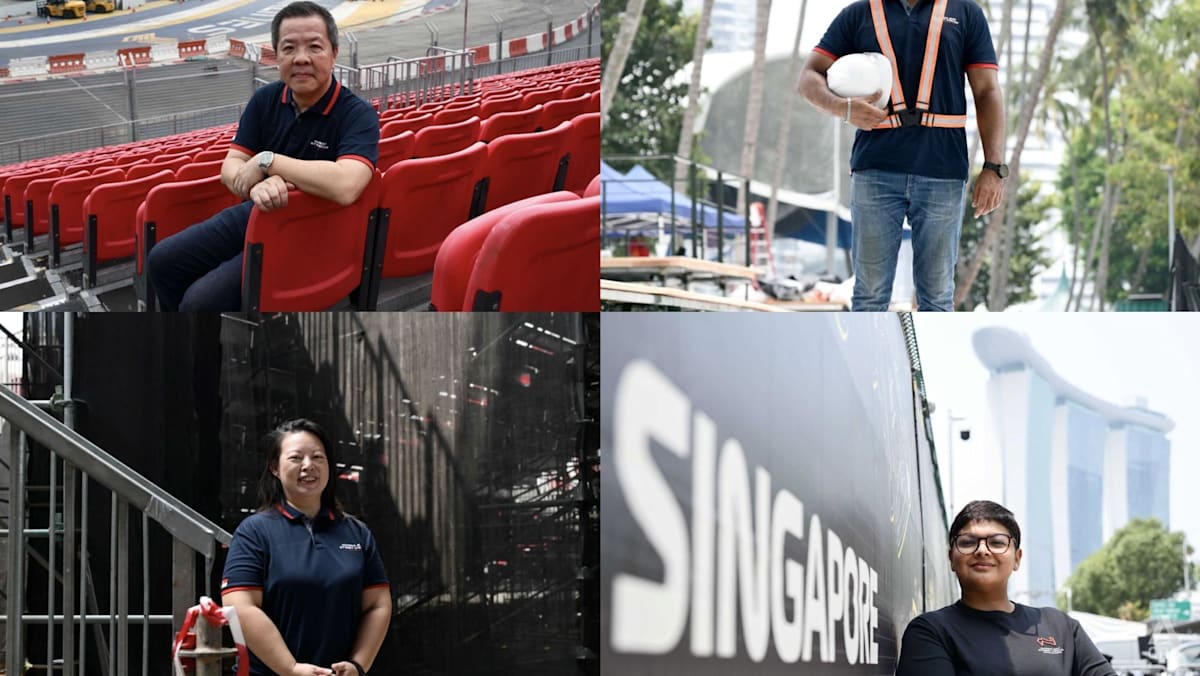
(Clockwise, from top left) Singapore GP's director of ticketing and accreditation Clarence Lai, senior manager of event facilities Shiv Raj Panday, senior director for marketing and partnerships Sasha Rafi and director of operations Melissa Phua. (Photos: CNA/Wallace Woon)
This audio is generated by an AI tool.
SINGAPORE: By 1am on Monday, the Padang's concert stages are dark and the roar of Formula 1 engines has faded. But on the Marina Bay Street Circuit, another race against the clock has just begun.
Mr Shiv Raj Panday and his technical crew have exactly four and a half hours to tear down parts of the track and reopen the roads to the public. By 5.30am, morning traffic will fill the very lanes where race cars hit speeds of over 300 km/h just hours earlier.
While the Singapore Grand Prix is a three-day spectacle for F1 teams and spectators, putting on the annual race is an unrelenting year-round operation by race promoter Singapore GP.
For the remaining 362 days of the year, the work for the next race begins right away and spans the gamut of sports event management, ranging from ticketing, planning crowd movements, marketing and monitoring global developments that could affect demand.
CNA Games Guess Word Crack the word, one row at a time Buzzword Create words using the given letters Mini Sudoku Tiny puzzle, mighty brain teaser Mini Crossword Small grid, big challenge Word Search Spot as many words as you can Show More Show Less As one of 70 full-time staff at the firm, Mr Raj, a senior manager who oversees event facilities in the technical department, told CNA that his team conducts numerous feasibility studies throughout the year. "We will take at least about two, three months to plan, before commencing set-up and build of the circuit,” he said. Much effort is also spent exploring how to better utilise the limited space within the circuit park, said Mr Raj, who was working for one of the race’s contractors from 2010 to 2023 before joining Singapore GP. This post-race routine has been the team's annual mission since the inaugural Singapore F1 race held at Marina Bay in 2008, except when the race was cancelled in 2020 and 2021 due to the COVID-19 pandemic. This year's race takes place from Oct 9 to Oct 11, the latest it has ever been held in a calendar year. Singapore renewed its contract for the fourth time in January 2022, with the latest deal granting Singapore the rights to host the race for seven more years until 2028. YEARLY RESET Mr Clarence Lai, director of ticketing and accreditation at Singapore GP, said the amount of time spent preparing for the event is "enormous”, even as most people think of the F1 race as a mere three-day affair. Ticketing for each race, for instance, is an “endless” year-round task which kicks off with the "super early bird" sales in race week of the year before, and runs until the race where the cycle restarts, said Mr Lai, who was assistant director from 2011 to 2013 before returning as director in 2022. His team handles issues related to access to the circuit, such as tickets for the public and accreditation for vendors and contractors. They look at the seating capacity and whether new grandstands are needed to accommodate the crowd, and also review the customer experience.
As one of 70 full-time staff at the firm, Mr Raj, a senior manager who oversees event facilities in the technical department, told CNA that his team conducts numerous feasibility studies throughout the year.
"We will take at least about two, three months to plan, before commencing set-up and build of the circuit,” he said.
Much effort is also spent exploring how to better utilise the limited space within the circuit park, said Mr Raj, who was working for one of the race’s contractors from 2010 to 2023 before joining Singapore GP.
This post-race routine has been the team's annual mission since the inaugural Singapore F1 race held at Marina Bay in 2008, except when the race was cancelled in 2020 and 2021 due to the COVID-19 pandemic.
This year's race takes place from Oct 9 to Oct 11, the latest it has ever been held in a calendar year.
Singapore renewed its contract for the fourth time in January 2022, with the latest deal granting Singapore the rights to host the race for seven more years until 2028.
Mr Clarence Lai, director of ticketing and accreditation at Singapore GP, said the amount of time spent preparing for the event is "enormous”, even as most people think of the F1 race as a mere three-day affair.
Ticketing for each race, for instance, is an “endless” year-round task which kicks off with the "super early bird" sales in race week of the year before, and runs until the race where the cycle restarts, said Mr Lai, who was assistant director from 2011 to 2013 before returning as director in 2022.
His team handles issues related to access to the circuit, such as tickets for the public and accreditation for vendors and contractors.
They look at the seating capacity and whether new grandstands are needed to accommodate the crowd, and also review the customer experience.
Formula One F1 - Singapore Grand Prix - Marina Bay Street Circuit, Singapore - October 5, 2025 McLaren's Lando Norris, McLaren's Oscar Piastri, Mercedes' George Russell and Red Bull's Max Verstappen in action during the race REUTERS/Athit Perawongmetha
For instance, Singapore GP introduced mobile ticketing last year, which helped curb ticket scams, he said.
Before that, there was a risk of scams as people could be sold duplicate digital tickets in PDF format from third-party sellers, he added.
Ms Sasha Rafi, senior director for marketing and partnerships, said that right after each race concludes, a review is conducted to see what went well and what did not, across elements such as marketing, sustainability and stakeholder engagement, including with the government and private sector.
“Even before the race takes place, we are already planning for next year,” said Ms Sasha, one of the firm’s earliest joiners who came on board in October 2007.
Her team spends months thinking of how to sell the event in a way that is fresh every year.
“It's really going out to see what is the latest in tech that could be applied and is relevant to our event. Looking at what is trending in entertainment, what exactly people are spending on,” she said.
They also spend lots of time monitoring global events, because if there is a war or something affecting the economy, it would also impact an event like the Singapore F1 race, said Ms Sasha.
She highlighted one new marketing initiative this year – a new two-day sprint bundle ticketing package.
Singapore hosts one of six sprint races on the F1 calendar this year, with sprint qualifying happening on Friday and the sprint race taking place on Saturday.
The sprint is a shorter race that is separate from the main race. It covers 100 km – about a third of a typical full race distance – and lasts about 30 minutes with no pit stops.
“We have looked at bundling and packages of different kinds over the years,” she said.
“When we look at the sprint bundle, it is one of the only few times that we have a two-day ticket package. We've always had three-day or single-day (packages).”
The sprint is a relatively new format in F1 and this is the first time it is happening in Singapore, so the team wanted to appeal to customers who do not want to head down for all three days but want to catch the sprint, said Ms Sasha.
Ms Sasha also confirmed that the super early bird tickets for 2027's race will once again go on sale this year.
Formula One F1 - Singapore Grand Prix - Marina Bay Street Circuit, Singapore - October 3, 2025 Red Bull's Max Verstappen during practice REUTERS/Athit Perawongmetha
ENGINEERING AROUND A CITY
In the Marina Bay circuit, some of the grandstands are built one and a half months before the race, which can lead to last-minute issues.
For instance, even though a grandstand might be located in the same spot for several years, there could be rows missing or a change in actual layout after the grandstands are rebuilt, which Mr Lai’s team has to address.
“We do our best to really make sure that all the seats are there, there're no missing seats and the seats are properly labeled. We also check the condition of the seats as well,” said Mr Lai, adding that they are exposed to the natural elements, such as wind and rain.
For his team, one key challenge is working under strict time constraints when assembling and dismantling the grandstands and facilities within the circuit park.
“Sometimes when there're events going on for certain stakeholders, we have to work out the timing as to when is the earliest they can hand over the space to us,” said Mr Raj.
He cited the example of Connaught Grandstand, located at the end of Esplanade Bridge, sits along a “live” road which is still open to public vehicles.
His team works around tight schedules to construct it. When they close off the road in the wee hours of Wednesday morning on race week, they only have a limited time to set up before they have to reopen the road for the morning traffic, said Mr Raj.
The same goes for the post-race rush on Sunday night. The priority is to re-open certain parts of the race track for use as public roads, such as Esplanade Drive, by 5.30am on Monday, said Mr Raj.
Ms Melissa Phua, Singapore GP’s director of operations who has been with the firm since 2008, said her work involves schools as well.
She spends a large part of her year engaging with students from the Institute of Technical Education and Republic Polytechnic, as Singapore GP provides training and employment opportunities for nearly 1,000 of them across the circuit park each year.
They perform roles such as grandstand and gate officials, and take care of the general welfare of patrons at the event, said Ms Phua.
Her team also has to assess and ensure public safety arrangements within the circuit park, including the movement and dispersal of the massive crowds.
“I think part of our KPI (key performance indicator) is also in making sure that they leave safely. We would hate to see complaints from patrons who were not happy after the event or we didn’t meet their satisfaction,” she said.
The main issue every year is the crowd leaving the area after the nightly concerts at the Padang, with most making their way to the MRT stations to catch the late trains home, said Ms Phua.
“So we are on the ground, making sure that all the necessary gates are open and everyone leaves according to the planned routes for effective dispersal,” she said, adding that some spectators may be unhappy as they may be diverted away from the path they took to enter the circuit park.
“It's about making sure that ushers are there and we are there on the ground, making sure that nobody gets yelled at or gets crushed.”
KEEPING SINGAPORE RELEVANT
Ms Sasha said that in the initial years, efforts were focused on marketing to Singaporeans what Formula 1 was, and also introducing the race to international audiences.
Today, the challenge has changed. With the Marina Bay race established internationally, the focus is increasingly on attracting repeat visitors and convincing fans to choose Singapore in a crowded calendar of 24 races, she said.
“When I first started, Formula 1 wasn't something that was known to most Singaporeans. It was seen in the first few years by some as an elitist sport,” she said.
To counter that, Singapore GP introduced a variety of product categories that would appeal to a wide demographic, including sports fans, corporate visitors who are networking, and locals attending more for the entertainment, she added.
“We were the first circuit in Formula 1 to actually inject entertainment into the racing experience that you get over the weekend,” said Ms Sasha.
Fans at G-Dragon's show on Oct 3, 2025. (Photo: Singapore GP Pte Ltd)
Noting that the Singapore race in 2026 is very different from how things were in 2008, Ms Sasha said the team has also had to adapt to infrastructural changes along the way. For instance, the track was modified in 2023 to run behind the Floating Platform, as one of F1’s largest grandstands made way for the development of NS Square.
For Mr Lai, the challenges for ticketing and seating comes with the nature of the temporary street circuit that is torn down and rebuilt every year.
“It's unlike a fixed venue, let's say, the National Stadium. The seats are always there, so most of the time you won't go wrong, it will not disappear,” he said.
SINGAPORE GP'S LONG GAME
Mr Lai shared that the team has still not managed to replace the number of seats lost from the removal of the Bay Grandstand, and have had to think of ways to maximise the capacity and vantage point for visitors over the years.
This year, the grandstand at Turn 2 – just after the exit from the pit straight – will be merged from two into one big one, while additional viewing platforms have also been installed alongside.
While staging a race in the city means that people can disperse in multiple directions, the area takes on a very unfamiliar look when it transforms into circuit park, noted Ms Phua.
There are also many foreigners who may not know where to go, she said.
“Even for ourselves, when we close up the track, it can be unfamiliar at times as the path isn't as straightforward,” she said.
She recalled the challenge of 2022, when the race was delayed by an hour due to heavy rain.
The crowd watches awarding ceremonies at the Singapore Formula One Grand Prix, at the Marina Bay City Circuit in Singapore, Sunday, Oct. 2, 2022. (AP Photo/Vincent Thian)
“We never had that kind of race delay before of that scale. It affected our dispersal plans as we had to make sure the students and patrons leave on time in order to catch the last train,” she said.
On the back-end, they had to move fast to secure approvals to further extend the train timings. The MRT trains typically already run later on race weekends.
Her team also had to ensure messages and information were shown on the screens around the circuit park, to keep visitors updated.
“I think that kind of coordination really helped us to seal how well the team works together as a whole,” said Ms Phua.
Ms Sasha shared that interactions with foreigners abroad have really hit home just how far the team has come from 2008, and how much the Singapore Grand Prix has grown.
“I think what amazes me the most is when I travel, be it for personal trips or for work, I am amazed at how, when I say I am from Singapore, people say, ‘You have a Formula 1 race in your country. I've seen it on TV and it's on my bucket list to attend’,” she said.
A single handpicked story that we think you shouldn't miss. Just one a day.
Get our pick of top stories and thought-provoking articles in your inbox
Stay updated with notifications for breaking news and our best stories
Join our channel for the top reads for the day on your preferred chat app
全年运营涵盖从人群安全和票务物流到跟踪可能影响新加坡赛事的全球事件等方方面面。
(顺时针方向,从左上角开始)新加坡大奖赛票务及认证总监赖嘉伦(Clarence Lai)、赛事设施高级经理希夫·拉杰·潘迪(Shiv Raj Panday)、市场营销及合作关系高级总监萨莎·拉菲(Sasha Rafi)和运营总监梅丽莎·普阿(Melissa Phua)。(图片:CNA/Wallace Woon)
这段音频是由人工智能工具生成的。
新加坡:周一凌晨1点,政府大厦草场的演唱会舞台已经熄灭,一级方程式赛车的引擎轰鸣声也已消散。但在滨海湾街道赛道上,另一场与时间的赛跑才刚刚开始。
希夫·拉杰·潘迪先生和他的技术团队只有四个半小时的时间来拆除部分赛道,重新开放道路。到早上5点30分,早高峰的车流将挤满这些车道,而就在几个小时前,赛车还在这些车道上以超过300公里/小时的速度飞驰。
虽然新加坡大奖赛对于F1车队和观众来说是一场为期三天的盛事,但举办这项年度赛事却是赛事推广方新加坡大奖赛全年不懈的努力。
一年中剩下的 362 天里,下一场比赛的筹备工作立即开始,涵盖体育赛事管理的各个方面,包括票务、人群流动规划、市场营销以及监测可能影响需求的全球发展动态。
CNA游戏 猜词游戏 逐行破解单词 流行词游戏 用给定的字母组成单词 迷你数独 小谜题,脑力挑战 迷你填字游戏 小方格,大挑战 单词搜索 尽可能多地找出单词 显示更多 显示更少 作为公司70名全职员工之一,技术部门负责赛事设施的高级经理Raj先生告诉CNA,他的团队全年都会进行大量的可行性研究。“在开始赛道的搭建和建设之前,我们至少需要两到三个月的时间来规划,”他说。Raj先生还表示,他们也投入了大量精力来探索如何更好地利用赛道公园内有限的空间。在加入新加坡大奖赛之前,他曾于2010年至2023年为该赛事的承包商之一工作。自2008年首届新加坡F1大奖赛在滨海湾举行以来,赛后例行活动一直是车队的年度惯例,但2020年和2021年因新冠疫情取消比赛的情况除外。今年的比赛将于10月9日至11日举行,是历年来举办时间最晚的一次。新加坡于2022年1月第四次续签了赛事举办权,最新协议授予新加坡未来七年举办该赛事的权利,直至2028年。新加坡大奖赛票务及认证总监赖先生表示,尽管大多数人认为F1比赛只是一场为期三天的赛事,但筹备工作耗时“非常巨大”。例如,每场比赛的门票销售都是一项“永无止境”的全年工作,从前一年比赛周的“超级早鸟票”销售开始,一直持续到比赛当天,然后循环往复。赖先生说道,他曾在2011年至2013年担任助理总监,并于2022年重返总监一职。他的团队负责处理与赛道准入相关的各种事宜,例如公众门票以及供应商和承包商的认证。他们会评估座位容量,考虑是否需要新建看台来容纳观众,并审查客户体验。
作为该公司 70 名全职员工之一,技术部门负责活动设施的高级经理 Raj 先生告诉 CNA,他的团队全年都会进行大量的可行性研究。
他说:“在开始赛道的搭建和建设之前,我们至少需要两到三个月的时间来制定计划。”
Raj 先生表示,他们还投入了大量精力来探索如何更好地利用赛道公园内有限的空间。Raj 先生曾在 2010 年至 2023 年期间为该赛事的承包商之一工作,之后加入新加坡大奖赛。
自 2008 年在滨海湾举行的首届新加坡 F1 比赛以来,赛后例行活动一直是该车队的年度任务,但 2020 年和 2021 年由于 COVID-19 疫情而取消了比赛。
今年的比赛将于 10 月 9 日至 10 月 11 日举行,这是该赛事在历年中举办时间最晚的一次。
新加坡于 2022 年 1 月第四次续签了合同,最新协议授予新加坡在未来七年内举办该赛事的权利,直至 2028 年。
新加坡大奖赛票务及认证总监赖先生表示,尽管大多数人认为F1比赛只是一场为期三天的赛事,但筹备这项赛事所花费的时间却是“巨大的”。
例如,每场比赛的门票销售都是一项“永无止境”的全年性工作,从前一年比赛周的“超级早鸟票”销售开始,一直持续到比赛当天,然后循环往复。赖先生说道,他曾在 2011 年至 2013 年担任助理总监,之后于 2022 年重返总监岗位。
他的团队负责处理与赛道准入相关的问题,例如公众门票和供应商及承包商的认证。
他们会考察座位容量,以及是否需要新建看台来容纳观众,还会审查顾客体验。
一级方程式赛车(F1)——新加坡大奖赛——新加坡滨海湾街道赛道——2025年10月5日 迈凯伦车队的兰多·诺里斯、奥斯卡·皮亚斯特里、梅赛德斯车队的乔治·拉塞尔和红牛车队的马克斯·维斯塔潘在比赛中驰骋赛道 路透社/Athit Perawongmetha
他举例说,新加坡大奖赛去年推出了手机购票系统,这有助于遏制票务诈骗。
他还补充说,在此之前,存在诈骗风险,因为人们可能会从第三方卖家那里买到PDF格式的重复电子票。
市场营销和合作关系高级总监萨沙·拉菲女士表示,每场比赛结束后,都会进行一次审查,看看在市场营销、可持续性和利益相关者参与(包括与政府和私营部门的合作)等各个方面,哪些方面做得好,哪些方面做得不好。
“甚至在比赛开始之前,我们就已经在为明年做准备了,”萨沙女士说道。她是该公司最早的员工之一,于 2007 年 10 月加入公司。
她的团队每年都要花几个月的时间思考如何以新颖的方式推销这个活动。
“我们真正想做的就是了解最新的科技发展趋势,看看哪些技术可以应用到我们的活动中,哪些技术与我们的活动相关。我们要关注娱乐领域的流行趋势,以及人们究竟在哪些方面花钱,”她说道。
萨沙女士说,他们还会花大量时间关注全球事件,因为如果发生战争或影响经济的事情,也会影响到像新加坡F1赛车这样的赛事。
她重点介绍了今年的一项新营销举措——新的两日冲刺套餐票务包。
新加坡是今年F1赛历上六场冲刺赛之一的举办地,冲刺赛排位赛将于周五举行,冲刺赛将于周六举行。
短距离赛是与主赛分开进行的短距离比赛。全程100公里——大约是完整比赛距离的三分之一——比赛时长约30分钟,期间没有中途停留。
“多年来,我们一直在研究各种类型的捆绑销售和套餐,”她说。
“当我们查看冲刺套餐时,会发现这是我们极少数提供两天票务套餐的情况之一。我们一直以来提供的都是三天或单日票务套餐。”
萨沙女士表示,冲刺赛是F1中一种相对较新的赛制,也是第一次在新加坡举行,因此车队希望吸引那些不想连续三天都来,但又想观看冲刺赛的顾客。
萨沙女士还确认,2027 年比赛的超级早鸟票将于今年再次开售。
一级方程式赛车(F1)——新加坡大奖赛——新加坡滨海湾街道赛道——2025年10月3日,红牛车队的马克斯·维斯塔潘在练习赛中。路透社/Athit Perawongmetha
城市周边工程
在滨海湾赛道,一些看台是在比赛前一个半月才搭建起来的,这可能会导致一些最后一刻出现问题。
例如,即使看台可能在同一个位置待了好几年,但重建看台后可能会出现缺座或实际布局发生变化的情况,赖先生的团队必须解决这些问题。
赖先生说:“我们尽最大努力确保所有座位都在,没有缺失,并且座位都贴有正确的标签。我们还会检查座位的状况。”他还补充说,这些座位会受到风吹雨打等自然因素的影响。
对于他的团队来说,一个关键挑战是在赛道公园内组装和拆卸看台和设施时,需要在严格的时间限制下工作。
Raj 先生说:“有时候,当某些利益相关者举办活动时,我们必须确定他们最早什么时候能把场地移交给我们。”
他以康诺特大看台为例,该看台位于滨海大道桥的尽头,坐落在一条仍然对公众车辆开放的“繁忙”道路上。
他的团队需要在紧迫的时间安排下进行搭建。拉杰先生说,在比赛周的周三凌晨,他们会封闭道路,但只有有限的时间进行搭建,之后就必须重新开放道路,以保证早高峰的交通。
周日晚间赛后交通高峰期的情况也类似。拉杰先生表示,首要任务是在周一早上5点30分前重新开放赛道的部分路段,例如滨海大道,作为公共道路使用。
新加坡GP运营总监Melissa Phua女士自2008年起就在该公司工作,她说她的工作也涉及学校。
她一年中的大部分时间都与工艺教育学院和共和理工学院的学生互动,因为新加坡大奖赛每年都会在赛道园区内为他们提供近 1000 个培训和就业机会。
傅女士说,他们担任看台和检票员等职务,并负责活动参与者的整体福利。
她的团队还必须评估和确保赛道公园内的公共安全安排,包括大量人群的流动和疏散。
“我认为确保他们安全离开也是我们关键绩效指标的一部分。我们最不希望看到的就是活动结束后顾客不满意或我们没有达到他们的期望而提出投诉,”她说。
潘女士表示,每年最大的问题是,在巴东广场举行的夜间音乐会结束后,人群纷纷离开,其中大多数人前往地铁站搭乘晚班火车回家。
“所以我们正在现场,确保所有必要的入口都已打开,每个人都按照计划路线离开,以便有效疏散,”她说道,并补充说,一些观众可能会不高兴,因为他们可能会被引导偏离进入赛道公园的路线。
“关键是要确保有引导员在场,我们也要在现场维持秩序,确保没有人被呵斥或被挤压。”
保持新加坡的相关性
萨沙女士表示,在最初几年,工作的重点是向新加坡人推广一级方程式赛车,同时也向国际观众介绍这项赛事。
她表示,如今的挑战已经改变。随着滨海湾金枪鱼赛在国际上确立地位,重点越来越放在吸引回头客,以及在24场赛事的密集赛程中说服粉丝选择新加坡上赛。
“我刚开始接触一级方程式赛车的时候,大多数新加坡人并不了解这项运动。在最初几年里,有些人甚至把它视为一项精英运动,”她说道。
她补充说,为了应对这种情况,新加坡大奖赛推出了各种产品类别,以吸引广泛的人群,包括体育迷、前来拓展人脉的企业访客以及更多是为了娱乐而来的当地人。
萨沙女士说:“我们是F1赛车中第一个真正将娱乐元素融入周末比赛体验的赛道。”
2025年10月3日,G-Dragon演唱会现场的粉丝。(图片:新加坡GP私人有限公司)
萨沙女士指出,2026年的新加坡站与2008年的情况截然不同,车队也必须适应基础设施的变化。例如,由于F1最大的看台之一被拆除,为NS广场的开发让路,赛道在2023年进行了改造,改道至浮动平台后方。
对于赖先生来说,票务和座位安排方面的挑战在于,这条临时街道赛道每年都要拆除重建。
“这不像像国家体育场那样是固定的场地。座位一直都在那里,所以大多数情况下你不会出错,它不会消失,”他说。
新加坡大奖赛的长远策略
赖先生表示,由于海湾大看台被拆除,球队至今仍未能弥补损失的座位数量,多年来,他们不得不思考如何最大限度地提高球场容量,并为游客提供更好的观景位置。
今年,位于 2 号弯(维修站直道出口之后)的看台将从两个合并成一个大看台,同时旁边还增设了观景平台。
傅女士指出,虽然在城市里举办比赛意味着人们可以向各个方向分散,但当该地区变成赛道公园时,它就会呈现出非常陌生的景象。
她还说,也有很多外国人可能不知道该去哪里。
“即使对我们自己来说,当我们关闭赛道时,有时也会感到陌生,因为道路不再那么笔直,”她说。
她回忆起 2022 年的挑战,当时由于暴雨,比赛推迟了一个小时。
2022年10月2日星期日,在新加坡滨海湾城市赛道举行的F1新加坡大奖赛上,人群正在观看颁奖典礼。(美联社照片/Vincent Thian)
“我们以前从未遇到过如此大规模的比赛延误。这影响了我们的疏散计划,因为我们必须确保学生和乘客准时离开,以便赶上末班车,”她说。
在后台,他们必须迅速行动,以获得进一步延长列车运行时间的批准。通常情况下,地铁列车在比赛周末的运行时间已经会延长。
她的团队还必须确保赛道公园周围的屏幕上显示信息和消息,以便让游客及时了解最新情况。
“我认为这种协调确实帮助我们巩固了团队整体的协作能力,”Phua女士说。
萨沙女士表示,与国外外国人的交流让她真切地感受到车队自 2008 年以来取得了多大的进步,以及新加坡大奖赛发展到了多大程度。
“我觉得最让我感到惊讶的是,当我旅行时,无论是私人旅行还是工作旅行,当我说我来自新加坡时,人们会说,‘你们国家有一级方程式赛车比赛。我在电视上看过,去现场观看是我的人生愿望之一’,”她说。
每天一篇,我们精心挑选一篇您不容错过的精彩故事。
订阅我们的邮件,即可获取精选热点新闻和引人深思的文章。
订阅通知,第一时间获取突发新闻和精彩报道。
加入我们的频道,即可在您常用的聊天应用上获取当日热门文章。