There Were Doomsday Ships Ready To Ride Out Nuclear Armageddon Before There Were Doomsday Planes在末日飞机出现之前,就已经有了准备应对核战争的末日战舰。
Had nuclear war broken out, three different presidents could have sought refuge aboard the Navy’s unique ‘Floating White Houses.’
Published Feb 19, 2021 1:18 PM EST
Among the U.S. government’s ever-evolving plans for what to do in an all-out nuclear confrontation, some of the least known involved highly modified warships that were deployed during one of the tensest periods between the Soviet Union and the United States. Had the Cold War turned hot, the U.S. president likely would have called the shots in the ensuing nuclear exchange from one of these remarkable ‘floating White Houses.’ These fascinating vessels were in every way a part of the ancestory of today’s ‘doomsday plane’ airborne command posts .
The program was officially known as the National Emergency Command Post Afloat, or NECPA, pronounced ‘neck-pa.’ It eventually yielded two specially equipped ships, the first of which, USS Northampton , began its new mission in March 1962.
USS Northampton , in around 1959, when still equipped as a command light cruiser., U.S. Navy
The Northampton had been built as an Oregon City class heavy cruiser, four of which were commissioned soon after World War II. The Northampton was completed as a command light cruiser, CLC-1, entering service in 1953 and then serving primarily as a flagship with the Atlantic Fleet. Because of its original role, the warship already featured an extra deck for command and control spaces.
Adapted for the NECPA role, the Northampton was reclassified as the first command ship, CC-1, and was based in Norfolk, Virginia, within easy reach of Washington, D.C. Its codename was “Sea Ruler.” In times of crisis, the president and their closest aides would have been whisked by U.S. Marine Corps helicopters to the waters off the eastern seaboard, to board the Northampton . The modifications carried out to prepare the ship for its role in potential Armageddon were extensive, as Garrett M. Graff observes in his peerless book on the subject of U.S. government Doomsday plans, Raven Rock: The Story of the U.S. Government’s Secret Plan To Save Itself — While the Rest Of Us Die :
More than forty tons of gear, including sixty transmitters and receivers, allowed it to process 3,000 messages a day (considered at the time quite a feat), and the Navy claimed the powerful communications system allowed the ship to set the world record for the fastest around-the-globe message, taking just eight-tenths of a second.
A year after the Northampton began its NECPA role, the Navy added a second ‘Floating White House’ to the fleet — USS Wright , codenamed “Zenith,” and also based at Norfolk.
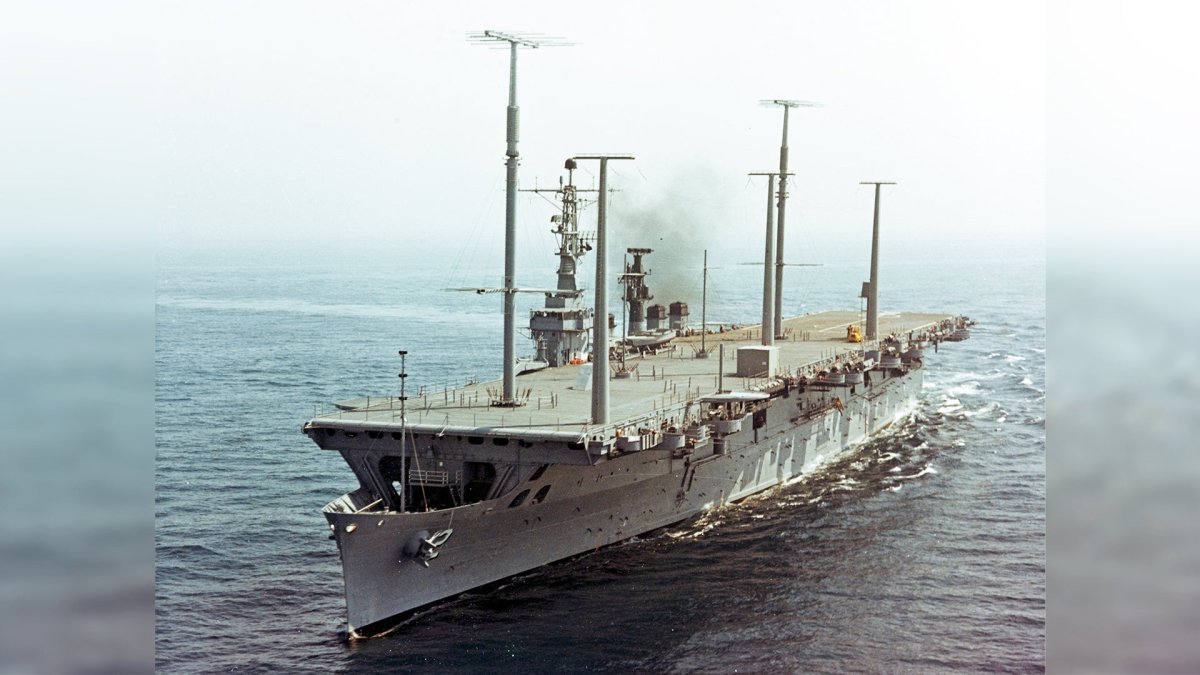
This warship had been completed as a Saipan class light aircraft carrier that first entered service in 1947 before being decommissioned for the first time in 1956. Although originally earmarked for use as an auxiliary aircraft transport, Wright was instead converted at Puget Sound Naval Shipyard as the second command ship, CC-2.
Even more comprehensively equipped than the Northampton , Graff describes Wright as “the most sophisticated communications platform ever placed at sea” — as of 1963, at least. The former flight deck of the ship became increasingly dominated by aerials, the tallest being a set of 156-foot masts festooned with troposcatter antennas.
USS Wright seen in 1967 with a less cluttered deck, but with a huge communications dish. , USN
A Navy press release soon after the ship had entered service enthused:
The Wright has the most extensive communications facilities ever put aboard a ship. Its ‘Voice of Command’ can be heard by ships, aircraft, and stations throughout the world. Wright ’s command spaces have facilities for theatre-type presentations similar to command posts ashore, including projection equipment and huge motion picture screens. Overall, there are rooms for war operations, plotting, charts and graphics, emergency action, briefings, and conferences. On the antenna deck are arranged the largest, most powerful transmitting antenna systems ever installed on a naval vessel. An entire room is given to the ship’s teletype machines, each of which is capable of receiving incoming messages at the rate of 100 words per minute. The Wright is capable of handling as many messages in a day as many large shore-based communications stations.
The former hangar space below deck was now filled with operations centers, with working areas and accommodation for 200 communications specialists, part of a complement of around 1,000 crew. There was also a team of 17 officers and 22 enlisted personnel from the Joint Chiefs of Staff, who would have managed the ‘Floating White House’ during an emergency. The crew could also be increased in size if required, to cope with different eventualities.
As for the president, they were provided with what Graff describes as an “elaborate, carpeted stateroom,” equipped with “nearly a dozen different color-coded telephones linked to various parts of the country’s military command structure.” The emergency operations center, which normally remained locked, featured the commander-in-chief’s desk and personnel could only enter with a security detail. In keeping with the presidential role, the Wright had three “themed” dining halls, where well-trained chefs provided the meals and a roaring log fire added to the atmosphere.
President John F. Kennedy cuts a cake during a visit aboard the USS Northampton ., PUBLIC DOMAIN
With the appropriate motto Vox Imperii , or “voice of the leaders,” the Wright would have used its antenna arrays to maintain contact with three specially constructed shore facilities, which in turn would have communicated with whatever was left of the U.S. military. If those three stations were to be destroyed, or communications with them lost, the Wright could deploy an unmanned QH-43 Huskie helicopter, a unique version of the Kaman design that could lift a super very-low-frequency antenna over two miles into the air and thereby communicate with Navy submarines around the globe. In all, there was space on the deck for three helicopters to be embarked. The same principle of a trailing very low-frequency antenna is used to this day by the Navy’s E-6B Mercury aircraft .
Although of poor quality, this photo of a Navy UH-2B Seaprite utility helicopter visiting USS Wright , around 1966, also seems to show the unique QH-43 Huskie drone helicopter in the background., PUBLIC DOMAIN
For operations in a nuclear environment, the Wright was equipped with special air filters so that the crew could be sealed off from fallout, while the decks would be washed down with a saltwater system.
There were also plans to convert another Saipan class carrier, the lead ship of that class to NECPA configuration, as CC-3, but these were quickly abandoned and instead, this vessel became a communications relay platform. Thought was also given to another, and even more survivable, NECPA platform, based on the nuclear-powered submarine USS Triton , but this never progressed beyond studies in the mid-1960s.
The Doomsday submarine that never was: the radar picket USS Triton seen in 1959. , U.S. Navy
The operating principle behind NECPA called for one of these two vessels to be permanently at sea, with the ships rotating duty every two weeks. In this way, at least one of the vessels was afforded more protection against a surprise attack from the Soviet Union. In such a scenario, or other times of increased superpower tensions, the president and other national leaders would be transferred to the vessel that was on duty.
In practice, the NECPA ship that was at sea would patrol around the U.S. Eastern Seaboard, generally within an area between Nova Scotia to the north and the Caribbean to the south, but usually operated within reasonable reach from Washington, D.C. During presidential trips to foreign countries, one of the NECPA vessels would frequently trail them, including on President Lyndon B. Johnson’s visit to Uruguay in 1967, and to El Salvador the following year.
A letter from President Johnson to the commander of USS Northampton , after an overnight stay in 1966., PUBLIC DOMAIN
As Graff points out, while little-known today, the NECPA ships were considered, at the time, to be the most survivable option for an evacuation of the president and their staff, prior to a nuclear strike. Indeed, the two ships seem to have been the Pentagon’s first choice for such a scenario all the way from the introduction of the Northampton in 1962 until midway through Nixon’s first term, which ran from 1969 until 1974.
USS Northampton passes a fountain decorated with a Polaris missile at the Portsmouth Naval Shipyard Museum, Norfolk, Virginia, around 1962., PUBLIC DOMAIN
It’s worth remembering that, to begin with, hardened land-based installations for “continuity of government” were considered fairly survivable , especially since the first atomic bombs were much less powerful than those deployed in the later years of the Cold War. Things changed entirely with the appearance of the first intercontinental ballistic missiles (ICBMs), which provided a terrifying combination of speed (reducing warning time to 15-30 minutes) and accuracy, plus the arrival of far more destructive thermonuclear weapons with which to arm them.
In the period in which these command ships were in commission, the other available options for the evacuation of the U.S. leadership involved hardened facilities on land, which could be decimated by a direct strike using thermonuclear ICBMs, or an airborne command post like the EC-135J Night Watch , which began its mission in 1962, but which could spend only a limited amount of time in the air before it would have to land. At the same time, the growing vulnerability of existing underground facilities did lead the United States to look at building super-shielded bunkers, including the Kubrick-esque Deep Underground Command Center that you can read about in this previous War Zone article .
Former C-135 pilot and War Zone columnist Robert Hopkins explains that the EC-135J, though touted as able to stay aloft indefinitely with air refueling, would begin to run out of engine oil between 72 and 96 hours. Nuclear war planners assumed 72 hours would be the limit. Moreover, the availability of a tanker to actually refuel the jet during a full nuclear exchange must be considered doubtful. “After 48 hours, if not sooner, the crew will run out of food and water (especially) and human survivability after that becomes tedious,” Hopkins says.
EC-135J Night Watch aircraft conduct aerial refueling., PUBLIC DOMAIN
In comparison, the NECPA ships could remain in operation for weeks at sea and offered a high level of survivability. What’s more, they also offered plenty of space for the staff to manage national security and war-planning, as well as considerable redundancy in terms of communications to maintain a link along the chain of command.
Exactly how survivable the NECPA vessels would have been in an actual shooting war remains somewhat open to question. Certainly, their ability to persist through a nuclear exchange was mainly attributed to the fact that they would be expected to avoid any encounters with a Soviet Navy that was, in this period, still building up its blue-water capabilities. However, the vessels both featured some limited armament. USS Northampton initially packed four of 5-inch dual-purpose guns, but eventually kept only a single aft turret, while the Wright had an array of 40mm Bofors guns to provide anti-aircraft firepower. Some reports state that they also retained their anti-submarine warfare sensors and other support systems that would have provided them with some level of organic situational awareness.
One of the 5-inch gun turrets aboard USS Northampton as of 1962., PUBLIC DOMAIN
Seen shortly before decommissioning in 1970, USS Northampton has had its armament reduced to a single 5-inch turret at the rear, due to the requirement for more command and control spaces within an enlarged superstructure., PUBLIC DOMAIN
On the other hand, if the Soviet Navy was to track unprotected NECPA vessels, they would have potentially been easy targets for a shadowing submarine. Indeed, Graff notes that there were rumors among crews of the two ships that the U.S. Navy provided one of its own submarines as an escort while deployed at sea.
Thankfully, neither of the NECPA ships were ever used in a full-on nuclear crisis situation, but they did at least go on alert during times of particular Cold War tensions. The Northampton was placed on alert during the Cuban Missile Crisis in 1962, while the Wright was called upon during the Pueblo Incident in 1968 when a U.S. Navy intelligence ship was attacked and captured by North Korean forces.
A U.S. Navy SP-2H Neptune flies over a Soviet cargo ship with crated Il-28 jet bombers on deck during the Cuban Crisis., U.S. Navy
Both President John F. Kennedy and Johnson spent nights aboard the NECPA vessels, during exercises, as well as during the aforementioned foreign tours. Perhaps the most significant event in these ships’ fortunes came during President Johnson’s return from Uruguay aboard the Wright in 1967. On April 17, Strategic Air Command successfully used an EC-135 aircraft to launch an unarmed Minuteman II ICBM from its silo. This was the first time that this had been achieved and was a sign that the airborne command post was the future for the Doomsday command post force.
By the end of the decade, moreover, the advent of Soviet spy satellites meant that the lumbering NECPA ships were no longer safe from prying eyes — their every movement could now potentially be tracked, putting them at the mercy of an ever more capable Soviet Navy’s surface warships, submarines, and aircraft. Even ICBMs could have been a risk. The U.S. Navy abandoned the NECPA program in around 1970 and the two ships were decommissioned the same year before eventually being sold for scrap: Northampton in 1977 and Wright in 1980.
Three stricken cruisers, from left to right, USS Newport News (CA-148), USS Springfield (CG-7), and USS Northampton (CC-1) await disposal at Philadelphia Naval Base in October 1978. , PUBLIC DOMAIN
Today, the job of these two ships is undertaken primarily by the U.S. Air Force’s fleet of four E-4B aircraft. Commonly referred to as “Doomsday Planes,” they provide a robust and survivable airborne command post that offers a platform for the President of the United States and the Secretary of Defense, via a mechanism known as the National Command Authority (NCA), to initiate a nuclear strike. Like the NECPA ships that preceded them, however, they are also equipped to support a range of other major military operations or the response to other significant contingencies, such as large-scale natural disasters. However, the E-4Bs are now old aircraft, dating back to the 1970s, and are in the early stages of being replaced by a new platform, likely also to be based on the Boeing 747 airframe .
In addition, the Air Force One VC-25As also conduct part of the “continuity of government” mission and is intended to operate in the most demanding situations, including a nuclear apocalypse. Air Force One has been modernized to better maintain communication with anyone on the ground or in the air and to stay abreast of a rapidly unfolding situation. The initiative to make it a more effective command post for the President came after the experience of 9/11, when President George H. W. Bush was aboard it and communications between the aircraft and major players on the ground broke down. The replacement of these aircraft with the VC-25B has led to concern that this mission set will be compromised, at least in part, by the new aircraft’s lack of aerial refueling capability . Currently, both E-4Bs and VC-25As have this capability.
As for the aforementioned E-6B Mercury airborne strategic command aircraft, they too, continue to provide an alternate flying communications link to America’s nuclear-capable bombers , ballistic missile submarines , and ICBM silos. These aircraft, too, are scheduled for replacement .
For the time being, it seems that if nuclear Armageddon does come, the hopes are that the U.S. President will be aloft in a bespoke “Doomsday Plane,” or a VC-25. When considering the critical role of these aircraft, and their planned successors, we should not forget the pioneering part played by their seagoing ancestors.
Contact the author: thomas@thedrive.com
Comments couldn’t be loaded. Please refresh the page.
发布于美国东部时间2021年2月19日下午1:18。
在美国政府不断完善的应对全面核对抗的计划中,一些鲜为人知的方案涉及经过高度改装的军舰,这些军舰在美苏关系最为紧张的时期被部署。如果冷战升级为热战,美国总统很可能从这些非凡的“海上白宫”之一指挥随后的核战争。这些引人注目的舰艇在各方面都可视为如今“末日飞机”空中指挥所的雏形。
该计划的正式名称是国家海上紧急指挥所(NECPA),发音为“neck-pa”。最终,该计划产生了两艘特制舰艇,其中第一艘“北安普顿”号于 1962 年 3 月开始执行新任务。
北安普顿号(USS Northampton),大约摄于1959年,当时仍装备为指挥轻巡洋舰。美国海军
“北安普顿”号最初是作为俄勒冈城级重型巡洋舰建造的,该级舰艇在二战结束后不久便服役了四艘。“北安普顿”号最终被改装为指挥轻巡洋舰(CLC-1),于1953年服役,之后主要担任大西洋舰队的旗舰。由于其最初的用途,这艘军舰已经预留了额外的甲板用于指挥和控制。
为了适应国家紧急行动计划(NECPA)的角色,北安普顿号被重新划分为第一艘指挥舰,编号为CC-1,并以弗吉尼亚州诺福克为基地,方便前往华盛顿特区。它的代号是“海上统治者”。在危机时刻,总统及其最亲密的助手将乘坐美国海军陆战队的直升机迅速抵达东海岸附近海域,登上北安普顿号。正如加勒特·M·格拉夫在他那本关于美国政府末日计划的杰作《渡鸦岩:美国政府自救计划——而我们其他人则走向死亡》中所述,为了使这艘船能够胜任其在潜在末日中的角色,该舰进行了大量的改装。
超过 40 吨的设备,包括 60 个发射器和接收器,使它每天能够处理 3000 条信息(在当时被认为是一项相当了不起的成就),海军声称强大的通信系统使该舰创造了环球通信速度最快的世界纪录,仅用了十分之八秒。
在“北安普顿”号开始履行NECPA职责一年后,海军又为舰队增添了第二艘“海上白宫”——“赖特”号,代号“天顶”,也驻扎在诺福克。
这艘军舰最初是一艘塞班级轻型航空母舰,于 1947 年首次服役,并于 1956 年首次退役。虽然最初计划用作辅助飞机运输舰,但“赖特”号在普吉特海湾海军造船厂被改装为第二艘指挥舰 CC-2。
格拉夫称,莱特号的装备比北安普顿号更加全面,是“迄今为止部署在海上的最先进的通信平台”——至少在1963年是如此。这艘军舰原先的飞行甲板逐渐被各种天线占据,其中最高的是一组156英尺高的桅杆,上面挂满了对流层散射天线。
1967年拍摄的“赖特”号驱逐舰,甲板上物品较少,但配备了一个巨大的通信天线。(美国海军)
该舰服役后不久,海军发布的新闻稿热情洋溢地写道:
“莱特”号拥有舰艇史上最完善的通信设施。其“指挥之声”系统可覆盖全球各地的舰船、飞机和电台。“莱特”号的指挥空间配备了与岸上指挥所类似的剧院式演示设施,包括投影设备和巨型电影屏幕。舰上设有作战室、标绘室、海图室、应急行动室、简报室和会议室。天线甲板上安装了海军舰艇史上规模最大、功率最强的发射天线系统。舰上还专门辟出一间房间用于放置电传打字机,每台机器的接收速度可达每分钟100字。“莱特”号一天处理的信息量可与许多大型岸基通信站相媲美。
原先位于甲板下方的机库空间如今已改造成作战中心,设有工作区和可容纳200名通信专家的宿舍,他们是约1000名船员的一部分。此外,还有一支由17名军官和22名士兵组成的联合参谋部小组,负责在紧急情况下管理这艘“海上白宫”。如有需要,船员人数还可以增加,以应对各种突发情况。
至于总统,他们被安排在格拉夫所描述的“铺着地毯的豪华套房”中,套房内配备了“近十部不同颜色编码的电话,分别与国家军事指挥系统的各个部门相连”。通常上锁的应急行动中心设有三军统帅的办公桌,人员只有在安保人员的陪同下才能进入。为了彰显总统的身份,莱特号游艇设有三个“主题”餐厅,由训练有素的厨师烹制佳肴,熊熊燃烧的壁炉更增添了氛围。
约翰·F·肯尼迪总统在访问“北安普顿”号航空母舰期间切蛋糕。(公共领域)
以“Vox Imperii”(意为“领袖之声”)为座右铭的“莱特号”将利用其天线阵列与三个特制的岸上设施保持联系,而这些设施又将与残存的美军部队进行通信。如果这三个设施被摧毁或通信中断,“莱特号”可以部署一架QH-43“哈士奇”无人直升机。这架卡曼设计的直升机拥有独特的改进型,可以将超低频天线提升到两英里(约3.2公里)的高空,从而与全球各地的海军潜艇进行通信。甲板上总共有足够的空间搭载三架直升机。海军的E-6B“水星”预警机至今仍在使用同样的拖曳式超低频天线原理。
尽管照片质量不佳,但这张摄于1966年左右的海军UH-2B“海精灵”通用直升机访问“赖特”号两栖攻击舰的照片,似乎还能在背景中看到独特的QH-43“哈士奇”无人直升机。(公共领域)
为了在核环境下作业,莱特号配备了特殊的空气过滤器,以便将船员与放射性尘埃隔离开来,同时用盐水系统冲洗甲板。
当时还曾计划将另一艘塞班级航母(该级首舰)改装为NECPA配置,命名为CC-3,但该计划很快被放弃,这艘航母最终成为了一艘通信中继平台。此外,还曾考虑过基于核动力潜艇“特里顿”号(USS Triton)打造另一艘生存能力更强的NECPA平台,但该计划在20世纪60年代中期止步于研究阶段。
从未建成的末日潜艇:雷达警戒潜艇“特里顿”号,摄于1959年。(美国海军)
NECPA的运作原则是,这两艘舰艇中始终有一艘在海上待命,每两周轮换一次。这样,至少有一艘舰艇能够更好地抵御苏联的突袭。一旦发生这种情况,或者其他超级大国关系紧张加剧的时期,总统和其他国家领导人将被转移到正在执勤的舰艇上。
实际上,在海上巡逻的NECPA船只将在美国东海岸附近巡逻,一般在北部的加拿大新斯科舍省和南部的加勒比海之间的区域内,但通常在华盛顿特区的合理航程范围内活动。在总统出访外国期间,NECPA的一艘船只经常会跟踪他们,包括林登·约翰逊总统1967年访问乌拉圭和次年访问萨尔瓦多。
1966年,约翰逊总统在北安普顿号巡洋舰上过夜后,写给舰长的一封信。(公共领域)
正如格拉夫所指出的,尽管如今鲜为人知,但当时的NECPA舰艇被认为是核打击前总统及其幕僚撤离最安全的选择。事实上,从1962年“北安普顿”号服役到尼克松第一任期中期(1969年至1974年),这两艘舰艇似乎一直是五角大楼应对此类情况的首选。
1962年左右,美国海军“北安普顿”号巡洋舰驶过位于弗吉尼亚州诺福克市朴茨茅斯海军造船厂博物馆内一座装饰着北极星导弹的喷泉。(公共领域)
值得注意的是,最初,为“政府连续性”而建造的加固陆基设施被认为具有相当高的生存能力,尤其是在第一批原子弹的威力远小于冷战后期使用的原子弹的情况下。然而,随着第一批洲际弹道导弹(ICBM)的出现,情况发生了彻底的改变。洲际弹道导弹兼具速度(将预警时间缩短至15-30分钟)和精度,再加上与之配套的威力更大的热核武器,使得这种武器的威力更加惊人。
在这些指挥舰服役期间,美国领导层撤离的其他可选方案包括陆地上的加固设施(这些设施可能被热核洲际弹道导弹直接摧毁)或空中指挥所,例如EC-135J“夜巡”飞机(该机于1962年开始执行任务,但飞行时间有限,必须降落)。与此同时,现有地下设施日益脆弱,促使美国考虑建造超强防护的掩体,包括库布里克电影中才会出现的“深层地下指挥中心”(您可以在之前的“战区”文章中读到相关内容)。
前C-135飞行员、《战区》专栏作家罗伯特·霍普金斯解释说,EC-135J虽然号称可以通过空中加油无限期地保持飞行,但实际上会在72到96小时内耗尽发动机油。核战争策划者认为72小时是极限。此外,在全面核战争期间,能否找到加油机为这架飞机加油也令人怀疑。“48小时后,甚至更短的时间,机组人员就会耗尽食物和水(尤其是水),之后人类的生存将变得极其艰难,”霍普金斯说道。
EC-135J“夜间守望”飞机进行空中加油。(公共领域)
相比之下,NECPA舰艇可在海上持续作战数周,并具有极高的生存能力。此外,它们还为工作人员提供了充足的空间来管理国家安全和战争计划,并在通信方面具备相当高的冗余度,以保持指挥链的畅通。
NECPA舰艇在实际核战争中的生存能力究竟如何,至今仍存疑。它们能够挺过核战争,主要原因在于它们被预期会避免与当时仍在发展远洋作战能力的苏联海军发生任何接触。然而,这两艘舰艇都配备了一些有限的武器装备。“北安普顿”号最初装备了四门5英寸双用途炮,但最终只保留了一座后部炮塔;而“莱特”号则配备了一系列40毫米博福斯炮,用于防空。一些报告指出,它们还保留了反潜作战传感器和其他支援系统,这些系统能够为它们提供一定程度的态势感知能力。
1962年,北安普顿号巡洋舰上的一座5英寸炮塔。(公共领域)
这张照片拍摄于1970年退役前不久,照片中的“北安普顿”号巡洋舰的武器装备已缩减至舰尾一座5英寸炮塔,这是由于扩建后的上层建筑需要更多的指挥控制空间。(公共领域)
另一方面,如果苏联海军追踪未设防的NECPA舰艇,它们很可能成为跟踪潜艇的活靶子。事实上,格拉夫指出,这两艘舰艇的船员中曾有传言说,美国海军在海上部署期间派出了一艘潜艇护航。
值得庆幸的是,NECPA的两艘舰艇从未在全面核危机情况下投入使用,但它们至少在冷战时期局势特别紧张的时候都处于警戒状态。“北安普顿”号在1962年古巴导弹危机期间进入警戒状态,而“赖特”号则在1968年“普韦布洛”号事件中被召集,当时一艘美国海军情报船遭到朝鲜军队袭击并被俘。
古巴导弹危机期间,一架美国海军SP-2H“海王星”侦察机飞越一艘苏联货船,船上甲板上装载着装在箱子里的伊尔-28喷气式轰炸机。
约翰·F·肯尼迪总统和约翰逊总统都曾在演习期间以及上述出访期间在NECPA舰艇上过夜。这些舰艇命运中最重要的事件或许发生在1967年约翰逊总统乘坐“莱特”号从乌拉圭返回期间。4月17日,战略空军司令部成功地使用一架EC-135飞机从发射井发射了一枚未携带弹头的“民兵II”洲际弹道导弹。这是人类首次实现这一壮举,也标志着空中指挥所将成为未来末日指挥部队的发展方向。
此外,到了70年代末,苏联间谍卫星的出现意味着笨重的NECPA舰艇再也无法躲避窥探——它们的一举一动都可能被追踪,使它们任由日益强大的苏联海军水面舰艇、潜艇和飞机摆布。甚至洲际弹道导弹也可能构成威胁。美国海军于1970年左右放弃了NECPA计划,这两艘舰艇也在同年退役,最终被拆解出售:北安普顿号于1977年,赖特号于1980年。
1978年10月,三艘受损巡洋舰——从左至右依次为“纽波特纽斯”号重巡洋舰(CA-148)、“斯普林菲尔德”号巡洋舰(CG-7)和“北安普顿”号巡洋舰(CC-1)——停泊在费城海军基地等待拆解。(公共领域)
如今,这两艘舰艇的任务主要由美国空军的四架E-4B预警机承担。这些预警机通常被称为“末日飞机”,它们提供了一个强大且生存能力强的空中指挥所,为美国总统和国防部长提供了一个平台,通过国家指挥权(NCA)机制启动核打击。然而,与之前的核能核打击指挥所(NECPA)一样,它们也配备了支持一系列其他重大军事行动或应对其他重大突发事件(例如大规模自然灾害)的能力。但是,E-4B预警机如今已是老旧机型,其服役时间可以追溯到20世纪70年代,目前正处于被新型平台取代的早期阶段,而新型平台很可能也基于波音747机身。
此外,“空军一号”VC-25A还承担着部分“政府连续性”任务,旨在应对包括核灾难在内的最严苛情况。“空军一号”已进行现代化改造,以更好地与地面和空中人员保持通信,并及时掌握瞬息万变的局势。将其打造为更高效的总统指挥中心的举措源于9·11事件的经历。当时,老布什总统正在“空军一号”上,飞机与地面主要机构之间的通信中断。VC-25B取代VC-25A引发了人们的担忧,即新飞机缺乏空中加油能力,至少在一定程度上会影响其执行这些任务的能力。目前,E-4B和VC-25A都具备空中加油能力。
至于前文提到的E-6B“水星”空中战略指挥飞机,它们也继续为美国的核轰炸机、弹道导弹潜艇和洲际弹道导弹发射井提供备用空中通信链路。这些飞机也已列入替换计划。
目前看来,如果核末日真的来临,人们希望美国总统能够乘坐特制的“末日飞机”或VC-25型飞机升空。在考虑这些飞机及其计划中的后续机型的关键作用时,我们不应忘记它们的海上前辈所发挥的开创性作用。
联系作者:thomas@thedrive.com
评论加载失败,请刷新页面。