The Amazing Tale Of Bravo November, The British Chinook Helicopter That Refused To Die布拉沃·诺文伯号的惊人故事:一架拒绝坠毁的英国奇努克直升机
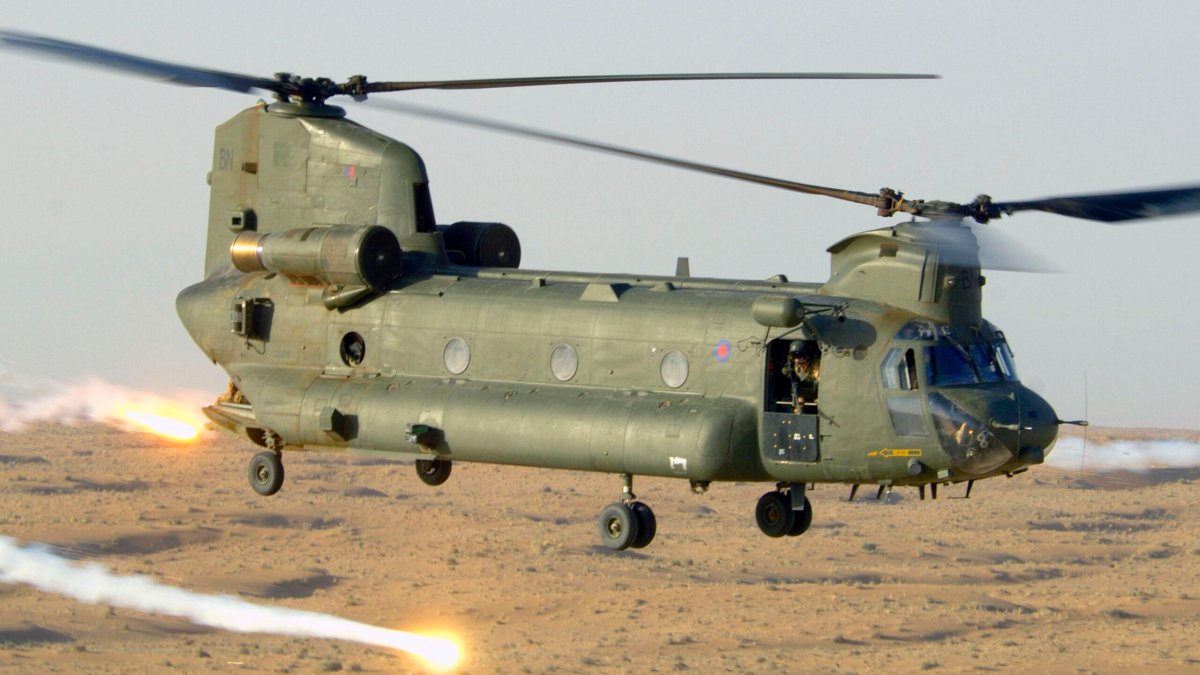
Different crews flying this battle-hardened Royal Air Force Chinook have won four Distinguished Flying Crosses between them.
Updated Nov 27, 2020 6:02 PM EST
As the British Royal Air Force and manufacturer Boeing celebrate 40 years of the CH-47 Chinook heavy-lift helicopter in U.K. service, one of the very first of these rotorcraft that the country received is still flying operationally today and has an incredible story to tell. This Chinook, known as “Bravo November,” narrowly avoided destruction more than once during the 1982 Falklands War . Since then no fewer than four of its pilots have been awarded the Distinguished Flying Cross on different operational missions.
Bravo November was among the initial batch of 30 Chinook HC1s ordered by the Royal Air Force (RAF) in 1978, the first of which arrived in the United Kingdom on November 22, 1980. Yesterday the RAF, Boeing, and assorted squadrons and individuals associated with the heavy-lift workhorse over the years that have followed marked the 40th anniversary of this delivery.
The Bravo November name was derived from the helicopter’s two-letter code, “BN,” though it was formally known as ZA718, according to the British military serial number system.
When Argentina invaded the Falklands Islands, a British overseas territory in the South Atlantic, on April 2, 1982, Bravo November was assigned to No. 18 Squadron, the RAF’s only Chinook operator at the time, based at RAF Odiham, Hampshire, in southwest England.
RAF Chinooks from Nos 18 and 27 Squadrons lined up on the Odiham dispersal. The Hampshire base has hosted the Chinook fleet for 40 years., Crown Copyright
Four days later, No. 18 Squadron was called into action in support of Operation Corporate, the British military action to retake the Falklands. Five of the unit’s Chinooks were then flown to the port of Plymouth, where they were loaded onboard the container vessel Atlantic Conveyor , which had been requisitioned by the U.K. Ministry of Defense at the beginning of the conflict. The Atlantic Conveyor arrived at Ascension Island, the British task force’s staging post in the South Atlantic Ocean, on May 5.
One of the Chinooks remained on Ascension Island, where it was used to shuttle stores between the island and various ships involved in the campaign. The other four heavy-lift helicopters remained on the deck of the Atlantic Conveyor , which continued toward the war zone. The ship’s other aircraft cargo comprised eight Sea Harrier fighter jets, six Harrier GR3 ground-attack jets, and another seven helicopters, a mixture of Lynx and Wessex types.
The ill-fated Atlantic Conveyor approaching the Falklands in May 1982, with one Wessex visible on deck., DM GERARD/WIKIMEDIA COMMONS
On May 18, the container vessel met up with the British task force and the Sea Harriers and Harriers took off to join the aircraft carriers involved in Operation Corporate, the official nickname for the British response to the Argentinian invasion. Meanwhile, it was planned that the helicopters would be delivered directly to the Falklands.
Before the Chinooks could take off from the Atlantic Conveyor and head to the Falklands, the ground crew faced the tricky job of refitting the rotor blades, each weighing around 300 pounds and 30 feet long. Reinstalling the blades required raising them into position with a forklift, but then the ground crew had to lock them into place. As the ship’s deck pitched in the rough sea, the blades flexed, and this, combined with the jerking movements of the forklift, nearly resulted in the loss of several fingers.
Finally, with rotor blades in place and engines tested, the Chinooks were ready to go and Bravo November was the first to launch, on the afternoon of May 25.
Soon after Bravo November had departed the Atlantic Conveyor on its test flight, a pair of Exocet anti-ship missiles launched by Argentine Navy Super Etendard fighter jets hurtled toward the vessel at wave-top height, slamming into its port side. The ship was rapidly set ablaze and 12 crew were killed. The vessel was left to burn out, a process aided by the stocks of ammunition stored below decks. Six Wessex, three Chinooks, and a Lynx were all destroyed in the process.
An Argentine Navy Super Etendard with a kill marking on the nose depicting the Atlantic Conveyor. , Martin Otero/Wikimedia Commons
Bravo November recovered to the aircraft carrier HMS Hermes before flying to East Falkland the following day. Here, the much-reduced No. 18 Squadron detachment set up base with its single helicopter, two four-man crews, nine technicians, and 10 support personnel.
The Chinook was by far the most capable helicopter available to the British task force, its lifting capacity of 12 tons equivalent to three Sea Kings. However, all the spare parts, tools, lubricants, and manuals had been destroyed on the Atlantic Conveyor , so keeping the rotorcraft flying would be an enormous challenge. At first, the crew reckoned they would be able to sustain flying operations for a couple of days, no longer, but things turned out very differently.
“The aeroplane went on day after day with bits going unserviceable,” recalled Squadron Leader Dick Langworthy, boss of No 18 Squadron at the time. “But the engines kept going, the rotors kept turning and she continued to do the job.”
This job at first included hauling supplies from ships positioned off the Falklands to storage areas on the islands, while Argentine prisoners captured during the battles on land were taken in the other direction. A vital role was carrying ammunition for British artillery, which involved 10-ton pallets being slung under the fuselage. More often than not, the Chinook was operated in excess of its maximum all-up weight.
Bravo November’s next close call came on the evening of May 30, during a nighttime Royal Marine raid on an Argentine position on Mount Kent, East Falkland. While three Sea Kings carried the Marines to their objective, the Chinook followed with three 105-mm guns (two in the fuselage, one underslung), plus 22 more troops. Although equipped with primitive night-vision goggles (NVGs), Bravo November was flying at low-level through snow, and the resulting whiteout made the goggles almost useless.
An RAF Chinook helicopter touches down on a snowy hillside in Northern Ireland while delivering agricultural aid to stricken farming communities. Today, the Chinook is much better equipped to handle operations in snowy conditions, also at night. , CROWN COPYRIGHT
While the underslung gun was delivered without too much difficulty, dropping off the other two guns and the troops would require a hazardous landing. The crew had been expecting some flat ground, but instead found a sloping bog with rivers and stones on either side. On the first landing, the rear end of the Chinook sunk into the mud, and the rear ramp couldn’t be operated. The next attempt was made with the ramp already lowered, but it was a struggle to disgorge the bulky guns over the soft ground.
At this point, a firefight broke out between British and Argentine troops before the Chinook’s cabin lighting failed, plunging it into darkness. The rest of the unloading operation was conducted with handheld flashlights before the Chinook departed again into the night.
The return leg was more dangerous still, with heavy snow showers, and at one point, Bravo November descended so low that it struck a creek, skidding across the surface as water was thrown up into the engines, draining them of power. On the flight deck, the co-pilot jettisoned his door, preparing for emergency egress, while the pilot struggled with the heavy controls, the hydraulic system now being starved of power.
“We were lucky, because if we had hit solid ground we would have been dead,” reflected co-pilot Flight Lieutenant Andy Lawless after the mission. “We hit at 100 knots. The bow wave came over the cockpit window as we settled, and the engines partially flamed out. I knew we had ditched, but I was not sure if we had been hit.”
It needed the combined strength of the pilot and co-pilot on the controls to bring the Chinook clear of the water.
A Chinook practices flying over water in a Mountain Flying Training Area (MFTA) in North Wales., CROWN COPYRIGHT
In the rear of the Chinook, one of the other two crewmen, Flight Lieutenant Tom Jones, had his flying helmet torn off during the impact with the water. Fearing that the helicopter was now about to break up, he was preparing to jump from the Chinook when another crewman provided a spare helmet and Jones then discovered over the intercom that the aircraft was successfully climbing at 1,500 feet.
The slightly more battered Bravo November made a safe landing back at its Port San Carlos base. As the pilot, Squadron Leader Langworthy was later awarded the Distinguished Flying Cross (DFC) for his actions.
June 2 saw Bravo November play a crucial part in the operation to secure Fitzroy settlement, an important area of high ground on East Falkland. For this mission, no fewer than 81 paratroops, twice the normal capacity, were crammed into the helicopter, together with their weapons, and, once again, the weather was dismal. With thick, low-lying clouds, the pilots relied on ground features to find their way, but the peaks of hills were obscured. The troops were successfully delivered, and the Chinook then brought in another 75 paratroops to Fitzroy to help secure the objective.
In the days that followed, Bravo November continued to move artillery to wherever it was needed around the Falklands, sometimes flying as many as 15 sorties each day. Other cargo included damaged Sea Kings carried as underslung loads, and wounded troops — as many as 64 being evacuated in one flight on June 8.
Another mission involved an underslung load that was described as “bloody awful” by one of the pilots involved. This was an eight-ton metal bridge that swung wildly under the Chinook as soon as the aircraft had picked up speed. The pilots were forced to decelerate to around 20 knots to prevent the bridge from flailing around dangerously below their helicopter.
The bridge-lift operation took place on June 14, the same day that the Chinook detachment got the news that Argentine forces in the Falklands had surrendered.
Personnel rig an underslung load for lifting by a Chinook. , Crown Copyright
In the course of their campaign, Bravo November had recorded over a hundred flying hours and carried some 1,500 troops, 95 casualties, 650 prisoners of war, and 550 tonnes of cargo.
Bravo November had done all that was asked of it, and more, in the effort to retake the Falkland Islands, and the crews were only left to wonder how much more efficient the British operation could have been had all four Chinooks made it off the Atlantic Conveyor in time.
Since 1982, Bravo November has been upgraded several times and remains in frontline service today. Most recently it has been reworked to become a Chinook HC6A variant, broadly equivalent to the U.S. Army’s CH-47F , and which features the Boeing Digital Automatic Flight Control System (DAFCS). This latter provides pilots with improved handling and stability in challenging operational environments and increases flight safety when flying at night or in degraded visual environments — just the kinds of conditions that Bravo November battled through in the Falklands.
An aircrewman from No 18 Squadron aboard Bravo November waits to take off from the aircraft carrier HMS Ark Royal , headed for Iraq., Crown Copyright
In the intervening years, Bravo November and the wider RAF Chinook fleet have played vital wartime roles in the 1991 Gulf War, as well as operations in Northern Ireland, the Balkans, Afghanistan, and Iraq again after the 2003 invasion. Most recently, an RAF Chinook detachment has been providing much needed heavy-lift rotary support to the French contingent in Mali . On the home front, the Chinook has become a familiar sight working in support of civilian relief operations in the United Kingdom, including responses to flooding and the COVID-19 pandemic.
The second DFC awarded to Bravo November crew came during Operation Telic, the British military’s component of the U.S.-led invasion and subsequent occupation of Iraq beginning in 2003, when Bravo November became the first helicopter to land Royal Marines on the Al-Faw peninsula in the extreme southeast of Iraq. You can read a highly unique perspective of that operation in this past War Zone feature . Squadron Leader Nick Carr was recognized for his actions during the assault, flying several waves, the second of which saw a firefight break out around the aircraft.
The side door gunner of an RAF Chinook surveys the southern Iraq desert landscape as it sweeps beneath him., Crown Copyright
Another two DFCs followed during Operation Herrick, the United Kingdom’s contribution to NATO-led operations in Afghanistan, these recognizing Flight Lieutenant Craig Wilson’s actions during a rescue mission in Helmand province in 2006, and Flight Lieutenant Ian Fortune, who led a casualty evacuation mission on behalf of the U.S. Marine Corps and Afghan National Army, under heavy enemy fire, in 2010. Flight Lieutenant Fortune was hit by a Taliban bullet that ricocheted onto his flying helmet as the injured soldiers were being extracted.
An RAF Chinook kicks up sand and dust as it comes in to land at Camp Bastion, Helmand, Afghanistan following a mission., Crown Copyright
The RAF’s continued reliance on the Chinook is reflected in its fleet of 60 examples (eight HC5, 14 HC6, and 38 HC6A variants), making it the most numerous helicopter type in the U.K. Armed Forces inventory. However, there are plans to buy yet more Chinooks, with another 14 on the U.K. Ministry of Defense’s shopping list.
The U.S. Defense Security Cooperation Agency (DSCA) announced on October 19, 2018, that US State Department approval had been granted for the sale of 16 H-47 Chinook (Extended Range) helicopters, a number that has since been trimmed back to 14, required to replace the RAF’s oldest Chinook airframes. These new rotorcraft will be in a special forces configuration similar to the U.S. Special Operations Command’s MH-47G Block II.
Once completed, the next U.K. Chinook order will likely mark the end of Bravo November’s career. There’s a high chance the airframe will be preserved, however, after which this remarkable survivor will see out a well-earned retirement.
Contact the author: thomas@thedrive.com
Comments couldn’t be loaded. Please refresh the page.
更新于美国东部时间2020年11月27日下午6:02
值此英国皇家空军和制造商波音公司庆祝CH-47“支奴干”重型运输直升机在英国服役40周年之际,英国最早接收的几架“支奴干”直升机之一至今仍在服役,并拥有一段传奇故事。这架名为“Bravo November”的“支奴干”在1982年福克兰群岛战争中多次死里逃生。此后,至少有四名飞行员在不同的作战任务中荣获杰出飞行十字勋章。
“布拉沃·诺文伯”号是英国皇家空军 (RAF) 于 1978 年订购的首批 30 架奇努克 HC1 型运输机之一,第一架于 1980 年 11 月 22 日抵达英国。昨天,英国皇家空军、波音公司以及多年来与这款重型运输机相关的各个中队和个人共同庆祝了这架飞机交付 40 周年。
Bravo November 的名称来源于直升机的双字母代码“BN”,尽管根据英国军用序列号系统,它的正式名称是 ZA718。
1982 年 4 月 2 日,阿根廷入侵南大西洋的英国海外领土福克兰群岛时,“十一月布拉沃”号被分配到第 18 中队,该中队是当时英国皇家空军唯一的奇努克直升机运营商,驻扎在英格兰西南部汉普郡的奥迪汉姆皇家空军基地。
英国皇家空军第18和第27中队的奇努克直升机在奥迪汉姆分散停机坪上列队。汉普郡的这个基地已经驻扎奇努克机队40年了。(英国皇家版权所有)
四天后,第18中队奉命支援“企业行动”(Operation Corporate),即英国收复福克兰群岛的军事行动。该中队的五架奇努克直升机随后飞往普利茅斯港,并在那里装载到“大西洋运输者号”(Atlantic Conveyor)集装箱船上。这艘船在冲突初期就被英国国防部征用。5月5日,“大西洋运输者号”抵达阿森松岛,这是英国特遣部队在南大西洋的集结地。
其中一架奇努克直升机留在阿森松岛,用于在岛屿和参与战役的各艘舰船之间运送物资。其余四架重型运输直升机则留在“大西洋运输者”号的甲板上,该舰继续驶向战区。舰上其他载有的飞机包括八架海鹞式战斗机、六架鹞式GR3攻击机以及另外七架直升机,其中包括山猫式和威塞克斯式直升机。
1982年5月,命运多舛的“大西洋运输者”号货轮驶近福克兰群岛,甲板上可见一架“威塞克斯”直升机。(图片来源:DM GERARD/WIKIMEDIA COMMONS)
5月18日,这艘集装箱船与英国特遣舰队会合,船上的海鹞式和鹞式战斗机随即起飞,加入参与“企业行动”(Operation Corporate)的航空母舰。“企业行动”是英国应对阿根廷入侵行动的官方代号。与此同时,直升机计划直接运往福克兰群岛。
在奇努克直升机从“大西洋运输者”号上起飞前往福克兰群岛之前,地勤人员面临着一项棘手的任务:重新安装旋翼叶片。每片叶片重约300磅,长约30英尺。重新安装叶片需要用叉车将其吊装到位,然后地勤人员还要将其锁定到位。由于船体甲板在波涛汹涌的海面上颠簸,叶片也随之弯曲,再加上叉车的剧烈晃动,险些导致几根手指被切断。
最后,旋翼叶片安装完毕,发动机也经过测试,奇努克直升机准备就绪,5 月 25 日下午,“布拉沃十一月”号率先起飞。
“布拉沃·诺文”号飞机从“大西洋运输者”号上起飞进行试飞后不久,阿根廷海军的“超级军旗”战斗机发射了两枚“飞鱼”反舰导弹,以浪尖高度呼啸而至,击中了该舰的左舷。舰体迅速燃起大火,12名船员丧生。由于甲板下储存的弹药,该舰最终被烧毁。六架“威塞克斯”直升机、三架“支奴干”直升机和一架“山猫”直升机也在此次事故中被摧毁。
一架阿根廷海军超级军旗战斗机,机头涂有击沉“大西洋运输者”号的标志。图片来源:Martin Otero/Wikimedia Commons
“布拉沃十一月”号返回“赫尔墨斯”号航空母舰,次日飞往东福克兰群岛。在那里,兵力大幅缩减的第18中队分遣队设立了基地,配备了一架直升机、两组四人机组、九名技术人员和十名后勤人员。
奇努克直升机是英国特遣部队所能使用的最强大的直升机,其12吨的起重能力相当于三架海王直升机。然而,所有备件、工具、润滑油和手册都在“大西洋运输者”号航母上被毁,因此维持这架旋翼机的飞行将是一项巨大的挑战。起初,机组人员估计他们最多只能维持几天的飞行任务,但事与愿违。
“飞机每天都在出现各种故障,但发动机和旋翼却依然运转,它一直在执行任务。”当时的第18中队指挥官迪克·兰沃西中队长回忆道,“但发动机还在运转,旋翼还在转动,它一直在执行任务。”
这项任务最初包括将停泊在福克兰群岛附近海域的船只上的补给品运送到岛上的仓库,同时将陆地战斗中俘虏的阿根廷战俘从岛上运往其他地方。一项至关重要的任务是为英国炮兵运送弹药,这需要将重达10吨的弹药托盘吊挂在机身下方。奇努克直升机经常超载飞行。
“十一月勇士”号的下一次险情发生在5月30日晚,当时皇家海军陆战队正在东福克兰群岛的肯特山上对阿根廷阵地进行夜间突袭。三架海王直升机将海军陆战队员送达目标后,“十一月勇士”号随后跟进,机上搭载了三门105毫米机炮(两门安装在机身内,一门悬挂在机身下方),以及另外22名士兵。尽管“十一月勇士”号配备了简易的夜视镜,但由于当时飞机在积雪中低空飞行,能见度极低,夜视镜几乎无法使用。
一架英国皇家空军的奇努克直升机降落在北爱尔兰白雪皑皑的山坡上,当时它正在向受灾的农业社区运送农业援助物资。如今,奇努克直升机已经配备了更完善的设备,能够更好地应对雪地和夜间的作业。,版权所有
虽然吊挂火炮的投放过程相对顺利,但要卸下另外两门火炮和部队却需要一次危险的着陆。机组人员原本以为会遇到一片平坦的地面,结果却发现是一片倾斜的沼泽地,两侧都是河流和乱石。第一次着陆时,奇努克直升机的尾部陷进了泥里,后舱门也无法打开。第二次尝试时,他们已经放下了舱门,但要把笨重的火炮卸到松软的地面上仍然十分困难。
此时,英军和阿根廷军队之间爆发了交火,随后奇努克直升机的机舱照明系统失效,机舱陷入一片黑暗。卸货工作只能依靠手电筒完成,之后奇努克直升机再次消失在夜色中。
返程航程更加危险,暴雪肆虐。途中,“十一月勇士”号一度下降到极低的高度,撞上一条小溪,在溪面上滑行,溅起的水花灌入发动机,导致发动机动力丧失。在驾驶舱内,副驾驶抛弃了舱门,准备紧急逃生,而正驾驶则艰难地操控着沉重的操纵杆,此时液压系统已经断电。
“我们很幸运,因为如果我们撞上坚实的地面,我们就没命了,”副驾驶安迪·劳利斯中尉在任务结束后回忆道。“我们以100节的速度撞击地面。飞机着陆时,船首波越过驾驶舱窗户,发动机部分熄火。我知道我们迫降了,但我不确定是否被击中。”
要让奇努克号飞机脱离水面,需要飞行员和副驾驶齐心协力操控。
一架奇努克直升机在北威尔士山地飞行训练区(MFTA)进行水面飞行训练。(英国皇家版权所有)
在奇努克直升机的后部,另外两名机组人员之一,飞行中尉汤姆·琼斯,在撞击水面时飞行头盔被扯掉。他担心直升机即将解体,正准备跳机时,另一名机组人员递给他一个备用头盔。琼斯随后通过机内通话系统得知,飞机正在成功爬升至1500英尺的高度。
略显破损的“十一月”号安全降落在圣卡洛斯港基地。飞行员兰沃西中队长后来因其英勇行为被授予杰出飞行十字勋章(DFC)。
6月2日,Bravo November直升机在确保东福克兰岛高地菲茨罗伊定居点安全的行动中发挥了关键作用。此次任务中,直升机上挤满了81名伞兵,是正常载客量的两倍,他们还携带了武器装备。而天气再次恶劣。由于厚厚的低云,飞行员只能依靠地面特征来辨别方向,但山峰都被遮蔽了。部队成功抵达后,这架奇努克直升机又将另外75名伞兵运送到菲茨罗伊,以协助确保目标的实现。
接下来的几天里,“十一月勇士”号继续向福克兰群岛各地运送火炮,有时一天最多执行15架次飞行任务。其他货物包括用作吊挂载荷的受损海王直升机和伤员——6月8日的一次飞行就撤离了多达64名伤员。
另一次任务中,飞行员们形容吊挂的载荷“简直糟透了”。那是一座重达八吨的金属桥,飞机一旦加速,桥身下方就会剧烈摆动。飞行员们被迫将速度降至20节左右,以防止桥梁在直升机下方危险地晃动。
6 月 14 日,也就是奇努克直升机分遣队接到阿根廷军队在福克兰群岛投降的消息的同一天,架桥行动展开。
工作人员正在为奇努克直升机吊装下挂货物。(版权所有)
在作战过程中,“十一月勇士”号飞行队累计飞行超过一百小时,运送了约 1500 名士兵、95 名伤员、650 名战俘和 550 吨货物。
在夺回福克兰群岛的行动中,“勇敢的十一月”号完成了所有被要求完成的任务,甚至做得更多。机组人员不禁思忖,如果所有四架奇努克直升机都能及时从“大西洋运输者”号上起飞,英国的行动效率将会提高多少。
自1982年以来,“十一月勇士”号(Bravo November)经过多次升级,至今仍在服役。最近一次升级是将其改装为“支奴干”HC6A型,大致相当于美国陆军的CH-47F,并配备了波音数字自动飞行控制系统(DAFCS)。该系统能够提升飞行员在复杂作战环境中的操控性和稳定性,并提高夜间或低能见度环境下的飞行安全性——而这正是“十一月勇士”号在福克兰群岛战争中浴血奋战的场景。
隶属于英国皇家海军第18中队“十一月勇士”号的机组人员正在等待从“皇家方舟”号航空母舰上起飞,前往伊拉克。(图片版权归英国皇家所有)
在过去的几年里,“布拉沃十一月”行动以及整个皇家空军奇努克直升机机队在1991年海湾战争中发挥了至关重要的战时作用,并在北爱尔兰、巴尔干半岛、阿富汗以及2003年入侵伊拉克后再次参与了相关行动。最近,皇家空军的一个奇努克直升机分遣队一直在为驻马里的法国特遣队提供急需的重型旋翼运输支援。在英国本土,奇努克直升机也经常出现在支援英国境内民事救援行动的岗位上,包括应对洪灾和新冠疫情。
“十一月”号直升机机组人员第二次获得杰出飞行十字勋章是在“特里克行动”期间。该行动是英国军队参与美国领导的入侵和随后占领伊拉克的行动,始于2003年。“十一月”号成为第一架将皇家海军陆战队员降落在伊拉克东南部法奥半岛的直升机。您可以在之前的《战区》专题报道中读到关于此次行动的独特视角。中队长尼克·卡尔因其在突击行动中的英勇表现而受到表彰。他驾驶直升机执行了多波攻击,其中第二波攻击时,飞机周围爆发了交火。
一架英国皇家空军奇努克直升机的侧门机枪手正在观察下方掠过的伊拉克南部沙漠景观。(英国皇家版权所有)
在赫里克行动(英国对北约领导的阿富汗行动的贡献)期间,又有两名飞行员荣获杰出飞行十字勋章(DFC)。这两项勋章分别表彰了飞行中尉克雷格·威尔逊在2006年赫尔曼德省的一次救援任务中的英勇表现,以及飞行中尉伊恩·福琼在2010年代表美国海军陆战队和阿富汗国民军在敌军猛烈炮火下领导的一次伤员撤离任务。在撤离受伤士兵的过程中,福琼中尉被一颗塔利班子弹击中,子弹反弹击中了他的飞行头盔。
一架英国皇家空军的奇努克直升机在执行任务后降落在阿富汗赫尔曼德省的巴斯蒂安营地,扬起沙尘。(英国皇家版权所有)
英国皇家空军对奇努克直升机的持续依赖体现在其60架机队的装备上(8架HC5、14架HC6和38架HC6A型),使其成为英国武装部队装备数量最多的直升机机型。然而,英国国防部计划再采购14架奇努克直升机。
美国国防安全合作局(DSCA)于2018年10月19日宣布,美国国务院已批准向英国皇家空军出售16架H-47“支奴干”(远程型)直升机。但后来数量削减至14架,用于替换英国皇家空军最老旧的“支奴干”机体。这些新型直升机将采用特种部队配置,类似于美国特种作战司令部的MH-47G Block II型直升机。
一旦完成英国的下一批奇努克直升机订单,布拉沃·诺文伯的服役生涯很可能就此结束。不过,这架飞机的机身很有可能会被保存下来,之后这架非凡的幸存者将安享晚年。
联系作者:thomas@thedrive.com
评论加载失败,请刷新页面。