China’s military wants to target US undersea sensor network: Analysis分析:中国军方意图打击美国水下传感器网络
Chinese experts believe that “the U.S. undersea surveillance system suffers from a number of vulnerabilities," according to a U.S. Naval College professor.
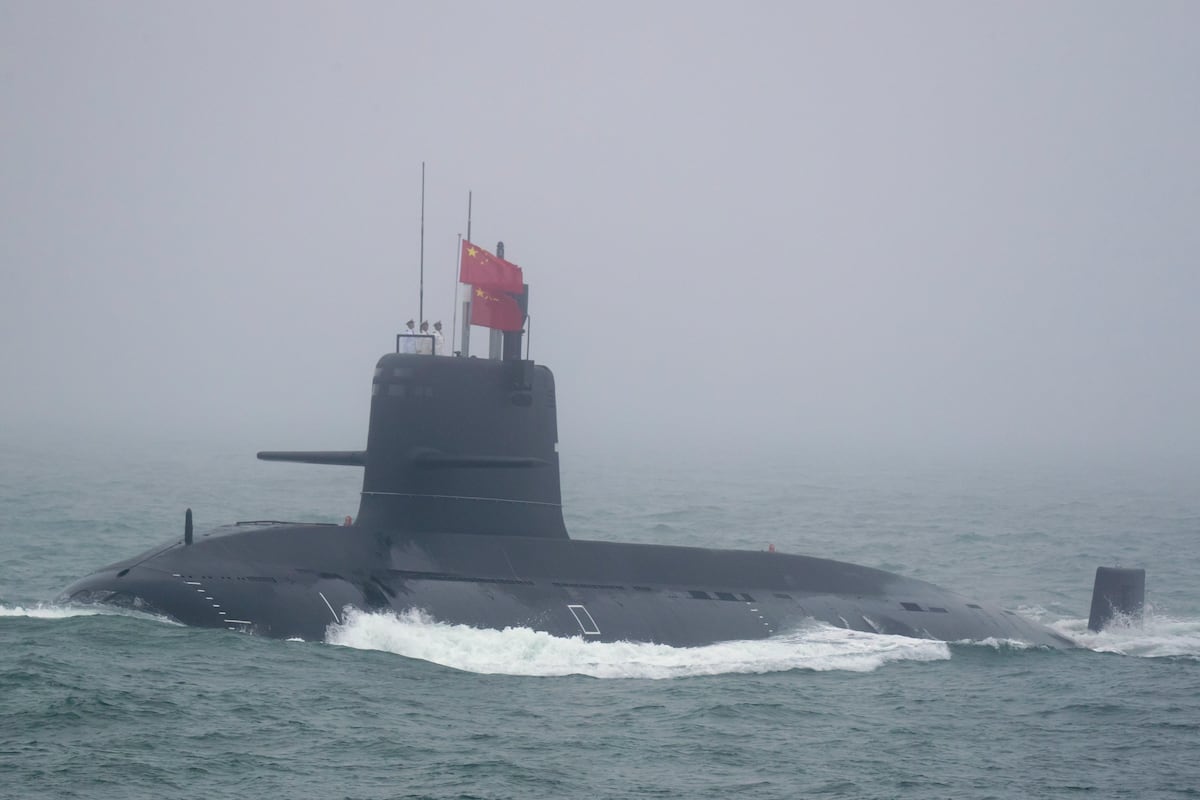
Submarines are a major part of China’s naval strategy. And U.S. underwater sensors are a major threat to those subs, Chinese experts warn.
Thus, some People’s Liberation Army Navy, or PLAN, officers are advocating a systematic attempt to destroy America’s undersea sensor network in time of war. This includes destroying, sabotaging or spoofing underwater microphones using a variety of countermeasures, from undersea drones to China’s huge fleet of commercial fishing vessels.
Chinese experts believe that “the U.S. undersea surveillance system suffers from a number of vulnerabilities, amplified by the sheer scale of the Western Pacific battlespace,” Ryan Martinson, a professor at the China Maritime Studies Institute at the U.S. Naval War College, wrote in an essay for the Center for International Maritime Security. “If enough nodes are degraded, the system as a whole may lose its functionality.”
Ironically, American and Chinese views of the undersea balance of power seem mirror images. The U.S. and its Pacific allies worry over China’s growing submarine fleet, which the Pentagon predicts will reach 65 units this year and 80 by 2035. China already can deploy six nuclear ballistic and six nuclear attack submarines, plus a large number of conventional subs armed with anti-ship missiles, including 21 advanced Yuan-class diesel-electric boats.
For its part, China worries that an intensive American anti-submarine warfare , or ASW, effort has already made Chinese subs too vulnerable.
“The PLAN is investing in submarines because it recognizes their tremendous potential deterrent and warfighting value,” Martinson wrote. “That value, however, hinges on the ability of their boats to operate undetected. According to Chinese military experts however, that basic requirement cannot be guaranteed — not even close.”
Martinson analyzed a November 2023 article written by three Chinese naval officers in Military Art, an internal Chinese military journal.
“This enables the authors to share their expertise with a candor that is rarely (if ever) seen in publicly-available PLA [People’s Liberation Army] sources,” Martinson noted.
The Military Art article expressed fears that Chinese submarines are outmatched by what the authors depict as an “integrated, three-dimensional surveillance system.” This includes warships, subs, aircraft, satellites, underwater drones, the undersea microphones of the Integrated Undersea Surveillance System , or IUSS, and surface ships hauling the Surveillance Towed Array Sensor System , or SURTASS.
Where America sees a Chinese underwater armada, China sees an American bid to achieve “unilateral transparency” under the waves. As China sees it, this ASW dragnet is so broad that it uses survey ships to map undersea terrain and water conditions for optimal submarine detection, and oceanic surveillance vessels to capture submarine acoustic signatures.
During the Cold War, the U.S. and its allies created chokepoints — such as the Greenland-Iceland-U.K., or GIUK, Gap — through which Soviet submarines would have run a gauntlet of ASW ships, planes and undersea sensors to reach the North Atlantic. Today, some Chinese experts believe the U.S. can bar its subs “from access to important sea lanes, threatening their ‘navigational security’ while transiting to and from training and operating areas,” Martinson wrote. In particular, Beijing worries about the safety of its half-dozen nuclear ballistic missile submarines.
“The probability that PRC [People’s Republic of China] submarines are discovered when leaving port is extremely high,” according to the Military Art article. “There is a fairly high probability that PRC submarines will be detected and intercepted while operating in the Near Seas.”
In turn, this admission is a “devastating indictment of the operational effectiveness of China’s submarine force,” Martinson pointed out.
One question is whether these Chinese officers are exaggerating the prowess of U.S. ASW, perhaps in a bid to secure more resources or lobby for a more aggressive maritime policy. However, Bryan Clark, a researcher at the Hudson Institute think tank and a former U.S. Navy submarine officer, believes “their overall assessment is realistic.”
“The U.S. IUSS network of fixed arrays and SURTASS ships has been effective at tracking submarines in important areas for decades,” Clark told Defense News.
The U.S. Navy, Japan Maritime Self-Defense Force and Republic of Korea Navy conduct a trilateral anti-submarine warfare exercise east of the Korean Peninsula in September 2022. (MC3 Gray Gibson/U.S. Navy)
Either way, some kind of Chinese response to America’s massive anti-submarine program was inevitable. In recent years, China has devoted great attention to disrupting the nervous system of the U.S. military: the elaborate and expensive networks that integrate communications, sensors, weapons and command-and-control systems. Not surprisingly, the Chinese authors advocate using the same approach to exploit multiple vulnerabilities in the U.S. ASW enterprise.
For starters, China’s own conventional military capabilities have improved to the point that American ASW platforms, such as aircraft and ships, can no longer operate close to Chinese territory, according to the Military Art article. And as some in the Trump administration would agree, U.S. forces are already overstretched.
More directly, Chinese forces can eliminate the individual nodes in the U.S. ASW system.
“Undersea cables and arrays are ‘fairly fragile and easily severed,’” while command-and-control systems – which the Chinese officers term the “Achilles heel” of the U.S. undersea sensor network – can be destroyed or disrupted through kinetic attacks or cyberwarfare.
To knock out American ASW in the Pacific, Chinese experts urge an intensive effort that will require long-term planning and resources.
“At the level of national strategy, China needs to combine both defensive measures and countermeasures, but it must place greater emphasis on countermeasures,” Martinson explained. “That means prioritizing the development of capabilities needed to ‘attack and damage’ the U.S. undersea surveillance system.”
These new capabilities would include technology to locate hidden undersea sensors and drones, utilizing acoustic, magnetic, optical, and electronic detection as well as artificial intelligence. The authors also call for developing unmanned underwater vehicles to destroy U.S. sensor arrays.
Clark questions how easily China could disrupt the U.S. ASW network.
“The PLA could easily attack deployed SURTASS ships at the onset of a conflict and maybe attack small vehicles or fixed arrays that support IUSS,” he said. “The operation, however, would take forces away from other missions and could require a substantial amount of time.”
“Finding small items in the water column or near the seabed is difficult,” Clark added. “The operation would also keep PLA undersea forces inside the first island chain when they are better used outside the island chain during a conflict.”
Nonetheless, U.S. ASW does have vulnerabilities that China can exploit.
“The PLA may be better off overwhelming IUSS by simply mounting a large submarine deployment before a conflict,” said Clark. “U.S forces would not be able to attack PLA subs, and there wouldn’t be enough U.S. subs and DDGs [destroyers] to trail all the deploying PLA subs.”
Ultimately, whether China’s civilian and military leadership heeds the recommendations of its navy remains to be seen.
“Still, that they are being discussed by serious experts means that the PLAN may be considering them,” Martinson warned. “Thus, U.S. Navy leaders must also take them seriously.”
Michael Peck is a correspondent for Defense News and a columnist for the Center for European Policy Analysis. He holds an M.A. in political science from Rutgers University. Find him at theuncommondefense.com. His email is mikedefense1@gmail.com.
潜艇是中国海军战略的重要组成部分。中国专家警告说,美国的水下传感器对这些潜艇构成重大威胁。
因此,一些中国人民解放军海军(简称“海军”)军官主张在战时系统性地摧毁美国的水下传感器网络。这包括利用各种反制措施,例如水下无人机和中国庞大的商用渔船队,来摧毁、破坏或干扰水下麦克风。
中国专家认为,“美国水下监视系统存在诸多漏洞,而西太平洋战场的庞大规模更凸显了这些漏洞,”美国海军战争学院中国海事研究所教授瑞安·马丁森在为国际海事安全中心撰写的一篇文章中写道。“如果足够多的节点性能下降,整个系统可能会丧失功能。”
具有讽刺意味的是,美国和中国对海底力量平衡的看法似乎截然相反。美国及其太平洋盟友担忧中国日益壮大的潜艇舰队,五角大楼预测,中国今年的潜艇数量将达到65艘,到2035年将达到80艘。中国目前已拥有6艘核动力弹道导弹潜艇和6艘核动力攻击潜艇,以及大量装备反舰导弹的常规潜艇,其中包括21艘先进的元级柴电潜艇。
中国方面则担心,美国密集开展的反潜战行动已经使中国潜艇过于脆弱。
马丁森写道:“中国海军之所以投资潜艇,是因为它认识到潜艇巨大的潜在威慑力和作战价值。然而,这种价值取决于潜艇能否隐蔽行动。但据中国军事专家称,这一基本要求无法得到保证——甚至远未达到。”
Martinson 分析了三位中国海军军官于 2023 年 11 月在中国内部军事期刊《军事艺术》上发表的一篇文章。
“这使得作者能够坦诚地分享他们的专业知识,而这种坦诚在公开的解放军资料中很少(甚至从未)出现过,”马丁森指出。
《军事艺术》杂志的文章表达了对中国潜艇的担忧,认为它们无法与作者所描述的“一体化三维监视系统”匹敌。该系统包括军舰、潜艇、飞机、卫星、水下无人机、一体化水下监视系统(IUSS)的水下麦克风,以及拖曳式监视阵列传感器系统(SURTASS)的水面舰艇。
美国眼中的中国水下舰队,在中国看来,是美国试图在水下实现“单边透明”。在中国看来,这套反潜作战网络覆盖范围极广,它不仅利用勘测船绘制海底地形和水文状况图以优化潜艇探测,还利用海洋监视船获取潜艇声学信号。
冷战期间,美国及其盟友设置了诸多咽喉要道,例如格陵兰-冰岛-英国海峡(简称GIUK海峡),苏联潜艇必须穿越重重反潜舰艇、飞机和水下传感器才能抵达北大西洋。马丁森写道,如今,一些中国专家认为,美国可以阻止苏联潜艇“进入重要航道,威胁其往返训练和作战区域的‘航行安全’”。尤其令北京担忧的是其六艘核动力弹道导弹潜艇的安全。
据《军事艺术》杂志文章称,“中国潜艇出港时被发现的概率极高。” “中国潜艇在近海活动时,被发现和拦截的概率也相当高。”
马丁森指出,反过来,这一承认“是对中国潜艇部队作战效能的毁灭性控诉”。
一个问题是,这些中国军官是否夸大了美国反潜作战的能力,或许是为了争取更多资源或游说采取更强硬的海上政策。然而,哈德逊研究所的研究员、前美国海军潜艇军官布莱恩·克拉克认为,“他们的总体评估是现实的”。
克拉克告诉《防务新闻》:“几十年来,美国IUSS固定阵列和SURTASS舰艇组成的网络在重要区域跟踪潜艇方面一直卓有成效。”
2022年9月,美国海军、日本海上自卫队和韩国海军在朝鲜半岛以东海域举行三方反潜作战演习。(美国海军三级军士格雷·吉布森/美国海军)
无论如何,中国对美国庞大的反潜计划做出某种回应是不可避免的。近年来,中国高度重视破坏美国军方的“神经系统”:即整合通信、传感器、武器和指挥控制系统的复杂而昂贵的网络。不出所料,中国学者主张采用同样的方法来利用美国反潜作战体系中的多个漏洞。
首先,据《军事艺术》杂志的文章所述,中国自身的常规军事能力已经提升到一定程度,以至于美国的反潜作战平台,例如飞机和舰艇,已无法在中国领海附近活动。而且,正如特朗普政府中的一些人所认同的那样,美军兵力已经捉襟见肘。
更直接地说,中国军队可以摧毁美国反潜作战系统中的单个节点。
“海底电缆和阵列‘相当脆弱,容易被切断’”,而指挥控制系统——中国官员称之为美国海底传感器网络的“阿喀琉斯之踵”——可以通过动能攻击或网络战被摧毁或破坏。
中国专家敦促各方付出巨大努力,以期在太平洋地区击败美国的反潜作战能力,而这需要长期的规划和资源投入。
马丁森解释说:“从国家战略层面来看,中国需要将防御措施和反制措施结合起来,但必须更加重视反制措施。这意味着要优先发展‘攻击和破坏’美国水下监视系统的能力。”
这些新能力将包括利用声学、磁学、光学和电子探测以及人工智能技术来定位隐藏的水下传感器和无人机。作者还呼吁开发无人水下航行器来摧毁美国的传感器阵列。
克拉克质疑中国能够多容易地干扰美国的反潜作战网络。
他说:“解放军很容易在冲突初期攻击已部署的SURTASS舰艇,也可能攻击支持IUSS的小型车辆或固定阵列。然而,这样的行动会占用部队资源,使其无法执行其他任务,而且可能需要相当长的时间。”
克拉克补充说:“在水体中或海底附近寻找小型物品很困难。此外,此次行动还会使解放军水下部队停留在第一岛链内,而冲突期间,他们在岛链外作战会更有优势。”
然而,美国的反潜作战能力确实存在一些弱点,中国可以利用这些弱点。
克拉克说:“解放军或许可以通过在冲突爆发前大规模部署潜艇来压制美国海军潜艇部队。美军既无法攻击解放军潜艇,也没有足够的潜艇和驱逐舰来跟踪所有部署的解放军潜艇。”
最终,中国文职和军事领导层是否会听取海军的建议,还有待观察。
“然而,既然这些方案正被严肃的专家们讨论,那就意味着中国海军可能正在考虑这些方案,”马丁森警告说。“因此,美国海军领导人也必须认真对待这些方案。”
迈克尔·佩克是《防务新闻》的通讯员,也是欧洲政策分析中心的专栏作家。他拥有罗格斯大学政治学硕士学位。您可以在theuncommondefense.com找到他。他的邮箱是mikedefense1@gmail.com。