How The Air Force Patched Up A Shrapnel-Damaged KC-135空军如何修复被弹片损坏的KC-135
In addition, pushing advanced repair work closer to the front lines was critical in keeping as many airframes supporting the mission as possible.
Published Sep 16, 2026 7:58 PM EDT
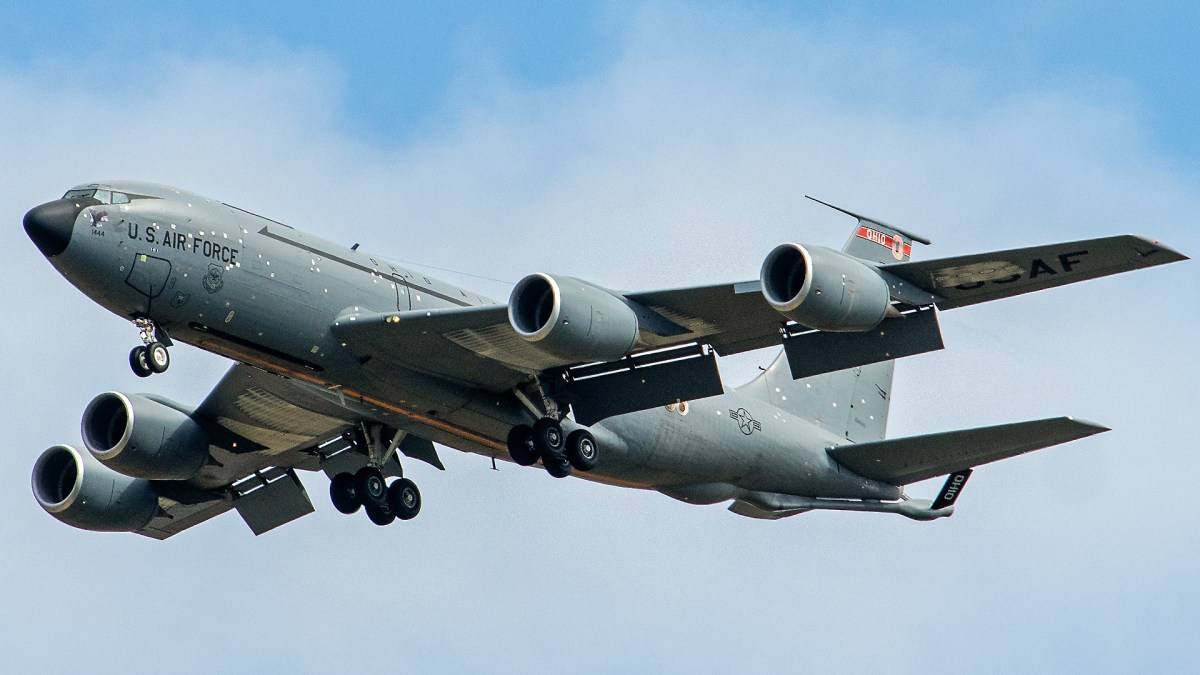
(Aviation photographer Andrew McKelvey)
The head of Air Mobility Command (AMC) on Wednesday offered some new details about what went into repairing a KC-135 Stratotanker riddled with shrapnel holes from an Iranian attack. We have previously written about a couple of these jets damaged during Operation Epic Fury (OEF) as they came through RAF Mildenhall in the U.K. on their way back to the U.S. for comprehensive repair work. We are also getting new information of how AMC kept its fleet operating at such a prolonged high-tempo ahead of and during OEF.
The discussion about the damaged tanker took place during a panel at the Air & Space Forces’ Air, Space and Cyber Conference that TWZ is attending. The tanker in question was damaged as it was preparing for a mission, explained AMC commander Lt. Gen. Daniel H. Tulley .
A U.S. Air Force maintainer performs preflight maintenance on a KC-135 Stratotanker refueling aircraft at a base in the Middle East, April 30, 2026. (U.S. Air Force photo by Master Sgt. James Cason) Master Sgt. James Cason
“A KC-135 ops crew is in the jet,” he said. “KC-135 maintenance team is about to launch this jet. Unexpected Alarm Red [an attack warning]. Everyone jumps in a bunker.”
After the barrage, the airmen emerged from their bunkers and checked out the plane.
“That aircraft is smoking,” Tulley said. “There are holes in it, and it’s a fully loaded KC-135. Two hundred thousand pounds of jet fuel. Took 48 hours for that [fuel] to be drained out of that aircraft. In the meantime, first on the scene was I think the pro super [ production superintendent ] and the expediter. They immediately began to collect the fuel… They start to patch the holes. They start to fix all the systems. Long story short, they were eventually able to get that plane to make a transoceanic flight back home to be fully repaired.”
Tulley did not say where the attack took place. However, as we have previously reported, five tankers were reportedly damaged in an Iranian long-range strike on Prince Sultan Air Base (PSAB) in Saudi Arabia on March 14. That was later confirmed in a Department of War Inspector General report released earlier this week .
You can see two of the shrapnel-damaged KC-135s as they passed through the UK on the way home in the following photographs shared with us by aviation photographer Andrew McKelvey. We do not know if either of these is the one discussed by Tulley.
Lt. Gen. Linda Hurry, Commander of Air Force Materiel Command (AFMC), followed Tulley’s comments with additional details about the repair work.
“I’ll pick right up on that because it was our aircraft battle damage repair team that was actually able to patch their aircraft back together to get it back to Tinker [Air Force Base in Oklahoma] that can put it completely back where it needed to be,” she noted. Tinker is home to the Expeditionary Depot Maintenance (EDMX), which is “responsible for maintaining the Air Force’s sole source for Aircraft Battle Damage Repair (ABDR) rapid repair capabilities for the entire tanker and bomber fleets,” according to the Air Force .
“So with Operation Epic Fury, we’re asking those questions: What can we sustain for how long? And it begs a question about regeneration,” Tulley further explained. “You know, our new teammates have regeneration as part of their doctrine, so readiness in contact is the way we’re approaching this. What can we do to improve how we generate capability while under fire, in contact, persistently in an extended or protracted conflict? Lots of great examples of work being done to get after this. General Hurry’s team has brought a lot of capability forward at Mildenhall Air Base.”
One example of how this has worked has been repairing damaged aerial refueling booms in the U.K. instead of all the way back to the U.S., Tulley highlighted. The booms, which extend from the back of tankers so that receiving aircraft can get their gas, can be damaged by the process, especially during combat refueling.
“I think we turned 30 booms instead of bringing them all the way back to the states,” Tulley noted.
A KC-135 refueling boom. (USAF)
Repairing battle damage is certainly a unique situation for AMC airman, but keeping hundreds of the command’s tankers and cargo aircraft moving at such a high rate prior to and during the war was a huge undertaking that was helped by new maintenance concepts. The Air Force sent maintainers and parts to bases in Europe to drastically speed up major maintenance that would have demanded the aircraft return stateside.
“We moved some maintenance actions forward, so they didn’t have to – the aircraft didn’t have to go all the way back to the states,” Air Force Chief of Staff Gen. Kenneth S. Wilsbach said during his keynote speech earlier this week. “We put some of them in Europe, so they could get through some normal safety inspections that were either due or deferred. Got those done, and the aircraft doesn’t have to go all the way back to the states. They can go somewhere in Europe, get the thing done, and then get right back to the flight. And so, those measures by Air Mobility Command paid dividends in the readiness of our mobility fleet.”
Air Force Global Strike Command (AFGSC), which maintains the service’s fleet of strategic bombers and its ICBM force, did something similar at RAF Fairford in the U.K., AFGSC commander Gen. Stephen L. Davis explained.
“It’s a complex problem,” said Davis. “I would say in the past we probably didn’t do this the right way. When we thought a conflict was kicking off, the first thing we do is start sending bombers forward, and that actually consumes our readiness. So I think we got it right during OEF.”
“We pushed maintainers and support personnel forward to RAF Fairford, and then we actually took the bombers, we loaded them up in CONUS [Continental United States]. We took them to the Middle East. They actually did a mission. They employed, deployed, conducted a combat mission, and then landed at Fairford. And then for the next, well, I guess they’ve been there for now six-plus months.”
“They’ve been conducting nearly daily operations out of there,” Davis proffered. “When bombers are back at home base, they build readiness. When we deploy it forward, they consume readiness. And then, as [Gen. Hurry] said, we’re getting great support in terms of parts, in terms of supplies, and in terms of forward depot support. So that fleet remains healthy.”
A U.S. Air Force B-1B Lancer at RAF Fairford, England, July 15, 2025. (U.S. Air Force photo by Tech. Sgt. Robert M. Trujillo) Tech. Sgt. Robert Trujillo
Being able to do as much repair and maintenance work as close to the front lines as possible will be hugely important in any future fight against China, and, unfortunately, repairing battle damaged aircraft will be necessary too. Clearly, the Air Force has learned some very important lessons from Epic Fury.
Contact the author: howard@twz.com
Comments couldn’t be loaded. Please refresh the page.
发布于美国东部时间2026年9月16日晚上7:58
(航空摄影师安德鲁·麦克尔维)
空军机动司令部(AMC)司令周三透露了一些关于修复一架在伊朗袭击中被弹片击穿的KC-135空中加油机的最新细节。此前我们曾报道过,在“史诗狂怒行动”(OEF)期间,有几架KC-135战机受损,它们途经英国米尔登霍尔皇家空军基地返回美国进行全面维修。我们还获得了一些关于AMC如何在“史诗狂怒行动”前后保持其机队长期高强度运转的新信息。
关于受损加油机的讨论是在TWZ出席的空军与太空部队空天网络会议上的一个小组讨论中进行的。空军机动司令部司令丹尼尔·H·图利中将解释说,这架加油机是在准备执行任务时受损的。
2026年4月30日,在中东某基地,一名美国空军维护人员正在对一架KC-135同温层加油机进行飞行前维护。(美国空军照片,由一级军士长詹姆斯·卡森拍摄)一级军士长詹姆斯·卡森
“KC-135作战机组人员在飞机上,”他说。“KC-135维护小组正准备起飞这架飞机。突然响起红色警报(攻击警报)。所有人立即躲进掩体。”
炮火过后,飞行员们从掩体中出来,检查了飞机。
“那架飞机冒着烟,”塔利说。“机身有洞,而且是一架满载的KC-135加油机。里面装了20万磅航空燃油。花了48小时才把燃油排干净。与此同时,最先赶到现场的应该是生产主管和调度员。他们立即开始收集燃油……开始修补漏洞,开始修复所有系统。总之,他们最终让这架飞机完成了一次跨洋飞行,飞回基地进行全面维修。”
图利并未透露袭击发生的地点。然而,正如我们此前报道,3月14日,伊朗对沙特阿拉伯苏丹王子空军基地(PSAB)发动远程空袭,据称造成五架加油机受损。本周早些时候发布的一份美国战争部监察长报告证实了这一消息。
在航空摄影师安德鲁·麦凯尔维分享的以下照片中,可以看到两架被弹片击中的KC-135加油机在返程途中飞越英国的画面。我们尚不清楚这两架飞机是否就是塔利所提到的那架。
空军装备司令部 (AFMC) 司令琳达·赫里中将随后补充了有关维修工作的更多细节。
“我会立即着手处理这件事,因为正是我们的飞机战损维修小组成功地将飞机修复,并送回廷克空军基地(位于俄克拉荷马州),在那里它能够完全恢复到应有的状态,”她指出。廷克空军基地是远征后勤维修中心(EDMX)的所在地,据空军称,该中心“负责维护空军唯一的飞机战损维修(ABDR)快速维修能力,涵盖所有加油机和轰炸机机队”。
“所以,在‘史诗狂怒行动’中,我们提出的问题是:我们能持续多久?这又引出了一个关于再生能力的问题,”塔利进一步解释道。“你知道,我们的新队友将再生能力纳入了他们的作战条令,因此,我们正着手解决这个问题。在持续的冲突或长期冲突中,我们如何才能在炮火下、在交战中、持续不断地提升自身能力?目前有很多优秀的案例正在为此努力。赫里将军的团队已经在米尔登霍尔空军基地推进了大量能力建设。”
图利强调,这种方法的一个应用实例是,受损的空中加油吊杆现在可以在英国本土维修,而无需运回美国。这些吊杆从加油机尾部延伸出来,供受油飞机加油,在加油过程中容易受损,尤其是在战斗加油过程中。
“我认为我们只用了 30 个烟囱,而不是把它们全部运回美国,”塔利指出。
KC-135空中加油吊杆。(美国空军)
对于空军机动司令部(AMC)的飞行员来说,修复战损无疑是一项独特的任务,但在战前和战时,要保持该司令部数百架加油机和运输机的高速运转,本身就是一项艰巨的任务,而新的维护理念为此提供了帮助。空军向欧洲的基地派遣了维护人员和零部件,从而大幅加快了原本需要飞机返回美国本土才能完成的大修工作。
“我们提前进行了一些维护工作,这样飞机就不用飞回美国本土了,”空军参谋长肯尼斯·S·威尔斯巴赫将军在本周早些时候的主题演讲中说道。“我们把其中一些飞机部署到欧洲,以便它们能够完成一些原本应该进行或被推迟的常规安全检查。这些检查完成后,飞机就不用飞回美国本土了。它们可以去欧洲的某个地方完成维护,然后立即恢复飞行。因此,空中机动司令部采取的这些措施显著提高了我们机动机队的战备水平。”
空军全球打击司令部(AFGSC)负责维护空军的战略轰炸机机队和洲际弹道导弹部队,该司令部在英国皇家空军费尔福德基地也做了类似的事情,空军全球打击司令部司令斯蒂芬·L·戴维斯将军解释说。
“这是一个复杂的问题,”戴维斯说。“我认为过去我们可能处理得不太好。当我们认为冲突即将爆发时,我们做的第一件事就是派出轰炸机,这实际上消耗了我们的战备能力。所以我认为我们在‘持久自由行动’期间的做法是正确的。”
“我们把维护人员和支援人员派往费尔福德皇家空军基地,然后我们把轰炸机装上飞机,在美国本土装载完毕。我们把它们运往中东。它们执行了任务,投入使用,部署作战,然后降落在费尔福德。接下来的时间,嗯,我想它们已经在那里待了六个多月了。”
“他们几乎每天都在那里进行作战行动,”戴维斯说道。“轰炸机返回基地后,会提升战备状态。当我们将其部署到前线时,战备状态就会下降。正如赫里将军所说,我们在零部件、补给和前线后勤保障方面都得到了大力支持。因此,这支机队保持着良好的状态。”
2025年7月15日,一架美国空军B-1B“枪骑兵”轰炸机停在英国费尔福德皇家空军基地。(美国空军技术军士罗伯特·M·特鲁希略摄)
在未来任何与中国的战争中,尽可能在前线附近开展维修和保养工作都至关重要,而且不幸的是,修复战损飞机也必不可少。显然,空军从“史诗狂怒”演习中吸取了一些非常重要的教训。
联系作者:howard@twz.com
评论加载失败,请刷新页面。