The early bird gets the worm at Nasi Lemak Abu in Kelana Jaya早起的鸟儿有虫吃 位于 Kelana Jaya 的 Nasi Lemak Abu
PETALING JAYA, Sep 17 — Happy belated Malaysia Day. I hope you were able to stay safe from the haze, show off your allegiance to the country by bidding for special car plates, or...
The article reflects on the cultural significance of Malaysia's national dish, nasi lemak, highlighting how its accessibility, from street stalls to high-end restaurants, symbolizes Malaysian unity despite social fragmentation.
The piece advocates for broadening culinary experiences and appreciating authentic local flavors, using Nasi Lemak Abu in Petaling Jaya as an exemplar for quality nasi lemak beyond mainstream hype.
Such experiences serve as a reminder of shared, yet distinct, cultural identities within Malaysia.
PETALING JAYA, Sep 17 — Happy belated Malaysia Day. I hope you were able to stay safe from the haze , show off your allegiance to the country by bidding for special car plates , or at the very least, hand over your hard-earned money to corporations pretending to care about Malaysian history by incorporating it into a promotional campaign.
No, no, I get it — the drink is only RM6.30. It’s very clever.
In some ways, this article risks being guilty of the same contrived approach: a nasi lemak story any other time of year is unremarkable; a nasi lemak story one day removed from the two most patriotic — publicly anyway — weeks in the national calendar is just a little too convenient.
But I’ve been thinking about what it means to be Malaysian, and specifically, what it means to eat like a Malaysian.
As a country, we’ve anointed nasi lemak as our national dish, a symbol of Malaysian-ness, and in turn it has permeated every level of our rapidly changing society.
Today, one can eat nasi lemak anywhere, from roadside stalls and fast food outlets to the swankiest of hotel restaurants.
Now, simply eating nasi lemak does not a Malaysian make.
And while I’m not here to police how people eat, choosing to eat nasi lemak exclusively within a bubble utterly divorced from the community that traditionally makes it is a symptom of our fragmented reality — and, worse yet, it pretty much guarantees a lifetime of mediocre nasi lemak .
But a bubble is just that — a bubble. Invisible and fragile, it doesn’t take a poke, so much as a whisper, to pop it.
A single stop is all it takes to unlearn a preference that had long since calcified into bias.
Which brings me to Nasi Lemak Abu, a truck parked outside Dataran Glomac in Kelana Jaya.
It sits just across the LDP from Paradigm Mall, and only a few minutes’ drive from some of the Klang Valley’s most talked-up nasi lemak joints, where the only thing more insufferable than the queue is the bottled-up social media hype spilling out of its gormless patrons.
Nasi Lemak Abu opens at 6.15am to serve the masses that keep the city running before the rest of us wake up.
Rather than a queue, it’s a loose gaggle of people zipping by in the dark to bungkus their breakfast or lunch — delivery riders, security guards, office workers, even early risers walking over from the neighbourhood.
By the time the street parking fills after 8.30am, the reserves of lauk have largely dwindled.
Staples like ayam goreng and sambal sotong won’t run out until they close at 10.30am or 11am, but to get a taste of the real treasures, like ayam masak merah and ayam rendang, showing up before the sun is out is a necessity.
Like the sloth that I am, I showed up well after 8.30am the first time and had to settle for nasi lemak ayam goreng with sambal sotong (RM9.50), although the kakak was nice enough to tell me to come back earlier the next time to get first dibs on the full spread.
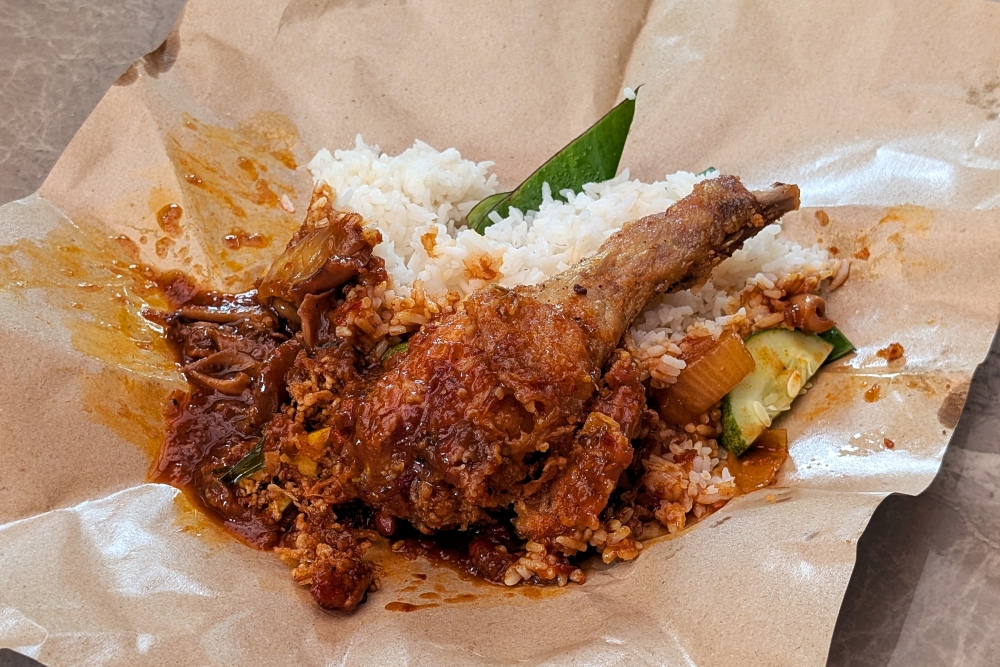
I set an alarm and returned the following day, and happily headed home with my bags of nasi lemak ayam masak merah , paru goreng and begedil and nasi lemak ayam rendang , sambal sotong and begedil for RM21.
The rice is fragrant enough to smell before you’ve unwrapped the parcel, rich with coconut milk and still fluffy after sitting tightly packed for the better part of an hour.
The sambal is legitimately pedas, cut with enough sweetness from the onions and a savoury backbone that keeps it from being one-note.
Even if they served nothing else, Abu is one of the few nasi lemak stalls still worth the detour for the quality of their rice and sambal alone.
And yet, the lauk impresses too. The ayam masak merah is nothing like the cloyingly sweet versions that pass for masak merah elsewhere; instead, it packs real heat and oomph.
The paru goreng is crisp without the pieces of lung drying out; the begedil are soft, small potato fritters done right, and the sotong in the sambal is cooked to just springy, avoiding the rubber-band texture squid usually turns into.
But the rendang — my goodness, the rendang ! Despite the light colour of the gravy, the depth of flavour it holds is crazy, with lemongrass and galangal doing the heavy lifting. Many places can’t hold a candle to this.
The encouraging, yet simultaneously frustrating truth about these insular eating bubbles is that the lines often aren’t physically tangible, geographic boundaries.
They’re preferences that turn into habits, and habits that turn into implicit bias. Nasi Lemak Abu isn’t some out-of-the-way, inconvenient trek from the rest of these hyped-up spots.
They’re all, more or less, in the same vicinity. If anything, it serves as a reminder of how we often live shared, but very parallel lives.
We occupy the same Malaysia, but don’t experience it the same way.
I don’t know what to do about that. But we can at least try to meet one another at the dinner table.
I’m reminded of a line uttered by a security guard, Mr Singh, in P. Ramlee’s 1961 film, Seniman Bujang Lapok.
“Lu punya nasib, lu makan. Dia punya nasib, dia makan. Apa salah lu makan sama-sama?”
(in front of Qualitas, Dataran Glomac)
Open Monday to Saturday, 6.15am — 10.30am
* This is an independent review where the writer paid for the meal.
* Follow us on Instagram @eatdrinkmm for more food gems.
* Follow Ethan Lau on Instagram @eatenlau for more meditations on nasi lemak.
PJ SS2 Restoran MaMa Lee’s Home Cooked Kitchen turns family favourites into worthy feasts for get-togethers
For plump, homemade ‘sui kow’, head to Palace Rice Vermicelli Restaurant in Yulek, Cheras to satisfy your dumpling noodle cravings
Ara Damansara’s Restoran Kacang Pool Haji showcase superb Johor eats like their legendary ‘kacang pool’, ‘lontong basah’ and ‘mee rebus’ using dried shrimps
Tuanku Muhriz remains legitimate Yamtuan, says Negeri Sembilan DKU
Sabah Marine Police seize untaxed cigarettes, liquor worth RM5.37m
Masked gang steals up to RM1m in second robbery at Kedah goldsmith
文章反思了马来西亚国菜椰浆饭的文化意义,强调了从街边小摊到高档餐厅,椰浆饭的普及象征着马来西亚在社会分裂的情况下依然保持团结。
这篇文章提倡拓宽美食体验,欣赏地道的当地风味,并以八打灵再也的 Nasi Lemak Abu 为例,展示了超越主流炒作的优质椰浆饭。
这些经历提醒我们,马来西亚内部存在着既共同又独特的文化身份。
八打灵再也,9月17日讯——马来西亚日快乐!希望您能平安度过雾霾,通过竞拍特殊车牌来表达对国家的忠诚,或者至少把辛苦赚来的钱交给那些假装关心马来西亚历史、将其融入宣传活动的公司。
不不,我明白了——这饮料只要6.30令吉。这真是个好主意。
在某些方面,这篇文章有可能会犯同样的刻意安排的错误:一年中其他任何时候的椰浆饭故事都不足为奇;而椰浆饭故事恰好发生在国家日历上最爱国的两周(至少在公众眼中是如此)之后一天,这就显得太巧合了。
但我一直在思考成为马来西亚人意味着什么,特别是像马来西亚人一样吃饭意味着什么。
作为一个国家,我们把椰浆饭奉为国菜,它是马来西亚的象征,反过来,它也渗透到我们快速变化的社会的各个层面。
如今,从路边摊、快餐店到最豪华的酒店餐厅,到处都能吃到椰浆饭。
仅仅吃椰浆饭并不能使你成为马来西亚人。
虽然我不是来管别人怎么吃的,但是选择只在一个与传统上制作椰浆饭的社区完全脱节的泡泡里吃椰浆饭,是我们支离破碎的现实的一个症状——更糟糕的是,这几乎注定了你一辈子都只能吃到平庸的椰浆饭。
但泡沫终究只是泡沫。它无形又脆弱,无需用力戳一下,只需一声轻语,就能将其戳破。
只需一次购物,就能改变你长期以来根深蒂固的偏见。
这让我想到了 Nasi Lemak Abu,一辆停在格拉纳再也 Dataran Glomac 外的卡车。
它位于 LDP 高速公路对面,与 Paradigm Mall 隔路相望,距离巴生谷一些最受追捧的椰浆饭店也只有几分钟的车程。在那里,唯一比排队更令人难以忍受的,就是那些愚蠢的顾客们压抑的社交媒体炒作。
Nasi Lemak Abu 早上 6 点 15 分开门营业,为在我们其他人醒来之前维持城市运转的大众提供服务。
与其说是排队,不如说是一群人在黑暗中匆匆走过,打包他们的早餐或午餐——外卖骑手、保安、上班族,甚至还有从附近街区走过来的早起者。
早上 8 点 30 分以后,街边停车位就满了,而此时 lauk 的储备也基本用完了。
像炸鸡和叁巴鱿鱼这样的经典菜肴,要到上午 10:30 或 11:00 关门时才会卖完,但要想品尝到真正的美味,比如红烧鸡和仁当鸡,就必须在太阳升起之前到店。
我像个懒虫一样,第一次去的时候已经过了早上 8 点半,只好点了椰浆饭配炸鸡和叁巴鱿鱼(9.50 马币),不过店主姐姐人很好,告诉我下次早点来,可以先尝尝全套菜品。
我定了闹钟,第二天就回来了,然后带着我的袋装椰浆饭、paru goreng 和 begedil、nasi lemak ayam rendang、sambal sotong 和 begedil 回家,价格为 RM21。
米饭在打开包装前就已经散发出浓郁的香味,椰奶味十足,即使紧实包装放置了近一个小时,仍然蓬松柔软。
这款叁巴酱味道正宗地道,辣度适中,洋葱的甜味恰到好处,咸鲜的底味让它不至于单调乏味。
即使他们不提供其他任何东西,Abu 也是少数几家值得绕道前往的椰浆饭摊之一,单凭他们的米饭和叁巴酱的品质就足以令人赞叹。
然而,这道菜也令人印象深刻。这里的红烧鸡与别处那些甜腻腻的所谓红烧鸡截然不同;相反,它辣味十足,风味浓郁。
炸猪肺酥脆可口,猪肺块不会变干;炸土豆球松软可口,炸得恰到好处;叁巴酱里的鱿鱼煮得恰到好处,有嚼劲,避免了鱿鱼通常会变得像橡皮筋一样。
但是那道仁当——我的天哪,那道仁当!尽管汤汁颜色较浅,但味道却浓郁得令人难以置信,香茅和高良姜功不可没。很多地方都无法与之媲美。
这些封闭的饮食圈子令人鼓舞,但同时也令人沮丧的真相是,这些圈子的界限往往不是实际存在的、有形的地理边界。
这些偏好会变成习惯,而习惯又会变成隐性偏见。Nasi Lemak Abu 并非远离其他热门餐厅、路途遥远且不便前往的地方。
它们或多或少都在同一区域。这恰恰提醒我们,我们常常过着共享却又非常相似的生活。
我们生活在同一个马来西亚,却有着不同的感受。
我不知道该怎么办。但我们至少可以尝试在餐桌上见面。
这让我想起了 P. Ramlee 1961 年的电影《Seniman Bujang Lapok》中保安 Singh 先生说的一句话。
“Lu punya nasib,lu makan。Dia punya nasib,dia makan。Apa salah lu makan sama-sama?”
(位于 Dataran Glomac 的 Qualitas 前面)
周一至周六,上午6:15至10:30营业
* 这是一篇独立评论,作者自行支付了餐费。
* 关注我们的Instagram账号@eatdrinkmm,获取更多美食资讯。
* 在 Instagram 上关注 Ethan Lau @eatenlau,了解更多关于椰浆饭的冥想内容。
PJ SS2 Restoran MaMa Lee's Home Cooked Kitchen 将家常菜变成适合聚会的盛宴
想吃饱喝足、口感扎实的自制“水饺”?那就去蕉赖裕力区的Palace Rice Vermicelli Restaurant吧,绝对能满足你对水饺面的渴望。
Ara Damansara 的 Restoran Kacang Pool Haji 展示了一流的柔佛美食,如传奇的“kacang pool”、“lontong basah”和使用干虾制成的“mee rebus”
森美兰 DKU 表示,Tuanku Muhriz 仍然是合法的 Yamtuan
沙巴海事警察查获价值537万令吉的未缴税香烟和酒类
蒙面团伙在吉打州金匠铺第二次抢劫,劫走高达100万令吉。