To market, to market: What is behind Singapore’s never-ending weekend bazaars?奔波于各个集市之间:新加坡永不停歇的周末集市背后究竟隐藏着什么?
Explore Singapore’s vibrant weekend markets featuring creative vendors, unique brands, live music, and workshops that attract Gen Z and young entrepreneurs. Read more at straitstimes.com.
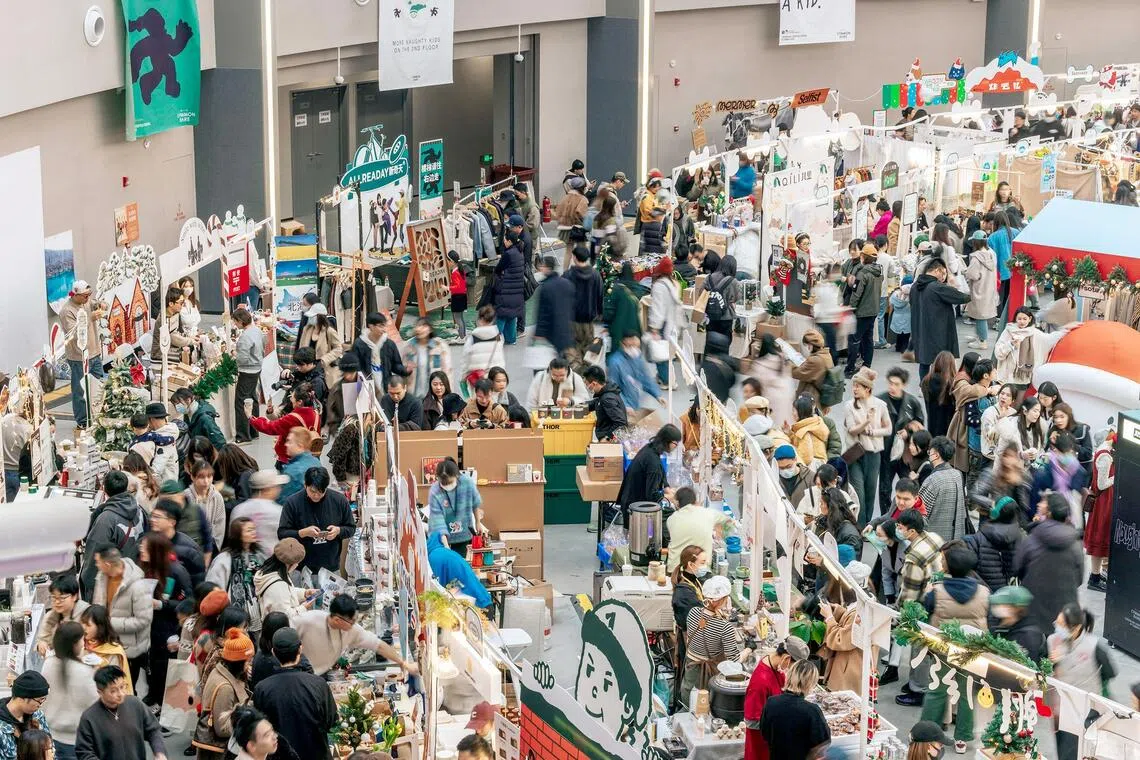
Common Rare, one of Shanghai’s biggest creative markets, will debut its first overseas edition in Singapore in September.
Published Sep 17, 2026, 10:35 AM
Updated Sep 17, 2026, 02:48 PM
One of Shanghai's largest creative markets Common Rare is coming to Singapore for its first overseas edition this weekend.
Common Rare senses growth opportunity here as creative markets spanning fashion, art and lifestyle become weekend fixtures in Singapore, with the calendar particularly stacked in recent months.
The popularity of the format is driven by demand from young people and a growing number of small online businesses eager to sell at pop-up markets.
SINGAPORE – There will be big, photogenic inflatables, tattoo artists, live music and more than 200 indie brands. Pets and children are welcome, and small do-it-yourself workshops are scheduled onsite.
This is the carnival-esque programming for one of Shanghai’s largest creative markets Common Rare, which lands here from Sept 18 to 20 at Suntec Singapore Convention & Exhibition Centre, putting an international spin on what has been a banner year for weekend bazaars .
Half of the participating vendors are flying in from China for the 10-year-old event’s first overseas edition, and they did not need much persuading, says Common Rare co-founder Tiffany Wong, 34.
Of the 100 brands culled from more than 200 applicants, many are new to the territory, with no client base in Singapore.
But rumours of an especially receptive – and affluent – local market, helpfully schooled in Mandarin, were a big enough carrot for the small business owners to pay for their own airfare, accommodation, logistics and booth rental, notes Wong.
Among the line-up are quirky accessories label Happy Restaurant and pet fashion brand Lazy Eazy, which makes “designer” garb for dogs including racing “jackets”. These novel Chinese brands are the fair’s unique selling point here. The other 100 or so brands hail from South-east Asia and Singapore.
Together, they form a catalogue of trendy Asian homeware, scents, accessories, illustrated prints and clothing.
To Wong and co-founder Vivian Sze, 34, Singapore is a land of opportunity. The city-state permits visa-free entry for Chinese creatives and is a good launchpad for regional follow-ups, they say.
Crucially, there is an appetite for markets. These pop-up events have become weekend fixtures here, with the calendar particularly stacked in recent months.
On the last weekend of August, five fairs vied for attention: art market Artsobi, multidisciplinary creative bonanza In-Between, zine platform Singapore Art Book Fair, the Singapore Night Festival’s Pasar Mad-lam and bookstore Wormhole’s small marketplace.
In September, there have been one or more every weekend, including the reliably packed Public Garden .
Wong, who often visits her sister, a Singapore resident, thinks Common Rare can plug a gap for mega-fairs with diverse attractions.
Its brand curation also leans more polished than the homespun wares at small craft markets here, she says. All Common Rare vendors are design-focused and, as a rule, must have a logo, good packaging and campaign imagery.
A poster for the Common Rare event, which features trendy Asian homeware, scents, accessories, illustrated prints and clothing. PHOTO: COMMON RARE
A poster for the Common Rare event, which features trendy Asian homeware, scents, accessories, illustrated prints and clothing.
Common Rare’s evolution from a dinky 55 stalls at its 2016 launch to its current mass of more than 400 brands at its quarterly Shanghai events reflects the popularity of the market retail format in Chinese cities. “Since Covid-19, everyone’s been doing markets,” says Sze, who estimates there are some 10 markets in Shanghai every weekend.
In response, Common Rare had to go bigger and better. At previous events, to maximise the offline experience of a market, it has held pet adoption drives and traditional Chinese medicine activities, and brought in a masseuse.
Its events are littered with photo spots – big screens, sticker walls and, once, even a 6m-tall outdoor inflatable installation – in keeping with the country’s penchant for “da ka” (punch card), a social media trend where users take pictures of themselves at nice backdrops as proof of their “travels”.
The scene is “a lot more competitive than before”, say the Chinese veterans.
Though less ferociously, the Singapore scene for markets is expanding too, powered by a happy harmony of demand and supply.
Like the high street of the 2000s and Regency-era parks, these fairs are also a place for young people to be seen. PHOTO: KONBINI
Like the high street of the 2000s and Regency-era parks, these fairs are also a place for young people to be seen.
Gen Z and young millennials turned off by rinse-and-repeat shopping centres and online shopping are flocking to creative fairs for retail therapy.
Freelance actor and student Russell Su goes to as many markets as he can, especially after payday.
“I love supporting the arts and discovering new artists locally or internationally,” says the 23-year-old. It is a sentiment that hits on the appeal of latter-day fairs – less bargain-friendly flea market, more creative hotbed.
He adds: “I used to buy most things on (Chinese e-commerce site) Taobao or (second-hand marketplace app) Carousell. But buying things in person, seeing them and feeling them in a tactile way, allows me to determine the quality better.”
Freelance actor and student Russell Su (pictured at a Berlin market) goes to as many markets as he can, especially after payday. PHOTO: COURTESY OF RUSSELL SU
Freelance actor and student Russell Su (pictured at a Berlin market) goes to as many markets as he can, especially after payday.
PHOTO: COURTESY OF RUSSELL SU
Like the high street of the 2000s or Regency-era parks, these fairs are also a place to be seen.
Su says one could even call them “aura-farming conventions”, using Gen Z speak for showing off one’s coolness in public, with the competitive element silently implied. “(At markets), people tend to ascertain your (cultural) tastes according to how stylish or avant-garde you present yourself.”
Local J-fashion market Konbini hires a photographer to snap pictures of its shoppers – an increasingly common practice – though organisers would do just as well without, what with local fashion magazines like F Zine starting to cover the street style at these events.
Says Konbini founder See Kaye: “That documentation is very important in a historical sense (as a record), but also socially, because they are posted online and you see your friends appearing on social media in their outfits. You celebrate one another.”
J-fashion fans at Konbini, which also serves as a gathering point for those in the niche fashion subculture. PHOTO: KONBINI
J-fashion fans at Konbini, which also serves as a gathering point for those in the niche fashion subculture.
See’s “loosely biannual” operation jumped from 500 visitors at its launch in 2023 to 8,000 at its latest event in June.
She sees markets as a “roving third place” for community-hungry Gen Z, displacing tired malls. “In the 1990s to 2000s, teens used to hang out at malls, but not any more. Malls aren’t targeting these young people, who can’t find products they want at malls,” she says.
Konbini, in particular, is a meeting ground for Harajuku-style adherents, the fashion subculture born from the Tokyo shopping street of the same name. There, niche aesthetics are on proud display – frilly Lolita skirts, the chains and leather of Japanese music and fashion movement visual kei, and technicolour hair.
Beyond shopping, there is a best-dressed contest and, at one edition, a Lolita-style picnic was held on the grass outside the venue. Guests took along props and enjoyed sitting on mats in their livery.
Konbini’s Lolita-style picnic in January, where guests brought props and sat on mats on the grass outside the venue. PHOTO: KONBINI
Konbini’s Lolita-style picnic in January, where guests brought props and sat on mats on the grass outside the venue.
Supply is booming alongside demand as a cottage industry of small online businesses fight to booth at these markets. The simple reason is that more people are starting their own small brands.
Common Rare’s Wong says: “A lot of the young generation don’t want to work a nine-to-five job any more, they want to have their own brand.”
These tend to start as passion projects, done on the side of a day job, and markets become the easiest way for these indie makers to test the waters, she adds. Helpfully, these events are held on weekends and organisers usually ask for low-to-mid three-figure sums for a booth, far below the monthly rent for a store in the big city.
As in Shanghai, so in Singapore.
Public Garden, a regular and hotly anticipated market on the shopping calendar. PHOTO: PUBLIC GARDEN
Public Garden, a regular and hotly anticipated market on the shopping calendar.
PHOTO: PUBLIC GARDEN
Konbini’s See, speaking for her generation, provides another reason for the bounty of Gen Z-run businesses. “It’s hard for young people to find the things they want in stores so they have to make it themselves. That’s because fast fashion creates a mono-aesthetic.
“Once you start making things on your own, you naturally start to sell things to cover the cost of supplies.”
As a 21-year-old, she began selling J-fashion clothes sourced online and handmade accessories. The Instagram operation became her impetus for launching Konbini in 2023 because of a lack of markets that catered to her niche, she adds.
According to illustrator Jean Kuah, the current spread of markets for would-be vendors to choose from is far wider than the slim pickings of 2014, when the 32-year-old started making T-shirts under the brand Dapinkrubbish.
“However, with more opportunities also comes greater competition. Many events now have a curation process, so being selected is not necessarily guaranteed.”
Kuah, who now draws original characters under her brand Mochibuddies, adds: “The cost of running a booth has also increased significantly over the years – from rental to manpower to the cost of producing products. As a result, I think it has become increasingly important for artists and small businesses to research each event carefully and consider whether its audience and overall concept are a good fit for their brand.”
Boutiques Singapore The Gifting Edition 2025, which is another market heavyweight in Singapore. PHOTO: BOUTIQUES
Boutiques Singapore The Gifting Edition 2025, which is another market heavyweight in Singapore.
Market regulars say that even three years ago, it was possible to get a weekend booth for $50. Now, $300 is the norm. At more established fairs, rates start at around $500.
Bigger markets and swelling crowds also mean vendors have to work harder to not get lost in the mix. The difficulty has ironically led to even more markets as creatives break off into smaller groups to hold downsized events, says Zu Wee, a creative producer at Thirtytwocm, organiser of the Illustration Arts Festival (IAF).
Designer Claire Boon making a cardboard bed for her booth at In-Between. PHOTO: WONG MENG FEI
Designer Claire Boon making a cardboard bed for her booth at In-Between.
PHOTO: WONG MENG FEI
Other times, markets are born from pure idealism, sans profit motive.
In-Between hit the scene on the happening weekend of Aug 28 – with four other markets running and a clutch of art exhibitions. The event was a first-of-its-kind “part exhibition, part fair” that only lightly encouraged its so-called boothers to sell something.
About 80 per cent of some 50 participants did, but the goods played second fiddle to the creativity on show.
The smorgasbord spanned disciplines: A ceramicist made a sculpture of Buddha from butter, then let it melt. Former nightclub co-owner Bobby Luo showed bizarre masks and garments from his archive. He also curated a roving fashion show of freaky looks that featured a veil made of chicken bones by designer Megan Renee Lim. An ecology graduate presented her research alongside a giant kite made of plastics fished from the sea, complete with algae and seaweed.
Bobby Luo's Odditorium at In-Between. PHOTO: WONG MENG FEI
Bobby Luo's Odditorium at In-Between.
Event co-organiser and design lecturer Dandy Hartono, 28, says: “Art markets have got so specific, only specific kinds of people can join. At IAF, it’s only illustrators. At Singapore Art Book fair, you need to make books. I have a lot of colleagues and students who aren’t illustrators or bookmakers. They don’t have a place to show their work.”
Enter In-Between – a platform for the misfits.
The frustration with “cookie cutter” art markets extended to the set-up. Instead of tables, In-Between gave its creatives a 2m by 2m floor space and eight cardboard boxes. Someone made a bed, another a car. One illustrator made a “cave” with curtains at the entrance that visitors entered with a torch that lit up his artwork on the “walls”, says Hartono.
“Booths” were arranged in criss-crossing lines, not neat rows, so people would have to pick their way through and, hopefully, mingle on the way .
It was controlled chaos inspired by Hartono and co-organiser Nicia Lam’s art school days. “This is not our official tagline but internally, we called it a graduation show for practising creatives,” says Hartono.
A group of art students, 80 Ben St, with their cardboard car booth at In-Between. PHOTO: WONG MENG FEI
A group of art students, 80 Ben St, with their cardboard car booth at In-Between.
These innovations were sparked by the pair’s yen to replicate the “anything goes” spirit of a graduation show and nothing to do with one-upping the competition. In fact, they very nearly did not break even from ticket sales ($6 each), even with rent at the New Bahru venue waived.
Says Hartono: “When we started this, we didn’t think about competing against other markets. It’s purely because we were so itchy to do this.”
With 2,400 visitors in its inaugural run, and a sequel event not ruled out, this itch just might spread.
上海最大的创意市集之一 Common Rare 将于 9 月在新加坡首次推出海外版本。
发布于 2026 年 9 月 17 日上午 10:35
更新于2026年9月17日下午2:48
上海最大的创意市集之一 Common Rare 将于本周末首次登陆新加坡,举办海外首秀。
Common Rare 认为,随着涵盖时尚、艺术和生活方式的创意市集在新加坡成为周末的固定活动,尤其是近几个月来活动安排更加密集,这里蕴藏着巨大的增长机会。
这种形式的流行是由年轻人的需求以及越来越多渴望在快闪市集上销售商品的小型在线企业的需求所推动的。
新加坡——届时将有大型的、上镜的充气装置、纹身艺术家、现场音乐表演以及超过200个独立品牌。欢迎携带宠物和儿童,现场还将举办小型DIY工作坊。
这是上海最大的创意市集之一 Common Rare 的嘉年华式活动安排,该市集将于 9 月 18 日至 20 日在新加坡新达城会展中心举行,为这个周末市集蓬勃发展的年份增添了国际风情。
Common Rare 联合创始人、34 岁的 Tiffany Wong 表示,参加此次活动 10 周年之际,一半的参展商都是从中国飞来参加的,而且他们几乎不需要任何劝说。
从 200 多个申请者中筛选出的 100 个品牌中,许多品牌都是新进入新加坡市场的,在新加坡没有客户群。
但据 Wong 指出,有传言称当地市场特别热情,而且富裕,当地人还懂普通话,这足以吸引小企业主自掏腰包支付机票、住宿、物流和摊位租金。
参展品牌中包括风格独特的配饰品牌“快乐餐厅”和宠物时尚品牌“懒惰易”,后者专门为狗狗设计“设计师”服装,例如赛马“外套”。这些新颖的中国品牌是本次展会的一大亮点。其余约100个品牌则来自东南亚和新加坡。
它们共同构成了一个涵盖时尚亚洲家居用品、香水、配饰、插画版画和服装的目录。
在黄和联合创始人、34岁的施薇薇看来,新加坡是一片充满机遇的土地。他们表示,这个城邦国家允许中国创意人才免签入境,是他们拓展区域业务的理想跳板。
至关重要的是,人们对市集有着强烈的需求。这些快闪市集已经成为这里周末的固定节目,近几个月来更是活动满满。
八月的最后一个周末,五个集市争夺人们的注意力:艺术市场 Artsobi、多学科创意盛会 In-Between、独立杂志平台新加坡艺术书展、新加坡夜间艺术节的 Pasar Mad-lam 以及书店 Wormhole 的小型市集。
九月份,几乎每个周末都有一场或多场活动,其中就包括人潮涌动的公共花园。
黄女士经常去新加坡探望她的姐姐,姐姐是新加坡居民。她认为,Common Rare 可以填补大型博览会缺乏多样化景点的空白。
她表示,Common Rare的品牌甄选也比本地小型手工艺品市场上的那些简陋商品更加精致。所有Common Rare的供应商都注重设计,而且通常都必须拥有自己的标志、精美的包装和宣传图片。
Common Rare 活动的宣传海报,该活动主打时尚的亚洲家居用品、香氛、配饰、插画版画和服装。图片:COMMON RARE
Common Rare 活动的宣传海报,该活动以时尚的亚洲家居用品、香水、配饰、插画版画和服装为特色。
Common Rare从2016年创立之初仅有的55个摊位,发展到如今每季度在上海举办的活动中汇聚超过400个品牌,这反映了市集零售模式在中国城市的受欢迎程度。“自新冠疫情以来,几乎每个人都在做市集,”Sze说道,他估计上海每个周末大约有10个市集。
为了应对这一挑战,Common Rare 必须扩大规模、提升服务质量。在之前的活动中,为了最大程度地提升线下市场的体验,他们举办过宠物领养活动、中医体验活动,甚至还邀请过按摩师。
其活动现场到处都是拍照点——大屏幕、贴纸墙,甚至还有一次搭建了一个 6 米高的户外充气装置——这与该国对“打卡”的喜爱相符,这是一种社交媒体趋势,用户在漂亮的背景下拍照,以此证明他们“旅行”过。
中国老将们表示,现在的竞争比以前激烈得多。
虽然不如新加坡那样迅猛,但在供需和谐的推动下,新加坡的市场也在扩张。
就像2000年代的商业街和摄政时期的公园一样,这些集市也是年轻人展示自我的场所。图片:KONBINI
就像 2000 年代的商业街和摄政时代的公园一样,这些集市也是年轻人展示自我的场所。
Z世代和年轻的千禧一代对千篇一律的购物中心和网上购物感到厌倦,纷纷涌向创意集市寻求购物疗法。
自由演员兼学生 Russell Su 会尽可能多地去集市逛逛,尤其是在发工资之后。
“我热爱支持艺术,也喜欢发掘本地和国际的新艺术家,”这位23岁的年轻人说道。这种想法正契合了如今艺术博览会的魅力所在——它不再是廉价的跳蚤市场,而更像是一个创意迸发的温床。
他补充道:“我以前大多在淘宝或二手交易平台Carousell上买东西。但亲自购买,亲眼看到、亲手触摸,能让我更好地判断质量。”
自由演员兼学生罗素·苏(Russell Su,图为在柏林集市上)尽可能多地逛集市,尤其是在发薪日之后。照片由罗素·苏提供
自由演员兼学生 Russell Su(图为在柏林集市上)尽可能多地去逛集市,尤其是在发工资之后。
照片:由 Russell Su 提供
就像 2000 年代的商业街或摄政时代的公园一样,这些集市也是一个人们展示自我的场所。
苏说,甚至可以称之为“炫耀风采大会”,用Z世代的话来说,就是在公共场合炫耀自己的酷炫,其中暗含着竞争的意味。“(在集市上),人们往往会根据你的穿着打扮是否时尚或前卫来判断你的(文化)品味。”
当地 J-fashion 便利店 Konbini 会聘请摄影师为顾客拍照——这种做法越来越普遍——不过,考虑到像 F Zine 这样的当地时尚杂志已经开始报道这些活动的街头风格,组织者其实完全可以不用这么做。
Konbini 创始人 See Kaye 表示:“这种记录在历史意义上非常重要(作为一种记录),而且在社交方面也很重要,因为它们会被发布到网上,你会看到你的朋友在社交媒体上展示他们的穿搭。你们会互相庆祝。”
在便利店 Konbini,J-fashion 的粉丝们熙熙攘攘,这里也成为了小众时尚亚文化爱好者的聚集地。(图片:Konbini)
Konbini便利店是J-fashion粉丝的聚集地,也是小众时尚亚文化爱好者的聚集地。
See 的“大致每两年一次”的活动从 2023 年首次举办时的 500 名参观者跃升至 6 月最新一届活动的 8000 名参观者。
她认为市集是渴望融入社区的Z世代的“流动第三空间”,取代了日渐衰落的购物中心。“上世纪90年代到本世纪初,青少年们常常在购物中心闲逛,但现在不再如此了。购物中心不再瞄准这些年轻人,因为他们在购物中心找不到自己想要的商品。”她说道。
便利店尤其受到原宿风爱好者的追捧,这种时尚亚文化起源于东京同名购物街。在那里,各种小众美学被骄傲地展示着——蓬蓬的洛丽塔裙、视觉系音乐和时尚运动中常见的链条和皮革元素,以及五彩缤纷的发型。
除了购物之外,还有最佳着装比赛;有一次,活动场地外的草坪上还举办了一场洛丽塔风格的野餐会。宾客们带着道具,穿着各自的服装,坐在垫子上享受野餐的乐趣。
一月份,Konbini举办了一场洛丽塔风格的野餐会,宾客们自带道具,坐在场地外草地上的垫子上。照片:Konbini
一月份,Konbini 举办了一场洛丽塔风格的野餐会,宾客们自带道具,坐在场地外草地上的垫子上。
随着众多小型在线企业争相在这些市场中占据一席之地,供应也与需求同步激增。原因很简单:越来越多的人开始创立自己的小品牌。
Common Rare 的 Wong 表示:“很多年轻人不想再朝九晚五地工作了,他们想要拥有自己的品牌。”
她补充说,这些项目往往是出于兴趣爱好,在正职工作之余开展的,而市集则成了这些独立创作者试水市场的最佳途径。值得一提的是,这些活动通常在周末举行,而且主办方通常只收取三位数的摊位费,远低于大城市店铺的月租金。
上海如此,新加坡亦如此。
公共花园市集,购物日历上一个定期举办且备受期待的市集。图片:公共花园
公共花园市集是购物日历上一个定期举办且备受期待的市集。
照片:公共花园
Konbini 的 See 代表她这一代人,为 Z 世代经营的企业蓬勃发展提供了另一个原因。“年轻人很难在商店里找到自己想要的东西,所以他们不得不自己动手做。这是因为快时尚创造了一种单一的审美。”
“一旦你开始自己制作东西,你自然而然就会开始出售这些东西来支付原材料成本。”
21岁时,她开始销售从网上搜罗的日系时尚服装和手工饰品。她补充说,由于缺乏满足她这一细分市场的渠道,Instagram 的运营促使她在 2023 年创立了 Konbini 便利店。
据插画家 Jean Kuah 称,目前有志成为供应商的商家可选择的市场范围远比 2014 年的有限选择要广得多。当时,这位 32 岁的插画家开始以 Dapinkrubbish 品牌制作 T 恤。
“然而,机会越多,竞争也越激烈。现在很多活动都有筛选流程,所以入选并不一定能保证。”
Kuah目前以Mochibuddies品牌创作原创角色,她补充道:“这些年来,摊位运营成本也大幅上涨——从租金、人工到产品制作成本。因此,我认为对于艺术家和小企业来说,认真调研每个活动,考虑其受众和整体理念是否与自身品牌契合,变得越来越重要。”
新加坡精品店2025礼品展,是新加坡市场上的另一大巨头。图片:精品店
Boutiques Singapore The Gifting Edition 2025 是新加坡市场上的另一大巨头。
常客们说,三年前,周末摊位只要50美元就能租到。现在,300美元已经是常态了。在一些更成熟的集市上,摊位费起价约为500美元。
规模更大的市集和不断涌入的人潮也意味着摊贩们必须更加努力才能不被淹没在人群中。讽刺的是,这种困境反而催生了更多市集,因为创意人士纷纷分成小组举办规模较小的活动。插画艺术节(IAF)主办方Thirtytwocm的创意制作人Zu Wee说道。
设计师克莱尔·布恩正在为她在In-Between的展位制作纸板床。摄影:黄梦菲
设计师克莱尔·布恩正在为她在 In-Between 展会的展位制作纸板床。
照片:黄孟飞
有时,市场的诞生纯粹出于理想主义,不以盈利为目的。
In-Between于8月28日那个热闹的周末盛大开幕,同时还有四个市集和一系列艺术展览同期举行。这场活动是首个“半展览半集市”的创新形式,它只是略微鼓励所谓的摊主们销售商品。
约 50 名参与者中有 80% 的人做到了,但商品本身却退居其次,创意才是主角。
这场盛宴涵盖了各个领域:一位陶艺家用黄油制作了一尊佛像,然后让它融化。前夜总会合伙人鲍比·罗展示了他收藏的奇特面具和服装。他还策划了一场巡回时装秀,展示了一系列怪诞造型,其中包括设计师梅根·蕾妮·林用鸡骨制作的面纱。一位生态学专业的毕业生展示了她的研究成果,旁边还有一个用从海里打捞上来的塑料制成的巨型风筝,上面还装饰着藻类和海藻。
Bobby Luo在In-Between的Odditorium。摄影:黄梦飞
Bobby Luo 在 In-Between 的奇趣馆。
活动联合组织者兼设计讲师丹迪·哈托诺(Dandy Hartono)今年28岁,他说:“艺术市场变得非常细分,只有特定类型的人才能参与。在国际艺术博览会(IAF),只允许插画师参展。在新加坡艺术书展,你必须创作书籍。我的很多同事和学生都不是插画师或书籍制作人。他们没有地方展示自己的作品。”
欢迎来到 In-Between——一个为格格不入的人而设的平台。
人们对“千篇一律”的艺术市集感到不满,这种不满也体现在市集的布置上。In-Between市集没有提供桌子,而是给艺术家们提供了一块2米乘2米的地面空间和八个纸箱。有人用纸箱做了一张床,有人做了一辆车。哈托诺说,一位插画家用帘子做了一个“洞穴”,入口处挂着帘子,参观者拿着手电筒进去,手电筒的光亮会照亮“墙壁”上的画作。
“摊位”呈纵横交错的线条排列,而不是整齐的行列,因此人们必须小心翼翼地穿过,并有望在途中相互交流。
这场展览呈现出一种可控的混乱,灵感源自哈托诺和联合组织者妮西亚·拉姆的艺术学院时代。“这并非我们的官方口号,但在内部,我们称之为创意从业者的毕业展,”哈托诺说道。
一群来自本街80号的艺术系学生,在In-Between艺术节上用纸板车搭建了一个展位。摄影:黄梦飞
一群艺术系学生,地址是本街 80 号,在 In-Between 展位上摆放了他们的纸板车展位。
这些创新源于两人想要重现毕业演出“无拘无束”的精神,与超越竞争对手无关。事实上,即使新巴鲁场地的租金被免除,他们也几乎没能从门票销售中收回成本(每张6美元)。
哈托诺说:“我们一开始并没有考虑与其他市场竞争。纯粹是因为我们太想做这件事了。”
首届活动吸引了 2400 名游客,而且不排除举办续集的可能性,这股热潮很可能会蔓延开来。