Lower fees, more places in facilities for PWDs among first moves by disability task force残疾人工作组的首要举措包括降低费用、增加残疾人设施床位。
More places and lower fees will improve access to disability services, benefiting 5,000 people with disabilities by 2030 in Singapore. Read more at straitstimes.com.
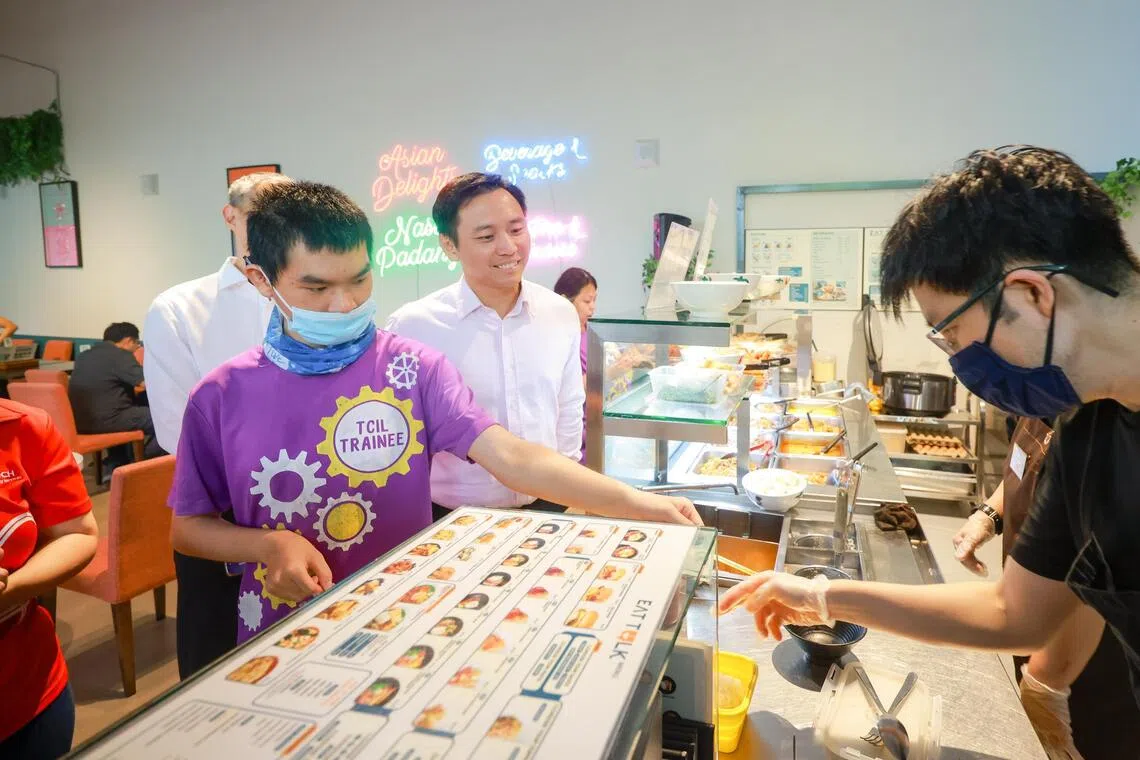
The changes were announced by Senior Minister of State for Social and Family Development Goh Pei Ming (centre), who engaged with clients from the TOUCH Centre for Independent Living on Sept 17.
ST PHOTO: JASON QUAH
Published Sep 17, 2026, 06:00 PM
Updated Sep 17, 2026, 06:00 PM
By 2028, the Singapore government will lower fees and increase subsidies for disability services, benefiting around 5,000 people with disabilities and making care more affordable for families.
The government will add 1,300 more spaces to day activity centres and sheltered workshops by 2030, easing long waiting lists and helping PWDs build skills and community ties.
Subsidy eligibility will expand to more middle-income households, with fee caps introduced and costs for families with higher support needs dropping by up to 80%, easing financial stress on caregivers.
SINGAPORE - By 2028, families will pay less for disability services, as the Government lowers fees and increases means-tested subsidies.
More spaces will also be added to day activity centres and sheltered workshops by 2030.
Around 5,000 people with disabilities accessing community and residential disability services are expected to benefit from these changes by 2030.
Fee caps for all government-funded disability services will be introduced, with the amounts varying for different facilities.
For most families, su bsidy rates will rise by at least 10 percentage points. These subsidies are means-tested, and apply to a wide range of disability services, including day activity centres, adult disability hostels and homes.
The income ceiling for households to qualify for these subsidies will also be raised . The maximum per capita monthly household income will increase from $4,800 to $6,000.
This will extend financial support to more middle-income households and covers about 80 per cent of households with people with disabilities (PWDs), said the Ministry of Social and Family Development (MSF).
These moves to make disability services more affordable are among the first set of recommendations by the Taskforce on Assurance for Families with Persons with Disabilities released on Sept 17. The task force was formed in December 2025 to review how support for the PWD community can be strengthened across life stages, and has held several engagement sessions with groups including families and service providers.
Senior Minister of State for Social and Family Development Goh Pei Ming, who leads the task force with four other political office holders, announced the moves at the sidelines of a visit to the TOUCH Centre for Independent Living at the Enabling Village in Lengkok Bahru.
Goh said affordability was one of the biggest concerns for caregivers, and some had expressed uncertainty about meeting their loved ones’ care needs over their lifetime.
“Over time, care costs can add up. Families hope to get assurances that support will continue to be affordable,” said Goh.
Another key move tackles a growing waiting list for day activity centres and sheltered workshops - facilities where adults with disabilities can be engaged in daily activities.
MSF will add another 1,300 day activity centre and sheltered workshop spaces by 2030, on top of the 1,000 additional places previously announced in 2024.
Goh said this “significant expansion” would bring the total number to about 5,800 places.
Families had told the task force that long wait times for such services can be stressful, he added.
Day activity centres are community-based facilities for those with disabilities who are aged 18 and above and cannot work, while sheltered workshops provide work skills training and job support for PWDs who can work, but are not yet ready or unable to take up open employment.
Full recommendations to come in October
Costs for disability services were last adjusted in July , when the Government increased subsidies for residential and community disability services by up to 15 per cent and 10 per cent respectively, and raised the household per capita income ceiling for subsidies from $3,600 to $4,800.
With the newest announcements, families of those with higher support needs will see their monthly fees after government subsidies for selected services drop by about 25 per cent to 80 per cent.
Lower-income households will pay no more than $10 per month for community-based services such as the day activity centres and Enabling Skills for Life Programme (ESLP), down from between $20 and $60 today.
The ESLP equips adult PWDs with independent living, communication, social-emotional functioning and vocational skills.
The Government will work with social service agencies over the next few years to expand capacity and carry out the adjustments to fees and subsidies , said MSF.
The inter-agency task force, which has looked into areas such as employment and lifelong learning for PWDs, will announce its full set of recommendations in early October.
Health product distributor Wu Ping’s son Sherman Jian, 24, has multiple disabilities and has attended TOUCH Centre for Independent Living since 2021. Any additional savings will give the middle-income family more room to plan for his future, said the 56-year-old.
Wu Ping (left) and her son Sherman, who has an intellectual disability, deafness, cerebral palsy and epilepsy. ST PHOTO: JASON QUAH
Wu Ping (left) and her son Sherman, who has an intellectual disability, deafness, cerebral palsy and epilepsy.
They currently pay $660 monthly for him to attend the day activity centre after government subsidies, down from $1,135 previously before the July adjustments. Their out-of-pocket costs are likely to fall further with the latest changes.
She said in Mandarin: “These subsidies make me feel that it’s not only the family and parents caring for the child... There are people walking with us on this journey.”
Christine Tan is a correspondent at The Straits Times reporting on social affairs and issues of justice in Singapore.
Special needs/Special education
Ministry of Social and Family Development
社会及家庭发展部高级政务部长吴佩明(中)于9月17日与TOUCH独立生活中心的客户进行了交流,并宣布了这些变化。
《海峡时报》摄影:JASON QUAH
发布于2026年9月17日下午6:00
更新于2026年9月17日下午6:00
到 2028 年,新加坡政府将降低残疾人服务的费用并增加补贴,这将使约 5000 名残疾人受益,并使家庭能够负担得起护理费用。
政府将在 2030 年前为日间活动中心和庇护工场增加 1300 个名额,以缓解长期等候名单,并帮助残疾人培养技能和建立社区联系。
补贴资格将扩大到更多中等收入家庭,同时引入费用上限,对有较高支持需求的家庭,费用将降低高达 80%,从而减轻照顾者的经济压力。
新加坡——到 2028 年,随着政府降低收费和增加经济状况调查补贴,家庭在残疾人服务方面的支出将会减少。
到 2030 年,日间活动中心和庇护工场也将增加更多空间。
预计到 2030 年,将有约 5000 名残疾人士受益于这些变化,他们将获得社区和住宿残疾服务。
政府将对所有政府资助的残疾人服务引入收费上限,不同机构的收费上限金额会有所不同。
对于大多数家庭来说,补贴率将至少提高10个百分点。这些补贴需经过收入审查,适用于各种残疾人服务,包括日间活动中心、成人残疾人旅舍和住所。
享受这些补贴的家庭收入上限也将提高。家庭人均月收入上限将从4800美元增加到6000美元。
社会及家庭发展部表示,这将为更多中等收入家庭提供财政支持,并覆盖约 80% 的残疾人家庭。
这些旨在降低残疾人服务成本的举措,是9月17日发布的“残疾人家庭保障工作组”提出的首批建议之一。该工作组成立于2025年12月,旨在审查如何加强对残疾人群体在各个生命阶段的支持,并已与包括家庭和服务提供者在内的多个团体举行了多次交流会。
社会及家庭发展部高级政务部长吴佩明与另外四位政治官员共同领导该工作组,他在访问位于 Lengkok Bahru 赋能村的 TOUCH 独立生活中心期间宣布了这些举措。
吴女士表示,经济承受能力是护理人员最关心的问题之一,一些护理人员表示不确定能否满足亲人一生的护理需求。
“随着时间的推移,护理费用会不断累积。家属们希望得到保证,这些支持服务将继续保持在他们能够负担得起的范围内,”吴女士说。
另一项关键举措是解决日间活动中心和庇护工场(残疾成年人可以参与日常活动的场所)日益增长的等候名单问题。
无国界医生组织将在 2030 年前再增加 1300 个日间活动中心和庇护工场空间,此前在 2024 年宣布将增加 1000 个空间。
吴先生表示,此次“大幅扩建”将使总人数达到约5800人。
他还补充说,一些家庭告诉工作组,此类服务的长时间等待会给他们带来压力。
日间活动中心是为 18 岁及以上无法工作的残疾人提供的社区设施,而庇护工场则为能够工作但尚未准备好或无法从事公开就业的残疾人提供工作技能培训和就业支持。
完整的建议将于10月公布。
残疾人服务费用上次调整是在 7 月,当时政府将住宿和社区残疾人服务的补贴分别提高了至多 15% 和 10%,并将补贴的家庭人均收入上限从 3,600 美元提高到 4,800 美元。
根据最新公告,对于需要更高程度支持的家庭,在政府对特定服务进行补贴后,他们的月费将下降约 25% 至 80%。
低收入家庭每月只需支付不超过 10 美元即可享受社区服务,例如日间活动中心和生活技能提升计划 (ESLP),而目前这些服务的费用在 20 美元到 60 美元之间。
ESLP 为成年残疾人士提供独立生活、沟通、社交情感功能和职业技能。
无国界医生组织表示,政府将在未来几年与社会服务机构合作,扩大服务能力,并对收费和补贴进行调整。
负责研究残疾人就业和终身学习等领域的跨部门工作组将于 10 月初公布其全部建议。
健康产品经销商吴平的儿子谢尔曼·简今年24岁,身患多种残疾,自2021年以来一直在TOUCH独立生活中心接受照护。这位56岁的父亲表示,任何额外的积蓄都将让这个中等收入家庭有更多空间为儿子的未来做规划。
吴萍(左)和她的儿子谢尔曼,谢尔曼患有智力障碍、耳聋、脑瘫和癫痫。(海峡时报摄影:JASON QUAH)
吴萍(左)和她的儿子谢尔曼,谢尔曼患有智力障碍、耳聋、脑瘫和癫痫。
目前,在政府补贴后,他们每月支付660美元供孩子参加日间活动中心,而7月份调整前的费用为1135美元。随着最新政策的出台,他们的自付费用可能会进一步降低。
她用普通话说:“这些补贴让我觉得,照顾孩子的不仅仅是家人和父母……还有人与我们一起走在这条路上。”
克里斯汀·谭是《海峡时报》的记者,报道新加坡的社会事务和司法问题。
特殊需求/特殊教育
社会及家庭发展部