Don’t you know that you’re toxic? Here's how to handle a difficult colleague你难道不知道你很伤人吗?以下是如何应对难缠的同事。
As an employee, he stayed silent about toxic colleagues and quit when he could not handle a workplace that felt like a landmine field. But now, as a business owner, here's why Kelvin Kao acts differently in dealing with toxic behaviour.
As an employee, he stayed silent about toxic colleagues and quit when he could not handle a workplace that felt like a landmine field. But now, as a business owner, here's why Kelvin Kao acts differently in dealing with toxic behaviour.
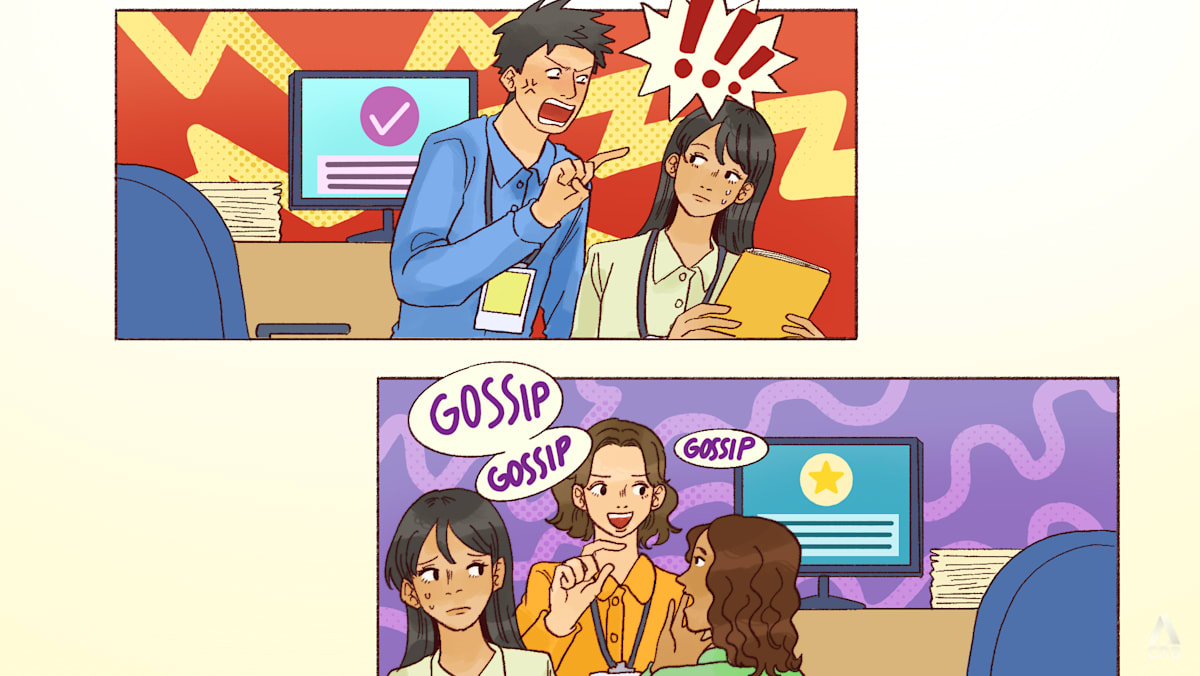
Always shouting or gossiping behind people's backs? Toxic colleagues can ruin a workplace, but tolerating them till you quit isn't the only way out. (Illustration: CNA/Clara Ho)
This audio is generated by an AI tool.
Let me introduce you to two of my ex-colleagues at a publishing company I used to work at: Harold and Felicia.
Their names have been changed to protect their identities – and my peace – but they are very much aligned with the typical "toxic colleague" stereotype.
Harold, for example, loved to yell. I sincerely believe that one of his favourite pastimes was berating people.
If the client came in with changes he didn't like, you would hear him yell to his colleagues about it three doors down. If you so much as gave the tiniest suggestion for improving his work, you'd best put in your earplugs and get ready for the "hair dryer treatment" – a loud, heated rant delivered at close range.
CNA Games Guess Word Crack the word, one row at a time Buzzword Create words using the given letters Mini Sudoku Tiny puzzle, mighty brain teaser Mini Crossword Small grid, big challenge Word Search Spot as many words as you can Show More Show Less
Harold turned our office into a minefield, where any misstep could set him off.
Then there was Felicia – sweet and soft-spoken, but a lover of sowing discord.
I admit to enjoying my fair share of office gossip back in the day, but when it came to workplace drama, Felicia was Leonardo DiCaprio in the movie Inception – a master at planting ideas in people's heads. She was also adept at spreading unfounded rumours and creating tension.
"Oh, I heard that Linda took credit for your work in front of the boss,” she'd say. "Can you believe that she got an off-in-lieu for that day we all worked overtime?"
Wherever Felicia went, an air of distrust followed. Conversations in the office started to feel loaded, and we started to be careful around her, and eventually, each other.
But while their toxicity made blood boil and tension soar across the office, both Harold and Felicia were just so competent. They met their goals and did their work.
Despite the emotional and mental pain of working with them, it was hard to find a justified reason to tattle on them to the boss.
Eventually, I saw no other way to escape the pain of it all other than to simply quit.
WHEN THE WORK IS GOOD BUT THE VIBES ARE BAD
If either Felicia or Harold were bad at their jobs, I would have pointed out their poor performance to my manager and the conversation would've been over. Bye, Felicia and Harold.
Unfortunately, real life is less obliging. Sometimes the person consistently delivering excellent work is also the person everyone dreads working with. The boss sees the results; everyone else sees the carnage it took to get there.
While some may keep the peace and simply tolerate toxic colleagues, the writer says that there are ways to counter negative workplace behaviour. (Photo: iStock)
It is easy to say: "Just tell the boss! Call out their toxic behaviour!" but it takes a lot of emotional and mental effort to be that courageous, especially when you're not someone with a high enough rank to pull in the workplace.
Personally, I just didn't have the bandwidth to be that courageous at the time. Nor was I willing to take the risk of making things worse, both for myself and everyone around me, by incurring the wrath of Harold or Felicia - or both of them.
And sometimes, you just want to get on with work without all the drama.
With the benefit of hindsight, I could have done more than just tolerate their toxic behaviour.
With Harold, I might have tried something like: “I know you are upset, but I would appreciate it if you didn't yell."
With Felicia, the trick may have been simple fact-checking. "Did Linda tell you that herself?" or "I'll check with her" are rarely the replies an office gossip is hoping for.
I wish I'd had the guts and the discipline to give those replies, but I'll confess that I did find some of Felicia's stories very juicy – at least, right up until I started wondering what she was telling other people about me.
WHAT IF THE MANAGER DOESN'T ACT?
Admittedly, the practical thing to do here is to tell your manager what happened and the impact of that action.
"He yelled at me during the internal review, so I stopped giving feedback and the client rejected the output." Such a statement gives your boss something to address.
"Nobody likes him", however, frames the problem as a personality issue.
It's not a foolproof method for avoiding frustration. Some bosses will hear you out. Some will tell you that Harold is under pressure, or that Felicia means well.
Others will privately agree with you but do absolutely nothing, which is perhaps the most irritating response of all.
Now that I've been a boss for some time, I completely understand why managers hesitate to take action, especially when the perpetrator is talented.
You worry about losing them. You worry that intervening will make things worse. You tell yourself that every team has its quirks and people should learn to get along.
I mean, nobody tells the football star Cristiano Ronaldo what to do, right? He scores goals and wins games.
But that doesn't mean failing to intervene is right.
If someone's performance is excellent but three other colleagues have to work around their temperament to get their own tasks done, that belongs in the assessment. Same goes for a star achiever who's doing anything to hamper clear communication in the office.
It comes down to this: If you want to build an organisation that both produces good work and retains talent in the long run, you need to call out bad behaviour.
And that means much more than simply saying: "People think you're toxic."
As a manager, I've found that the best way to address such situations is to tell the person what they did, hear their side and be clear about what needs to change.
The old me avoided Harold. The me of now would tell him: "You raised your voice at the team when the client requested changes. I understand the request was frustrating. I need you to explain your concerns without shouting at them."
With Felicia, I would try something like: "You've been passing around claims about colleagues that you haven't checked. In future, if you have a concern about how work or time off is being handled, bring it to me."
Having tough conversations is important, but what matters more is what happens afterwards.
Does the employee take it in and make an effort, or does the behaviour return as soon as another deadline gets tight?
And are colleagues actually more comfortable speaking up, or have they simply decided there's no real point in complaining openly?
Now, as a manager, the writer makes it a point to also examine whether toxic behaviour in the workplace stems from things like unreasonable deadlines. (Photos: iStock)
Now, as a manager, I make it a point to examine my part in it too. Are people behaving unreasonably, or have our workload and deadlines become unreasonable? Do employees really feel they have been treated unfairly, or have I not explained my decisions adequately, leading them to draw the wrong conclusions?
Those problems need to be fixed, but they also cannot become an excuse for shouting at people or setting colleagues against each other.
And if they show no change in behaviour, managers need to think about what they need more – keeping a competent worker, or ensuring a positive work environment.
Truth be told, that's a hard decision to make. But don't think every difficult person is beyond help.
I have had my own moments of defensiveness and impatience, and I would hate to be judged forever by the worst of them.
But that generosity has to extend to the people on the receiving end of the toxic behaviour as well. And sometimes, managers do need to detox their workplaces.
Kelvin Kao is the co-owner of a creative agency.
If you have an experience to share or know someone who wishes to contribute to this series, write to voices [at] mediacorp.com.sg ( voices[at]mediacorp[dot]com[dot]sg ) with your full name, address and phone number.
Get our pick of top stories and thought-provoking articles in your inbox
Stay updated with notifications for breaking news and our best stories
Join our channel for the top reads for the day on your preferred chat app
作为一名员工,他曾对那些有毒的同事保持沉默,最终因为无法忍受如同雷区般的工作环境而选择辞职。但现在,作为一名企业主,Kelvin Kao在处理有毒行为方面采取了截然不同的做法,原因如下。
总是大声喧哗或在背后议论别人?有毒的同事会毁掉一个工作环境,但忍气吞声直到辞职并不是唯一的出路。(插图:CNA/Clara Ho)
这段音频由人工智能工具生成。
让我来介绍一下我以前在一家出版社的两位前同事:哈罗德和费利西亚。
为了保护他们的隐私(也为了避免我的困扰),他们的名字都做了更改,但他们确实非常符合典型的“有毒同事”的刻板印象。
例如,哈罗德就喜欢大吼大叫。我真心相信,他最喜欢的消遣之一就是斥责别人。
如果客户提出不满意的修改意见,你会听到他冲着隔壁办公室的同事大吼大叫。如果你哪怕提出一点点改进建议,最好戴上耳塞,准备迎接他的“吹风机式”训斥——他会近距离大声咆哮,怒气冲冲地抱怨一番。
CNA游戏 猜词游戏 逐行破解单词 流行词游戏 用给定的字母组成单词 迷你数独 小小谜题,挑战你的大脑 迷你填字游戏 小方格,大挑战 单词搜索 尽可能多地找出单词 显示更多 显示更少
哈罗德把我们的办公室变成了雷区,任何一点小错都可能激怒他。
还有费利西亚——她性格温柔,说话轻声细语,但却喜欢挑拨离间。
我承认当年我也挺喜欢八卦的,但要说职场八卦,菲丽西亚简直就是电影《盗梦空间》里的莱昂纳多·迪卡普里奥——她擅长在别人脑子里植入各种想法。她也精于散布毫无根据的谣言,制造紧张气氛。
“哦,我听说琳达当着老板的面把你的功劳揽到自己身上了,”她会说。“你能相信吗?我们那天都加班了,她居然还拿到了补休!”
费利西亚走到哪里,不信任的气氛就跟到哪里。办公室里的谈话开始变得紧张起来,我们开始小心翼翼地对待她,最终,也开始小心翼翼地对待彼此。
虽然哈罗德和费利西亚之间的矛盾令人怒火中烧,办公室气氛紧张,但他们两人的能力却都非常出色。他们完成了目标,也做好了工作。
尽管与他们共事会造成情感和精神上的痛苦,但很难找到一个合理的理由向老板告发他们。
最终,除了辞职之外,我找不到其他摆脱这一切痛苦的方法。
工作很好,但氛围不好
如果菲丽西亚或哈罗德工作表现不好,我会直接向经理指出他们的不足,谈话也就到此为止了。再见,菲丽西亚和哈罗德。
可惜,现实生活往往不如人意。有时候,那个始终表现出色、工作能力超群的人,反而是人人都避之不及的同事。老板看到的是成果,而其他人看到的却是为了达到这些成果所付出的惨痛代价。
虽然有些人可能会选择维持表面和平,容忍那些有毒的同事,但作者指出,还是有办法应对职场中的不良行为的。(图片:iStock)
说起来容易:“直接告诉老板!指出他们的不良行为!”但要做到如此勇敢,需要付出大量的情感和精神努力,尤其是在职场上地位不够高,无法左右局面的时候。
就我个人而言,当时我实在没有足够的精力去鼓起那样的勇气。我也不愿意冒着惹怒哈罗德或费利西亚——或者他们俩——让事情变得更糟的风险,无论对我自己还是对周围的人都是如此。
有时候,你只想安安静静地工作,不想卷入各种纷争。
事后看来,我本可以做得更多,而不仅仅是容忍他们的恶劣行为。
如果对哈罗德说话,我可能会这样说:“我知道你很生气,但如果你不要大声喊叫,我会很感激的。”
对费利西亚来说,诀窍或许在于简单的核实事实。“琳达亲口告诉你的吗?”或者“我去问问她”很少是办公室八卦爱好者想要得到的回答。
我希望自己有勇气和自制力给出那些回复,但我得承认,我发现费利西亚的一些故事非常精彩——至少在我开始怀疑她跟别人说了我的事之前是这样的。
如果经理不采取行动怎么办?
诚然,这里最实际的做法是告诉你的经理发生了什么事以及该行为的影响。
“他在内部评审期间对我大吼大叫,所以我停止提供反馈,客户也拒绝了最终成果。” 这样的说法会让你的老板不得不着手处理。
然而,“没有人喜欢他”这句话将问题归结为性格问题。
这并非避免挫败感的万全之策。有些老板会听你倾诉,有些则会告诉你哈罗德压力很大,或者费利西亚是好意。
有些人私下里会同意你的观点,但却什么也不做,这或许是最令人恼火的反应。
现在我当了一段时间的老板,我完全理解为什么管理者不愿采取行动,尤其是在肇事者很有才华的情况下。
你担心失去他们。你担心介入会让事情变得更糟。你告诉自己,每个团队都有自己的怪癖,人们应该学会相处。
我的意思是,没人能告诉足球明星克里斯蒂亚诺·罗纳尔多该怎么做,对吧?他进球得分,赢得比赛。
但这并不意味着不加干预就是正确的。
如果某人的工作表现非常出色,但其他三位同事却不得不迁就他的脾气才能完成自己的工作,那么这种情况也应该纳入评估范围。同样,如果一位业绩突出的员工以任何方式阻碍办公室的清晰沟通,也应该纳入评估范围。
归根结底:如果你想建立一个既能产出好作品又能长期留住人才的组织,你就需要指出不良行为。
这远不止是简单地说:“人们认为你很伤人。”
作为一名管理者,我发现处理这种情况的最好方法是告诉当事人他们做了什么,听听他们的说法,并明确指出需要改变的地方。
以前的我会躲着哈罗德。现在的我会对他说:“客户提出修改要求时,你对团队大声吼叫。我知道这个要求很让人沮丧。我需要你解释你的顾虑,而不是对他们大吼大叫。”
对于菲利西亚,我会这样说:“你一直在未经核实的情况下散布关于同事的谣言。以后如果你对工作或休假安排有任何疑问,请告诉我。”
进行艰难的对话固然重要,但更重要的是对话之后发生的事情。
员工会吸取教训并努力改正吗?还是一旦下一个截止日期临近,这种行为就会再次出现?
同事们真的更愿意畅所欲言了吗?还是他们只是觉得公开抱怨没什么意义?
如今,作为一名管理者,这位作家也特别关注职场中的不良行为是否源于不合理的截止日期等因素。(图片:iStock)
现在,作为一名管理者,我也会认真反思自己在其中的角色。是员工的行为不合理,还是我们的工作量和截止日期变得不合理?员工真的觉得自己受到了不公平的对待,还是我没有充分解释我的决定,导致他们得出错误的结论?
这些问题需要解决,但也不能成为对人大吼大叫或挑拨同事关系的借口。
如果他们的行为没有改变,管理者就需要思考他们更需要的是什么——是留住称职的员工,还是确保积极的工作环境。
说实话,这的确是个艰难的决定。但不要以为所有难缠的人都无可救药。
我也有过防备和不耐烦的时候,我不想永远被我最糟糕的那些表现所评判。
但这种宽容也必须延伸到那些遭受不良行为侵害的人身上。而且有时候,管理者确实需要净化工作场所。
Kelvin Kao是一家创意机构的共同所有人。
如果您有经验想要分享,或者认识有人想要为本系列文章投稿,请将您的全名、地址和电话号码写信至 voices [at] mediacorp.com.sg ( voices[at]mediacorp[dot]com[dot]sg )。
订阅我们的邮件,即可获取精选热点新闻和引人深思的文章。
订阅通知,第一时间获取突发新闻和精彩报道。
加入我们的频道,即可在您常用的聊天应用上获取当日热门文章。