Nammo CEO warns European rupture with US risks 10-year capability gapNammo首席执行官警告称,欧洲与美国关系破裂可能导致长达十年的能力差距。
"This industrial base among our allies is already very interconnected, so we cannot break it up," said Morten Brandtzæg.
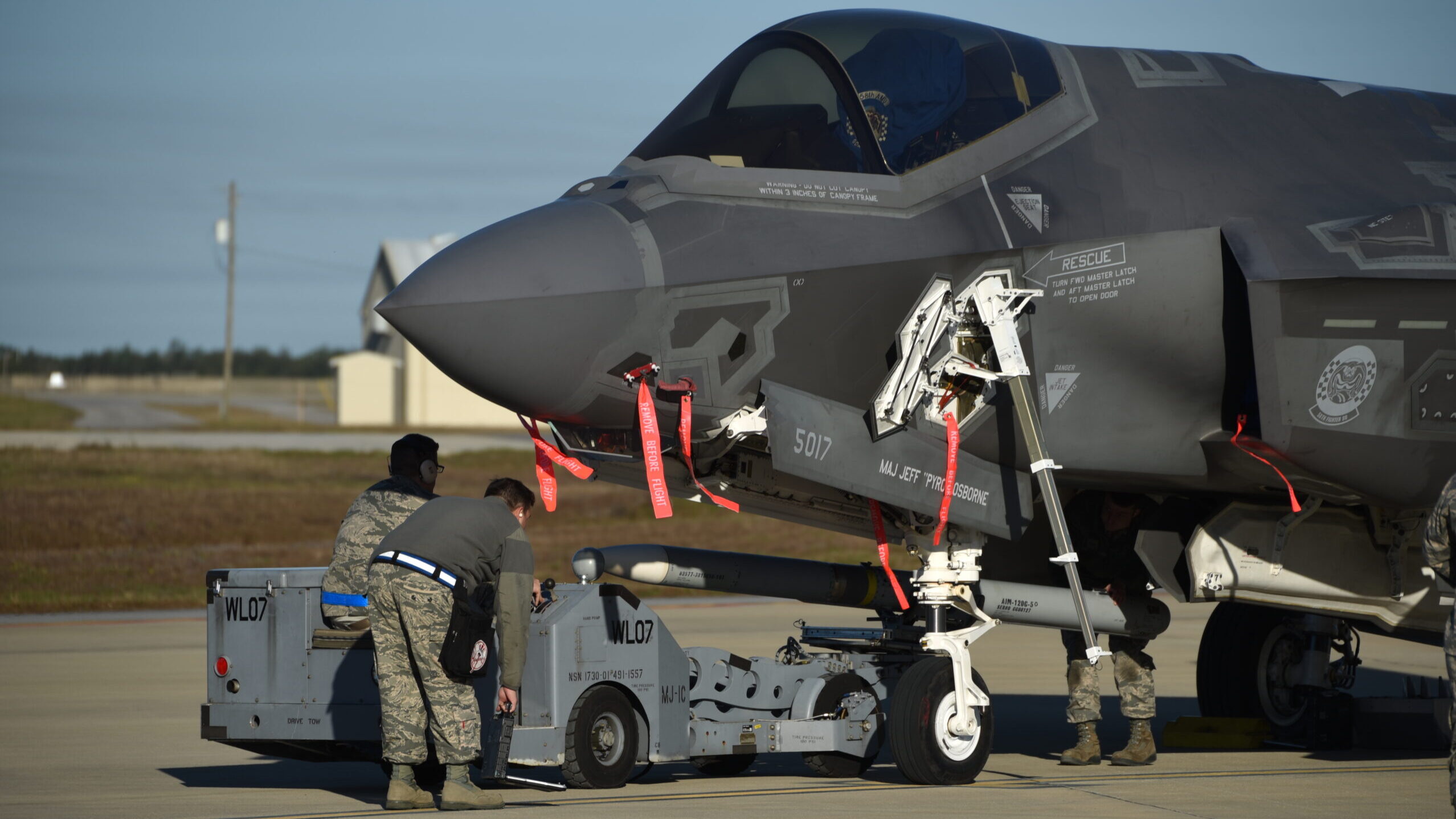
A U.S. Air Force weapons load crew assigned to the 33rd Aircraft Maintenance Squadron loads a live AIM-120 advanced medium-range air-to-air missiles (AMRAAM) into an F-35A January 31, 2017, at Eglin Air Force Base, Florida. (U.S. Air Force photo by Staff Sgt. Peter Thompson)
RAUFOSS, Norway — The CEO of one of Europe’s major ammunition and rocket motor engine producers has warned that any potential cutting off of industrial cooperation with the US risks European allies suffering a loss of capability that could take up to a decade to replace.
“If we cannot deliver AMRAAM rocket motors to Raytheon, well, none of the European F-35s” will have the weapons equipped on the fifth-generation fighter jet, Morten Brandtzæg, CEO of Norwegian manufacturer NAMMO, said Wednesday during the opening of the company’s multipurpose symposium here. American AMRAAM-maker Raytheon is heavily dependent on NAMMO-supplied rocket motor engines for the air-to-air missile, and Brandtzæg made clear that destroying such a supply chain would be counterproductive. It would take Europe “five to ten years” to replace equivalent capabilities, he added.
“We don’t have that” amount of time, he said, appearing to refer to Russia’s war in Ukraine. “This industrial base among our allies is already very interconnected, so we cannot break it up,” he argued.
Relations between the US and Europe have been extraordinarily tense during President Donald Trump’s second administration, as Trump has repeatedly threatened to take over the Danish territory of Greenland and in 2024 suggested the US may not uphold NATO’s Article V commitment to collective defense for countries who did not “pay” enough into the alliance. European leaders, in turn, have publicly called on the continent to boost its domestic defense industrial base to be less reliant on the US.
But speaking to Breaking Defense and other trade media on Tuesday ahead of the symposium, Brandtzæg said that “short term [political] turbulence” cannot be allowed to ruin decades worth of industrial co-operation between Europe and the US.
“It’s not for this industry to start running their own politics. … I support a strong cooperation among allied countries, and that includes every single NATO country and a few other countries as well,” he explained. “I think that is the way we build deterrence.”
As for Nammo, Brandtzæg said, “We are ready to step in whenever needed to do even more,” for US-based solid rocket motor production. “We have the technology and we have proven the process to work, so we are ready to step up,” including additional investment in Nammo’s Perry, Fla. production site. “We are in constant talks to help ramp up to produce more rocket motors, for missiles used by the US government,” he said.
Localizing tactical communications for sovereign, NATO-ready C3I
Beyond foreign sales, Rafael’s model enables tech transfer, local engineering, and is a template for NATO partners.
Closer to home, Nammo recently stood up a third rocket motor production line at Raufoss, with Brandtzæg identifying additional lines as a long term target.
“We are ramping up everywhere, and we foresee to double the size of Raufoss” by 2032, he told reporters.
In the earlier stages of the Ukraine conflict, Brandtzæg called on governments to issue longer-term contracts for 155mm ammunition, on the basis that Western industry is involved in a war of capacity with Moscow.
Nammo is in “a better place” than last year, but progress is not “sufficient yet” in terms of increasing production of the shells, he told reporters.
At the symposium he went further, saying that restocking of 155mm supplies for European armies is “not there yet” as “everything we are producing is going” to Ukraine. (Breaking Defense accepted travel and accommodation for the trip from Nammo.)
Nammo’s immediate plan to scale up 155mm production rests with a new, state of the art facility set to open at the end of the year and production launching in 2027.
At a cost of $180 million, it takes between “two to three years to build it and the output is just enough for seven days in Ukraine,” said Brandtzæg, of the new site.
Jack Watling, senior research fellow for applied military sciences at the British-based Royal United Services Institute think tank, said that beyond industrial planning, if Russia’s war was to stretch into a conflict directly with NATO, the “biggest challenge” for the alliance will be how to keep ammunition flowing from production to the frontline. There’s also the matter of the raw materials required.
Speaking at the symposium today, he argued against Western governments signing off new 155mm orders unless production of critical ingredients like nitrocellulose can be increased and industry can demonstrate it can preserve nitric acid supplies.
Although dependence on raw materials critical to 155mm artillery shell supplies has troubled industry throughout the Ukraine war, the situation is increasingly concerning because of infrastructure hurdles, explained Watling.
“Unless we have the high explosive to be able to go into the shelves, simply placing more orders for 155 is not going to resolve our issues because, again, if I want to set up a propellant factory somewhere, then the planning overhead [costs] alone to get permission to start building is certainly, in the UK…. [is such that it] risks making the project unprofitable.”
2017年1月31日,在佛罗里达州埃格林空军基地,隶属于美国空军第33飞机维修中队的武器装载小组正在将一枚实弹AIM-120先进中程空空导弹(AMRAAM)装载到一架F-35A战斗机上。(美国空军照片,摄影:彼得·汤普森中士)
挪威劳福斯——欧洲一家主要弹药和火箭发动机生产商的首席执行官警告说,任何切断与美国工业合作的可能性都可能导致欧洲盟友遭受能力损失,而这种能力损失可能需要长达十年的时间才能弥补。
“如果我们无法向雷神公司交付AMRAAM导弹的火箭发动机,那么欧洲的F-35战机将无法装备这种第五代战斗机,”挪威制造商NAMMO的首席执行官莫滕·布兰特泽格周三在公司于此举办的多用途研讨会开幕式上表示。美国AMRAAM导弹制造商雷神公司严重依赖NAMMO提供的火箭发动机,布兰特泽格明确指出,破坏这条供应链将适得其反。他还补充说,欧洲需要“五到十年”的时间才能重建同等能力。
“我们没有那么多时间,”他说道,似乎指的是俄罗斯在乌克兰的战争。“我们盟友之间的工业基础已经高度互联,我们不能将其瓦解,”他辩称。
在唐纳德·特朗普总统的第二任期内,美欧关系异常紧张。特朗普曾多次威胁要吞并丹麦领土格陵兰岛,并在2024年暗示,美国可能不会履行北约第五条关于集体防御的承诺,为那些“会费”不足的国家提供保障。作为回应,欧洲领导人公开呼吁欧洲大陆加强本国国防工业,以减少对美国的依赖。
但在研讨会召开前夕,布兰特泽格周二在接受《防务新闻》和其他贸易媒体采访时表示,“短期(政治)动荡”不能破坏欧洲和美国之间数十年的工业合作。
“这个行业不应该插手政治……我支持盟国之间加强合作,这包括所有北约成员国以及其他一些国家,”他解释说。“我认为这才是构建威慑力的方式。”
关于Nammo公司,布兰德茨格表示:“我们随时准备在需要时介入,为美国固体火箭发动机的生产做出更多贡献。”他补充道:“我们拥有这项技术,并且已经证明了该工艺的有效性,因此我们已准备好加大投入。”这包括对Nammo位于佛罗里达州佩里市的生产基地进行追加投资。“我们一直在积极洽谈,以帮助提高火箭发动机的产量,这些发动机将用于美国政府使用的导弹。”他说道。
为主权、符合北约标准的C3I系统实现战术通信本地化
除了对外销售,拉斐尔的模式还实现了技术转让和本地工程,并为北约合作伙伴提供了一个模板。
就近而言,Nammo 最近在 Raufoss 建立了第三条火箭发动机生产线,Brandtzæg 将增设生产线视为长期目标。
“我们正在各个方面加大投入,预计到 2032 年,劳福斯的规模将翻一番,”他告诉记者。
在乌克兰冲突的早期阶段,布兰特泽格呼吁各国政府签订更长期的 155 毫米弹药合同,理由是西方工业正与莫斯科进行一场产能之战。
他告诉记者,Nammo 目前的情况比去年“好”,但在提高炮弹产量方面,进展还“不够充分”。
在研讨会上,他进一步表示,欧洲军队的155毫米火炮补给“尚未实现”,因为“我们生产的所有火炮都运往”乌克兰。(Breaking Defense接受了Nammo公司提供的此次行程的差旅和住宿费用。)
Nammo 扩大 155 毫米胶片生产规模的近期计划取决于一座将于年底开放的全新最先进的工厂,以及 2027 年开始的生产。
布兰特扎格表示,这座新工厂耗资 1.8 亿美元,“建造它需要两到三年时间,而其产量仅够乌克兰使用七天”。
英国皇家联合军种研究所(RUSI)应用军事科学高级研究员杰克·沃特林表示,除了工业规划之外,如果俄罗斯的战争演变为与北约的直接冲突,北约面临的“最大挑战”将是如何确保弹药从生产地持续供应到前线。此外,所需的原材料也是一大问题。
在今天的研讨会上,他反对西方政府批准新的 155 毫米订单,除非硝化纤维素等关键成分的产量能够增加,并且相关行业能够证明其可以保障硝酸的供应。
沃特林解释说,尽管对155毫米炮弹供应至关重要的原材料的依赖性在整个乌克兰战争期间一直困扰着工业界,但由于基础设施障碍,这种情况越来越令人担忧。
“除非我们有足够的高爆炸药可以上架销售,否则仅仅增加155吨的订单并不能解决我们的问题,因为,再说一遍,如果我想在某个地方建立一个推进剂工厂,那么仅仅是获得开工许可的规划管理费用,在英国肯定……(如此之高)会使项目无利可图。”