Russia’s Carrier Was Designed To Be Heavily Armed Even Without Its Air Wing俄罗斯的航母设计之初就考虑到即使没有舰载机联队,也具备强大的武装能力。
The Admiral Kuznetsov’s most powerful combat punch has nothing to do with the aircraft it carries.
新闻视频
Updated Jul 2, 2020 3:13 PM EDT
During the Cold War, Russia’s navy prioritized moving huge numbers of cruise missiles around the globe, threatening the power-projection capabilities of American Carrier Battle Groups. In the 1950s and 1960s, aircraft carriers were seen by Soviet military elites as imperialist tools of aggression, and any initiative by the USSR to build one of their own was shot down by the powers that be. Eventually this began to change, but only gradually.
The Kiev class that was launched in the 1970s was a puzzling cross-breed compromise between a heavy missile cruiser and a helicopter and VTOL (Yak-38) tactical jet carrier. Eventually Russian ship designers were allowed to develop the Soviet Union’s first dedicated fixed-wing aircraft carrier out of the Kiev class design, but it couldn’t stray too far from its predecessor’s missile carrying philosophy. The ship that resulted was something unlike anything contrived in the west–a fixed-wing aircraft carrier that also packed a massive punch of its own, regardless of whether its air wing was deployed on its deck or not. This would ship would eventually be known as the Kuznetsov class, with the first example being launched in the early 1980s.
A Kiev class heavy aviation cruiser. , DoD
People always seem to be a little confused by Admiral Kuznetsov’s unique designation as a “heavy aircraft-carrying missile cruiser” instead of as a conventional aircraft carrier. At first glance, the ship does seem to pack a lot more missile punch than an American supercarrier, and way more than an American Midway class carrier of the 1980s , which is of similar size and displacement.
The Admiral Kuznetsov. , Russian Navy
The Admiral Kuznetsov is equipped with no less than 24 rotary-style vertical launch systems, with eight missile cells each. These fire the SA-N-9 “Gauntlet” point air defense missile, and a whopping 192 of these missiles are carried in all. In addition, the ship bristles with a virtual wall off close-in weapon systems (CIWS), including six AK-630 cannons and no less than eight (notoriously formidable) Kashtan missile/cannon CIWS systems . The ship even sports its own anti-submarine defenses with a pair of UDAV-1 anti-submarine/anti-torpedo rocket systems. Although the UDAV-1 system is a less complex concept, American carriers are just beginning to field a capable defense against torpedoes today.
All this armament is impressive, but it is defensive in nature. Admiral Kuznetsov’s real offensive punch comes from 12 massive SS-N-19 “Shipwreck”/P-700 “Granit” supersonic anti-ship missiles. Each of these beasts weighs in at 15,500 pounds – about the same as a combat configured F-5E Tiger II fighter. They can be armed with a 1,600-lb conventional warhead, a fuel-air explosive warhead or a nuclear warhead.
A rare photo of a P-700 Granit missile. Its air intake is covered here, when uncovered it resembles the one found on a MiG-21., …
These missiles were designed in the late 1970s, and intended to allow Russia’s future capital ships to be able to reliably strike American carrier battle groups from outside the range of their surface-based weapon systems. In combat, the missiles would be launched in large salvos, then scream toward their targets as fast as mach 2.5 at altitude, or about mach 1.5 while low over the water.
The missiles were very advanced for their time, integrating networking and automated cooperative “swarm” tactics. They were launched at a target (or targets) usually based on third party data, such as coordinates derived by a scout ship, a maritime patrol aircraft, or even a submarine. They would fly toward their targets from over 350 miles away on inertial navigation, then as they approached the suspected target area, one missile out of the swarm would “pop up” to higher altitude to use its own active radar and anti-radiation sensors to obtain updated targeting info. It would then classify these targets and assign them to missiles in the swarm below.
If the pop-up missile were destroyed another one would automatically take its place. The missiles could also accept updates from third party sources as well and supposedly had connectivity to the now defunct Soviet-era EORSAT satellite network . Once in the terminal attack phase of their flight, each surviving missile would acquire its own target, and prosecute that target, blazing over the horizon at supersonic speeds and giving (presumably) American close-in weapon systems little time to react.
There is no doubt, the P-700 was born to be a high-end carrier killer. Their speed and numbers would overwhelm a Carrier Battle Group’s defenses, and their individual warheads were large enough to register a kill even on America’s largest surface combatants. The Soviet Navy’s aspirations were clear, with dozen of missiles available on Kirov class battlecruisers, Oscar class nuclear guided missile submarines, and the carriers that would eventually be known as the Kuznetsov class, Soviet surface action groups could have filled the air with these deadly missiles.
Granit anti-ship missile being loaded onto the doomed Oscar class nuclear guided missile submarine Kursk . , …
Even today, with only one Kirov class ( soon to be two ) battlecruiser, five Oscar class submarines and one Kuznetsov class carrier in service, when paired together or even operating alone, they represent a formidable threat. Thankfully American CIWS capabilities, the AEGIS combat system deployed aboard US Navy cruisers and destroyers, and the electronic warfare capabilities on all of these ships, as well as the passage of time time, has likely blunted the danger posed by these missiles to some degree.
The thing that is most confusing about the Kuznetsov’s hard-hitting anti-ship missile arsenal is that it seems to be non-existent when you examine the ship. These are big missiles – their launch tubes take up a large portion of the massive nuclear-powered Kirov class battlecruiser’s bow. No such structures are apparent on the Kuznetsov, which looks like, well, just an aircraft carrier.
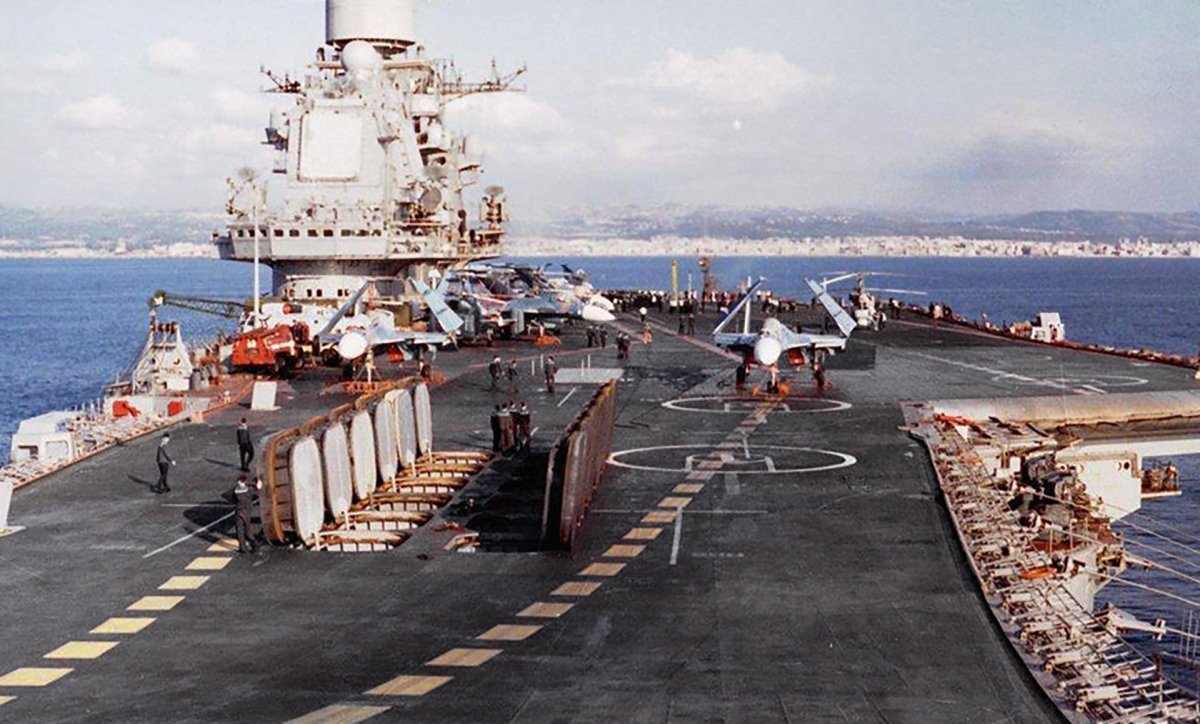
The 12 missile tubes inlayed into the Kuznetsov’s deck. , …
But look closer and you’ll see signs that the ship’s 12 P-700s are sitting right below the surface of the forward flight deck. Two parallel rows of eight vertical launch tubes are flush mounted, and covered with the same non-skid surfaces as the rest of the ship’s flight deck. The launch cells “disappear” as soon as their hatches are closed.
It seems like an “interesting” design choice to have 30 ton fighters, armed and full of fuel, thundering their way over some of the most powerful anti-ship missiles ever devised, but Soviet designers had their goals to achieve, and they made it work. It is hard not imagine the vigorous “debate” over shoehorning these missiles into the USSR’s only true fixed-wing carrier design, as the space could have been used for aviation related needs. But one way or another the Kuznetsov ended up with this funky feature, one which it has lugged around long after the Soviet Union was no more.
Another rare view of the carrier’s P-700 missile hatches open., …
Over the last decade there has been talk about having P-700 Granit missile capability stripped from Admiral Kuznetsov . The area below deck where the missile farm is located would be opened up for more hangar space, a feature the ship has always been short on . This was supposed to happen during a major refit that would see the ship redeployed sometime in the 2017-2018 timeframe. It seems the overhaul never happened, and instead a light refit was executed, as the ship was prepared to sail for the Syrian coast once again in late 2016. This time it would be packing new and upgraded aircraft that would actually fly combat missions over the embattled country.
Admiral Kuznetsov going through a recent refit., Christopher Michel/wikicommons
Whether the P-700 missile tubes are still active and filled with live rounds is unknown. It’s possible, as the ship is slated to go through a much deeper refit when it returns from its Syrian deployment. On its return home, this capability will most likely be removed, once and for all, with new hangar space making room for the Kuznetsov’s modernized air wing that will increasingly be made up of MiG-29KR strike fighters and KA-52K attack helicopters.
Su-33s stuffed inside the Kuznetsov’s hangar bay. , …
Other improvements slated for the ship during its deep refit are rumored to include new gas turbines, replacing the dated boiler system that has plagued the ship’s reliability for years. New missile defense systems, including medium-range surface-to-air missiles and a navalized version of the Pantsir point defense system would be added. New communications systems and sensors would also replace long-obsolete ones.
Russia’s lone carrier has had a colorful past to say the least. It has had three names, Riga, Leonid Brezhnev and Tbilisi before becoming the Admiral Kuznetsov . Kuznetsov’s sister ship, the Varyag, is now China’s first carrier, the Liaoning . How it got to China is a whole saga unto itself.
China’s Liaoning was born out of the rusted hulk of the Kuznetsov’s sister ship., Chinese Internet
Admiral Kuznetsov sat for years before being reactivated, and the way the Russians supposedly moved her from the Black Sea to the Severomorsk following the fall of the Soviet Union is interesting to say the least. One Russian wesbite recounts a legend that may be more fiction than fact, but it is entertaining nonetheless:
Following the collapse of the USSR, the Admiral Kuznetsov could have been inherited by Ukraine, which claimed ownership of it. In 1991, the ship, then assigned to the Northern Fleet, underwent tests with the Black Sea Fleet in Feodosia, leaving it in Ukrainian territory. However, the first deputy commander of the Northern Fleet flew to Ukraine at once and stepped in. The vice admiral gave the order to raise the anchor immediately and head for Severodvinsk. With its navigation lights off, the ship left its harbor and spent more than three weeks sailing to its permanent base without any aircraft and without two thirds of its crew, who were off-duty at the time. Having saved the aircraft carrier, the vice admiral rightly judged that the sailors would “catch us by train,” and that the aircraft remaining at the onshore airbase would “get there by themselves.”
Sadly, in recent years the ship has been more associated with tragedy than triumph, especially in the western press. Its drags around a thick black smoke trail that makes the ship seem like an antique propaganda tool more than a fighting ship. On previous deployments the carrier has suffered chronic mechanical failures, and deadly mishaps. An ocean-going tug follows the ship around as a precaution – not exactly the sign of a first rate naval vessel. Its fixed-wing fighter aircraft, the Su-33 , is visually impressive, but not exactly cutting edge even when it entered service decades ago. Up until a recent light upgrade , its combat capabilities were largely discounted.
But things seem to be looking up for Russia’s lonely carrier. New aircraft and investments in the ship appear to be materializing, albeit slowly. Russia plans on keeping Admiral Kuznetsov in service for at least another decade, but it will likely soldier on far past then. In the meantime, the world will be watching the ship and its upgraded contingent of aircraft, and what they will be doing off the shores of Syria.
Currently, a multi-national carrier group, with the French nuclear-powered carrier Charles De Gaulle at it center, is also prowling the eastern Mediterranean . Once the Kuznetsov and the largest Russian surface action group assembled since the end of the Cold War arrive on station, the eastern Med will become a crowded patch of sea and sky. That much traffic could make things ‘interesting’ to say the least.
As of publishing this piece, Admiral Kuznetsov and its escorts are steaming past Portugal and approaching the Strait of Gibraltar. We will keep you updated as the deployment unfolds.
Contact the author Tyler@thedrive.com
An extremely rare photo of the Kuznetsov firing a Granite anti-ship missile. , …
Comments couldn’t be loaded. Please refresh the page.
更新于美国东部时间2020年7月2日下午3:13
冷战期间,苏联海军优先在全球范围内部署大量巡航导弹,威胁到美国航母战斗群的投射能力。在20世纪50年代和60年代,苏联军方精英将航空母舰视为帝国主义侵略的工具,苏联任何建造航母的计划都遭到当权者的否决。这种情况最终开始有所改变,但过程十分缓慢。
20世纪70年代下水的基辅级航母,是重型导弹巡洋舰和直升机/垂直起降(雅克-38)战术喷气式航母之间一种令人费解的混合体。最终,俄罗斯舰艇设计师获准在基辅级的基础上研发苏联第一艘专用固定翼航空母舰,但其设计理念不能偏离基辅级太多,仍保留了其导弹搭载的特性。最终建成的航母与西方任何同类舰艇都截然不同——它既是一艘固定翼航空母舰,又拥有强大的自身火力,无论舰载机是否部署在甲板上。这艘航母最终被命名为库兹涅佐夫级,首舰于20世纪80年代初下水。
基辅级重型航空巡洋舰。,美国国防部
人们似乎总是对“库兹涅佐夫海军上将”号的独特定位感到困惑,它被称作“重型航空母舰导弹巡洋舰”,而不是传统的航空母舰。乍一看,这艘舰艇的导弹火力似乎比美国超级航母强大得多,也远胜于上世纪80年代与其尺寸和排水量相近的美国“中途岛”级航母。
库兹涅佐夫海军上将,俄罗斯海军
“库兹涅佐夫海军上将”号航母配备了不少于24套旋转式垂直发射系统,每套系统包含8个导弹发射单元。这些发射单元发射SA-N-9“铁拳”近程防空导弹,该舰共携带192枚此类导弹。此外,该舰还配备了密集的近程防御武器系统(CIWS),包括6门AK-630舰炮和不少于8套(威力强大的)“卡什坦”导弹/舰炮近程防御武器系统。该舰甚至还配备了反潜防御系统,包括两套UDAV-1反潜/反鱼雷火箭系统。尽管UDAV-1系统结构相对简单,但美国航母如今才刚刚开始部署有效的鱼雷防御系统。
这些武器装备固然令人印象深刻,但本质上都是防御性的。库兹涅佐夫海军上将真正的进攻火力来自12枚巨型SS-N-19“沉船”/P-700“花岗岩”超音速反舰导弹。每枚导弹重达15500磅——与一架战斗配置的F-5E“虎II”战斗机重量大致相同。它们可以携带1600磅的常规弹头、燃料空气爆炸弹头或核弹头。
一张罕见的P-700“花岗岩”导弹照片。照片中它的进气口被遮盖着,打开后类似于米格-21战斗机的进气口。
这些导弹设计于20世纪70年代末,旨在使俄罗斯未来的主力舰能够从美国水面武器系统射程之外可靠地打击美国航母战斗群。在战斗中,这些导弹将以大规模齐射的方式发射,然后以高达2.5马赫的高空飞行速度或约1.5马赫的低空飞行速度飞向目标。
这些导弹在当时非常先进,集成了网络化和自动化协同“集群”战术。它们通常根据第三方数据(例如侦察舰、海上巡逻机甚至潜艇提供的坐标)发射,攻击一个或多个目标。导弹利用惯性导航从350英里(约560公里)外飞向目标,当接近目标区域时,集群中的一枚导弹会“跃升”到更高高度,利用自身的主动雷达和反辐射传感器获取更新的目标信息。然后,它会对这些目标进行分类,并将其分配给下方集群中的其他导弹。
如果弹出式导弹被摧毁,另一枚会自动取而代之。这些导弹还可以接受来自第三方的更新,并且据称能够连接到现已失效的苏联时代EORSAT卫星网络。一旦进入飞行末段攻击阶段,每枚幸存的导弹都会锁定自己的目标,并以超音速划破地平线,(据推测)使美国近程防御武器系统几乎没有反应时间。
毫无疑问,P-700导弹天生就是为高端航母杀手而生的。它们的速度和数量足以压倒航母战斗群的防御,而且其单个弹头威力巨大,甚至能击沉美国最大的水面作战舰艇。苏联海军的野心显而易见:基洛夫级战列巡洋舰、奥斯卡级核动力导弹潜艇以及后来被称为库兹涅佐夫级的航母上都装备了数十枚P-700导弹,苏联水面作战群完全可以依靠这些致命导弹封锁敌方天空。
一枚“花岗岩”反舰导弹正被装载到注定沉没的奥斯卡级核动力导弹潜艇“库尔斯克”号上。
即使在今天,美国海军仅有一艘(即将扩充为两艘)基洛夫级战列巡洋舰、五艘奥斯卡级潜艇和一艘库兹涅佐夫级航空母舰服役,但这些舰艇协同作战或单独行动时,仍然构成巨大的威胁。所幸,美国的近程防御武器系统(CIWS)、部署在美军巡洋舰和驱逐舰上的宙斯盾作战系统,以及所有这些舰艇都具备的电子战能力,再加上时间的推移,可能在一定程度上削弱了这些导弹构成的威胁。
库兹涅佐夫号战列巡洋舰强大的反舰导弹库最令人费解的地方在于,当你仔细观察这艘舰艇时,它似乎并不存在。这些导弹体积庞大——它们的发射管占据了基洛夫级核动力战列巡洋舰舰艏的大部分空间。但在库兹涅佐夫号上,却看不到任何类似的结构,它看起来就像一艘普通的航空母舰。
库兹涅佐夫号航母甲板上镶嵌着12个导弹发射管。
但仔细观察,你会发现舰上的12架P-700导弹就隐藏在前飞行甲板下方。两排平行的垂直发射管,每排八根,与甲板齐平安装,表面覆盖着与飞行甲板其他部分相同的防滑材料。发射舱门关闭后,就仿佛“消失”了一般。
让30吨重的战斗机,满载燃料和武器,轰鸣着飞越一些有史以来最强大的反舰导弹,这看起来似乎是一个“有趣”的设计选择,但苏联设计师有他们的目标,而且他们做到了。很难想象,当初为了把这些导弹塞进苏联唯一真正的固定翼航母设计中,会引发怎样的激烈“争论”,因为原本可以利用的空间满足其他航空方面的需求。但无论如何,“库兹涅佐夫”号最终还是拥有了这个奇特的装备,而且在苏联解体后,它仍然保留着这个装备。
航母P-700导弹舱门打开的罕见景象……
过去十年间,一直有传言说要从“库兹涅佐夫海军上将”号航母上移除P-700“花岗岩”导弹。原本计划将导弹发射架所在的甲板下区域腾出空间,用于建造更多机库,而机库空间一直是该舰的短板。这项计划原本应该在2017-2018年间的一次大修中进行,届时该舰将重新部署。然而,这次大修似乎并未成行,取而代之的是一次小规模的改装。2016年底,该舰再次准备前往叙利亚海岸。这一次,它将搭载新型和升级的飞机,执行在饱受战火蹂躏的叙利亚上空的作战任务。
“库兹涅佐夫海军上将”号正在进行近期改装。(图片来源:Christopher Michel/wikicommons)
P-700导弹发射管是否仍然处于启用状态并装有实弹尚不得而知。考虑到该舰从叙利亚部署返回后将进行深度改装,这种情况并非不可能。回国后,该导弹发射能力很可能被彻底移除,取而代之的是为“库兹涅佐夫”号现代化舰载机联队腾出空间,该联队将越来越多地由米格-29KR攻击战斗机和卡-52K攻击直升机组成。
库兹涅佐夫号航母的机库里塞满了苏-33战斗机。
据传,该舰深度改装期间的其他改进措施还包括安装新型燃气轮机,以取代多年来一直影响其可靠性的老旧锅炉系统。此外,还将加装新型导弹防御系统,包括中程舰空导弹和舰载版“铠甲”近程防御系统。新的通信系统和传感器也将取代早已过时的设备。
俄罗斯唯一的航母可谓经历丰富多彩。它曾先后被命名为“里加”号、“勃列日涅夫”号和“第比利斯”号,最终定名为“库兹涅佐夫海军上将”号。“库兹涅佐夫”号的姊妹舰“瓦良格”号如今已成为中国的第一艘航母——“辽宁”号。至于它如何来到中国,那又是一段漫长的故事了。
中国的辽宁舰是由库兹涅佐夫号姊妹舰锈迹斑斑的残骸改造而成的。——中国互联网
“库兹涅佐夫海军上将”号潜艇在重新启用前沉没多年,而苏联解体后,俄罗斯人将其从黑海转移到北莫尔斯克港的过程,至少可以说非常有趣。一个俄罗斯网站讲述了一个传说,虽然真假难辨,但仍然引人入胜:
苏联解体后,“库兹涅佐夫海军上将”号航母本可归乌克兰所有,乌克兰也声称拥有该舰的所有权。1991年,这艘当时隶属于北方舰队的航母在费奥多西亚与黑海舰队进行联合测试,测试结束后停泊在乌克兰领海内。然而,北方舰队第一副司令立即飞往乌克兰,介入此事。这位海军中将下令立即起锚,驶往北德文斯克。航母关闭了导航灯,驶离港口,在没有舰载机、且三分之二的船员(当时正值休假)的情况下,花了三个多星期才抵达其永久基地。这位海军中将成功地挽救了这艘航母,他正确地判断出水兵们会“乘火车赶上我们”,而留在岸上空军基地的飞机也会“自行抵达”。
令人遗憾的是,近年来这艘航母更多地与悲剧而非胜利联系在一起,尤其是在西方媒体上。它拖着浓厚的黑烟,看起来更像是一件老旧的宣传工具,而非一艘作战舰艇。在之前的部署中,这艘航母饱受机械故障和致命事故的困扰。一艘远洋拖船作为预防措施跟随其航行——这显然不是一艘一流海军舰艇应有的姿态。它的固定翼战斗机苏-33外形令人印象深刻,但即使在几十年前服役时也算不上尖端技术。直到最近一次小规模升级之前,它的作战能力一直被人们低估。
但俄罗斯这艘孤零零的航母似乎正在迎来转机。新飞机和对舰艇的投资正在逐步落实,尽管进展缓慢。俄罗斯计划让“库兹涅佐夫海军上将”号至少再服役十年,但它很可能会服役更长时间。与此同时,全世界都在关注这艘航母及其升级后的舰载机群,以及它们在叙利亚海岸附近的行动。
目前,一支以法国核动力航母“戴高乐”号为核心的多国航母战斗群正在东地中海巡逻。一旦“库兹涅佐夫”号航母以及冷战结束以来俄罗斯集结的最大规模水面作战群抵达部署位置,东地中海将变得异常繁忙。如此密集的海空交通,至少可以说,会让局势变得“相当有趣”。
截至本文发布时,“库兹涅佐夫海军上将”号航母及其护航舰艇正驶过葡萄牙,接近直布罗陀海峡。我们将持续关注此次部署的进展,并及时向您汇报。
联系作者:Tyler@thedrive.com
一张极其罕见的库兹涅佐夫号航母发射“花岗岩”反舰导弹的照片。
评论加载失败,请刷新页面。