US Navy should target Chinese aircraft carriers, report says报道称,美国海军应将目标对准中国航空母舰。
A U.S. think tank devised a strategy to target Chinese aircraft carriers by using similar tactics that China has planned against American ships.
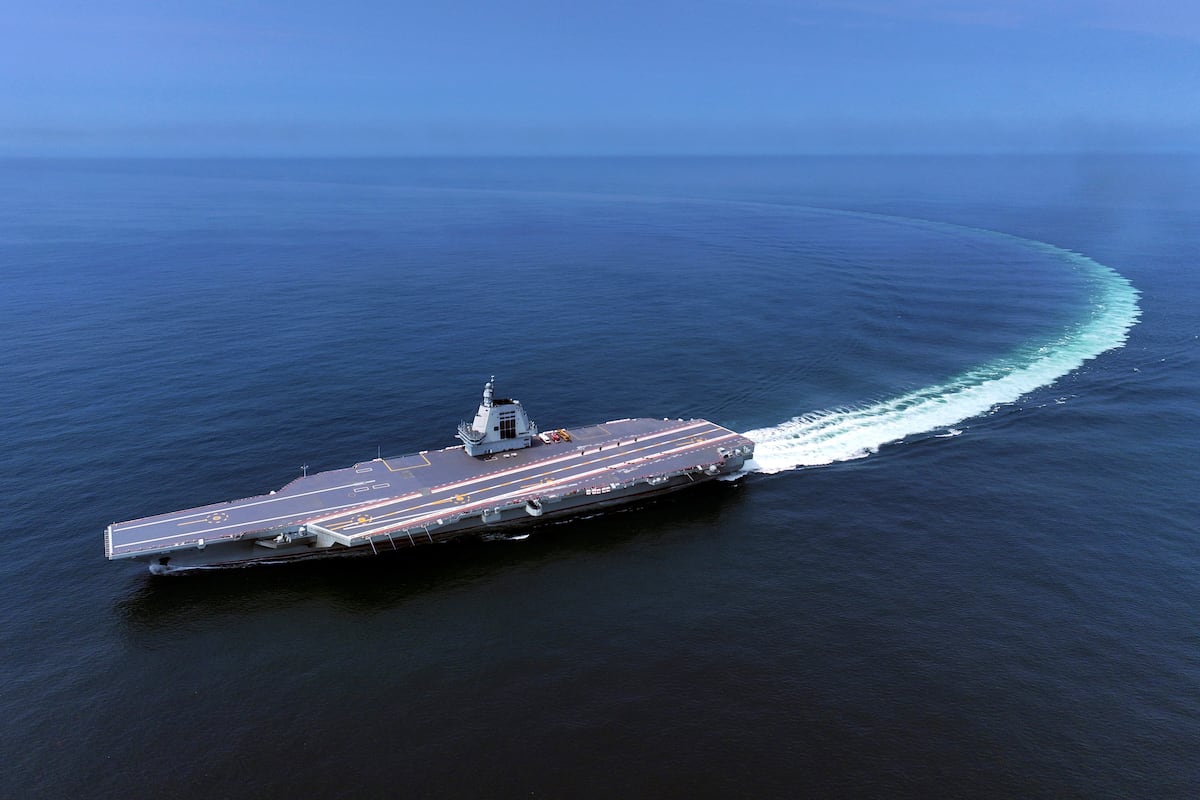
China is devoting enormous efforts — from submarines to ballistic missiles — to destroy America’s aircraft carriers.
The strategy prompted a U.S. think tank to ask why America couldn’t do the same and sink China’s growing fleet of carriers.
The think tank, the Center for Strategic and International Studies, devised a plan to target Chinese carriers by using many of the same tactics that China would use against American flattops.
“China’s expanding carrier force presents a strategic vulnerability that the United States and its allies can exploit, rather than merely a challenge to U.S. dominance,” argues a CSIS report , titled “Flip the Script.”
“Instead of treating U.S. carriers as hunted platforms, focusing on how to defend U.S. assets, this report argues that the United States and allied Pacific powers can — and should — go on the offense, becoming the hunters instead of the hunted in this near-peer competition,” it continues.
For years, China has painted a bullseye on American carriers, including building a full-sized mockup of a U.S. carrier in the Taklamakan Desert. Beyond the poetic justice of replying in kind, targeting Chinese carriers exploits the same sensitivities that Americans have about their vessels.
Just as losing a Ford-class carrier would deeply humiliate Washington, sinking a Fujian-class carrier would be devastating for Beijing. Just as U.S. planners must be cautious about committing carriers in waters exposed to submarine attack, so, too, might Chinese admirals.
“These platforms are both prestige projects and critical enablers of future Chinese sea control and expeditionary operations,” CSIS said. “Moreover, just like their U.S. counterparts, the Chinese carriers are high‑value, hard‑to‑replace assets vulnerable to long‑range strike.”
China currently has three operational aircraft carriers, and a 2025 Pentagon study estimated that the People’s Liberation Army Navy will build six more by 2035. Yet, Beijing’s quest to build a carrier fleet may be driven less by military considerations than by prestige, just as Britain and Germany raced to build dreadnoughts before the First World War.
“China’s desire to be taken seriously as a first‑rate power may drive its construction of these capital ships more than pure military thinking,” the CSIS report said. Thus, “the PLAN’s new carriers become concentrated nodes of military, political, and symbolic risk.”
The tactics advocated by CSIS may seem eerily familiar to U.S. Navy strategists contemplating American carriers sailing within harm’s way to save Taiwan from invasion. For example, CSIS envisions deploying manned and unmanned submarines that could ambush Chinese flattops. This would include U.S. nuclear subs and quiet diesel-electric boats from allies such as Australia, Japan and South Korea.
“The key is to turn the undersea domain into a continuous threat envelope that forces Beijing to invest heavily in escorts, ASW aviation, and fixed sensors simply to move carriers out of its home waters,” the report said.
Chinese navy servicemen stand at the ready next to a large armament onboard the Chinese missile frigate Yuncheng in Hong Kong on April 30, 2012. (Aaron Tam/AFP via Getty Images)
Just like China and its “carrier-killer” ballistic missiles, the U.S. and its allies would deploy land-based missiles against Chinese ships, the CSIS plan says.
Launched from bases in Japan down to the Philippines, these weapons would interdict chokepoints that a Chinese carrier would be forced to pass through. The idea is that “the mere expectation that upon entering the Philippine Sea, carriers such as the Fujian or Sichuan will face dense, land‑based anti‑ship fires backed by allied ISR [reconnaissance and targeting] raises the perceived risk of using them as front‑line tools of coercion.”
In addition, the U.S. would target Chinese carriers with air-launched, anti-ship missiles backed by satellite surveillance. Meanwhile, electronic and cyber warfare would disrupt Chinese command networks in the same way that China would disrupt America’s.
Taking a leaf from Ukraine’s successful campaign to drive the Russian Navy out of the Black Sea, swarms of unmanned surface vessels would hit Chinese ports and ships in those ports.
“The central idea is to make a carrier’s routine employment around Taiwan, the South China Sea, or beyond the first island chain appear prohibitively risky, day in and day out,” said the report.
Historically, powerful and prestigious warships have been a double-edged sword. For example, in World War I and World War II, the German navy’s battleships and battlecruisers spent much of their time in port. Losing a capital ship — such as the battleship Bismarck in May 1941 — could be seen as a national humiliation.
“The potential domestic political fallout from losing the carriers might make the CCP [Chinese Communist Party] more risk-averse,” one U.S. expert on China told Defense News.
“The CCP spent a lot of political capital making its case to the public about building a carrier fleet,” said the expert, who spoke about the situation on the condition of anonymity. “The sustained public campaign to drum up support was part of a larger effort to shape China’s ‘maritime consciousness.’ The CCP tapped into naval nationalism to mobilize enormous resources for the buildup.”
Los Angeles-class fast-attack submarine USS Charlotte departs Joint Base Pearl Harbor-Hickam, Hawaii, to begin the sea phase of Exercise Rim of the Pacific 2026, on July 7, 2026. (MCS2 Mark Bergado/U.S. Navy)
The question then becomes what resources the U.S. Navy would need to threaten China’s carriers.
CSIS’s plan would require changes to U.S. defense strategy, especially building more submarines.
However, the study questioned whether U.S. shipyards have the capacity to build enough nuclear attack submarines to “sustain a dense ‘ambush belt’ against PLAN carrier groups.”
CSIS sees the solution as threefold: buying more unmanned underwater vehicles, investing in allied bases to host naval drones and procuring more torpedoes to bolster an inadequate stockpile.
Significantly, the plan calls for a change in the composition of the U.S. Navy. Rather than current plans for a force of 350 manned vessels and 150 surface and underwater drones, the force would be evenly split between 300 manned and 300 unmanned vessels under the CSIS plan.
The U.S. Army and Marine Corps would contribute units equipped with anti-ship missiles. The U.S. would also arrange for its Pacific allies to co-produce guided munitions.
“The United States cannot afford to fight a long war in the Western Pacific if every LRASM, SM‑6, or Naval Strike Missile must be produced in and shipped from North America,” CSIS said.
Beyond finding a means to discomfit China, the study seems to aim at critics who believe the U.S. Navy’s carriers have become a liability in the age of missiles and drones. CSIS argues that while U.S. carriers are not invulnerable, they “may not be as vulnerable as analysts assume.”
The “current discussion in Washington often frames carriers as unique to the United States and uniquely vulnerable, while underplaying the fact that China is now building its own large‑deck, network‑enabled capital ships that are at least as targetable as the U.S. ships China aims to threaten.”
Michael Peck is a correspondent for Defense News and a columnist for the Center for European Policy Analysis. He holds an M.A. in political science from Rutgers University. Find him at theuncommondefense.com. His email is mikedefense1@gmail.com.
中国正投入巨大力量——从潜艇到弹道导弹——来摧毁美国的航空母舰。
这一战略促使一家美国智库质疑,为什么美国不能采取同样的策略,击沉中国日益壮大的航母舰队。
智库“战略与国际研究中心”制定了一项计划,旨在利用中国对付美国航母的许多相同策略来打击中国航母。
战略与国际研究中心 (CSIS) 的一份题为《扭转乾坤》的报告指出:“中国不断壮大的航母力量构成了美国及其盟友可以利用的战略弱点,而不仅仅是对美国主导地位的挑战。”
报告继续指出:“与其将美国航母视为猎物,专注于如何保卫美国资产,不如让美国及其太平洋盟国采取进攻姿态,在这场势均力敌的竞争中成为猎人而不是猎物。”
多年来,中国一直将美国航母视为攻击目标,甚至在塔克拉玛干沙漠建造了一艘与美国航母尺寸相同的模型。除了以牙还牙的讽刺意味之外,针对中国航母的攻击也利用了美国人对其舰艇的敏感心理。
正如失去一艘福特级航母将令华盛顿颜面尽失一样,击沉一艘福建级航母对北京来说也将是毁灭性的打击。正如美国决策者必须谨慎地将航母部署到易受潜艇攻击的海域一样,中国海军将领也应该如此。
“这些平台既是具有声望的项目,也是中国未来海上控制和远征行动的关键推动力量,”战略与国际研究中心(CSIS)表示。“此外,与美国同类舰艇一样,中国航母也是高价值、难以替代的资产,容易受到远程打击。”
中国目前拥有三艘现役航空母舰,五角大楼2025年的一项研究估计,到2035年,中国人民解放军海军还将建造六艘。然而,北京建造航母舰队的动力或许并非出于军事考量,而是出于声望,正如英国和德国在第一次世界大战前竞相建造无畏舰一样。
战略与国际研究中心(CSIS)的报告指出,“中国希望被视为一流强国的愿望,或许比纯粹的军事考量更能推动其建造这些主力舰。” 因此,“中国海军的新型航母成为军事、政治和象征性风险的集中节点。”
战略与国际研究中心(CSIS)所倡导的战术,对于正在考虑派遣美国航母冒险前往台湾免遭入侵的美国海军战略家来说,或许会感到似曾相识。例如,CSIS设想部署有人和无人潜艇伏击中国航母。这其中既包括美国的核潜艇,也包括来自澳大利亚、日本和韩国等盟友的静音柴电潜艇。
报告称:“关键在于将水下领域变成一个持续的威胁范围,迫使北京为了将航母调离本土水域,而在护航舰艇、反潜航空和固定传感器方面投入巨资。”
2012年4月30日,中国海军官兵在香港的中国导弹护卫舰运城号上,在一门大型武器装备旁严阵以待。(Aaron Tam/AFP via Getty Images)
就像中国及其“航母杀手”弹道导弹一样,美国及其盟友也将部署陆基导弹攻击中国舰船,CSIS 的计划如此表示。
这些武器将从日本的基地发射至菲律宾,旨在封锁中国航母必须经过的咽喉要道。其理念是,“仅仅是预期福建或四川等航母一旦进入菲律宾海,就会面临盟军情报、监视和目标定位系统(ISR)支持的密集陆基反舰火力,就增加了将它们用作前线胁迫工具的风险。”
此外,美国还将利用卫星侦察支援,以空射反舰导弹打击中国航母。与此同时,美国将以电子战和网络战的方式干扰中国的指挥网络,正如中国干扰美国的指挥网络一样。
借鉴乌克兰成功将俄罗斯海军赶出黑海的行动,大量无人水面舰艇将袭击中国港口和停泊在这些港口的船只。
报告称:“其核心思想是让航母在台湾、南海或第一岛链以外地区的日常作业看起来风险极大,日复一日。”
历史上,强大而尊贵的战舰一直是把双刃剑。例如,在第一次世界大战和第二次世界大战期间,德国海军的战列舰和战列巡洋舰大部分时间都停泊在港口。损失一艘主力舰——例如1941年5月的俾斯麦号战列舰——会被视为国家的耻辱。
一位美国中国问题专家告诉《防务新闻》:“失去航母可能带来的国内政治后果,可能会使中国共产党更加规避风险。”
这位不愿透露姓名的专家表示:“中共投入了大量政治资本,向公众宣传建造航母舰队的必要性。持续不断的公众宣传活动旨在争取支持,这是塑造中国‘海洋意识’这一更大战略的一部分。中共利用海军民族主义情绪,调动了巨额资源用于航母舰队的建设。”
2026年7月7日,洛杉矶级快速攻击潜艇“夏洛特”号离开夏威夷珍珠港-希卡姆联合基地,开始参加2026年环太平洋军事演习的海上阶段。(MCS2 Mark Bergado/美国海军)
那么问题就变成了:美国海军需要哪些资源才能对中国的航母构成威胁?
战略与国际研究中心(CSIS)的计划将需要改变美国的国防战略,特别是建造更多的潜艇。
然而,该研究质疑美国造船厂是否有能力建造足够的核动力攻击潜艇来“维持针对中国人民解放军海军航母战斗群的密集‘伏击带’”。
战略与国际研究中心 (CSIS) 认为解决方案有三方面:购买更多无人水下航行器、投资盟军基地以部署海军无人机以及采购更多鱼雷以补充不足的库存。
值得注意的是,该计划要求改变美国海军的组成。根据战略与国际研究中心(CSIS)的计划,海军将不再按照目前的350艘有人舰艇和150艘水面及水下无人舰艇的编制,而是平均分配300艘有人舰艇和300艘无人舰艇。
美国陆军和海军陆战队将派遣装备反舰导弹的部队。美国还将安排其太平洋盟国共同生产制导武器。
“如果每一枚远程反舰导弹、SM-6导弹或海军打击导弹都必须在北美生产和运输,那么美国就无法承受在西太平洋打一场旷日持久的战争,”战略与国际研究中心(CSIS)表示。
除了试图找到削弱中国实力的方法之外,这项研究似乎还针对那些认为美国海军航母在导弹和无人机时代已成为累赘的批评者。战略与国际研究中心(CSIS)认为,虽然美国航母并非坚不可摧,但它们“可能不像分析人士认为的那样脆弱”。
“华盛顿目前的讨论往往将航母视为美国独有的,并且特别容易受到攻击,同时却淡化了中国正在建造自己的大型甲板、联网主力舰这一事实,这些航母至少与中国意图威胁的美国舰艇一样容易成为攻击目标。”
迈克尔·佩克是《防务新闻》的通讯员,也是欧洲政策分析中心的专栏作家。他拥有罗格斯大学政治学硕士学位。您可以在theuncommondefense.com找到他。他的邮箱是mikedefense1@gmail.com。