France to quicken defense-spending boost in bid to be ‘feared’法国将加快增加国防开支,力求令其“畏惧”
France’s nuclear deterrent, while “totally and invariably sovereign,” plays a role in Europe’s security, Macron told troops and officers gathered in Paris.
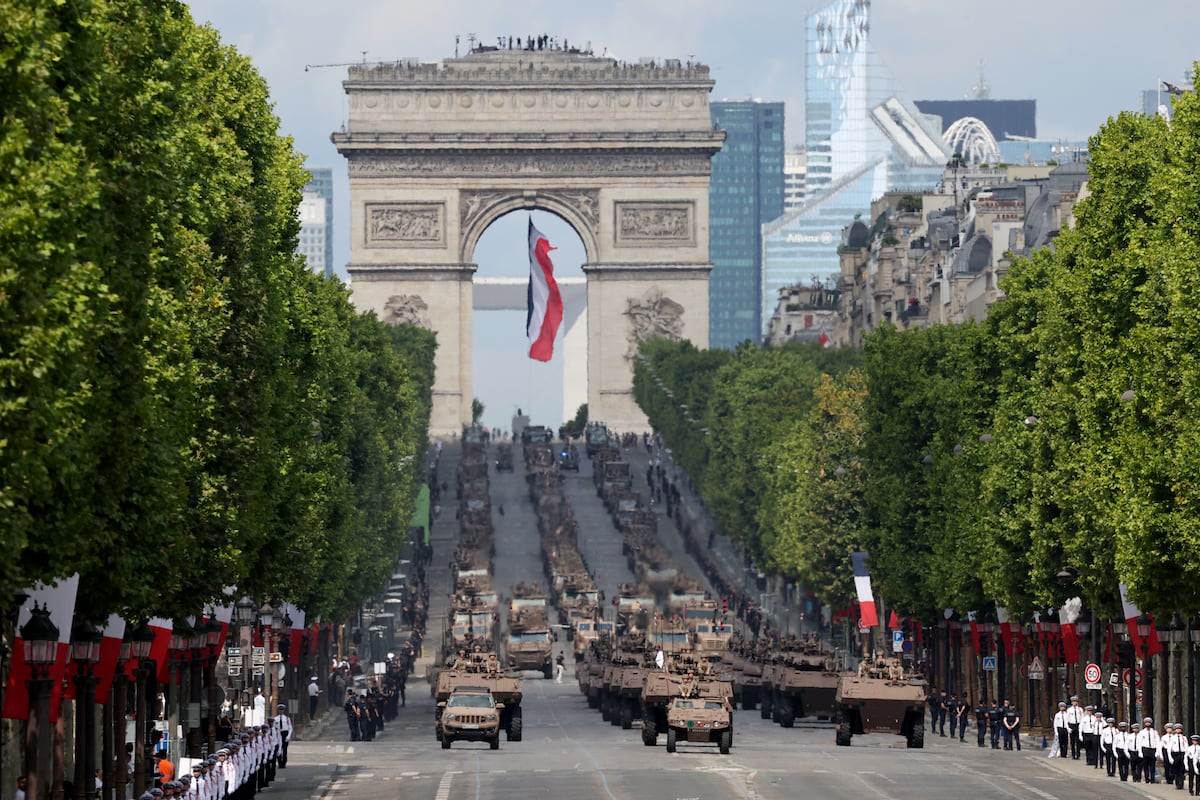
PARIS — France will accelerate a hike in defense spending to reach €64 billion (US$75 billion) in 2027, three years earlier than planned, President Emmanuel Macron told troops and military brass ahead of Bastille Day celebrations on July 14.
In the face of the greatest threat to freedom since 1945, France needs to step up, the president said in his traditional speech at the Armed Forces Ministry in Paris the evening before the national holiday. Macron said Europe must be ready to face a permanent Russian threat on its borders, from the Caucasus to the Arctic.
“Across Europe, nations are rearming, and France cannot leave its European allies on the front line in the face of very short-term threats,” Macron said.
France will add €3.5 billion to the 2026 defense budget on top of a planned increase, and €3 billion to the 2027 budget, the French president said. With that, the country will have doubled its defense budget from when Macron took office in 2017, ahead of a plan to reach that level by the end of the current 2024-2030 military planning law.
The planned increase comes after NATO members agreed to raise core defense spending to 3.5% of GDP, at a June meeting in The Hague, Netherlands. While a number of allies, including Germany , Sweden and Norway, in recent weeks announced plans to meet the target within the next five years, France has yet to say whether and when it will meet the spending goal.
While “certainly appreciable,” Macron’s announcement for an additional €6.5 billion spending over two years amounts to little less than 0.2% of additional GDP at the end of 2027, from a level of defense spending of 2.3% of GDP in 2025, Francois Heisbourg, senior adviser for Europe at the International Institute for Strategic Studies, wrote in a social media post on Sunday.
“The target of 3.5% is a long way off, while Germany plans to reach it in 2029,” Heisbourg said.
Macron said France – one of the most indebt ed countries in the European Union – must not rely on more borrowing to pay for more defense. He said Prime Minister Francois Bayrou will explain how the defense budget will be financed on Tuesday, with increased spending to be paid for through “increased activity and more production.”
The French effort will allow the country to be credible vis-à-vis its partners, Macron said. He said France and Germany will meet at the end of August for a joint defense and security council, where the countries “will have new decisions to take,” and combined investment and enhanced cooperation will allow to build the European pillar of NATO that France has been calling for.
The world is experiencing a technology race in multiple areas with the emergence of artificial intelligence and drones, the return of electronic warfare and new areas of confrontation such as space, cyberspace and the seabed, as well as the shift to quantum technologies, according to Macron.
The world is also seeing the return of nuclear proliferation and major conflicts, and “ultimately, let’s be clear, to be free in this world, you have to be feared,” Macron said. “To be feared, you have to be powerful.”
That means France must be stronger, “because it’s the nation above all that must defend the nation,” the president said. The war in Ukraine has shown “we need bravery, but also stocks and an appropriate defense industry. We need a nation that is capable of holding out and being mobilized.”
Macron said France needs to address areas of weakness, first and foremost its stocks of ammunition, including loitering munitions, as well as saturation weapons and precision arms. French combat groups, frigates and air bases must be equipped with more drones, he said.
Other areas to be strengthened include air defense and electronic-warfare capabilities, as well as space capabilities, according to the president.
While France has “solid armies,” the country needs to “harden the model and also gain in mass,” Macron said. “These are the areas of efforts that have been identified and which will be the priority areas in the additional efforts to be made under the current military programming law.”
The effort will also require defense companies to produce more, faster and at lower cost, according to Macron. He said France’s Directorate General for Armament will monitor this, and prioritize new capabilities and production on French territory.
France has world-class capabilities that “should become European solutions,” including the SAMP/T NG air-defense system, missiles, Rafale fighter jets, constellation of low-orbit satellites as well as AI companies, radar and anti-drone systems, according to Macron.
“We often already produce them in partnership with several other major European manufacturers or through our groups that already have a European footprint and shareholding structure,” Macron said. “So let’s buy European en masse.”
Developing European defense strengthens rather than takes away from French sovereignty, Macron said, calling to “move on from the ridiculous old debates” in a jab at frequent criticism from French nationalist and populist lawmakers slamming pan-European defense cooperation.
France’s nuclear deterrent, while “totally and invariably sovereign,” plays a role in Europe’s security, Macron told the troops and officers gathered in Paris. The president said he asked Armed Forces Minister Sebastien Lecornu and Chief of Staff of the Armed Forces Gen. Thierry Burkhard to engage in dialogue with European partners ready to do so to “fully assess the role of our deterrence in collective security.”
Macron also said France, as the EU’s only nuclear power, has a “major responsibility” to make sure conventional rearmament is “effective, credible and consistent.”
Rudy Ruitenberg is a Europe correspondent for Defense News. He started his career at Bloomberg News and has experience reporting on technology, commodity markets and politics.
巴黎——法国总统埃马纽埃尔·马克龙在7月14日巴士底日庆祝活动前夕告诉军队和军方高层,法国将加快增加国防开支,到2027年达到640亿欧元(750亿美元),比原计划提前三年。
面对自1945年以来对自由的最大威胁,法国总统马克龙在国庆节前夜于巴黎武装部队部发表的传统讲话中表示,法国必须挺身而出。马克龙指出,欧洲必须做好准备,应对俄罗斯在其边境地区(从高加索到北极)构成的持续威胁。
马克龙表示:“欧洲各国都在重新武装,面对短期威胁,法国不能让它的欧洲盟友独自承受压力。”
法国总统表示,法国将在原计划的基础上,为2026年国防预算追加35亿欧元,并为2027年预算追加30亿欧元。如此一来,法国的国防预算将比马克龙2017年上任时翻一番,并提前实现了在现行2024-2030年军事规划法到期前达到这一目标的计划。
此次增税计划是在北约成员国于6月在荷兰海牙举行的会议上同意将核心国防开支提高到GDP的3.5%之后提出的。尽管包括德国、瑞典和挪威在内的多个盟国最近几周宣布了在未来五年内实现这一目标的计划,但法国尚未表明是否以及何时能够达到这一支出目标。
国际战略研究所欧洲高级顾问弗朗索瓦·海斯堡周日在社交媒体上发帖称,马克龙宣布的两年内额外支出 65 亿欧元“当然值得赞赏”,但到 2027 年底,这仅相当于 GDP 的不到 0.2%,而 2025 年国防开支占 GDP 的 2.3%。
“3.5%的目标还遥遥无期,而德国计划在2029年实现这一目标,”海斯堡说。
马克龙表示,法国——欧盟负债最重的国家之一——不应依赖更多借贷来支付增加的国防开支。他表示,总理弗朗索瓦·贝鲁将于周二解释国防预算的融资方式,增加的开支将通过“增加经济活动和提高产量”来弥补。
马克龙表示,法国的努力将提升其在伙伴国中的信誉。他指出,法国和德国将于8月底举行联合防务与安全委员会会议,届时两国“将做出新的决定”,而联合投资和加强合作将有助于构建法国一直以来所呼吁的北约欧洲支柱。
马克龙表示,随着人工智能和无人机的出现、电子战的回归以及太空、网络空间和海底等新的对抗领域的出现,以及向量子技术的转变,世界正在多个领域经历一场技术竞赛。
世界也正面临核扩散和重大冲突的卷土重来,马克龙表示:“归根结底,我们必须明确一点,要想在这个世界上获得自由,就必须令人畏惧。要想令人畏惧,就必须强大。”
这意味着法国必须更加强大,“因为保卫国家是首要的,是整个国家的责任,”总统说道。乌克兰战争表明,“我们需要勇气,也需要储备物资和完善的国防工业。我们需要一个能够坚守阵地并随时动员起来的国家。”
马克龙表示,法国需要解决薄弱环节,首要任务是补充弹药储备,包括巡飞弹、饱和武器和精确制导武器。他还指出,法国作战部队、护卫舰和空军基地必须配备更多无人机。
总统表示,其他需要加强的领域包括防空和电子战能力,以及太空能力。
马克龙表示,虽然法国拥有“强大的军队”,但该国需要“强化军队模式并扩大规模”。“这些是已经确定的努力领域,也将是根据现行军事规划法需要采取的额外措施的优先领域。”
马克龙表示,这项努力还将要求国防企业以更快的速度、更低的成本生产更多产品。他说,法国军备总局将对此进行监督,并优先考虑在法国境内开发和生产新的武器装备。
马克龙表示,法国拥有世界一流的能力,“应该成为欧洲的解决方案”,包括SAMP/T NG防空系统、导弹、阵风战斗机、低轨道卫星星座以及人工智能公司、雷达和反无人机系统。
马克龙表示:“我们通常已经与几家其他欧洲主要制造商合作生产这些产品,或者通过我们旗下已经在欧洲拥有业务布局和股权结构的集团进行生产。所以,让我们大规模采购欧洲产品吧。”
马克龙表示,发展欧洲防务不会削弱法国主权,反而会加强法国主权。他呼吁“结束那些荒谬的旧争论”,以此抨击法国民族主义和民粹主义议员经常对泛欧防务合作的批评。
马克龙在巴黎向聚集的部队和军官表示,法国的核威慑力量虽然“完全且始终自主”,但在欧洲安全中发挥着作用。总统说,他已要求武装部队部长塞巴斯蒂安·勒科尔努和武装部队总参谋长蒂埃里·布尔克哈尔将军与愿意对话的欧洲伙伴展开对话,以“全面评估我们的威慑力量在集体安全中的作用”。
马克龙还表示,法国作为欧盟唯一的核大国,负有“重大责任”,确保常规武器的重新武装“有效、可信和一致”。
鲁迪·鲁伊滕贝格是《防务新闻》的欧洲记者。他的职业生涯始于彭博新闻社,拥有报道科技、大宗商品市场和政治方面的经验。