Ukraine fielding new crop of unmanned boats optimized for river combat乌克兰正在部署一批新型无人艇,这些无人艇经过优化,适用于河流作战。
Smaller naval drones are starting to appear on vital waterways, designed for low-profile attack missions.
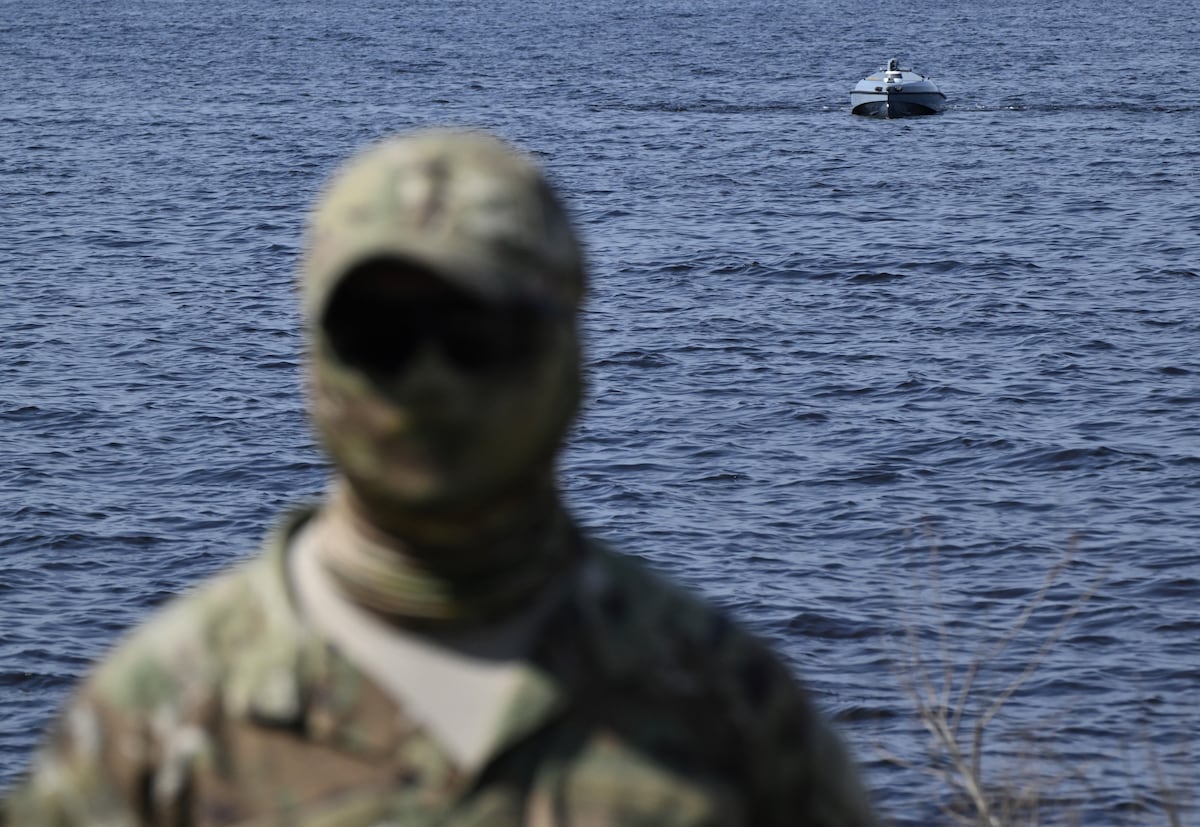
MILAN — Ukraine’s fleet of unmanned surface vessels is expanding with the emergence of a new, smaller type dedicated to riverine warfare for countering Russian presence in key waterways.
Ukrainian firm NoviTechNe debuted this month a new one-meter-long USV dubbed the Ursula, according to United24 Media, a government-run news website focused on Ukraine.
The multi-function system is said to be able to conduct river reconnaissance, act as a floating mine or as a drone carrier to launch two-kilogram, first-person-view drones from the water.
In a video published by the manufacturer, the naval drone is seen maneuvering through riparian vegetation while carrying what appears to be a small FPV drone.
The Ursula is not the first USV of this type that Ukrainian companies are experimenting with.
Over the winter, Brave1, a government defense-technology hub tasked with getting new capabilities field-ready, reported that Ukrainian troops were trialling the Black Widow 2. The system, which also measures roughly one meter in length, has a reported payload of three kilograms and a range of 10 kilometers.
What makes these riverine naval drones stand out is their low profile and compact size, especially in comparison to the much larger USVs Ukraine typically uses, such as the Magura variant and Seababy, that measure up to six meters.
“Ukraine’s focus on developing these brown-water USVs stems from the need to counter Russian activities along the Dnipro river basin, especially in the Kherson area – they had to develop specific capabilities and units to navigate a vast network of canals and attack the adversary,” Federico Borsari, fellow for transatlantic defense at the Center for European Policy Analysis, said.
Ukrainian forces could, for example, use these platforms to carry and launch an FPV from unfamiliar spots in proximity to Russian positions along the low Dnipro river or even to strike slower enemy resupply boats.
According to Borsari, the smaller size of such USVs, although at the expense of a larger payload capability, is better suited for river channels as they can be more agile and maneuverable for defensive and discreet offensive missions.
Size is the most important metric, he argues, when developing systems intended to operate in shallow waters.
Rivers such as the Dnipro, of which 981 kilometers flow through Ukraine, have played a central role throughout the war, acting as natural defensive lines. Their bridges have been vital targets and chokepoints that both sides have tried to take advantage of.
Riverine capabilities bring their own set of tactical challenges. They often include natural obstacles such as sandbanks, vegetation, branches or tall groves, which can make navigation more challenging and prone to interference. Water levels also change frequently, which makes navigation unpredictable.
Elisabeth Gosselin-Malo was a Europe correspondent for Defense News. She covers a wide range of topics related to military procurement and international security, and specializes in reporting on the aviation sector. She is based in Milan, Italy.
米兰——乌克兰无人水面舰艇舰队正在扩大,一种新型的、更小的舰艇出现,专门用于内河作战,以对抗俄罗斯在关键水道的存在。
据专注于乌克兰的政府新闻网站United24 Media报道,乌克兰公司NoviTechNe本月推出了一款名为Ursula的新型一米长无人水面艇。
据称,该多功能系统能够进行河流侦察,充当漂浮水雷或无人机载体,从水中发射两公斤重的第一人称视角无人机。
在制造商发布的一段视频中,可以看到这架海军无人机在河岸植被中穿梭,同时携带着一架看起来像是小型 FPV 无人机的物体。
Ursula 并不是乌克兰公司正在试验的第一款此类无人水面艇。
冬季期间,负责将新技术投入实战应用的政府国防技术中心 Brave1 报告称,乌克兰军队正在试用“黑寡妇 2”型导弹。该系统长度约为一米,据报道有效载荷为三公斤,射程为 10 公里。
这些内河海军无人机的突出之处在于其低矮的外形和紧凑的尺寸,尤其是与乌克兰通常使用的体型大得多的无人水面艇(如 Magura 型和 Seababy,其长度可达 6 米)相比。
“乌克兰之所以专注于发展这些棕水无人水面艇,是因为需要应对俄罗斯在第聂伯河流域,尤其是在赫尔松地区的活动——他们必须发展特定的能力和部队,才能在庞大的运河网络中航行并攻击对手,”欧洲政策分析中心跨大西洋防务研究员费德里科·博尔萨里说。
例如,乌克兰军队可以利用这些平台,从靠近俄罗斯第聂伯河下游阵地的陌生地点携带和发射FPV,甚至可以攻击速度较慢的敌方补给船。
博尔萨里表示,虽然这种无人水面艇的尺寸较小,但有效载荷能力有限,因此更适合在河道中使用,因为它们可以更加灵活机动地执行防御和隐蔽的进攻任务。
他认为,在开发旨在浅水区运行的系统时,尺寸是最重要的指标。
第聂伯河等河流在战争中发挥了核心作用,它们全长981公里流经乌克兰,构成天然防线。河流上的桥梁是双方都试图利用的重要目标和咽喉要道。
河流航行带来了一系列独特的战术挑战。这些挑战通常包括沙洲、植被、树枝或高大的树丛等天然障碍,这些障碍会增加航行难度,并容易造成干扰。此外,水位变化频繁,也使得航行难以预测。
伊丽莎白·戈斯林-马洛曾任《防务新闻》欧洲通讯员。她的报道涵盖军事采购和国际安全等广泛领域,尤其擅长航空领域的报道。她常驻意大利米兰。