Army has enough drones for each unit, now it needs to train soldiers to use them军队每个单位都配备了足够的无人机,现在需要训练士兵如何使用它们。
“Where we still have some work to do candidly is getting everybody trained at the appropriate level," Col. Gregory Merkl, Drone Dominance director for the Army, said.
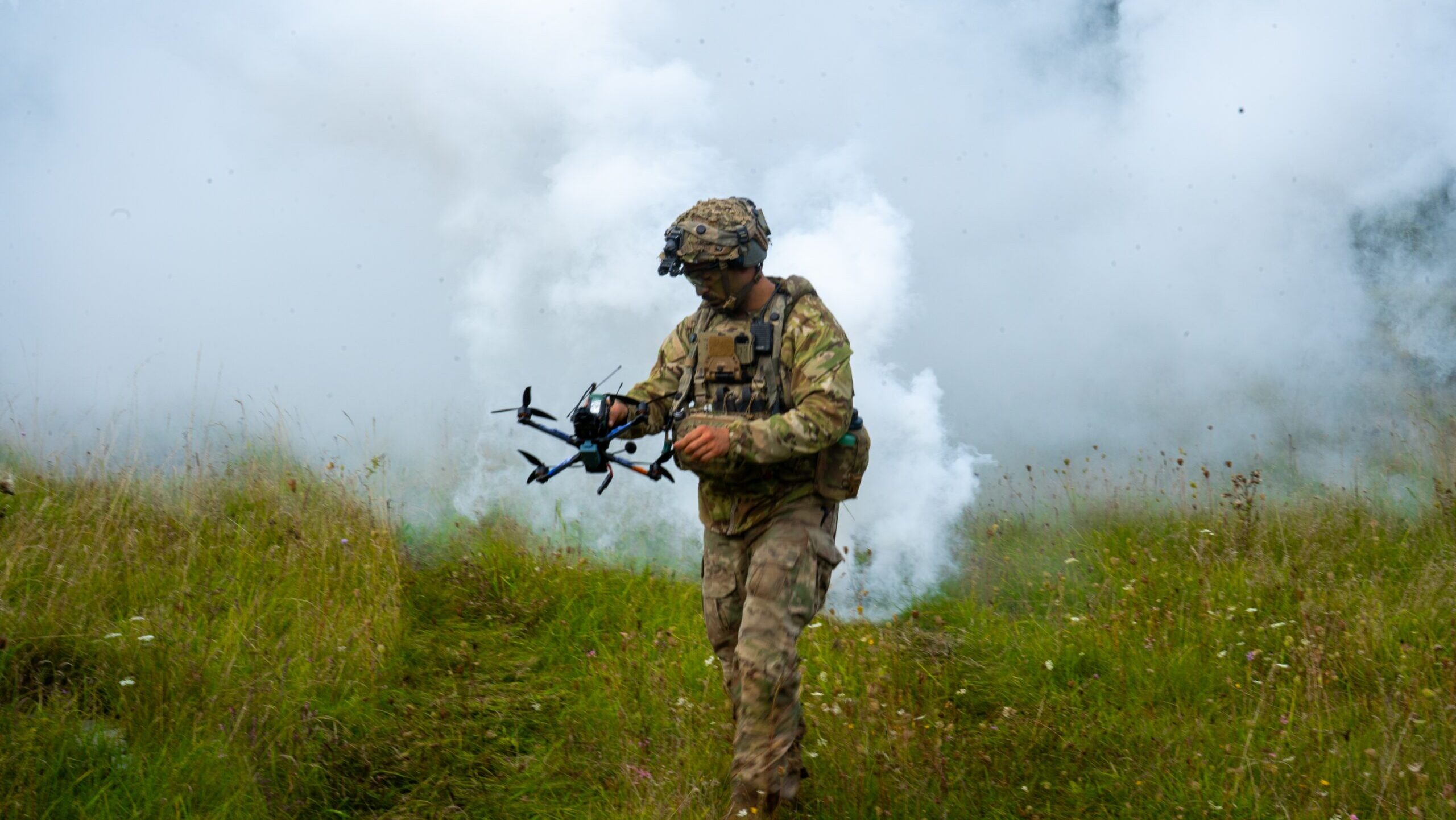
Staff Sgt. Kristopher Garbea, from the unmanned aerial system platoon, 1st Squadron, 2nd Cavalry Regiment, holds a small reconnaissance drone during Saber Junction 25 (SJ25) at the Joint Multinational Readiness Training Center at Hohenfels, Germany Sept. 9, 2025. (U.S. Army photo by Capt. Shenicquia Fulton)
WASHINGTON — The Army’s lead for the Drone Dominance program said today that the Defense Department’s gauntlet-style competitions have, in part, helped get enough drones for every squad, but now the service needs more trained personnel to operate them, especially when operating in a contested electromagnetic spectrum.
“We do have the volume to do that. A lot of that has been facilitated by [the Pentagon’s] Drone Dominance program,” Col. Gregory Merkl, the Army’s Drone Dominance director, said. “Where we still have some work to do, candidly, is getting everybody trained at the appropriate level.
“I think if you look across the force, you have that capability in every platoon. We still have a little bit of work to do in terms of getting the qualified pilots down to the squad level,” he added.
When Defense Secretary Pete Hegseth announced the Drone Dominance program — an initiative aimed at cutting through bureaucratic red tape and accelerating drone production and fielding — in 2025, he mandated that every Army squad be outfitted with small, one-way attack drones by the end of fiscal 2026.
With that deadline approaching at the end of the month, Merkl said the service is now focusing on training soldiers to use the drones, es pecially when it comes to operating in a contested electromagnetic spectrum — an operational environment where the opposition forces actively try to jam or otherwise disrupt drones and comms equipment.
Merkl said the service is “running a whole series of working groups” within the Army’s headquarters level and with interagency partners like the Federal Aviation Administration so soldiers can better understand how to “safely use the spectrum.”
The service is also conducting such training abroad at a smaller level, like during the recent Saber Junction exercise in Germany. During the exercise, the 504th Parachute Infantry Regiment, a drone-focused unit that will soon go back to being a traditional infantry unit , soldiers were able to better understand how to operate in a contested spectrum by working with Ukrainian and NATO counterparts, Merkl said.
Physics AI is different and changes the way defense systems are designed
Models that replicate real-world physics streamline design, testing and iteration processes.
At the end of the exercise, he said the biggest lesson learned was that soldiers have to understand to navigate the electromagnetic magnetic spectrum like they “know how to navigate the terrain.” The troops made progress, Merkl said, but more results will come with continued training.
It’s unclear just how many drones the Pentagon has sent directly to Army units, but as of today, the Drone Dominance Leaderboard shows that units have accepted 12,080 drones from Gauntlet 1 of the program. As Breaking Defense previously reported , 11 companies have received deals to provide a total of 24,320 small drones through the first gauntlet.
Further, the top performers from Gauntlet 2 — which specialized in long range strike and tactical assault missions in confined environments — could receive a share of the 60,000 platforms the department expects to order from that round. Earlier this week, the Drone Dominance Program announced nine winners from the second gauntlet competition out of the initial 19 participants.
2025年9月9日,在德国霍亨费尔斯联合多国战备训练中心举行的“军刀交汇25”(SJ25)演习期间,来自第2骑兵团第1中队无人机系统排的克里斯托弗·加贝亚中士手持一架小型侦察无人机。(美国陆军上尉谢尼奎亚·富尔顿摄)
华盛顿——陆军无人机优势计划负责人今天表示,国防部的严格竞争在一定程度上帮助每个班组获得了足够的无人机,但现在陆军需要更多训练有素的人员来操作这些无人机,尤其是在竞争激烈的电磁频谱中操作时。
“我们的确有足够的规模来做到这一点。这很大程度上得益于五角大楼的无人机优势计划,”陆军无人机优势计划主任格雷戈里·默克尔上校说。“坦白地说,我们仍然需要做一些工作,那就是让每个人都接受适当水平的培训。”
“我认为,纵观整个部队,每个排都具备这种能力。我们还需要做一些工作,才能把合格的飞行员下放到班组层面,”他补充道。
2025 年,国防部长皮特·赫格塞斯宣布了“无人机优势计划”(旨在简化官僚程序,加快无人机生产和部署),并强制要求到 2026 财年末,每个陆军班都必须配备小型单向攻击无人机。
随着月底最后期限的临近,默克尔表示,军方目前正集中精力训练士兵使用无人机,尤其是在竞争激烈的电磁频谱中作战——在这种作战环境中,敌对势力会积极尝试干扰或以其他方式破坏无人机和通信设备。
默克尔表示,陆军总部正在“开展一系列工作组”,并与联邦航空管理局等跨部门合作伙伴合作,以便士兵能够更好地了解如何“安全地使用频谱”。
该部队还在国外进行小规模的此类训练,例如最近在德国举行的“军刀交汇”演习。默克尔表示,在这次演习中,第504伞兵步兵团(一支以无人机作战为主的部队,即将回归传统步兵部队)的士兵通过与乌克兰和北约同行合作,更好地了解如何在对抗环境中作战。
物理人工智能有所不同,它改变了防御系统的设计方式。
能够模拟真实世界物理现象的模型可以简化设计、测试和迭代过程。
演习结束后,他表示,最大的收获是士兵必须像“熟悉地形”一样,懂得如何在电磁波谱中穿梭。默克尔说,部队取得了进步,但需要持续训练才能取得更大成果。
目前尚不清楚五角大楼究竟向陆军部队直接交付了多少架无人机,但截至今日,“无人机优势排行榜”显示,各部队已接收了该项目第一阶段交付的12080架无人机。正如《防务新闻》此前报道,共有11家公司通过第一阶段交付获得了总计24320架小型无人机的合同。
此外,在第二轮“挑战赛”(Gauntlet 2)中表现最佳的参赛者——该赛事专注于在狭小空间内执行远程打击和战术突击任务——有机会获得国防部预计在该轮订购的6万架无人机平台的一部分。本周早些时候,“无人机优势计划”(Drone Dominance Program)公布了第二轮“挑战赛”的9个获胜者,这些获胜者来自最初的19个参赛者。