Marines Rushing To Equip Amphibious Combat Vehicles With New Anti-Drone Jammers美国海军陆战队正加紧为两栖作战车辆配备新型反无人机干扰器
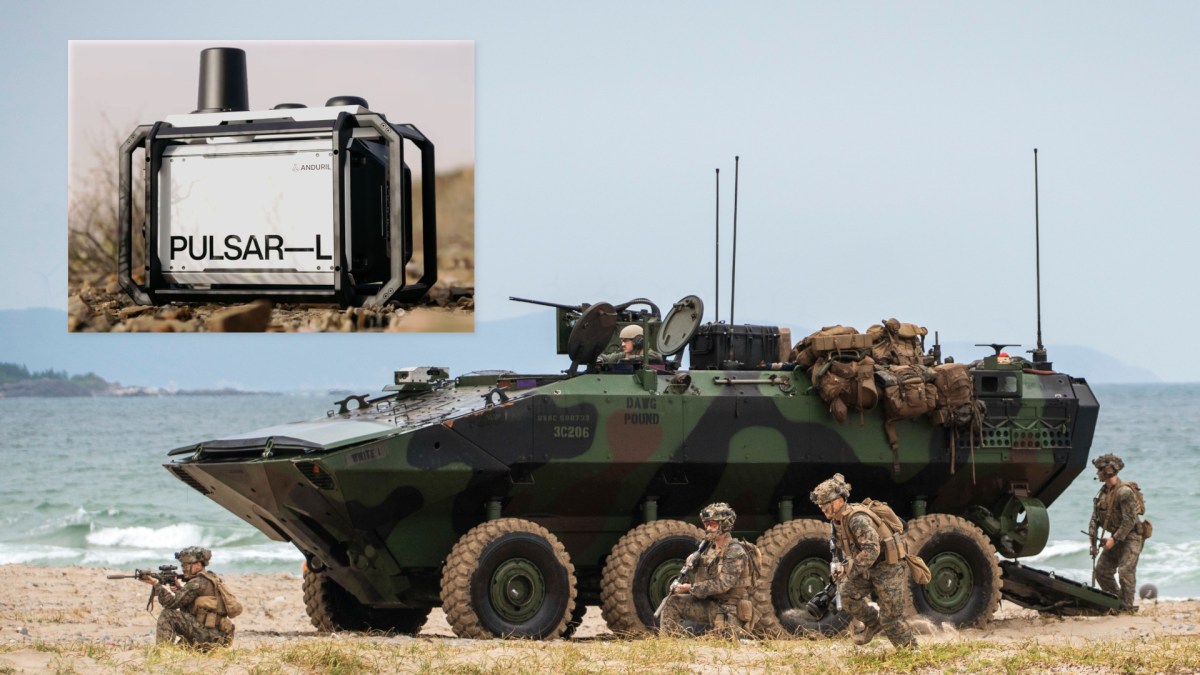
The USMC says an urgent need for Anduril Pulsar-L systems ties in with larger plans to boost the ACV's defenses against drones.
新闻视频
By Joseph Trevithick
Published Sep 25, 2026 1:56 PM EDT
The U.S. Marine Corps is buying Anduril Pulsar-L electronic warfare jammers to meet an urgent operational need to better protect its 8×8 wheeled Amphibious Combat Vehicles (ACV) from drones. This is part of broader efforts the service is pursuing to boost the ACV’s defenses against uncrewed aerial attackers, as well as incoming anti-tank guided missiles and other threats . Drone threats are real now and have notably sidelined even the most advanced heavy armor in Ukraine.
Marine Corps Systems Command (MARCORSYSCOM) announced it had awarded a sole-source deal to Anduril, valued at $15,711,445.50, for an unspecified number of Pulsar-Ls, yesterday. This follows a statement of intent the Command put out last month. Anduril first unveiled Pulsar-L , a lightweight addition to its larger Pulsar family of electronic warfare systems , in April 2025.
The Marine Corps had 150 baseline personnel carrier variants of the ACV (or ACV-Ps), as well as 21 command-and-control ACV-C versions, in inventory as of April 2026. The default armament for ACV-P currently is just a single .50 caliber M2 machine gun in a remote weapon station on top of the hull. The service’s goal is to eventually acquire 389 ACV-Ps and 33 ACV-Cs, as well as 152 ACV-30s with new 30mm cannon-armed turrets and 34 ACV-R armored recovery vehicle variants. The ACV family has already supplanted the Marine Corps’ previous fleet of tracked Assault Amphibious Vehicles (AAV).
From left to right, an Amphibious Combat Vehicle command and control variant (ACV-C), a 30mm cannon-armed ACV-30, and a standard ACV personnel carrier version (ACV-P). The ACV-R recovery variant is not shown here. USMC/Sgt. Alexis Sanchez
“The Anduril Pulsar-L system is a platform-integrated omni-directional SK C-UAS [soft-kill counter-uncrewed aerial systems] with a combined sensor/jammer package that detects, tracks, identifies, and defeats radio frequency-dependent Group 1 and Group 2 Unmanned Aerial Systems (UASs),” MARCORSYSCOM wrote in a justification for the sole-source contract, which was also released yesterday. “Additionally, the system provides counter positioning, navigation, and timing capabilities.”
The U.S. military definition of a Group 1 drone is any design weighing up to 20 pounds, that is able to fly up to an altitude of 1,200 feet, and that can reach speeds of up to 100 knots. Group 2 is the next tier up, encompassing types with gross weights between 21 and 55 pounds, that can get up to an altitude of 3,500 feet, and hit top speeds of up to 250 knots. Kamikaze drones and other small weaponized types that fall into Groups 1 and 2 are used on a daily basis in Ukraine to attack armored vehicles , as well as unarmored vehicles and personnel . These are threats that have been steadily expanding to other hotspots globally, and that we will come back to later on.
Furthermore, “the Pulsar-L is the only solution capable of being mounted on the ACV to provide a mobile and organic means to effectively and simultaneously execute the entire kill-chain against hostile UASs in the deployed land and mai·itime/littoral environment while not exceeding the limited ACV space, weight, and power claim allotted to the SK C-UAS solution,” according to MARCORSYSCOM. “This will provide the ACV with an essential defensive capability, directly contributing to increased survivability and force protection while not sacrificing the mobility and operational tempo of the ACV.”
A row of Marine ACVs seen during training. USMC
Pulsar-L is already “in use by the Special Operations Command due to the system’s low weight, proven performance in engaging multiple UASs, and simultaneous execution of the full kill-chain while static or on the move,” the justification document adds. “Additionally, it is the only known commercially available system that meets the minimum requirement to rapidly identify and respond to emerging UAS technologies and tactics without frequent updates to predefined threat data libraries. The Pulsar-L is the only solution that uses machine based learning to continually adapt to these ever-changing threats without requiring vendor updates, allowing the warfighters to continually be effective in the fight.”
The latter point here is a particularly important consideration for electronic warfare systems, in general, which need to be able to accurately detect, categorize, and respond to different waveforms to be most effective. The emergence of new waveforms, as well as changes to how existing ones are emitted, together with new tactics, techniques, and procedures, can all negatively impact a system’s performance. Historically, the process of responding to those developments with updates to built-in threat libraries has been lengthy and complex. The conflict in Ukraine has shown that the cycle of new developments in the electromagnetic spectrum and then the need for new countermeasures can be regularly measured in weeks .
The U.S. military has been heavily investing in so-called cognitive electronic warfare capabilities to help automate and otherwise accelerate various aspects of this process. The ability of a particular electronic warfare suite to adapt autonomously in real-time, even in the middle of operations, has been viewed as the absolute ‘holy grail’ of this concept, which you can read more about here . How exactly Pulsar-L leverages machine-learning and artificial intelligence to this end, and the speed with which it can adapt to changing threats, is still not entirely clear.
Regardless, “there is an unusual and compelling need for the rapid deployment of SK C-UASs to forward-deployed ground units as Marines currently lack the ability to conduct self-defense against emerging UAS threats,” the justification document stresses. “Failure to deliver this capability places Marines at unnecessary risk, potentially leading to mission failure and loss of life, and hampers the Government’s ability to keep them safe during forward deployments.”
MARCORSYSCOM’s justification for the sole-source deal to Anduril does not otherwise elaborate on the urgent requirements that drove the deal, which it says were only formalized on April 7. That is notably roughly a week after the United States and Israel first launched major combat operations against Iran , which is a prolific developer and user of various tiers of weaponized drones . There is no explicit confirmation of any link, but Iranian drones, as well as missiles and other capabilities , have been a real threat to U.S. forces in the region. We have also just gained more insights recently into how forward-deployed Marine Corps elements contributed to those operations. Counter-drone capabilities would also be especially critical in any future amphibious landing operation, wherever it might occur.
Marines prepare to load an M142 High Mobility Artillery Rocket System (HIMARS) onto a KC-130J aircraft somewhere in the Middle East in July 2026. USAF
All that being said, threats posed by armed Group 1 and 2 drones are not at all limited to Iran and the Middle East, nor are they new. They are only likely to become a more ubiquitous feature in the hands of nation-state armed forces and non-state actors in conflict zones globally as time goes on. The nature of these threats is also expanding significantly in scale and scope, especially when it comes to more automated targeting capabilities , thanks heavily to the increasing democratization of AI-driven technologies, something TWZ has explored in depth in the past .
A number of other significant developments in this arena have emerged from the conflict in Ukraine, where electronic warfare systems are heavily employed against drones. This includes the introduction of physical fiber-optic control links that cannot be jammed , as well as the use of mesh-like and often ad-hoc networks to increase resiliency.
The fighting in Ukraine has also underscored the threat that even small kamikaze drones pose to armored vehicles, including types that are far more heavily protected to start with than the Marine Corps’ ACVs. As mentioned, Ukrainian forces have been sidelining their M1 Abrams and other main battle tanks in the face of constant drone attacks.
MARCORSYSCOM’s justification for the Pulsar-L order makes clear that this is just one part of a larger plan to boost the ACV’s defenses.
“Marine Corps program of record for SK C-UAS is planned to initiate in FY27,” the document mentions toward the very end. “The components of this future program will be procured through full and open competition as it is expected that advanced non-kinetic and SK defeat technologies should be mature by this time.”
Another look at a Marine Corps ACV-P, showing the general configuration of these vehicles today. USMC
Marine Corps officials have also talked in the past about integrating active protection systems (APS) , which could be blended together with C-UAS capabilities , and other defensive features to the service’s ACV fleet.
“We’re constantly looking at what the next generation of APS is and how we can get that onto the [ACV] platform in a lightweight form factor,” Chris Melkonian, the Marine Corps’ Program Manager for Advanced Amphibious Assault (PM AAA), told TWZ and other attendees at the annual Modern Day Marine exposition in April.
Improved “situational awareness, that’s kind of a gateway to counter-UAS, in terms of the ability to sense your environment,” Melkonian also highlighted at that time. “Take all that video on board and then be able to feed that into [a] counter-UAS system.”
Additional “overhead protection right now is a critical thing that we’re working on right now for this platform,” he added. The practice of adding on anti-drone armor screens on armored vehicles (and now other platforms ), especially to protect against top-down attacks, first emerged in Russia in the lead-up to the all-out invasion of Ukraine in 2022. However, the installation of this kind of so-called ‘cope cage’ type armor has now become a global trend, including in the U.S. military .
The U.S. Marine Corps is also pressing ahead with a larger vision to field several tiers of counter-drone capabilities at all levels of its forces , to better protect everything from static installations at home and abroad right down to individual squads .
When it comes to the Marine Corps ACV fleet, the rush order for Pulsar-Ls is an important new step in boosting those vehicles’ defenses against threats that exist now. At the same time, drones are increasingly calling the role of armored vehicles in future conflicts into question.
Contact the author: joe@twz.com
Comments couldn’t be loaded. Please refresh the page.
作者:约瑟夫·特雷维西克
发布于美国东部时间2026年9月25日下午1:56
美国海军陆战队正在采购安杜里尔脉冲星-L型电子战干扰器,以满足其8×8轮式两栖作战车辆(ACV)抵御无人机攻击的迫切作战需求。这是该军种为提升ACV防御无人空中攻击者、来袭反坦克导弹及其他威胁而采取的更广泛举措的一部分。无人机威胁如今已不容忽视,甚至在乌克兰也已使最先进的重型装甲车辆束手无策。
美国海军陆战队系统司令部(MARCORSYSCOM)昨日宣布,已将一份价值15,711,445.50美元的独家采购合同授予Anduril公司,采购数量不详的Pulsar-L系统。此前,该司令部已于上月发布意向声明。Anduril公司于2025年4月首次推出Pulsar-L,它是其Pulsar系列电子战系统新增的轻量化产品。
截至2026年4月,美国海军陆战队装备有150辆基本型ACV(或称ACV-P)人员运输车,以及21辆指挥控制型ACV-C。ACV-P的默认武器配置目前仅为一挺安装在车体顶部遥控武器站上的.50口径M2机枪。海军陆战队的目标是最终采购389辆ACV-P和33辆ACV-C,以及152辆配备新型30毫米火炮炮塔的ACV-30和34辆ACV-R装甲抢修车。ACV系列装甲车已经取代了海军陆战队此前使用的履带式两栖突击车(AAV)。
从左至右依次为:两栖作战车辆指挥控制型(ACV-C)、装备30毫米火炮的ACV-30以及标准型ACV人员运输车(ACV-P)。图中未显示ACV-R回收型。美国海军陆战队/中士亚历克西斯·桑切斯
“Anduril Pulsar-L系统是一款平台集成式全向软杀伤反无人机系统(SK C-UAS),配备组合式传感器/干扰器组件,能够探测、跟踪、识别并干扰射频相关的1类和2类无人机系统(UAS)。”美国海军陆战队系统司令部(MARCORSYSCOM)在昨天发布的独家合同说明中写道,“此外,该系统还提供反定位、导航和授时功能。”
美国军方对第一类无人机的定义是:重量不超过20磅,飞行高度不超过1200英尺,速度不超过100节。第二类无人机则更高一级,重量在21至55磅之间,飞行高度不超过3500英尺,最高速度不超过250节。在乌克兰,神风特攻队无人机和其他属于第一类和第二类的小型武装无人机每天都被用来攻击装甲车辆、非装甲车辆和人员。这些威胁正在稳步蔓延到全球其他热点地区,我们将在后文中详细讨论。
此外,据美国海军陆战队系统司令部(MARCORSYSCOM)称,“Pulsar-L是唯一能够安装在ACV上的解决方案,它提供了一种机动且一体化的手段,可以在部署的陆地和近海/沿海环境中有效且同时执行针对敌方无人机系统的完整杀伤链,同时又不超出分配给SK反无人机系统解决方案的ACV空间、重量和功率限制。这将为ACV提供至关重要的防御能力,直接有助于提高生存能力和部队防护,同时又不牺牲ACV的机动性和作战节奏。”
训练中出现的一排海军陆战队装甲运兵车。美国海军陆战队
这份论证文件补充道,Pulsar-L系统“由于其重量轻、在对抗多个无人机系统方面性能卓越,且无论静止还是移动都能同时执行完整的杀伤链,因此已被特种作战司令部投入使用。此外,它是目前已知唯一一款能够满足快速识别和应对新兴无人机系统技术和战术的最低要求的商用系统,无需频繁更新预定义的威胁数据库。Pulsar-L是唯一一款利用机器学习技术持续适应这些不断变化的威胁,且无需供应商更新的解决方案,从而使作战人员能够持续保持作战效能。”
后一点对于电子战系统而言尤为重要,因为电子战系统必须能够准确地探测、分类和应对不同的波形才能发挥最大效用。新波形的出现,以及现有波形发射方式的改变,再加上新的战术、技术和程序,都会对系统的性能产生负面影响。历史上,通过更新内置威胁库来应对这些变化的过程漫长而复杂。乌克兰冲突表明,电磁频谱的新发展周期以及随之而来的新型对抗措施的需求,通常以周为单位计算。
美国军方一直在大力投资所谓的认知电子战能力,以帮助自动化并加速这一过程的各个方面。特定电子战系统能够实时自主调整,即使在作战过程中也能如此,这被视为该概念的终极目标,您可以在这里了解更多信息。然而,Pulsar-L究竟如何利用机器学习和人工智能来实现这一目标,以及它能够以多快的速度适应不断变化的威胁,目前尚不完全清楚。
然而,这份论证文件强调,“鉴于海军陆战队目前缺乏应对新兴无人机系统威胁的自卫能力,因此迫切需要快速向前沿部署的地面部队部署SK反无人机系统。未能提供这种能力将使海军陆战队员面临不必要的风险,可能导致任务失败和人员伤亡,并削弱政府在前沿部署期间保障他们安全的能力。”
美国海军陆战队系统司令部(MARCORSYSCOM)对授予安杜里尔公司(Anduril)独家采购无人机系统的理由,并未详细说明促成该交易的紧急需求,仅表示该交易于4月7日正式敲定。值得注意的是,这大约是在美国和以色列首次对伊朗发动大规模军事行动一周之后。伊朗是各类武装无人机的研发和使用者。虽然目前尚无明确证据表明两者之间存在关联,但伊朗的无人机、导弹及其他武器装备已对驻扎在该地区的美国军队构成切实威胁。我们最近也对前沿部署的海军陆战队部队如何参与这些行动有了更深入的了解。无论未来两栖登陆作战发生在何处,反无人机能力都将至关重要。
2026年7月,在中东某地,美国海军陆战队员准备将一套M142高机动性火箭炮系统(HIMARS)装载到一架KC-130J运输机上。
尽管如此,第一类和第二类武装无人机构成的威胁绝非伊朗和中东地区所独有,也并非新出现的威胁。随着时间的推移,它们很可能在全球冲突地区的国家武装部队和非国家行为体手中变得更加普遍。这些威胁的性质也在规模和范围上显著扩大,尤其是在自动化目标定位能力方面,这很大程度上要归功于人工智能驱动技术的日益普及,TWZ过去曾对此进行过深入探讨。
在乌克兰冲突中,电子战系统被大量用于对抗无人机,由此也催生了该领域的一系列其他重要进展。这些进展包括引入无法被干扰的物理光纤控制链路,以及使用网状网络和通常为自组织网络的网络来增强系统的韧性。
乌克兰的战事也凸显了即使是小型自杀式无人机对装甲车辆构成的威胁,其中包括一些本身防护能力远超海军陆战队装甲车的装甲车辆。正如前文所述,面对持续不断的无人机袭击,乌克兰军队不得不将M1艾布拉姆斯主战坦克和其他主战坦克暂时搁置。
MARCORSYSCOM 对 Pulsar-L 订单的理由明确表明,这只是提升 ACV 防御能力的更大计划的一部分。
文件末尾提到:“海军陆战队计划于2027财年启动SK反无人机系统项目。由于预计届时先进的非动能武器和SK反制技术将趋于成熟,因此该未来项目的组件将通过全面公开竞争的方式采购。”
再来看看海军陆战队的ACV-P装甲车,展示了这些车辆目前的总体配置。美国海军陆战队
海军陆战队官员过去也曾谈到将主动防护系统 (APS) 集成到该部队的 ACV 机队中,该系统可以与反无人机系统 (C-UAS) 能力和其他防御功能相结合。
“我们一直在研究下一代 APS 是什么,以及如何以轻量化的形式将其安装到 [ACV] 平台上,”海军陆战队先进两栖突击项目经理 (PM AAA) Chris Melkonian 在 4 月份举行的年度现代海军陆战队博览会上告诉 TWZ 和其他与会者。
梅尔科尼安当时还强调,“提高态势感知能力,就感知周围环境的能力而言,是反无人机系统的切入点。把所有视频都录下来,然后输入到反无人机系统中。”
他补充说:“目前,我们正在为这个平台研发额外的顶部防护,这至关重要。”在装甲车辆(现在也包括其他平台)上加装反无人机装甲网的做法,尤其用于防御自上而下的攻击,最早出现在俄罗斯,时间是在2022年全面入侵乌克兰之前。然而,这种所谓的“笼式”装甲的安装如今已成为全球趋势,包括美国军方也在采用。
美国海军陆战队也在推进一项更大的愿景,即在其所有级别的部队中部署多层次的反无人机能力,以更好地保护从国内外的固定设施到单个小队的一切。
对于海军陆战队的装甲运兵车(ACV)车队而言,紧急订购Pulsar-L无人机是提升这些车辆防御能力、应对现有威胁的重要一步。与此同时,无人机的出现也日益使装甲车辆在未来冲突中的作用受到质疑。
联系作者:joe@twz.com
评论加载失败,请刷新页面。