USMC Used Its Expeditionary Operations Playbook In Combat For First Time During Epic Fury在“史诗狂怒”行动中,美国海军陆战队首次在实战中使用了其远征作战手册。
The USMC set up remote forward refueling and rearming points for F-35Bs and other aircraft, as well as sensing locations during the war with Iran.
Published Sep 17, 2026 5:46 PM EDT
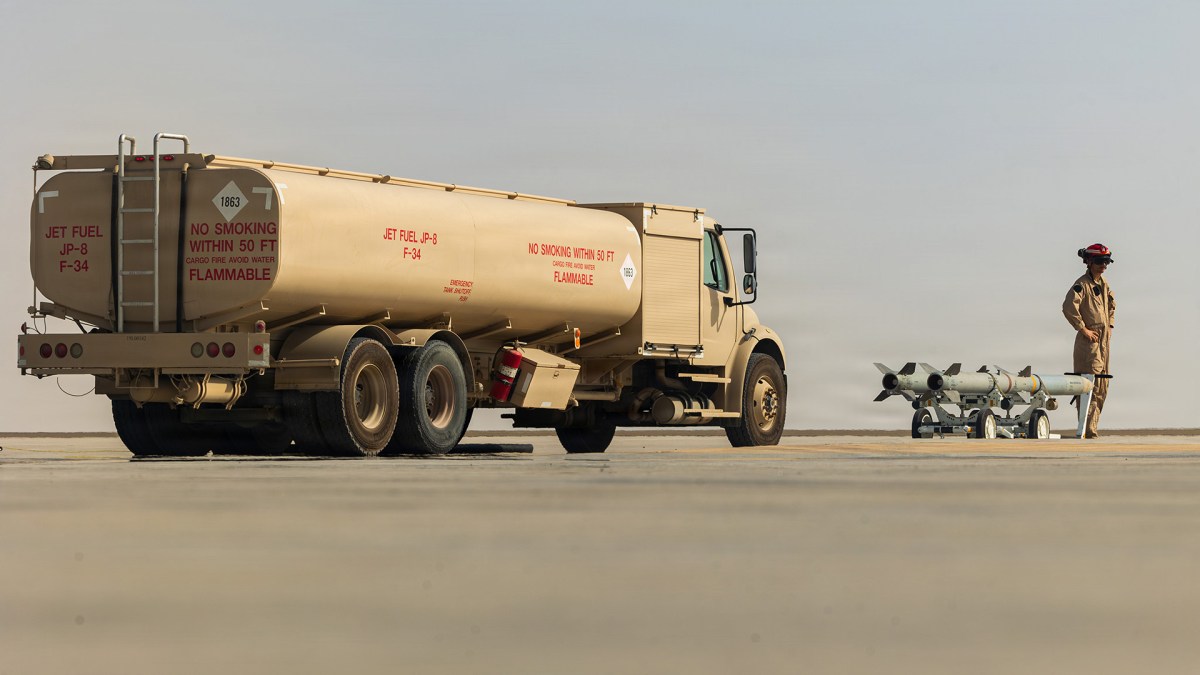
A U.S. Marine with the 31st Marine Expeditionary Unit, stands next to aircraft ordinance at a forward arming and refueling point in the U.S. Central Command area of responsibility, May 26, 2026. (U.S. Marine Corps photo by Cpl. Maksim Masloboev)
The 31st Marine Expeditionary Unit ’s (31st MEU) recent deployment to the Middle East marked the first time the United States Marine Corps (USMC) used its Expeditionary Advanced Base Operations (EABO) concept in a combat setting, the service confirmed to TWZ on Thursday. At its core, EABO involves relatively small groups of Marines quickly establishing bases of operation in forward areas, often within the enemy’s weapons range. During operations in the fight against Iran, Marines refueled and rearmed their own aircraft, as well as those from the joint force, at these austere locales. They also set up remote sensing locations, among other actions from the EABO playbook.
This employment of EABO for Epic Fury is a highly significant development. After years of progressively evolving the EABO playbook, it was no longer an experimental exercise. This meant that Marines were forward deployed in a contested area in a region where established bases were taking heavy fire from Iranian missile and drone barrages. Troops were killed in some of these attacks and U.S. aircraft, buildings and equipment were damaged and destroyed across the Middle East . Pushing aircraft from the MEU, as well the joint force, to FARPs would have been a relevant asset preservation tactic as well as one that would help accelerate combat operations, and it’s exactly what EABO is meant to do.
The 31st MEU’s six-month deployment began in January in the Pacific, before the unit was ordered to the Middle East in March , returning to Okinawa, Japan, in July. That’s where it is stationed as the USMC’s only continuously forward-based MEU.
A map of the 31st MEU’s deployment. (31st MEU)
“This was the first time we were able to implement EABO in combat operations since the concept was created for the force,” Capt. Steven J. Keenan, a USMC spokesperson, told us. “We have practiced it many times, but this was a first for supporting a Joint Force named operation with forward FARPs [forward arming and refueling points] and forward bases that supported joint ops and combat power sustainment.”
EABO was first introduced in 2020 by then-Commandant Gen. David Berger in his Force Design 2030 plan for the future of the Corps. It was created with a fight against China in mind, especially utilizing small Pacific islands. The idea is to have highly mobile, low-signature forces deployed forward in austere, contested or potentially contested maritime locations. The mission is to “support sea control operation, conduct sea denial operations within the littorals, contribute to maritime domain awareness, provide forward command, control, communications, computers, combat systems, intelligence, surveillance, reconnaissance , targeting, and counter-targeting capability and forward sustainment,” according to the Marines .
A Marine holding a Stinger missile launcher stands in front of a Combat Rubber Raiding Craft on Ukibaru Island off the coast of Okinawa during Exercise Hagatna Fury 21. (USMC) A Marine holding a Stinger missile launcher stands in front of a Combat Rubber Raiding Craft on Ukibaru Island off the coast of Okinawa during Exercise Hagatna Fury 21. USMC
The news of the first activation of the EABO concept in combat came Wednesday during a media roundtable with Col. Chris P. Niedziocha, who commanded the 31st MEU during its deployment to the Middle East in support of Operation Epic Fury. Now director of the USMC Expeditionary Warfare School, Niedziocha discussed EABO and a range of other operations during that deployment, including boarding vessels during the blockade of Iranian ports.
The 31st MEU was embarked aboard the Tripoli Amphibious Ready Group (ARG), which consisted of the America class amphibious assault ship USS Tripoli , San Antonio class amphibious transport dock ship USS New Orleans , and Whidbey Island class dock landing ship USS Rushmore . You can read more about the ARG/MEU and its assets in our initial story about the deployment to the Middle East here .
USS Tripoli . (Staff Sgt. Samuel Ruiz)
“You’re starting to see this has been validated,” the colonel said of the EABO concept during the roundtable TWZ attended virtually. “It’s still nascent, but we actually, for the first time, demonstrated what we thought we were able to do, which I think is pretty exciting. And then things like forward arming and refueling to extend the operational reach of aircraft and expeditionary reloading, and then the ever-present logistic challenge of doing something like that. So that’s pretty significant.”
“We successfully implemented critical Expeditionary Advanced Base Operations (EABO), establishing sensor expeditionary advanced bases and forward arming and refueling points (FARPs) where none existed,” the colonel added. “Through our forward logistic elements, we proved that an agile Marine Air-Ground Task Force can sustain itself and generate ready, lethal power in contested maritime environments, directly setting the theater for follow-on joint forces.”
One of the objectives of the FARPs was to reduce reliance on the Marines’ fleet of KC-130 aerial refuelers and serve as jumping-off points for its F-35B Lightning II fighters .
“There was all manner of tankers all the time, but the FARP is to extend the operational reach, and if you can do it, you reduce the load on that,” Niedziocha noted. “Because there’s some aircraft that are basically for expeditionary austere operations, especially the F-35B,” the Marine Corps’ variant of the aircraft designed for short take off and vertical landing.
“There are some trade-offs associated with the Bravo,” Niedziocha pointed out, using a slang for the jets. “There’s less internal fuel, but you have the lift [ system ], which gives you the option to do these kinds of things. So, the goal there was to walk that fine line between providing the full sortie over wherever you needed it, and keeping the ships far enough away to make them as survivable as possible.”
An F-35B Lightning II aircraft taxis to a forward arming and refueling point in the U.S. Central Command area of responsibility, May 26, 2026. (U.S. Marine Corps photo by Cpl. Maksim Masloboev) Cpl. Maksim Masloboev
In addition to the F-35Bs and other aircraft organic to the 31st MEU, the FARPs were also used by Army helicopters, Keenan told us, In addition, imagery posted on the Pentagon’s image distribution site showed they included U.S. Army Gray Eagle drones and Marine MV-22B Osprey tiltrotor aircraft .
A Gray Eagle drone lands at a forward arming and refueling point in the U.S. Central Command area of responsibility, May 26, 2026. (U.S. Marine Corps photo by Cpl. Maksim Masloboev) Cpl. Maksim Masloboev
U.S. Marines with the 31st Marine Expeditionary Unit transport AIM-120 AMRAAMs to a forward arming and refueling point in the U.S. Central Command area of responsibility, May 26, 2026. (U.S. Marine Corps photo by Cpl. Maksim Masloboev) Cpl. Maksim Masloboev
Niedziocha did not provide details about where the FARPs were set up, but a U.S. defense official told us they were “disaggregated throughout the Middle East.” The official declined to provide further information, citing operational security concerns since they are still being used.
“Throughout the deployment, the Tripoli ARG and 31st MEU successfully conducted over 1,600 mishap-free flight hours of combat aviation missions, including precision strikes, transporting 800,000 pounds of cargo, and moving 5,000 personnel,” a 31st MEU overview of the deployment explained. “The units also provided sustained combat support to joint force operations by delivering critical intelligence and refueling over 300 aircraft ashore and underway.”
The colonel also didn’t provide details about the sensor expeditionary advanced bases. According to the Marines , “a sensing expeditionary advanced base (SEAB) brings together coastal surveillance radars, electronic sensors, and Marines ashore to extend maritime domain awareness, complementing the radars and sensors already at work aboard naval ships off the coast.”
“When SEAB systems identify surface vessels in nearby sea lanes, small unmanned aircraft system (sUAS) operators launch their platforms to visually identify and track the contacts,” the Marines added. “Sensor data and imagery are transmitted in real time across the blue-green command network to decision-makers.”
U.S. Marines with 12th Marine Regiment, 3rd Marine Division, prepare to set up a Ground/Air Task Oriented Radar (G/ATOR) system during a routine unit level training exercise on Iejima, Okinawa, Japan, July 15, 2023. (U.S. Marine Corps photo by Staff Sgt. Manuel A. Serrano) Gunnery Sgt. Manuel Serrano
This capability could have been used to track Iran’s remaining fleet of small boats that it has used to harass shipping and mine the Strait of Hormuz , as well as larger vessels trying to transport oil. Other sensors, like radars and counter-drone systems, could also help identify incoming threats and provide general situational awareness. The EABO concept was employed as part of the 31st MEU’s larger role in supporting the blockade and mine clearance efforts.
The 31st MEU interdicted four vessels during the deployment, three of which led to boardings. On April 19, Marines boarded the MV Touska ; on April 28, the MV Blue Star III ; and on May 19, the MT Celestial Sea .
The Touska was boarded after USS Spruance fired multiple 5-inch rounds, targeting the engine room and disabling the vessel’s propulsion. The crew of the vessel was retained for about two weeks before being repatriated.
Niedziocha told us that none of the crews offered any resistance.
“At two in the morning, when 30 Force Reconnaissance Marines fast rope onto your vessel, [you are] just compliant with a capital C. They did exactly what they were directed to do. The overmatch that you put onto that vessel is pretty surprising. And then there’s overwatch provided by UAS and manned aircraft, so you create this bubble around the vessel. So yeah, they complied.”
You can see the Touska being boarded in the following video .
The U.S. just released a video of its forces boarding and seizing the Iranian container ship M/V Touska near the Hormuz Strait after it tried to break the U.S. naval blockade pic.twitter.com/FpB2obb3jY — Visegrád 24 (@visegrad24) April 20, 2026
The U.S. just released a video of its forces boarding and seizing the Iranian container ship M/V Touska near the Hormuz Strait after it tried to break the U.S. naval blockade pic.twitter.com/FpB2obb3jY
Two years ago, as the EABO concept was maturing, TWZ was invited to get an exclusive look at how advanced EABO concept would be put into action, including how squadrons operated the F-35B out of an austere combat environment while generating combat sorties. It was an unprecedented and exclusive peek into the EABO playbook and what a real fight in the Pacific with the USMC’s most advanced fighter aircraft could actually look like. You can read about that in our story here . It appears the operations in the Middle East mirrored this exercise closely.
Now back in Japan, the ARG/MEU is getting ready for a new deployment, said the colonel.
“We got back to Okinawa, I think July 22nd, and they had already begun their workup cycle in earnest to be on the water in early January to go out and do another Iron Fist [training exercise] with the Japanese, and then long periods of a crisis response,” said Niedziocha, who relinquished command in August before moving on to his new role. “Just being there, present in the First Island Chain to partner with your allies, demonstrates the resolve and commitment to deter whatever needs deterring.”
As noted earlier in this story, the EABO concept was designed with a Pacific fight in mind. Its first combat employment in the Middle East clearly offers lessons that can now be adapted to enhance EABO operations globally.
Contact the author: howard@twz.com
Comments couldn’t be loaded. Please refresh the page.
发布于美国东部时间2026年9月17日下午5:46
2026年5月26日,一名隶属于美国海军陆战队第31远征部队的海军陆战队员站在美国中央司令部责任区内的一个前沿武器补给和加油点旁,旁边是飞机弹药。(美国海军陆战队下士马克西姆·马斯洛博耶夫摄)
美国海军陆战队周四向TWZ证实,第31海军陆战队远征部队(31st MEU)近期部署至中东,标志着美国海军陆战队首次在实战环境中运用其远征前进基地作战(EABO)理念。EABO的核心在于,由规模相对较小的海军陆战队小队在前沿地区(通常位于敌方武器射程之内)快速建立作战基地。在与伊朗的作战行动中,海军陆战队员在这些条件简陋的基地为己方及联合部队的飞机进行加油和重新装弹。此外,他们还根据EABO作战手册开展了其他行动,包括建立遥感站点。
在“史诗狂怒”演习中运用EABO(远征航空作战基地)是一项意义重大的进展。经过多年对EABO作战手册的不断完善,它已不再是实验性质的演习。这意味着海军陆战队被前沿部署到冲突地区,该地区的既有基地正遭受伊朗导弹和无人机的猛烈攻击。在这些袭击中,一些美军士兵阵亡,美军飞机、建筑物和装备在中东各地遭到破坏和摧毁。将海军陆战队远征部队(MEU)以及联合部队的飞机部署到前沿作战基地(FARP)是一种有效的资产保护策略,同时也有助于加快作战行动,而这正是EABO的宗旨所在。
第31远征部队的六个月部署于1月份在太平洋开始,之后该部队于3月份奉命前往中东,并于7月份返回日本冲绳。目前,该部队作为美国海军陆战队唯一一支持续前沿部署的远征部队,驻扎在那里。
第31海军陆战队远征部队部署图。(第31海军陆战队远征部队)
“这是自该概念提出以来,我们首次在作战行动中运用EABO,”美国海军陆战队发言人史蒂文·J·基南上尉告诉我们。“我们已经进行过多次演练,但这是首次利用前沿武器补给点(FARP)和前沿基地,为联合部队的指定行动提供支持,以保障联合行动和作战力量的持续保障。”
EABO(前沿作战作战)最早由时任海军陆战队司令大卫·伯杰将军于2020年提出,并纳入其“2030年海军陆战队部队设计”计划。该计划旨在应对与中国的对抗,尤其是在太平洋小型岛屿上作战。其理念是在条件艰苦、竞争激烈或潜在竞争的海域前沿部署高机动性、低特征的部队。根据海军陆战队的说法,其任务是“支持海上控制作战,在近岸海域开展海上拒止作战,提升海上态势感知能力,提供前沿指挥、控制、通信、计算机、作战系统、情报、监视、侦察、目标定位和反目标定位能力以及前沿保障”。
在“哈加特纳狂怒21”联合军演期间,一名海军陆战队员手持“毒刺”导弹发射器,站在冲绳海岸附近的宇喜原岛上的一艘战斗橡皮艇前。(美国海军陆战队)
周三,在一次媒体圆桌会议上,美国海军陆战队第31远征部队指挥官克里斯·P·尼齐奥查上校宣布了EABO概念首次在实战中投入使用的消息。尼齐奥查上校曾指挥该部队部署到中东,支援“史诗狂怒行动”。他目前担任美国海军陆战队远征作战学校校长。在会上,尼齐奥查上校讨论了EABO以及在那次部署期间的其他一系列行动,包括在伊朗港口被封锁期间登船作战。
第31远征部队(MEU)部署在的黎波里两栖戒备群(ARG)上,该戒备群由“美利坚”级两栖攻击舰“的黎波里”号、“圣安东尼奥”级两栖船坞运输舰“新奥尔良”号和“惠德贝岛”级船坞登陆舰“拉什莫尔”号组成。您可以在我们之前关于此次中东部署的报道中了解更多关于该戒备群/远征部队及其装备的信息(点击此处)。
“的黎波里”号两栖攻击舰。(参谋军士塞缪尔·鲁伊斯)
“你们开始看到这个概念得到了验证,”这位上校在TWZ线上参与的圆桌会议上谈到EABO概念时说道。“它还处于起步阶段,但我们确实首次展示了我们之前认为能够做到的事情,我认为这非常令人兴奋。此外,还有前沿武器补给和空中加油等,以延长飞机的作战半径,以及远征补给,当然,还有开展此类行动始终存在的后勤挑战。所以,这意义重大。”
“我们成功实施了关键的远征前进基地作战(EABO),在原本没有的地方建立了传感器远征前进基地和前沿武器补给点(FARP)。”这位上校补充道,“通过我们的前沿后勤保障力量,我们证明了一支敏捷的海军陆战队空地特遣部队能够在竞争激烈的海上环境中维持自身运转并迅速形成有效的杀伤力,从而直接为后续联合部队的行动奠定了基础。”
FARP 的目标之一是减少对海军陆战队 KC-130 空中加油机的依赖,并作为其 F-35B 闪电 II 战斗机的起飞点。
“各种加油机一直都有,但前沿空中加油点(FARP)是为了扩大作战范围,如果能做到这一点,就能减轻其他加油机的负担,”尼齐奥查指出。“因为有些飞机基本上是为远征作战而设计的,特别是F-35B,”海军陆战队的F-35B改进型,专为短距起飞和垂直降落而设计。
“Bravo战机也有一些取舍,”Niedziocha指出,他用俚语指代这些战机。“它的内部燃料较少,但它有升力系统,这使你能够执行这类任务。因此,我们的目标是在满足任何所需地点的完整出击任务和保持舰船与目标足够远的距离以尽可能提高其生存能力之间找到平衡点。”
2026年5月26日,一架F-35B“闪电II”战斗机滑行至美国中央司令部责任区内的前沿武器补给和加油点。(美国海军陆战队下士马克西姆·马斯洛博耶夫摄)
基南告诉我们,除了第 31 海军陆战队远征部队的 F-35B 和其他飞机外,陆军直升机也使用了前沿空中巡逻区。此外,五角大楼图像分发网站上发布的图像显示,它们还包括美国陆军灰鹰无人机和海军陆战队 MV-22B 鱼鹰倾转旋翼机。
2026年5月26日,一架“灰鹰”无人机降落在美国中央司令部责任区内的前沿武器补给和加油点。(美国海军陆战队下士马克西姆·马斯洛博耶夫摄)
2026年5月26日,美国海军陆战队第31远征部队的士兵将AIM-120先进中程空对空导弹(AMRAAM)运送至美国中央司令部责任区内的前沿武器补给和加油点。(美国海军陆战队下士马克西姆·马斯洛博耶夫摄)
尼兹奥查没有透露前沿部署点的具体位置,但一位美国国防官员告诉我们,这些前沿部署点“分散在中东各地”。这位官员以行动安全为由,拒绝提供更多信息,因为这些前沿部署点仍在部署中。
第31海军陆战队远征部队在一份部署概述中解释道:“在整个部署期间,的黎波里两栖戒备群和第31海军陆战队远征部队成功执行了超过1600小时的无事故作战航空任务,包括精确打击、运输80万磅货物和运送5000名人员。这些部队还通过提供关键情报和为300多架岸上和海上飞机加油,为联合部队行动提供了持续的作战支援。”
这位上校也没有提供有关传感器远征前进基地的详细信息。据海军陆战队称,“传感器远征前进基地(SEAB)将海岸监视雷达、电子传感器和岸上海军陆战队员聚集在一起,以扩展海上态势感知能力,补充已在近海海军舰艇上运行的雷达和传感器。”
海军陆战队补充说:“当海上预警系统(SEAB)在附近航道识别出水面舰艇时,小型无人机系统(sUAS)操作员会放飞平台,对这些目标进行目视识别和跟踪。传感器数据和图像会通过蓝绿联合指挥网络实时传输给决策者。”
2023年7月15日,在日本冲绳家岛,隶属于美国海军陆战队第3师第12陆战团的陆战队员在例行部队级训练演习中准备架设地面/空中任务导向雷达(G/ATOR)系统。(美国海军陆战队照片,由参谋军士曼努埃尔·A·塞拉诺拍摄)
这项能力本可用于追踪伊朗残存的小型船只(这些船只曾用于骚扰航运并在霍尔木兹海峡布雷),以及试图运输石油的大型船只。其他传感器,例如雷达和反无人机系统,也有助于识别来袭威胁并提供总体态势感知。EABO概念是第31海军陆战队远征部队在支援封锁和扫雷行动中发挥更大作用的一部分。
第31远征部队在部署期间拦截了四艘船只,其中三艘进行了登船检查。4月19日,海军陆战队员登船检查了“图斯卡”号货轮;4月28日,登船检查了“蓝星III”号货轮;5月19日,登船检查了“天海”号油轮。
在“斯普鲁恩斯”号驱逐舰发射多枚5英寸炮弹,瞄准机舱并使其推进系统瘫痪后,“图斯卡”号被美国海军登船检查。该舰船员被扣留约两周后遣返回国。
尼兹奥查告诉我们,所有船员都没有进行任何抵抗。
“凌晨两点,当30名海军陆战队侦察兵快速绳降到你的船上时,你绝对服从命令。他们完全按照指示行事。你对那艘船的火力压制相当惊人。此外,还有无人机和有人驾驶飞机提供掩护,在船只周围形成了一个保护罩。所以,是的,他们服从了命令。”
您可以在以下视频中看到人们登船的场景。
美国刚刚发布了一段视频,显示其部队在霍尔木兹海峡附近登船并扣押了试图突破美国海上封锁的伊朗集装箱船“图斯卡”号。pic.twitter.com/FpB2obb3jY — Visegrád 24 (@visegrad24) April 20, 2026
美国刚刚发布了一段视频,显示其部队在霍尔木兹海峡附近登船并扣押了试图突破美国海上封锁的伊朗集装箱船“图斯卡”号。pic.twitter.com/FpB2obb3jY
两年前,随着EABO概念日趋成熟,TWZ受邀独家探访了先进的EABO概念将如何付诸实践,包括各中队如何在简陋的作战环境下操控F-35B战机执行作战任务。这是一次前所未有的独家视角,让我们得以深入了解EABO的作战手册,以及美国海军陆战队最先进的战斗机在太平洋战场上的真实作战场景。您可以点击此处阅读我们的报道。看来,中东地区的作战行动与此次演习极为相似。
上校说,现在两栖戒备群/海军陆战队远征部队已经返回日本,正在准备新的部署。
“我们回到冲绳,大概是7月22日,他们已经开始认真进行训练,准备在1月初出海与日军进行另一次‘铁拳’联合演习,之后还要应对长时间的危机,”尼齐奥查说道。他在8月卸任指挥官一职,随后就任新职。“身处第一岛链,与盟友并肩作战,本身就展现了威慑一切需要威慑的威胁的决心和承诺。”
正如本文前文所述,EABO概念最初是为太平洋战区作战而设计的。它在中东的首次实战运用,无疑提供了可供借鉴的经验,以提升EABO在全球范围内的作战能力。
联系作者:howard@twz.com
评论加载失败,请刷新页面。