How realistic is it for Rheinmetall to build a tank plant in Ukraine?莱茵金属公司在乌克兰建设坦克工厂的可行性有多大?
Company boss Armin Papperger said negotiations with Kyiv are ongoing, with a decision expected later this spring.
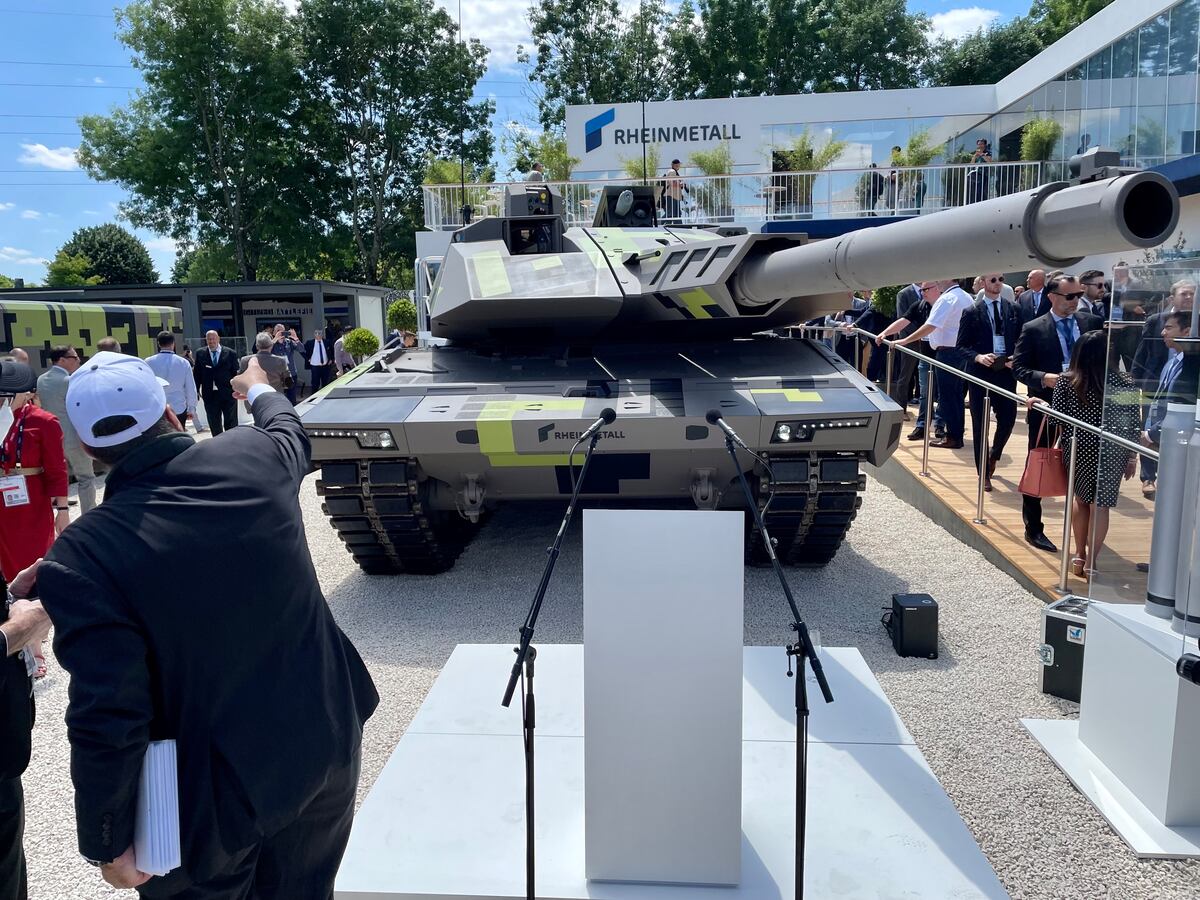
MILAN, Italy — German arms maker Rheinmetall wants to build a factory in Ukraine that could produce up to 400 of the company’s envisioned Panther KF51 main battle tanks annually. Some land warfare experts argue those plans are iffy, at best, pointing to pitfalls ranging from site security to supply-chain risks.
Rheinmetall CEO Armin Papperger broached the subject with German media numerous times since the beginning of the year, saying the company is negotiating with Ukraine about the possibility of investing €200 million ($215 million) in a brand new tank plant that could equip Kyiv’s forces with heavy armor.
Asked for details by Defense News, a company spokesman confirmed the plans but demurred on specifics, pointing to Papperger’s interview on the subject with the Rheinische Post newspaper.
“For business reasons and in view of Ukraine’s sensitive security interests, we are however, unable to provide further details at this time on the status of talks and the possible establishment of manufacturing capabilities in the country,” spokesman Jan-Phillipp Weisswange wrote in an email.
Several elements of the proposal have left experts skeptical. For one, the envisioned production rate appears unrealistically high, according to Mark F. Cancian, senior advisor at the Center for Strategic and International Studies in Washington.
“To produce 400 complete tanks per year is a huge endeavor,” he said. “By comparison, the U.S. roughly currently manufactures 100 per year. The Ukrainian Army, in contrast, had a total of about 800 before the war erupted. Assuming a lifespan of about 20 years, that requires procuring around 40 tanks a year, not 400,” he said.
Cancian added that €200 million as an investment to build production capabilities sounds far too low for an endeavor of this magnitude and duration.
Notably, Rheinmetall’s plans, at least whatever is public about them, are notional and may be aimed more at a post-war Ukraine. Perhaps most importantly, it remains unclear whether the goal is to erect a full-scale production plant or a potentially smaller assembling facility.
Marta Kepe, a senior defense analyst at RAND Corporation, said that pre-building parts in Germany and doing the final assembly and qualification in Ukraine carries the risk associated with shipping sensitive goods to a war zone. In contrast, fully building the vehicle in Ukraine could alleviate these difficulties and in the longer-term also possibly benefit other European countries.
“Producing the Panther in Ukraine would mean that Germany along other European states would not have to hand over the platforms in their inventories to Ukraine, thus preserving their own deterrence and defense capabilities, while assisting the country,” she noted.
Rheinmetall’s newest tank is essentially still a concept weapon, unveiled at last summer’s Eurosatory defense exhibition in Paris . The Panther KF51, which in technical terms is actually a turret and not a complete tank, is based on the hull of the Leopard 2A4 fitted with a new turret, housing an auto-loaded 130 mm caliber main gun. By the company’s own account, the design will take until 2026 to reach full technical maturity.
Producing the Panther in Ukraine would likely require the German government’s approval, a step carrying political risk in Berlin.
Meanwhile, Cancian pointed out that Ukraine is in the process of amassing different styles of tanks from donor countries that could prove difficult to maintain, and adding yet another type could exacerbate the problem.
In that spirit, Rheinmetall’s proposal makes little sense, he argued. It would be more useful to build or modernize a plant to upgrade the country’s T72 main battle tanks, Cancian said.
“Ukraine possesses a lot more of these Soviet-era vehicles and could modernize them for a much lower cost. It would also allow them to possibly enter the world market since many other states have T72s that are becoming obsolete,” he said.
At the same time, a new platform with technological bells and whistles may just be what Ukraine needs in the long run, according to Scott Boston, a senior RAND analyst whose research has focused on land warfare and Russian military capabilities.
“The tank’s new 130mm main armament is going to have a lot of room for future growth,” he said. “Particularly since Russia has lost so much of its modern tank fleet, it will be a very long time before its land force can assemble as large a number of modernized vehicles as they did in the initial months of the invasion last year,” he stated.
There is also a prospect for the Panther to be able to operate robotic platforms, drones and unmanned ground systems, capabilities already designed into the concept tank, Boston said.
Given how experienced Ukrainian forces have become with employing drones on the battlefield, the technology could prove a capability leap, he added.
Elisabeth Gosselin-Malo was a Europe correspondent for Defense News. She covers a wide range of topics related to military procurement and international security, and specializes in reporting on the aviation sector. She is based in Milan, Italy.
意大利米兰——德国武器制造商莱茵金属公司计划在乌克兰建造一座工厂,每年可生产多达400辆该公司设想的“黑豹”KF51主战坦克。一些陆战专家认为,这些计划充其量也只是差强人意,他们指出了从场地安全到供应链风险等一系列潜在问题。
自年初以来,莱茵金属公司首席执行官阿明·帕佩格尔多次向德国媒体提及此事,称该公司正在与乌克兰就投资 2 亿欧元(2.15 亿美元)建设一座全新的坦克工厂的可能性进行谈判,该工厂可以为基辅的部队提供重型装甲。
《防务新闻》就此询问详情时,该公司发言人证实了该计划,但拒绝透露具体细节,并指出帕珀格曾就此接受《莱茵邮报》的采访。
“出于商业原因,并考虑到乌克兰敏感的安全利益,我们目前无法提供有关谈判进展以及在该国建立制造能力的进一步细节,”发言人扬-菲利普·魏斯旺格在一封电子邮件中写道。
该提案的几个方面令专家们持怀疑态度。例如,华盛顿战略与国际研究中心高级顾问马克·F·坎西安表示,设想的生产率似乎高得不切实际。
“每年生产400辆完整的坦克是一项巨大的工程,”他说。“相比之下,美国目前每年大约生产100辆。而乌克兰军队在战争爆发前总共拥有约800辆坦克。假设坦克的使用寿命约为20年,那么每年只需要采购约40辆坦克,而不是400辆,”他说道。
Cancian补充说,投资2亿欧元来建设生产能力对于如此规模和持续时间的项目来说远远不够。
值得注意的是,莱茵金属公司的计划,至少就目前公开的信息而言,还只是设想,而且可能更多地针对战后乌克兰。或许最重要的是,目前尚不清楚其目标是建造一座大型生产厂,还是规模较小的组装厂。
兰德公司高级国防分析师玛尔塔·凯佩表示,在德国预先制造零部件,然后在乌克兰进行最终组装和认证,会带来向战区运输敏感货物的风险。相比之下,在乌克兰完成车辆的全部制造可以缓解这些困难,并且从长远来看,也可能使其他欧洲国家受益。
她指出:“在乌克兰生产‘黑豹’坦克意味着德国和其他欧洲国家不必将库存中的坦克移交给乌克兰,从而既能维护自身的威慑和防御能力,又能帮助乌克兰。”
莱茵金属公司最新推出的坦克本质上仍是一款概念武器,于去年夏天在巴黎举行的欧洲防务展(Eurosatory)上亮相。这款名为“豹”KF51的坦克,严格来说只是一个炮塔而非完整的坦克,它基于豹2A4坦克的底盘,并配备了一个新型炮塔,炮塔内装有一门130毫米口径的自动装填主炮。据该公司称,该设计要到2026年才能完全成熟。
在乌克兰生产“黑豹”坦克可能需要德国政府的批准,这一举动在柏林会带来政治风险。
与此同时,坎西安指出,乌克兰正在从捐助国大量购入不同类型的坦克,这些坦克可能难以维护,而再增加一种坦克可能会加剧这个问题。
他认为,从这个角度来看,莱茵金属公司的提议意义不大。坎西安表示,更有意义的做法是新建或改造一座工厂,用于升级该国的T-72主战坦克。
他说:“乌克兰拥有大量苏联时代的这类车辆,而且现代化改造的成本要低得多。这也有助于他们进入国际市场,因为许多其他国家的T-72坦克也正在逐渐过时。”
与此同时,兰德公司高级分析师斯科特·波士顿表示,一个拥有先进技术的新平台或许正是乌克兰从长远来看所需要的。波士顿的研究重点是陆地战争和俄罗斯的军事能力。
“这款坦克的新型130毫米主炮还有很大的发展空间,”他说。“特别是考虑到俄罗斯损失了大量现代化坦克,其陆军需要很长时间才能像去年入侵初期那样,重新集结起如此庞大的现代化车辆,”他指出。
波士顿表示,黑豹坦克还有可能操作机器人平台、无人机和无人地面系统,这些能力已经在概念坦克的设计中有所体现。
他补充说,鉴于乌克兰军队在战场上使用无人机方面已经积累了丰富的经验,这项技术可能会带来能力上的飞跃。
伊丽莎白·戈斯林-马洛曾任《防务新闻》欧洲通讯员。她的报道涵盖军事采购和国际安全等广泛领域,尤其擅长航空领域的报道。她常驻意大利米兰。