An unprepared West contemplates threat of Russia’s nonstrategic nukes毫无准备的西方正面临着俄罗斯非战略核武器的威胁
Opinion: A deeper and broader study of Russia’s approach to nonstrategic nuclear weapons is essential to maintaining the peace in Europe.
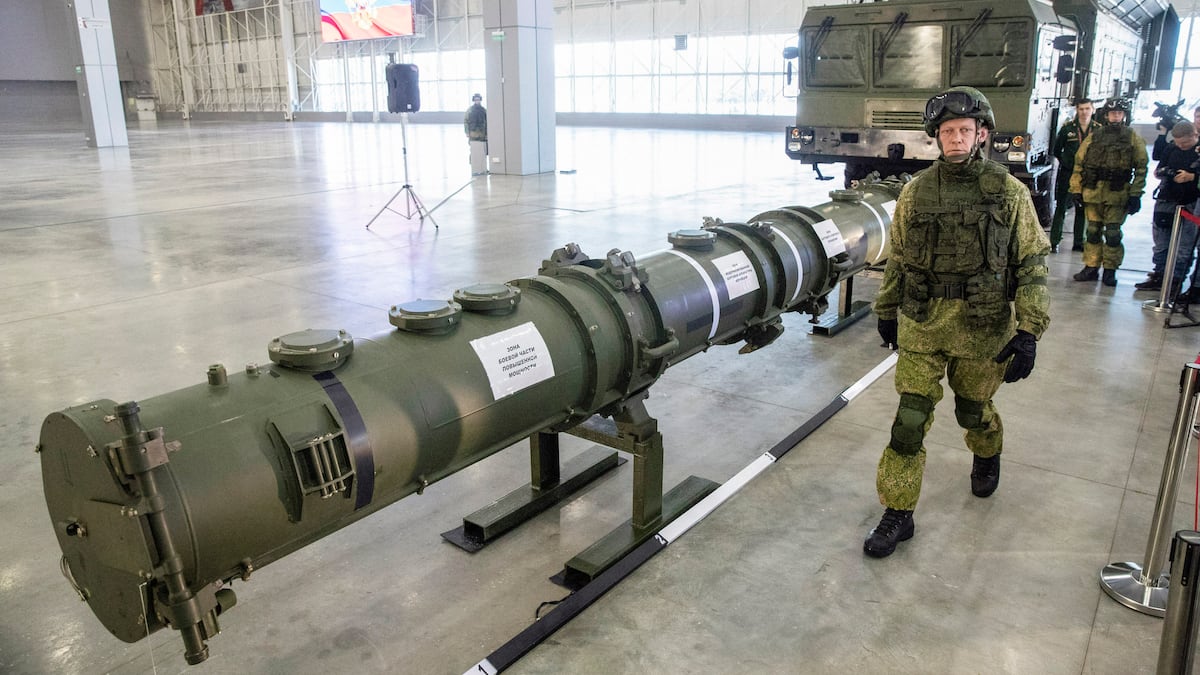
Nuclear threats have been a regular feature of Russian President Vladimir Putin’s discourse since even before he was president. My first memory of reading his name came with the title of secretary of Russia’s national security council in 1999, reporting to then-President Boris Yeltsin that Russian forces had successfully defeated NATO through the use of theater-range nuclear weapon strikes on Poland and Hungary. At that time, Russia’s nuclear-capable, theater-range (nonstrategic) nuclear weapons were less accurate, stealthy and numerous than they are today.
Since 1999, Russia has invested tremendous amounts of money in maintaining legacy systems as well as developing and fielding new types, totaling more than 30 types of nonstrategic nuclear weapon delivery systems, ranging from cruise and ballistic missiles, torpedoes, air-dropped bombs, and anti-aircraft and anti-ballistic missiles. Clearly, Russia values nonstrategic nuclear weapons, or NSNW, particularly those that serve a dual duty — delivering conventional or nuclear warheads.
President Vladimir Putin has asserted that Russia’s nuclear weapons are a guarantor of its sovereignty and its status as a great power. The roles of NSNWs in Russian strategy include deterring unwanted conflicts, coercing adversaries, shaping the battlefield for planned conflicts, controlling escalation within conflicts to protect the Russian homeland, preventing outside powers (read: the U.S.) from intervening in its conflicts, and ensuring that it prevails in war.
NSNWs provide Russia with a comparative and asymmetric advantage over its immediate neighbors as well as the U.S. and its allies, especially considering that the NATO alliance relies entirely on U.S. air-dropped B61-12 bombs for theater nuclear strikes. Russia, on the other hand, employs and continues to develop NSNWs of varying types and ranges to provide a nuclear option at every rung in the escalation ladder.
Recent developments reinforce these observations about Russian thought and doctrine regarding NSNWs. In its war on Ukraine , Russia has used direct nuclear signaling to the U.S. and NATO with its strategic and theater nuclear forces. More recently, it has shown with Belarus that it sees NSNWs as a useful tool to exert further control over its near abroad and increase its coercive power against NATO. China is watching carefully and drawing lessons that it may apply in a potential war against Taiwan — a fact well known to the countries across that region.
A particularly concerning development, from the perspective of the West, is Russia’s belief in its ability to gain and maintain escalation dominance. Russia also has demonstrated during its war on Ukraine that it can absorb personnel and materiel losses in conventional combat to a degree unimaginable to the West, calling into question the very concept of unacceptable costs through mutually assured destruction. This tolerance for casualties and indifference to mutually assured destruction may also be shared by China, which demonstrated a similar indifference to casualties in the Korean War.
The more that can be understood of Russian doctrine and military thought related to NSNWs, the more likely it is that deterrence with Russia can be maintained. Understanding Russia and maintaining deterrence vis-à-vis Russia are matters of survival for the West. If Russia believes that it can control escalation in a potential conflict with the West, and can use nuclear weapons to force the U.S. to back down and concede defeat, it may one day seek to initiate conflict and defeat NATO.
While the performance of Russian conventional forces and depletion of its armies may stay its hand for a while, Russia surely will rearm with its enormous stores of oil and gas money built up over the past few years. Yet many in the West have not grappled with the realities of Russia’s NSNW arsenal, nor developed means to counter Russia’s likely stratagems, systems and doctrine.
I am not advocating for the West to mirror Russia’s nuclear posture by any means, but a deeper and broader study of Russia’s NSNW thought and doctrine is essential to maintaining the peace in Europe.
Within Russia itself, a wide-ranging debate continues in political and military journals on the best way to prevail in a conflict with the West, examining the role of China and other powers such as Iran and North Korea in a potential wider conflict. In the West, the debates on a “two-peer” problem — maintaining deterrence against Russia and China simultaneously — are only now getting underway.
With North Korea and Pakistan increasing their own stocks of NSNWs, and thinking about how they could be used in conflict, Western thought is following on behind the rest. Russian thinking on nuclear weapons, and NSNWs in particular, appears consistent with certain strands of Soviet thinking, but with significant discontinuities due to improvements in the accuracy and lethality of a variety of short-, medium- and long-range artillery and missiles.
Examining this scholarship systematically, through three eras — the Cold War, post-Cold War to Crimea, and Crimea to today — can provide critical insights. More work is needed, and time is short.
William Alberque is the director of strategy, technology and arms control at the International Institute for Strategic Studies.
早在普京就任总统之前,核威胁就一直是他讲话中的常见内容。我第一次读到他的名字是在1999年,当时他担任俄罗斯国家安全委员会秘书,向时任总统叶利钦报告说,俄罗斯军队通过使用战区核武器成功击败了北约,目标是波兰和匈牙利。当时,俄罗斯的战区(非战略)核武器的精度、隐蔽性和数量都远不及今天。
自1999年以来,俄罗斯投入巨资维护现有系统,并研发和部署新型系统,目前已拥有超过30种非战略核武器运载系统,涵盖巡航导弹、弹道导弹、鱼雷、空投炸弹、防空导弹和反弹道导弹等。显然,俄罗斯非常重视非战略核武器,尤其是那些兼具常规弹头和核弹头双重功能的武器。
俄罗斯总统弗拉基米尔·普京曾断言,俄罗斯的核武器是其主权和世界大国地位的保障。非核武器在俄罗斯战略中的作用包括:威慑不必要的冲突、胁迫对手、为计划中的冲突塑造战场格局、控制冲突升级以保护俄罗斯本土、阻止外部势力(例如美国)干预其冲突,以及确保其在战争中取得胜利。
俄罗斯的核潜艇武器(NSNW)使其相对于其近邻以及美国及其盟友而言,拥有了相对优势和不对称优势,尤其考虑到北约联盟完全依赖美国空投的B61-12核弹进行战区核打击。而俄罗斯则部署并持续研发各种类型和射程的核潜艇武器,以便在局势升级的各个阶段都拥有核选项。
近期事态发展进一步印证了我们对俄罗斯核武库思想和理论的观察。在对乌克兰的战争中,俄罗斯利用其战略核力量和战区核力量,直接向美国和北约发出核信号。而最近,俄罗斯在与白俄罗斯的冲突中表明,它将核武库视为进一步控制其周边地区、增强对北约胁迫能力的有效工具。中国正密切关注事态发展,并从中汲取经验教训,以备将来可能发生的对台战争之需——这一事实在该地区各国中广为人知。
从西方的角度来看,尤其令人担忧的是俄罗斯坚信自身有能力获得并维持升级冲突的优势。俄罗斯在对乌克兰战争中也展现出,其在常规战争中承受人员和物资损失的能力是西方难以想象的,这使得“相互确保摧毁”原则本身就受到了质疑。这种对伤亡的容忍度和对相互确保摧毁的漠视,或许也存在于中国身上,中国在朝鲜战争中也表现出了类似的漠视伤亡的态度。
对俄罗斯有关核潜艇武器的理论和军事思想了解得越多,就越有可能维持对俄威慑。了解俄罗斯并维持对俄威慑对西方而言事关生死。如果俄罗斯认为它能够控制与西方潜在冲突的升级,并能利用核武器迫使美国让步并承认失败,那么它或许有一天会主动挑起冲突并击败北约。
尽管俄罗斯常规部队的表现及其兵力损耗或许能暂时阻止其扩张,但俄罗斯肯定会利用过去几年积累的巨额石油和天然气资金重新武装。然而,西方许多国家尚未真正理解俄罗斯非国家行为体武器库的实际情况,也没有制定应对俄罗斯可能采取的战略、系统和理论的措施。
我绝不是主张西方效仿俄罗斯的核姿态,但对俄罗斯的核不扩散核武器思想和理论进行更深入、更广泛的研究,对于维护欧洲和平至关重要。
在俄罗斯国内,政治和军事期刊上仍在就如何才能在与西方的冲突中取得胜利展开广泛辩论,探讨中国以及伊朗和朝鲜等其他国家在潜在更大规模冲突中的角色。而在西方,关于“双头对立”问题——即如何同时对俄罗斯和中国保持威慑——的辩论才刚刚开始。
随着朝鲜和巴基斯坦不断增加其非核潜艇武器储备,并考虑如何在冲突中使用这些武器,西方国家的思想却落后于其他国家。俄罗斯关于核武器,特别是非核潜艇武器的思考,似乎与苏联的某些思路相符,但由于各种短程、中程和远程火炮和导弹的精度和杀伤力不断提高,两者之间存在显著差异。
系统地考察这些学术成果,并将其分为三个时期——冷战时期、冷战后至克里米亚时期以及克里米亚时期至今——可以提供重要的见解。然而,这项工作仍需开展,而时间紧迫。
威廉·阿尔伯克基是国际战略研究所战略、技术和军备控制部门的主任。