Air Force contemplates unmanned tankers空军正在考虑无人加油机
The technology isn’t yet available to give autonomy to very large aircraft—but it’s coming.
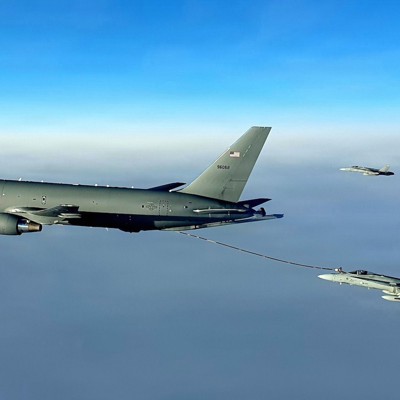
A U.S. Air Force Reserve Command’s KC-46 Pegasus refuels Finnish F/A-18s in Finland airspace, Dec. 7, 2022. Finland Air Force
The technology isn’t yet available to give autonomy to very large aircraft—but it’s coming.
Air, Space & Cyber Conference
NATIONAL HARBOR, Md.— With an eye on the Navy’s progress toward an unmanned aerial tanker, Air Force planners are asking questions about their own future tanker fleet.
“Thinking beyond the current KC-46 buy and the program extension . Whatever that next tanker looks like—our advanced tanker system—it's got to be connected. It's got to be able to defend itself. But it begs the question: Does it need to be manned? Could it be optionally manned, or could it be autonomous, or is there a family of solutions maybe that would answer that question?” Lt. Gen. Daniel Tulley, who leads Air Mobility Command, told reporters at the Air, Space, & Cyber 2026 conference.
The Air Force is currently buying Boeing KC-46 Pegasus tankers and spent $12 million to explore buying a new tanker this year. But it zeroed out funding to continue those explorations in the 2027 budget request and is asking instead for $13 million for “advanced tanker systems.”
Tulley said the Navy’s work on the Boeing MQ-25 Stingray suggests that his own service might eventually not need manned tankers. The Navy announced on Thursday that the MQ-25, which first flew earlier this year, has received approval to enter low-rate production. The service also ordered three more aircraft, bringing its total to 14.
“I do not believe that it has to be manned, a future air-refueling solution,” he said. “But then, how do we, the U.S. Air Force, bring that to bear in scope, scale, and range?”
A drone tanker for the Air Force would need to be a very large aircraft with the capacity for fuel and the ability to fly for a long time. The KC-46 , for example, can fly nearly 7,400 miles and carry more than a thousand tons of fuel. The MQ-25 can fly about 500 miles and carry up to 7.5 tons of fuel.
“An optionally manned or an unmanned tanker at the ranges we need it to operate at is a very large aircraft. And we're not yet to where we're employing fully autonomous large aircraft,” Tulley said.
“Just about any large aircraft these days made by Boeing can take itself off with very little help, can fly on a programmed route and pretty much land itself on autopilot, bring itself to a stop on the runway. But we don't employ it that way with a system that's controlling it and then taxiing it in and making it a part of a more effective, broader system.”
One maker of autonomous-aircraft control systems said the vision of autonomy for large aircraft was getting clearer. And while the technology isn’t there yet, there’s progress, said Matthew George, CEO of Merlin Labs.
“We’re the furthest along in the world on making that real—in our opinion,” said Matthew George, CEO of Merlin Labs. “So we're going to be implementing autonomy on the C-130J, which is the same general size class” as the Boeing KC-135 Stratotanker .
“And the advantage with those aircraft is you can start to implement autonomy still with human crews aboard, and you can supplement those human crews in a way that's pretty helpful. That's a way that you can start to chip away at that without actually going fully to the unmanned tanker right away,” George said. “The goal is that the unmanned tanker is ready, and the autonomy ends up being ready at the same time.”
George agreed with Tulley’s point that many aircraft can somewhat fly themselves, but there are instances, such as emergency situations, when a human needs to make a decision.
“What's really hard is those edge cases and those emergencies—or those things where there are decisions to be made. So, for instance, if you're going to a destination and then there's weather in between, how do you get around the weather?” he said.
And beyond technology, there are policy challenges.
“None of this matters unless it's certified and safe. So for us, getting certification done is important, and that's what we're working really closely with the Air Force on this year,” George said. “We're taking that [ autonomous pilot ] brain and putting it onto the C-130J. And as far as we know, that's going to be the first time autonomy fully takes control of an operational U.S. Air Force aircraft.”
No date was provided for when that flight will occur, but the company’s technology completed a critical design review , George said.
NEXT STORY: NGA official takes top AI job at Cyber Command
2022年12月7日,美国空军预备役司令部的一架KC-46“飞马”加油机在芬兰领空为芬兰的F/A-18战斗机进行空中加油。芬兰空军
目前这项技术还不足以赋予超大型飞机自主飞行能力——但这项技术终将到来。
航空航天网络会议
马里兰州国家港——鉴于海军在无人空中加油机方面取得的进展,空军规划人员正在思考他们自己未来的加油机队。
“要超越目前的KC-46采购和项目延期计划。无论下一代加油机——我们的先进加油机系统——是什么样子,它都必须具备互联互通能力,必须具备自卫能力。但这引出了一个问题:它需要有人驾驶吗?它可以是可选有人驾驶的,还是可以自主驾驶的?或者是否存在一系列解决方案可以回答这个问题?” 空军机动司令部司令丹尼尔·图利中将在2026年空天网络会议上对记者表示。
美国空军目前正在采购波音KC-46“飞马”加油机,并于今年花费1200万美元用于探索采购新型加油机的可能性。但在2027财年的预算申请中,空军取消了继续进行这些探索的资金,转而申请1300万美元用于“先进加油机系统”。
塔利表示,海军在波音MQ-25“黄貂鱼”无人机项目上的进展表明,海军最终可能不再需要有人驾驶加油机。海军周四宣布,今年早些时候首飞的MQ-25已获准进入小批量生产阶段。海军还追加订购了三架该型飞机,使其总订购量达到14架。
“我不认为未来的空中加油方案必须有人操作,”他说。“但是,我们美国空军该如何将其应用到规模、范围和射程上呢?”
空军的无人加油机需要是一种体型非常大的飞机,具备足够的燃料容量和长时间飞行能力。例如,KC-46的航程接近7400英里,可携带超过1000吨的燃料。MQ-25的航程约为500英里,可携带高达7.5吨的燃料。
“在我们所需的作战范围内,无论是有人驾驶还是无人驾驶的加油机都是非常庞大的飞机。而且我们目前还没有达到使用完全自主的大型飞机的阶段,”塔利说道。
“如今波音公司制造的几乎所有大型飞机都能在极少帮助下自动起飞,按照预设航线飞行,并几乎完全依靠自动驾驶系统自动降落,在跑道上自动停稳。但我们并没有采用这种方式,而是通过系统控制飞机,然后将其滑行到跑道尽头,使其成为一个更高效、更广泛的系统的一部分。”
一家自主飞行器控制系统制造商表示,大型飞机的自主飞行愿景正变得越来越清晰。Merlin Labs首席执行官马修·乔治表示,虽然这项技术尚未完全成熟,但已经取得了进展。
“我们认为,我们在实现这一目标方面是世界上最领先的,”Merlin Labs首席执行官Matthew George表示。“因此,我们将在C-130J上实现自主飞行,它的尺寸与波音KC-135同温层加油机大致相同。”
乔治说:“这些飞机的优势在于,你可以在机组人员在场的情况下开始实现自主飞行,并且可以以一种非常有效的方式辅助这些机组人员。这是一种循序渐进的方法,无需立即完全投入无人加油机的研发。我们的目标是,无人加油机和自主飞行系统能够同时准备就绪。”
乔治同意塔利的观点,即许多飞机可以在一定程度上自主飞行,但在某些情况下,例如紧急情况,需要人类做出决定。
他说:“真正困难的是那些特殊情况和紧急情况——或者说是需要做出决定的情况。例如,如果你要去某个目的地,途中遇到天气状况,你该如何应对呢?”
除了技术方面,还存在政策方面的挑战。
“除非经过认证且安全,否则这一切都毫无意义。因此,对我们来说,完成认证至关重要,这也是我们今年与空军密切合作的重点,”乔治说。“我们将把(自主飞行器的)核心系统安装到C-130J运输机上。据我们所知,这将是美国空军作战飞机首次实现完全自主控制。”
乔治表示,虽然没有给出该次飞行的具体日期,但公司的技术已经完成了一项关键的设计审查。
下一篇报道:NGA官员出任网络司令部人工智能要职