Space Shuttle Carrying 747 Was Secretly Modified To Defend Itself From Heat-Seeking Missiles (Updated)搭载747客机的航天飞机曾秘密改装以防御热寻导弹(更新)
NASA's Shuttle Carrier Aircraft was secretly equipped with infrared countermeasures for its high-profile 1983 European tour.
新闻视频
By Joseph Trevithick and Tyler Rogoway
Updated Jan 28, 2022 3:02 PM EST
In May 1983, what was then NASA’s only Shuttle Carrier Aircraft , a highly-modified Boeing 747 airliner capable of carrying a Space Shuttle on the top of its fuselage, arrived at the Paris Air Show carrying the shuttle Enterprise . The international aviation spectacle, arguably Europe’s highest-profile air show, had long been an arena for Cold War competition. While the visit was hugely publicized, what most don’t know is that the plane had been modified for its European trip with an advanced countermeasures system to protect itself from heat-seeking missiles that was still highly classified at the time. The defensive additions to NASA’s 747 were so sensitive that the plane’s crew was told to keep it a secret no matter what.
The story of exactly how NASA’s jet came to be equipped with this system is oddly murky, as are details about the specific factors that prompted this modification, considering the very high-profile and public nature of the Shuttle Carrier Aircraft’s (SCA) attendance at the 1983 Paris Air Show. It certainly was not a secret for long that this plane, which carried the U.S. civil registration code N905NA, was fitted with a countermeasures system for this trip, something that was reported on in Aviation Week after the aircraft touched down in France after spotting the mysterious modifications. The system itself appears to have been one known variously as Have Charcoal and Matador , or a related predecessor.
The War Zone reached out to NASA’s History Division for more details about the installation of this self-defense capability on this particular aircraft, which carried the U.S. civil registration code N905NA, but individuals there had no luck finding any additional information. We’ve also submitted a number of Freedom of Information Act requests related to this story.
Here’s what we’ve been able to find out so far.
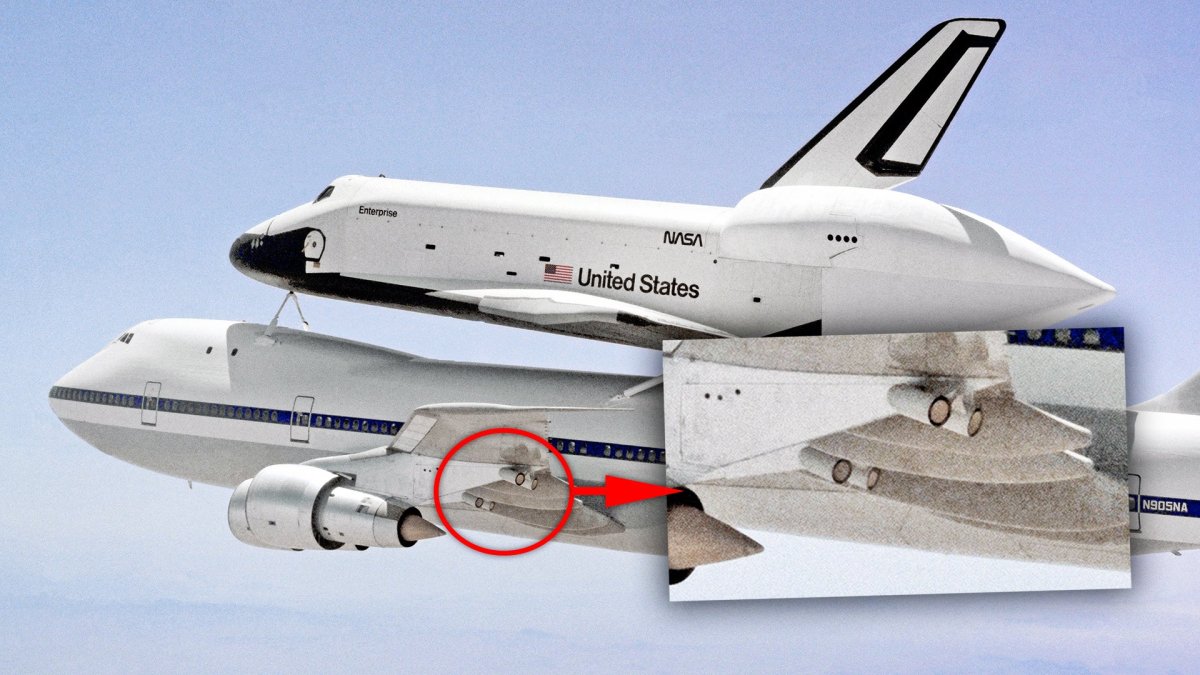
NASA’s Shuttle Carrier Aircraft N905NA with the shuttle Enterprise on top at what was then called the Dryden Flight Research Center in California in 1983 ahead of the start of the trip that would take it to the Paris Air Show that year. Components of the Have Charcoal/Matador infrared countermeasures system are just barely visible behind the aircraft’s left inboard engine., NASA
NASA had first acquired N905NA in the early 1970s from American Airlines. While the plane had that company’s logos removed, it continued to fly for a time with that carrier’s basic paint job, before being repainted in a white and gray NASA scheme with a blue cheatline. This jet was heavily involved in the testing of Enterprise , the first prototype Space Shuttle , which Rockwell completed in 1976 and that conducted its first free test flight in 1977.
You can read all about the Shuttle Carrier Aircraft in this past feature of ours.
Enterprise was originally supposed to be named Constitution , but NASA changed the moniker on orders from then-President Gerald Ford who been on the receiving end of a major letter-writing campaign by fans of the sci-fi television show Star Trek . That show centered on the exploits of the crew of a spaceship called the Enterprise, as did numerous sequels and spinoffs , including a number of full-length feature movies.
The Space Shuttle Enterprise flies free after being released from N905NA, seen here still wearing parts of its old American Airlines livery., NASA
Enterprise never actually went into space. It was built initially as an atmospheric test article and lacked various key features and systems for actual spaceflight. NASA had planned to make it spaceworthy after the conclusion of the testing. However, the core design of the shuttle changed dramatically during the construction of the second example, Columbia . NASA and Rockwell subsequently determined it would be easier and cheaper to make an older test article named Challenger capable of exoatmospheric operations rather than effectively rebuild Enterprise , which was ultimately relegated to various test roles.
As a result, NASA was initially unsure of exactly what it wanted to do with Enterprise following the completion of the original testing plan. One mission for the Space Shuttle that couldn’t go into space was to help promote the program on Earth, as well as NASA in general, as part of a high-profile tour of various sites in the United States and Europe in 1983. The plan as it ended up being carried out saw N905NA bring the shuttle to the following locations, in order as they are listed: Peterson Air Force Base in Colorado, McConnell Air Force Base in Kansas, Wright-Patterson Air Force Base in Ohio, RAF Fairford in England, Bonn-Cologne in what was then West Germany, Le Bourget Airport in France, stops in Italy, and then finally Ottawa in Canada. On the flight to Europe, the SCA carrying Entperise made relatively brief stopovers at Goose Bay in Canada’s Newfoundland and at Naval Air Station Keflavik in Iceland .
“We overnighted at a lot of them but some we didn’t. Some of them were just a gas-and-go. Keflavik, Iceland, was a gas-and-go, but Fairford, England, was the next stop,” Pete Seidl, who worked as a site supervisor for the SCA between 1979 and 2008, recalled about the tour, which was a major undertaking, in an interview for an official NASA oral history monograph . “These people were crazy. NASA sent a whole bunch of PR stuff with us and they gave us these little pins, shuttle pins. … these pins were like gold.”
N905NA with Enterprise on top at Naval Air Station Keflavik in Iceland in 1983., NARA
Taking off from Keflavik., NARA
“After that we went to Bonn, Germany. We had a good time there. They really treated us nice in Bonn. They went overboard,” he continued. “Gosh, we went bar hopping that night and couldn’t buy a drink, those people were so friendly. Shots for everybody; it was a fun time but we all felt like hell the next day.”
N905NA and Enterprise after their arrival at Bonn-Cologne in West Germany., NARA
Another view of the pair in West Germany., NARA
“Then after that we made it in to Paris. In Paris we were just supposed to display the airplane. There weren’t supposed to be any flights at all in the show,” the retired SCA site supervisor explained. “Well, Joe Algranti was in charge. He was the director of operations at Houston [at the Johnson Space Center], flight operations. Anyway, he decided he wanted to fly it, so we started flying.”
“The people just loved the flights but they hated us because it was such a cramped area in the parking space where we were,” he added. “These vendors would have to move all their little tents and everything when we went by, so we were very unpopular. They got over it finally but it was pretty trying.”
At some point before all of this, the decision was made to install the infrared countermeasures system on N905NA. “Before we even went they decided that they needed a missile defense put on our aircraft, so they had a team from Boeing come out; it took them about a week and they installed an infrared missile defense,” Seidl said in his oral history interview. “It was quite a job.”
From the photographs and other information available, the countermeasures system that was fitted to N905NA appears to have been Have Charcoal/Matador, or at least a closely-related predecessor to it. This system was very new at that time, with the initial version only having been first developed for the U.S. Air Force in 1982, according to GlobalSecurity.org . Have Charcoal was the Air Force’s official nickname for the development program. Matador was the trade name for the system. The U.S. military eventually assigned the designation AN/ALQ-204 to at least some versions of the system. It’s not immediately clear who was responsible for the development of the original design, something that is often attributed to Lockheed. However, early units were built by Sanders Associates, a company well known for designing and building infrared countermeasures (IRCM) systems, which only became a Lockheed subsidiary in 1986.
All Matador variants work on the same general principle, emitting large amounts of pulsed infrared energy to blind and confuse the seekers on incoming heat-seeking missiles. This could prevent an opponent from achieving a lock to begin with or break an infrared-homing missile’s lock after it had been fired. Compared to expendable decoy flares , IRCM systems like this can provide more persistent protection, do so without the dangers and handling issues surrounding expendable flares, and are better suited for countering the latest in infrared seekers. Matador is also somewhat modular with a central control system being able to support multiple emitters positioned around an aircraft.
Whatever the exact system that was fitted to N905NA was, it had a total of eight emitters, two at the rear of each one of its four underwing engine pylons facing slightly downward. This would have provided good coverage against various contemporary air and ground-launched heat-seeking missiles in service around the world in the 1980s, many of which typically could only effectively home in on the heat plume at the rear of an aircraft’s engine exhaust.
A close up look at N905NA’s left wing showing four of the eight Matador emitters., NASA
We don’t know if there were any specific threats that prompted the decision to fit Matador to N905NA, but it is clear that terrorism was at least one factor . A number of terrorist organizations were active in Europe at the time, including but certainly not limited to militant communist-inspired groups like the Red Army Faction and various anti-Israel Arab nationalist ones .
In addition, though still a relatively new category of weapons at the time, highly-portable shoulder-fired heat-seeking surface-to-air missiles, also known as Man-Portable Air Defense Systems (MANPADS) were already emerging as a serious concern for commercial flights, as well as military aircraft. A 2019 RAND Corporation report on the use of MANPADS against commercial aviation mentions two separate incidents in Italy in 1973 in which terrorists linked to a group called Black September attempted, but failed to shoot down Israeli airliners with unspecified shoulder-fired missiles. Black September is most infamously associated with the massacre of athletes from Israel at the 1972 Olympics in Munich in West Germany.
The video below is a Soviet-era training video for the 9K38 Igla MANPADS, also known to NATO as the SA-18, which entered service in the early 1980s.
Some of these terrorist groups even had ties with the Soviet Union, which might have raised additional concerns about the possibility of the Kremlin leveraging proxies to carry out some kind of attack. The Soviets had been very publicly critical of the Space Shuttle program, which they accused of being a cover for space-based weapons and intelligence-gathering systems.
Whether those specific allegations were true or not, the U.S. Air Force was certainly a major stakeholder in the Space Shuttle program and the orbiters were used to support secret U.S. military and Intelligence Community missions. In fact, before the loss of Challenger , when it was still hoped the Shuttle would make regular low-cost trips into orbit, the Air Force’s involvement in the program was extensive, with its own launch, recovery, and reset facilities constructed at Vandenberg AFB in California.
The US Air Force’s Space Launch Complex Six (SLC-6) at Vandenberg Air Force Base in California. This is where the service planned to launch own Space Shuttle’s from and Enterprise is seen here mocked-up on the launch pad., DOD
Meanwhile, the Soviets were pushing ahead with work on their own shuttle, the Buran , at the time. The Soviets would have had a vested interest in seeing the U.S. Space Shuttle program veer massively off course.
Of course, Matador would have offered less protection against some kind of more concerted or even overt attempt by the Soviets to shoot N905NA down, potentially under false pretenses. While Matador would have offered a way to neutralize heat-seeking missiles, it would not have provided any defense against radar-homing types. In September 1983, just months after the conclusion of the SCA’s tour of Europe, a Soviet Su-15 Flagon interceptor did shoot down a civilian 747, Korean Air Lines Flight 007 , over the Sea of Japan with a pair of K-8 air-to-air missiles, likely one heat-seeking and one radar-homing type, as was the common practice at the time. The Soviets initially denied that the incident had occurred at all, but eventually admitted to destroying the airliner while claiming, without evidence, that it had been involved in a clandestine spy mission .
With someone providing credible intelligence as to potential threats to the SCA — who exactly that was remains unclear — it’s not hard to see how NASA wouldn’t approve a plan to equip N905NA with defensive capabilities which were cutting-edge for their time. Taking any steps necessary to avoid the possibility of losing this SCA is more relevant than it may seem as it was the only one in service at the time. Losing it, as well as Enterprise , would have massively hampered the Space Shuttle program’s, progress, which was faltering at the time , in addition to just being a highly embarrassing catastrophe. A shootdown would have had the potential to cause casualties and other collateral damage on the ground, which would only exacerbate the fallout from any such incident.
It’s also important to stress that the SCA was absolutely critical to the Space Shuttle program. Without it, the orbiters could not be moved around the country as necessary and the Air Force’s dreams — although misplaced in retrospect — of putting the system to work full-tilt would be delayed further. The SCA was truly a strategic asset although it may not have seemed like it at the time.
After that decision was made, Matador, or an experimental progenitor of it, would have been an obvious choice. The system had been designed from the outset with an eye toward being able to be fitted to various types of large aircraft, including airliners. One of the first aircraft it was installed on was a Boeing 707-based VC-137C aircraft known as SAM 27000 . That aircraft had served as the Air Force’s primary Air Force One plane for transporting the President, their family, and their closest advisors around since 1972. It also had the benefit of requiring relatively little training to operate, with the crew being able to switch it on during the flight and simply have it running in the background.
A look at part of the Matador installation on the US Air Force’s VC-137C Air Force One jet., via GlobalSecurity.org
At the same time, this may well help explain why the history behind the installation of Matador on N905NA remains so obscured. In 1983, information about Matador and the technology behind it, which was being used to protect the President of the United States, would have been very closely guarded. While Seidl mentions that Boeing carried out the modifications to the SCA ahead of its trip to Europe, it seems more than plausible that the Air Force would have been involved in some way, even if only to ensure proper operational security measures were taken.
In his recollections in the NASA monograph, Pete Seidl, the retired SCA site supervisor, lent some credence to this potentiality, saying:
Back then it was supposedly a secret. They told us: “don’t tell anybody, don’t tell anybody what they are.” So we kept it a secret; we were trying to. After we got to Paris Air Show all of the refuelers were asking us what those were. We had to tell them they were directional lights for in-flight refueling. We didn’t even have in-flight refueling on the airplane so that was a farce, but we went along with it. We left here and had to go way up north and across to get over there because we didn’t have very long range with the orbiter on the back, 1,500 miles I think was probably our max – pretty short legs.
After the SCA’s European tour, it was quickly demodified, as well.
“As soon as we got back they took all that off. It wasn’t on there very long,” Seidl told his interviewer. “It went by the way side. Never put it on again. Still have the hookups and everything but never had any use for it.”
N905NA carrying Enterprise at Dulles International Airport in Virginia following the pair’s European tour. The Matador system is still seen fitted in this picture., NARA
Seidl’s recollections about N905NA being equipped with Matador appear to be, by far, the most detailed official statements on the matter. As already noted, NASA’s internal history office told The War Zone that it could not locate any further information on this topic. NASA also said that it could not find any relevant records in response to one of our Freedom of Information Act requests.
“The History Office also consulted the Agency shuttle expert who noted that the ALQ-204 system was still under development in 1983/84,” the FOIA office at NASA’s headquarters wrote in a letter responding to that request. “He stated that the system was not available for NASA use at that time as it was just beginning operational trials specifically for United States Air Force (USAF) use in 1983.”
Of course, whether or not Matador was the system in question, Seidl’s oral history interview, the readily available pictorial evidence, contemporary news reporting on the subject, and information found in other secondary sources make clear that infrared countermeasures were installed on the SCA. Beyond that, this statement does underscore just how sensitive the entire arrangement was at the time and continues to be for whatever reason.
Regardless, the Matador-less N905NA continued to serve as an SCA, as well as in support of other testing, for decades afterward. In 1988, it was joined by a second SCA, a modified 747 that NASA had acquired from Japan Airlines, which was assigned the U.S. civil registration code N911NA.
As was mentioned earlier in this piece, Enterprise never went into space, though NASA did consider making it spaceworthy after the Challenger disaster in 1986. It was used for various other test purposes, including to explore the causes behind the loss of the Space Shuttle Columbia in 2003.
NASA shuttered the Space Shuttle program for good in 2011 and many of N905NA’s own last flights involved ferrying retired shuttles around the United States to museums. This SCA is now itself on display with a mockup of the shuttle Independence on top at Space Center Houston, NASA’s official visitor’s center at the Johnson Space Center in Houston, Texas.
N905NA as it appears now on display at Space Center Houston., Romain2k via Wikimedia
Various versions of Matador did find their way onto various other aircraft, including other military and commercial types, including the Air Force’s 747-based VC-25A Air Force One jets and E-3 Sentry Airborne Warning And Control System (AWACS) radar planes, as well as the earlier VC-137C aircraft that served as Air Force One, as well. The Matador installation on N905NA differs from the one seen on the later VC-25A Air Force One aircraft, which have a single multi-faceted enclosure at the rear of each engine pylon and one on the tail. Still, Boeing might have leveraged some of its experience modifying NASA’s SCA when it added the latest version of the system to those presidential jets, the first of which was delivered to the Air Force in 1990.
Later versions of Matador installed on one of the US Air Force’s VC-25A Air Force One aircraft., Tyler Rogoway
Various other IRCM systems had been in service across the U.S. military before the development of Matador and afterward, as well. At least one Matador variant did eventually receive a certification from the U.S. Federal Aviation Administration (FAA) underscoring its use in the commercial aviation industry. It was acquired for head-of-state aircraft internationally, such as on the Sultan of Brunei’s old 747 and those belonging to middle east royalty flights, like on Oman’s 747SP, and others. An installation was also designed for Gulfstream business jets.
In 1995, as part of the merger of Lockheed and Martin Marietta into Lockheed Martin, Sanders became part of Lockheed Martin Aerospace Electronic Systems. Lockheed Martin subsequently sold that division to U.K.-headquartered BAE Systems in 2000, which continued to produce Matador for some time afterward, though it no longer lists the system on its website. BAE Systems, as well as a number of other companies, continue to offer various IRCM systems, including various newer laser-based directional infrared countermeasures (DIRCM) types . These systems are designed to defeat advanced infrared-homing threats from all aspects.
The use of an IRCM system to protect NASA’s prized shuttle-carrying 747s during its 1983 visit to the Paris Air Show and other stops along the way is certainly intriguing. What started out as a technical interest for us turned into something of a Cold War mystery. The big question remains: what intelligence led to such a drastic measure being taken and who supplied that intelligence to NASA?
We hope to find out more as our investigation continues.
After the publishing of this story, Dennis Jenkins, an expert on the Space Shuttle and author , who worked on the program directly during his 33 years as a contractor to NASA, reached out to us with more information about the infrared countermeasures system installed on N905NA. The system in question was actually an earlier design developed prior to Have Charcoal/Matador as part of a Quick Reaction Capability (QRC) project and was known as the QRC-81-01 Ten High .
The QRC-81-01 was developed as part of a program known as Have Siren and it functions in the same general manner as Matador. In addition, while Matador is often cited as the infrared countermeasures system installed on the VC-137C Air Force One aircraft, it appears that plane was actually also fitted with the QRC-81-01. This was the system used on variants of the E-3 Sentry radar plane, a number of different models of RC-135 intelligence-gathering aircraft , and certain EC-135 types , among others, as well.
Jenkins further explained that from his research it appears that N905NA delivered Challenger to the Kennedy Space Center in Florida before flying to Paine Field in Washington State on April 18, 1983. Boeing’s facility in Everett, Washington, the location of the 747 production line , is attached to Paine Field. The SCA then flew to Edwards Air Force Base on April 28. There are photographs, seen below, of the plane at the Dryden Flight Research Center, now called the Armstrong Flight Research Center, which is situated within Edwards, with the system installed as of May 16.
NASA via Dennis Jenkins
“There is remarkably little documentation on the installation,” Jenkins told The War Zone . “So it probably got installed at Paine. Ten days was quick.”
“The QRC was missing by the time of the [shuttle] Discovery delivery flight on 6 November 1983,” he added. “No visits to Paine in the interim, so I suspect it was removed at McConnell [Air Force Base]/Wichita [in Kansas] since she was there for most of July.”
Contact the author: joe@thedrive.com and tyler@thedrive.com
Comments couldn’t be loaded. Please refresh the page.
作者:约瑟夫·特雷维西克和泰勒·罗戈韦
更新于美国东部时间2022年1月28日下午3:02
1983年5月,当时NASA唯一的航天飞机运输机——一架经过高度改装的波音747客机,机身顶部可以搭载航天飞机“企业号”抵达巴黎航展。这场国际航空盛会,堪称欧洲最受瞩目的航展,长期以来一直是冷战时期各方角逐的舞台。尽管此次访问被大肆宣传,但鲜为人知的是,这架飞机为了此次欧洲之行进行了改装,加装了一套先进的反制系统,用于防御当时仍属高度机密的红外制导导弹。NASA为这架747飞机加装的防御系统极其敏感,机组人员被告知无论如何都要对此保密。
关于NASA这架喷气式飞机究竟是如何配备这套系统的,以及促成此次改装的具体因素,至今仍扑朔迷离。考虑到航天飞机运输机(SCA)在1983年巴黎航展上的高调亮相,这些细节更显得扑朔迷离。这架注册号为N905NA的飞机在此次飞行中加装了对抗系统,这很快就成了公开的秘密。飞机降落在法国后,《航空周刊》就报道了此事,因为人们发现了这些神秘的改装。这套系统似乎名为“Have Charcoal”或“Matador”,或者与其相关的早期版本。
《战区》栏目联系了美国宇航局历史部门,希望了解更多关于这架注册号为N905NA的飞机安装自卫系统的信息,但该部门未能找到任何补充资料。此外,我们还根据《信息自由法》提交了多份与此相关的申请。
以下是我们目前了解到的情况。
1983年,美国宇航局(NASA)的航天飞机运输机N905NA搭载着“企业号”航天飞机,停放在当时位于加利福尼亚州的德莱顿飞行研究中心,准备启程前往巴黎参加当年的巴黎航展。在飞机左侧内侧发动机后方,隐约可见“Have Charcoal/Matador”红外对抗系统的组件。(NASA)
美国国家航空航天局(NASA)于20世纪70年代初从美国航空公司购得N905NA号飞机。虽然飞机上的美国航空公司标志已被移除,但它仍保留了航空公司的基本涂装飞行了一段时间,之后才被重新涂装成带有蓝色饰条的NASA标志性白灰配色方案。这架飞机曾深度参与“企业号”(Enterprise)——第一架航天飞机原型机——的测试工作。“企业号”由洛克威尔公司于1976年完成建造,并于1977年进行了首次自由飞行测试。
您可以在我们之前的专题报道中了解有关航天飞机运输机的全部信息。
“企业号”航天飞机最初计划命名为“宪法号”,但美国宇航局(NASA)奉时任总统杰拉尔德·福特之命更改了名称。福特总统此前收到了大量科幻电视剧《星际迷航》粉丝的来信,要求更改名称。《星际迷航》讲述了一艘名为“企业号”的宇宙飞船及其船员的冒险故事,该剧还衍生出众多续集和衍生作品,包括多部电影长片。
企业号航天飞机从N905NA停机坪脱离后自由飞行,图中仍保留着部分原先美国航空公司的涂装。(美国国家航空航天局)
企业号航天飞机实际上从未进入太空。它最初是作为大气层测试飞机建造的,缺少实际太空飞行所需的各种关键功能和系统。美国宇航局原本计划在测试结束后对其进行改造,使其具备太空飞行能力。然而,在第二架航天飞机“哥伦比亚号”的建造过程中,航天飞机的核心设计发生了巨大变化。美国宇航局和洛克威尔公司随后认为,与其对企业号进行彻底改造,不如制造一架名为“挑战者号”的旧测试飞机,使其具备大气层外飞行能力,这样更容易也更经济。最终,企业号被降级用于各种测试任务。
因此,在完成最初的测试计划后,NASA最初并不确定该如何处置“企业号”航天飞机。其中一项无法进入太空的任务是,在1983年进行一次高规格的美国和欧洲巡回演讲,以帮助在地球上推广航天飞机项目以及NASA的整体形象。最终的执行方案是,N905NA号航天飞机按顺序将航天飞机送往以下地点:科罗拉多州的彼得森空军基地、堪萨斯州的麦康奈尔空军基地、俄亥俄州的赖特-帕特森空军基地、英国的费尔福德皇家空军基地、当时西德的波恩-科隆机场、法国的勒布尔热机场、意大利的停留,最后抵达加拿大渥太华。在飞往欧洲的途中,搭载“企业号”的航天飞机在加拿大纽芬兰的鹅湾和冰岛的凯夫拉维克海军航空站进行了相对短暂的停留。
“我们在很多地方都过夜了,但也有一些地方没有。有些地方只是加完油就走。比如冰岛的凯夫拉维克,就是加完油就走,但下一站是英国的费尔福德,”皮特·塞德尔在接受美国宇航局官方口述历史专著采访时回忆起这次巡回之旅时说道。塞德尔曾在1979年至2008年间担任航天飞机中心(SCA)的现场主管。这次巡回之旅是一项浩大的工程。“这些人真是太疯狂了。美国宇航局给我们带了一大堆宣传品,还给了我们一些小徽章,航天飞机徽章……这些徽章简直跟黄金一样珍贵。”
1983年,冰岛凯夫拉维克海军航空站,N905NA号机,机顶搭载“企业”号飞机。(图片来源:美国国家档案馆)
从凯夫拉维克机场起飞。(图片来源:美国国家档案馆)
“之后我们去了德国波恩。我们在那里玩得很开心。波恩人对我们特别热情,简直到了过分的程度,”他继续说道。“天哪,那天晚上我们去酒吧转悠,结果连一杯酒都买不起,那里的人太友好了。每个人都喝了烈酒;那晚玩得很尽兴,但第二天我们都感觉糟透了。”
N905NA 和 Enterprise 抵达西德波恩-科隆机场后的照片。(美国国家档案馆)
这是两人在西德的另一张照片。(图片来源:美国国家档案馆)
“之后我们就到了巴黎。在巴黎,我们原本只是展示这架飞机,航展上根本不应该有任何飞行表演,”这位退休的SCA现场主管解释说。“结果,乔·阿尔格兰蒂负责这件事。他是休斯顿(约翰逊航天中心)飞行运营总监。总之,他决定要亲自驾驶这架飞机,所以我们就开始飞行了。”
“人们很喜欢我们的航班,但他们讨厌我们,因为我们停在停车场的地方太拥挤了,”他补充道。“每次我们经过,那些小贩都得挪开他们的小帐篷和所有东西,所以我们非常不受欢迎。他们最终还是接受了,但这确实很煎熬。”
在此之前,他们就决定在N905NA飞机上安装红外对抗系统。“在我们出发之前,他们就决定需要为我们的飞机安装导弹防御系统,所以他们派了一个波音公司的团队过来;他们花了大约一周时间安装了红外导弹防御系统,”塞德尔在他的口述历史采访中说道。“这可真是一项艰巨的任务。”
从现有照片和其他信息来看,N905NA飞机上安装的对抗系统似乎是“Have Charcoal/Matador”,或者至少是与其密切相关的早期版本。据GlobalSecurity.org网站报道,该系统在当时非常新颖,其初始版本于1982年才为美国空军首次研发。“Have Charcoal”是空军对该研发项目的官方昵称,“Matador”则是该系统的商品名。美国军方最终将该系统的至少部分型号命名为AN/ALQ-204。目前尚不清楚最初的设计是由谁负责的,虽然通常认为是洛克希德公司完成的。然而,早期的样机是由桑德斯联合公司(Sanders Associates)制造的,该公司以设计和制造红外对抗(IRCM)系统而闻名,直到1986年才成为洛克希德公司的子公司。
所有“斗牛士”(Matador)型号的工作原理基本相同,即发射大量脉冲红外能量,使来袭热寻导弹的导引头失效并产生干扰。这可以阻止对手锁定目标,或在红外制导导弹发射后使其失去锁定。与一次性诱饵弹相比,此类红外对抗系统能够提供更持久的防护,避免了一次性诱饵弹的危险性和操作问题,并且更适合对抗最新的红外导引头。“斗牛士”系统还具有一定的模块化设计,其中央控制系统能够支持安装在飞机周围的多个发射器。
无论N905NA上安装的具体系统是什么,它总共有八个发射器,四个机翼下发动机挂架的后部各有两个,略微向下倾斜。这足以有效防御20世纪80年代世界各地使用的各种空射和地射红外制导导弹,其中许多导弹通常只能有效地追踪飞机发动机尾焰产生的热气流。
近距离观察N905NA的左翼,可以看到八个“斗牛士”(Matador)发射器中的四个。(美国宇航局)
我们并不清楚促使N905NA飞机安装Matador防盗系统的具体威胁是什么,但恐怖主义显然至少是其中一个因素。当时欧洲活跃着许多恐怖组织,包括但不限于受共产主义思想影响的激进组织,例如红军派,以及各种反以色列的阿拉伯民族主义组织。
此外,尽管肩扛式红外制导地对空导弹(也称便携式防空导弹系统,简称MANPADS)在当时仍是一种相对较新的武器类型,但它已开始对民用航班以及军用飞机构成严重威胁。兰德公司2019年发布的一份关于MANPADS用于打击民用航空的报告提到了1973年发生在意大利的两起事件,其中与一个名为“黑色九月”的恐怖组织有关的恐怖分子试图使用不明型号的肩扛式导弹击落以色列客机,但未能成功。“黑色九月”最臭名昭著的事件是1972年慕尼黑奥运会期间在西德发生的以色列运动员遭屠杀事件。
下面的视频是苏联时期 9K38“针”便携式防空导弹系统(北约称之为 SA-18)的训练视频,该系统于 20 世纪 80 年代初投入使用。
其中一些恐怖组织甚至与苏联有联系,这可能引发人们对克里姆林宫利用代理人发动袭击的担忧。苏联曾公开强烈批评航天飞机计划,指责该计划掩盖了天基武器和情报收集系统。
无论这些具体指控是否属实,美国空军无疑是航天飞机计划的主要参与者,航天飞机被用于支持美国军事和情报部门的秘密任务。事实上,在挑战者号失事之前,人们仍然希望航天飞机能够定期进行低成本的轨道飞行,当时空军对该计划的参与程度非常广泛,并在加利福尼亚州的范登堡空军基地建造了自己的发射、回收和重置设施。
美国空军位于加利福尼亚州范登堡空军基地的第六航天发射场(SLC-6)。美国空军曾计划从这里发射自己的航天飞机,图中可以看到“企业号”航天飞机模型放置在发射台上。(美国国防部)
与此同时,苏联当时正在加紧研发自己的航天飞机“暴风雪”号。苏联肯定非常希望看到美国的航天飞机计划严重偏离轨道。
当然,如果苏联方面有组织地甚至公开地试图击落N905NA,而苏联方面可能出于虚假借口,那么“斗牛士”导弹的防护能力就会下降。虽然“斗牛士”导弹可以拦截红外制导导弹,但它无法防御雷达制导导弹。1983年9月,就在SCA结束欧洲巡演几个月后,一架苏联苏-15“酒壶”战斗机在日本海上空用两枚K-8空空导弹击落了一架民用波音747客机——大韩航空007号班机。这两枚导弹很可能是一枚红外制导导弹和一枚雷达制导导弹,这在当时是一种常见的做法。苏联最初否认发生过这起事件,但最终承认击落了这架客机,并在没有任何证据的情况下声称该客机参与了一项秘密间谍任务。
既然有人提供了关于航天飞机辅助运输机(SCA)潜在威胁的可靠情报——具体是谁尚不清楚——就不难理解为什么NASA不会批准为N905NA配备当时最先进的防御能力。采取一切必要措施避免失去这架SCA比表面看起来更为重要,因为它是当时唯一一架在役的SCA。失去它,以及“企业号”航天飞机,不仅会造成极其尴尬的灾难,还会严重阻碍当时步履维艰的航天飞机计划的进展。被击落可能会造成人员伤亡和其他地面附带损害,这将加剧此类事件的后果。
必须强调的是,航天飞机运输系统(SCA)对航天飞机计划至关重要。如果没有它,航天飞机就无法根据需要在美国境内调动,空军全面启用该系统的梦想——尽管事后看来是错误的——也会进一步延后。尽管当时可能并非如此,但航天飞机运输系统的确是一项战略资产。
做出决定之后,Matador系统或其实验原型自然成为不二之选。该系统从一开始就被设计成能够适配各种大型飞机,包括客机。首批安装该系统的飞机之一是基于波音707的VC-137C型飞机,编号为SAM 27000。自1972年以来,这架飞机一直是美国空军的主要专机“空军一号”,用于运送总统、其家人和最亲密的顾问。此外,该系统操作简便,机组人员只需接受相对较少的培训即可上手,飞行途中只需开启系统即可使其在后台运行。
图片来自 GlobalSecurity.org,展示了美国空军 VC-137C“空军一号”专机上 Matador 防空系统的部分安装情况。
与此同时,这或许也能解释为何N905NA上安装“斗牛士”(Matador)系统的历史至今仍扑朔迷离。1983年,关于“斗牛士”系统及其背后的技术(当时正用于保护美国总统)的信息必然受到严密保护。虽然塞德尔提到波音公司在SCA飞往欧洲之前对其进行了改装,但空军以某种方式参与其中似乎也并非不可能,即便仅仅是为了确保采取适当的运行安全措施。
在NASA专著的回忆录中,退休的SCA现场主管皮特·塞德尔(Pete Seidl)对这种可能性表示了一定的认同,他说:
当时这据说是个秘密。他们告诉我们:“别告诉任何人,别告诉任何人那是什么。”所以我们一直保守着这个秘密;我们尽力了。到了巴黎航展之后,所有的加油机都问我们那些是什么。我们只好告诉他们那是空中加油的方向指示灯。我们的飞机根本没有空中加油装置,所以这简直是个笑话,但我们还是配合着演了下去。我们离开这里,不得不一路向北飞,横穿整个航线才能到达目的地,因为飞机后面拖着航天飞机,航程很短,我想大概只有1500英里——航程相当短。
SCA欧洲巡演结束后,它也很快被取消了配音。
“我们一回去他们就把那些东西都拆掉了。没装多久,”塞德尔告诉采访者。“就被弃用了。再也没装过。所有连接线什么的都还在,但从来没用过。”
N905NA 飞机搭载着 Enterprise 航空公司,在结束欧洲之旅后停靠在弗吉尼亚州杜勒斯国际机场。照片中仍可以看到飞机上安装的 Matador 系统。(图片来源:美国国家档案馆)
塞德尔关于N905NA配备Matador系统的回忆,似乎是迄今为止关于此事最详尽的官方声明。正如前文所述,NASA内部历史办公室告诉“战区”网站,他们无法找到关于此主题的任何其他信息。NASA还表示,在我们根据《信息自由法》提出的申请中,他们也未能找到任何相关记录。
美国国家航空航天局(NASA)总部信息自由办公室在回复该请求的信中写道:“历史办公室还咨询了航天飞机专家,该专家指出,ALQ-204系统在1983/84年仍在研发中。他表示,该系统当时尚未可供NASA使用,因为它在1983年才开始专门为美国空军(USAF)进行运行试验。”
当然,无论“斗牛士”(Matador)系统是否就是所指系统,塞德尔的口述历史访谈、现存的图片证据、当时的新闻报道以及其他二手资料都清楚地表明,SCA上确实安装了红外对抗措施。除此之外,这一声明也凸显了当时整个安排的敏感性,无论出于何种原因,这种敏感性至今依然存在。
尽管如此,没有了“斗牛士”发动机的N905NA在接下来的几十年里继续作为小型飞机(SCA)服役,并支持其他测试工作。1988年,第二架小型飞机加入其行列,这架经过改装的波音747是NASA从日本航空公司购得的,并被分配了美国民用注册号N911NA。
正如本文前面提到的,企业号航天飞机从未进入太空,尽管在 1986 年挑战者号航天飞机灾难之后,NASA 确实考虑过使其具备太空飞行能力。它被用于各种其他测试目的,包括探索 2003 年哥伦比亚号航天飞机失事的原因。
美国宇航局于2011年彻底关闭了航天飞机项目,N905NA的最后几次飞行任务中,许多都是将退役的航天飞机运送到美国各地的博物馆。如今,这架航天飞机运输机本身也在休斯顿太空中心展出,机顶上还放置着一架“独立号”航天飞机的模型。休斯顿太空中心是位于德克萨斯州休斯顿约翰逊航天中心的美国宇航局官方游客中心。
N905NA 目前在休斯顿太空中心展出。图片来自 Wikimedia,Romain2k 提供。
Matador系统的各种版本被安装在其他多种飞机上,包括其他军用和民用机型,例如美国空军基于747的VC-25A“空军一号”专机和E-3“哨兵”空中预警与控制系统(AWACS)雷达飞机,以及早期的VC-137C“空军一号”。N905NA上的Matador系统安装方式与后期VC-25A“空军一号”上的有所不同,后者在每个发动机吊架后部和尾部都安装了一个多面体外壳。不过,波音公司在为这些总统专机(首架于1990年交付美国空军)加装最新版本的Matador系统时,可能借鉴了其改装NASA的SCA系统的经验。
泰勒·罗格威(Tyler Rogoway)报道,美国空军VC-25A“空军一号”飞机上安装了后期版本的“斗牛士”(Matador)系统。
在“斗牛士”(Matador)系统研发之前和之后,美国军方已经服役过多种其他红外对抗系统。至少有一种“斗牛士”系统最终获得了美国联邦航空管理局(FAA)的认证,这表明该系统在商业航空领域也有应用。它被国际上一些国家元首专机采用,例如文莱苏丹的旧款747飞机,以及中东王室的专机,如阿曼的747SP等等。此外,该系统还被设计用于湾流公务机。
1995年,洛克希德·马丁公司与马丁·玛丽埃塔公司合并为洛克希德·马丁公司,桑德斯公司也随之并入洛克希德·马丁航空航天电子系统公司。2000年,洛克希德·马丁公司将该部门出售给了总部位于英国的英国航空航天系统公司(BAE Systems)。BAE Systems公司此后继续生产“斗牛士”(Matador)系统一段时间,但其网站上已不再列出该系统。BAE Systems公司以及其他一些公司仍在继续提供各种红外对抗系统,包括各种新型的基于激光的定向红外对抗(DIRCM)系统。这些系统旨在从各个方面对抗先进的红外制导威胁。
在1983年NASA珍贵的航天飞机747客机访问巴黎航展及沿途其他站点期间,使用红外对抗系统来保护飞机,这的确令人费解。起初,我们只是出于技术兴趣,但后来却发现这背后隐藏着一段冷战谜团。最大的疑问依然存在:究竟是什么样的情报促使NASA采取了如此极端的措施?又是谁向NASA提供了这些情报?
随着调查的深入,我们希望能够了解更多信息。
本文发表后,航天飞机专家兼作家丹尼斯·詹金斯联系我们,提供了更多关于N905NA上安装的红外对抗系统的信息。詹金斯曾在NASA担任承包商长达33年,直接参与了航天飞机项目。他指出,该系统实际上是“Have Charcoal/Matador”任务之前开发的早期设计,属于快速反应能力(QRC)项目的一部分,名为QRC-81-01“Ten High”。
QRC-81-01是“Have Siren”项目的一部分,其工作原理与“Matador”系统大致相同。此外,虽然“Matador”常被认为是安装在VC-137C“空军一号”飞机上的红外对抗系统,但实际上该飞机也配备了QRC-81-01系统。该系统也曾用于E-3“哨兵”预警机的多个型号、多种RC-135情报收集飞机以及某些EC-135机型等。
詹金斯进一步解释说,根据他的研究,N905NA似乎在1983年4月18日将挑战者号航天飞机交付给佛罗里达州的肯尼迪航天中心后,飞往华盛顿州的佩恩机场。波音公司位于华盛顿州埃弗雷特的工厂(747生产线所在地)与佩恩机场相连。随后,这架SCA飞机于4月28日飞往爱德华兹空军基地。以下照片显示了这架飞机在德莱顿飞行研究中心(现更名为阿姆斯特朗飞行研究中心,位于爱德华兹空军基地内)的照片,照片拍摄于5月16日,当时该系统已安装完毕。
美国国家航空航天局(NASA)通过丹尼斯·詹金斯报道
詹金斯告诉《战区》杂志:“关于这次安装的记录少得惊人。所以它很可能是在佩恩空军基地安装的。十天就安装好了,速度很快。”
“1983年11月6日发现号航天飞机交付飞行时,快速反应堆控制模块(QRC)已经不见了,”他补充道。“在此期间,佩恩号航天飞机没有进行过任何访问,所以我怀疑它是在麦康奈尔空军基地/威奇托(堪萨斯州)被拆除的,因为佩恩号在7月份的大部分时间都停在那里。”
联系作者:joe@thedrive.com 和 tyler@thedrive.com
评论加载失败,请刷新页面。