Latvia sends mobile intercept units to Russian border in wake of drone incursions无人机入侵事件发生后,拉脱维亚向俄罗斯边境派遣移动拦截部队
“The force teams we plan to deploy to the border in the coming days will be equipped with local interceptor drones,” a Latvian military official said.
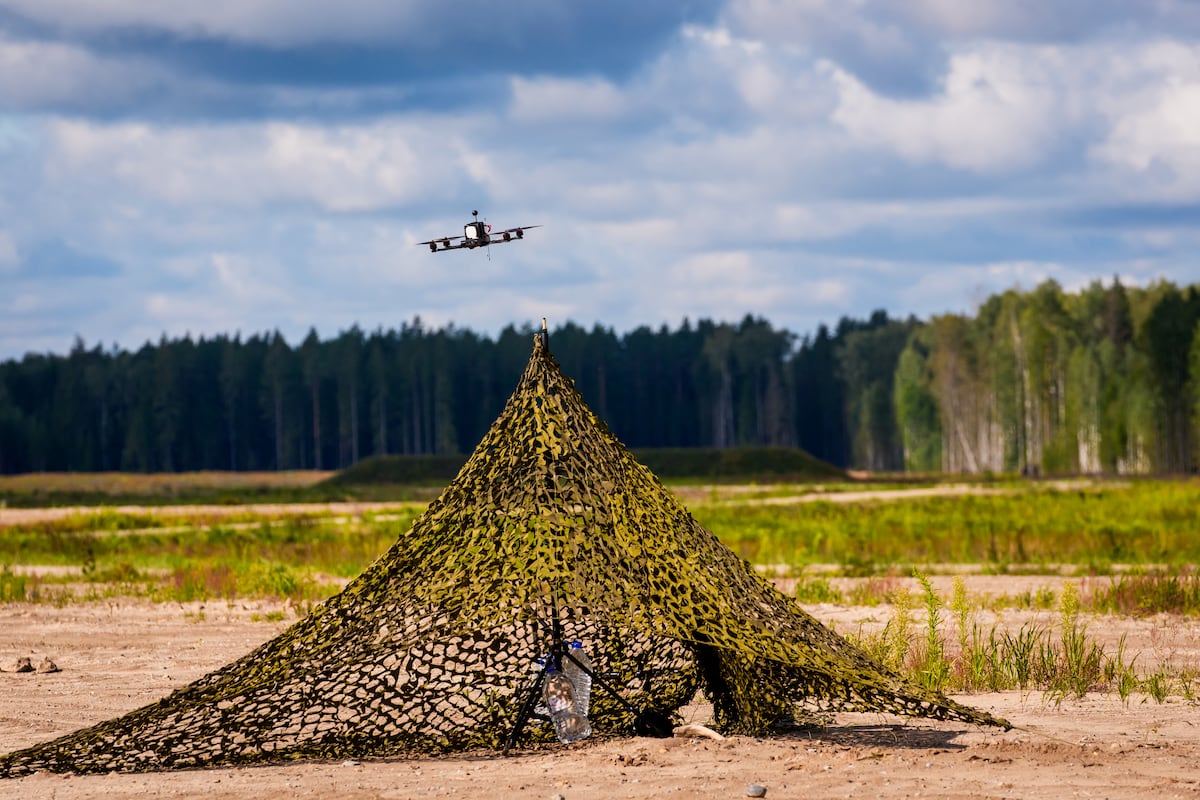
RIGA, Latvia — Latvia will deploy mobile drone-interceptor units to its eastern border within a matter of days in response to a string of drone incursions from the direction of Russia, according to the head of the Baltic country’s Autonomous Systems Competence Center .
The Latvian armed forces will deploy teams up to four soldiers in 4x4 vehicles, equipped with interceptor drones from Latvian manufacturers Origin Robotics and Eraser, to the eastern border with Russia, said Maj. Modris Kairišs, head of the center, in a briefing with reporters here on May 26. The goal is to have the units operational by early next month, he said.
Low-altitude drone defense has become one of the most critical security gaps for Latvia and neighboring Lithuania and Estonia amid a growing number of drone incursions from the direction of Russia. Independent Russian media outlet Novaya Gazeta Europe counted at least 24 drone incidents in the three Baltic countries since early 2025.
“The force teams we plan to deploy to the border in the coming days will be equipped with local interceptor drones,” Kairišs said, adding that the number of teams to be deployed is confidential.
Latvia’s government collapsed this month in the wake of a renewed incursion of Ukrainian drones into the country’s airspace, with two drones crashing in Latvian territory on May 7, including one that hit an empty fuel depot, and a third drone entering the country’s airspace before leaving again. Kairišs said Russia is using “very powerful” jamming to disrupt navigation of Ukrainian drones.
“At least if we will send these initial teams, it will solve the society requirements, politicians’ requirements, and we are moving forward,” Kairišs told Defense News. “Let’s say it is initial capability. We need a lot of teams to fully cover the border.”
Maj. Modris Kairišs, head of Latvia's Autonomous Systems Competence Center, stands in front of the drone-testing range of the Sēlija training area on May 26, 2026. (Rudy Ruitenberg/staff)
Ukraine has been using mobile fire teams to defeat Russian drone threats since 2022, though the country has increasingly shifted to interceptor drones.
Interceptor teams are not a long-term answer, according to Kairišs, who instead envisages a future solution of fully automatic interceptor drones stationed along the border in launch canisters, “where you can, from the command and control center, just give the command to intercept.” He said Latvia is testing what he called “launch-box technologies.”
“This is where Western countries need to move, because our human resource is very expensive,” Kairišs said.
With Latvia’s eastern border with Russia and Belarus nearly 400 kilometers long, achieving Ukrainian-style levels of drone protection would require “a huge number” of personnel and put significant stress on the armed forces, Kairišs said in the briefing. He said Latvia needs to “find a balance between peacetime and war.”
The country is counting on assistance from Ukrainian experts for tactical advice and practical operator experience on intercepting drones, according to Kairišs. He said Latvia is seeking Ukrainian expertise rather than hardware, for example, on tactical procedures related to the kill chain and sensors.
One of the biggest challenges NATO faces in dealing with drone threats is what Kairišs called “a legacy way of thinking” around command and control, in which all sensor data is fused and information classified. Delivering that classified information to a mobile group operating near the border then stumbles over procedures that disrupt effective C2 at the tactical level, the Latvian major said.
Kairišs said countries need a cross-border solution for drone interception that allows for command and control at a “very low classification level.” With multiple NATO countries working on their own C2 systems for drone defense, there will need to be an effort to let them work together, he said.
Shahed-type drones, once detected, are “not a hard target” due to their relatively low speeds, according to Kairišs, who compared them to World War I-era biplanes. However, detection is the hardest part, with the drones flying at low altitudes and usually built from cheap composite materials that are radar-transparent, the major said.
Latvia has deployed a network of acoustic sensors for several months already, which when combined with radar and optical sensors is “quite effective,” Kairišs said. With drones flying at altitudes of 50-100 meters, detecting them requires tactical radars every 10 to 20 kilometers, with associated infrastructure, he said.
Latvia hosts the NATO innovation range for counter-unmanned aerial systems at the Sēlija training area in the center of the country, and is taking a leading role in the alliance’s C-UAS efforts. European countries and more broadly NATO lack the opportunity to test systems against real front-line drones, which is something the Sēlija range allows, Kairišs said.
Testing of drones, counter-UAS and electronic warfare is “almost impossible” in some European countries due to bureaucracy, population density and air-traffic density, “and here in Latvia we have this opportunity, and we want to share it,” the Latvian major said.
He said that due to the urgency of the security situation, the government has exempted the Sēlija range from some restrictions regarding use of electronic warfare and high-altitude flights, and Latvian forces are “more or less” capable of simulating current battlefield conditions as they exist on parts of the front line in Ukraine.
In addition to interceptor drones, Latvia is field-testing an automated .50 caliber turret that Kairišs said may be demonstrated within several weeks, as well as working on electronic warfare and cheap missile systems. The Autonomous Systems Competence Center has special governmental permission to fast-track procurement, Kairišs said.
Rudy Ruitenberg is a Europe correspondent for Defense News. He started his career at Bloomberg News and has experience reporting on technology, commodity markets and politics.
拉脱维亚里加——据波罗的海国家拉脱维亚自主系统能力中心负责人称,为应对来自俄罗斯方向的一系列无人机入侵,拉脱维亚将在几天内向其东部边境部署移动无人机拦截器部队。
拉脱维亚武装部队将在东部与俄罗斯接壤的边境部署最多由四名士兵组成的小组,乘坐配备拉脱维亚制造商Origin Robotics和Eraser生产的拦截无人机的四驱车辆。该中心负责人莫德里斯·凯里什少校5月26日在此间举行的记者会上表示,目标是在下月初让这些小组投入使用。
随着来自俄罗斯方向的无人机入侵事件日益增多,低空无人机防御已成为拉脱维亚及其邻国立陶宛和爱沙尼亚面临的最关键安全漏洞之一。俄罗斯独立媒体《新报欧洲》统计,自2025年初以来,波罗的海三国至少发生了24起无人机事件。
“我们计划在未来几天部署到边境的部队将配备本地拦截无人机,”凯里什说,并补充说,将要部署的部队数量属于机密。
本月,由于乌克兰无人机再次侵入拉脱维亚领空,拉脱维亚政府垮台。5月7日,两架无人机在拉脱维亚境内坠毁,其中一架撞上了一个空燃料库;另有一架无人机进入拉脱维亚领空后又离开。凯里什斯表示,俄罗斯正在使用“非常强大的”干扰技术来干扰乌克兰无人机的导航。
“至少如果我们能派出这些首批队伍,就能满足社会和政界的需求,我们正在向前迈进,”凯里什斯告诉《防务新闻》。“姑且称之为初始能力吧。我们需要很多队伍才能全面覆盖边境。”
2026年5月26日,拉脱维亚自主系统能力中心负责人莫德里斯·凯里什少校站在塞利亚训练区的无人机测试靶场前。(鲁迪·鲁伊滕贝格/工作人员摄)
自 2022 年以来,乌克兰一直使用机动火力小组来应对俄罗斯的无人机威胁,尽管该国已越来越多地转向使用拦截无人机。
凯里什认为,拦截小组并非长久之计。他设想的未来解决方案是在边境部署全自动拦截无人机,这些无人机装在发射箱内,“指挥控制中心只需发出拦截指令即可”。他还表示,拉脱维亚正在测试他所谓的“发射箱技术”。
“西方国家需要朝着这个方向发展,因为我们的人力资源非常昂贵,”凯里什斯说。
拉脱维亚东部与俄罗斯和白俄罗斯接壤的边界线长达近400公里,凯里什在简报会上表示,要达到乌克兰式的无人机防护水平,需要“大量”人员,这将给武装部队带来巨大压力。他还表示,拉脱维亚需要“在和平时期和战争时期之间找到平衡”。
据凯里什称,拉脱维亚正指望乌克兰专家提供战术建议和拦截无人机的实际操作经验。他表示,拉脱维亚寻求的是乌克兰的专业知识,而非硬件,例如与杀伤链和传感器相关的战术程序。
北约在应对无人机威胁方面面临的最大挑战之一,正如凯里什所说,是围绕指挥控制的“传统思维模式”,在这种模式下,所有传感器数据都被融合,信息被列为机密。这位拉脱维亚少校表示,将这些机密信息传递给在边境附近行动的机动部队时,会因为程序上的障碍而导致战术层面的有效指挥控制受阻。
凯里什表示,各国需要一种跨境无人机拦截解决方案,该方案允许在“极低的保密级别”下进行指挥和控制。他指出,由于多个北约国家都在研发各自的无人机防御指挥控制系统,因此需要努力促成它们之间的合作。
据凯里什称,沙赫德型无人机一旦被发现,由于其速度相对较低,并不难击落,他将其比作一战时期的双翼飞机。然而,这位少校表示,探测才是最难的部分,因为这些无人机飞行高度低,而且通常由雷达透明的廉价复合材料制成。
拉脱维亚已部署声学传感器网络数月之久,凯里什表示,该网络与雷达和光学传感器结合使用“相当有效”。他还指出,由于无人机飞行高度在50至100米之间,探测它们需要每隔10至20公里部署战术雷达,并配备相关基础设施。
拉脱维亚在中部塞利亚训练区设有北约反无人机系统创新靶场,并在北约的反无人机系统(C-UAS)工作中发挥着主导作用。凯里什斯表示,欧洲国家乃至整个北约都缺乏与真正的前线无人机进行对抗测试的机会,而塞利亚靶场恰好弥补了这一不足。
在一些欧洲国家,由于官僚主义、人口密度和空中交通密度等原因,测试无人机、反无人机系统和电子战“几乎是不可能的”,“而拉脱维亚有这样的机会,我们想与大家分享,”这位拉脱维亚少校说道。
他表示,由于安全形势紧迫,政府已豁免塞利亚靶场在电子战和高空飞行方面的一些限制,拉脱维亚军队“或多或少”能够模拟乌克兰部分前线存在的当前战场状况。
除了拦截无人机外,拉脱维亚还在实地测试一种自动化的.50口径炮塔,凯里什表示,该炮塔可能在几周内进行演示。此外,拉脱维亚还在研发电子战和低成本导弹系统。凯里什说,自主系统能力中心已获得政府特别许可,可以加快采购流程。
鲁迪·鲁伊滕贝格是《防务新闻》的欧洲记者。他的职业生涯始于彭博新闻社,拥有报道科技、大宗商品市场和政治方面的经验。