French Army wants to keep adversaries guessing on see-through battlefield法国陆军希望在透明战场上让对手摸不透他们的意图。
The French Future Combat Command is looking at what Baratz called “frugal artificial intelligence,” designed to consume as little energy as possible.
BESANÇON, France — The French Army’s Future Combat Command is seeking ways to create “opacity” on an increasingly transparent battlefield in order to restore offensive maneuver , looking at everything from physical decoys to electronic warfare and electromagnetic deception, said Gen. Bruno Baratz , who heads the command.
Battlefield transparency and powerful, precise modern weapons have jointly created a “zone of death” along the frontline where approaching the enemy is “very, very dangerous,” Baratz said at an innovation day held by the French 7th Armored Brigade in eastern France last week. In terms of new technology, what the Army needs most is a way to break the resulting tactical stalemate, he said.
Maneuver along the Ukrainian frontline has largely stalled as near-continuous drone observation means neither Ukraine nor Russia can mass forces without exposing them to destruction. Baratz compared the situation to World War I, when artillery and machine guns meant maneuver and offensive operations could be futile or only possible at the cost of enormous casualties.
“We’re in a system of tactical stalemate, where defensive systems are more powerful than offensive ones,” Baratz said on the sidelines of an innovation day in Besançon on Sept. 9. “We need to be able to break out of this system. So today, we have to be able to recreate what we call a bit of opacity in this world of transparency.”
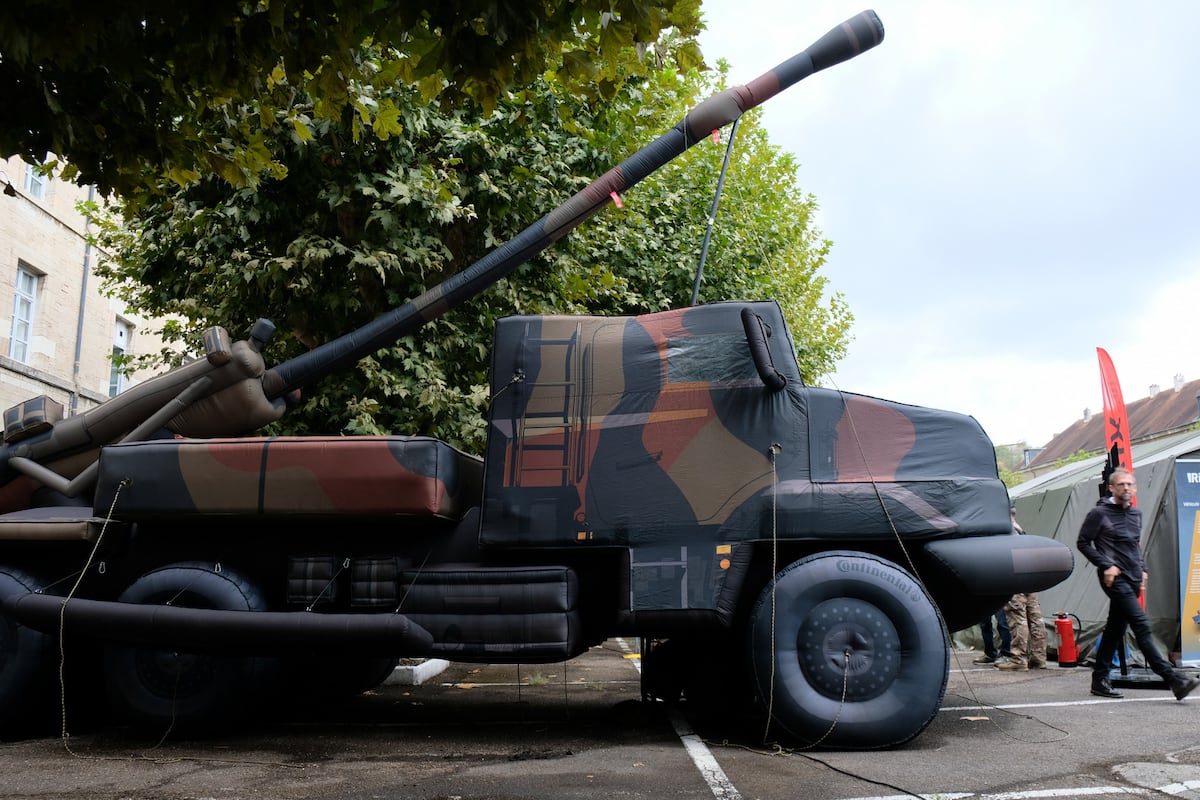
Baratz said there are “a great number of ways” to think about deception, including physical decoys and electromagnetic deception using simulated command posts. The innovation day featured inflatable copies of equipment used by the 7th Armored Brigade, including a Caesar howitzer and the VBL light armored vehicle.
Gen. Bruno Baratz, the commander of France's Future Combat Command, speaks at an innovation day held at the headquarters of France's 7th Armored Brigade in Besançon, France, on Sept. 9, 2026. (Rudy Ruitenberg/staff)
The commander also noted the importance of electromagnetic jamming, and of electronic warfare and cyber warfare as forces become increasingly connected.
“How can we blind the adversary? How do we mislead him about our intentions? How can we create a temporary vulnerability with the adversary to restore momentum and offensive action,” Baratz said.
“Above all, how do we deceive his sensors or ensure that his sensors don’t see the right things, allowing the concentration of force? Because today, we can’t concentrate if we’re destroyed, and so there isn’t the mass necessary to be able to throw the adversary off balance.”
Other technologies that could reshape the battlefield include quantum technology, both for secure communications as well as for sensing, according to Baratz.
“There’s also multi-spectral image analysis that is starting to allow us to see what’s under trees, what’s under cover,” the general said. “There are new technologies, often driven by artificial intelligence, that provide capabilities we couldn’t have imagined until now.”
With the pace of technological change in some areas now measured in weeks rather than years or months, that creates difficulties for the military, according to Baratz. He cited telecommunications, where the military is “lagging far behind” the civilian sector in terms of bandwidth and data transmission capacity, even as the modern battlefield is organized around data.
The general said the military may be on the brink of a revolution in warfare similar to that of 1920, when mechanization and radio communications accelerated the pace of maneuver. The growing use of data on the battlefield may ultimately speed up both decision-making and destruction of the adversary, Baratz said.
Baratz said the modern battlefield has “radically changed” from the past, when military tactics were ultimately organized around geography, “that is to say the ridge line that defined the field of fire or field of view.”
“So how do we reinvent ourselves tactically?” Baratz said. “At the time, we French didn’t really reinvent ourselves, and we paid the price in 1940.”
Baratz said innovation has become an element of operational superiority for armies, and the ability to continuously adapt systems and incorporate new technology is fundamental.
The Future Combat Command has therefore adopted “a logic that is entirely different” from the Army’s traditional top-down approach, and is encouraging “testing, tinkering, experimenting” at the regimental level, Baratz said, with the aim of making the force more efficient, more flexible, more adaptable and more creative.
While large-scale programs will remain necessary, the Army also needs to be able to repurpose civilian technologies for military purposes and increasingly move toward open-architecture systems, Baratz said.
The Army currently provides each regiment with €150,000 ($172,000) a year to spend on their own projects or to buy off-the-shelf kit in a bid to stimulate grassroots innovation. The Army’s €20 million account for these “subsidiarity credits” is being increased with an additional €35 million in the 2027 defense budget, according to Baratz.
The commander said the Army has “real needs” in areas including robotics, autonomous vehicles, discreet mobility and battlefield-energy generation. New companies are entering the market in those areas and reaching out to the French forces, including increasingly European firms, which is helping stimulate thinking and the wider ecosystem, Baratz said.
He said all French brigades have initiatives around light mobility, working with companies on electric scooters, motorcycles and quads to be “faster and stealthier on this changing battlefield.”
Electric power allows forces to be more discreet but is also an area of vulnerability, due to the need for intelligence-gathering systems and frontline data hubs that are all power hungry, the general said. The Future Combat Command is therefore also looking at what Baratz called “frugal artificial intelligence,” designed to consume as little energy as possible.
“All of this is the combat of the future,” Baratz said. “It’s the future combat that remains hard to imagine, because technology is moving so quickly that I’m incapable of telling you what things will look like in one or two years.”
Rudy Ruitenberg is a Europe correspondent for Defense News. He started his career at Bloomberg News and has experience reporting on technology, commodity markets and politics.
法国贝桑松——法国陆军未来作战司令部司令布鲁诺·巴拉茨将军表示,该司令部正在寻求在日益透明的战场上创造“不透明性”的方法,以恢复进攻机动性,他们正在研究从物理诱饵到电子战和电磁欺骗等各种方法。
巴拉茨上周在法国东部举行的法国第七装甲旅创新日活动上表示,战场透明度和强大精准的现代武器共同在前线制造了一个“死亡地带”,接近敌人“极其危险”。他指出,就新技术而言,陆军最需要的是打破由此产生的战术僵局的方法。
由于无人机近乎不间断的侦察,乌克兰前线的军事行动基本陷入停滞,乌克兰和俄罗斯都无法在不暴露自身兵力的情况下集结兵力。巴拉茨将这种情况比作第一次世界大战,当时火炮和机枪的存在意味着机动和进攻行动可能徒劳无功,或者只能以付出惨重伤亡为代价。
“我们正处于战术僵局之中,防御体系比进攻体系更强大,”巴拉茨9月9日在贝桑松举行的创新日活动间隙说道。“我们需要打破这种局面。所以今天,我们必须在这个透明的世界里重新创造一些我们称之为‘不透明’的东西。”
巴拉茨表示,欺骗手段“多种多样”,包括使用实体诱饵和模拟指挥所进行电磁欺骗。创新日活动展出了第7装甲旅使用的装备的充气模型,包括凯撒榴弹炮和VBL轻型装甲车。
2026年9月9日,法国未来作战司令部司令布鲁诺·巴拉茨将军在法国贝桑松第七装甲旅总部举行的创新日活动上发表讲话。(鲁迪·鲁伊滕贝格/工作人员摄)
指挥官还指出,随着部队之间联系日益紧密,电磁干扰、电子战和网络战的重要性也日益凸显。
“我们如何才能蒙蔽对手?我们如何才能误导对手,使其对我们的意图产生误解?我们如何才能在对手身上制造暂时的弱点,从而恢复势头并采取进攻行动?”巴拉茨说道。
“最重要的是,我们如何欺骗他的传感器,或者确保他的传感器看不到正确的信息,从而集中兵力?因为如今,如果我们被摧毁,就无法集中兵力,因此也就没有足够的质量来扰乱敌人的平衡。”
巴拉茨表示,其他可能重塑战场的技术还包括量子技术,它既可以用于安全通信,也可以用于传感。
这位将军说:“多光谱图像分析技术也开始让我们能够看到树下、掩体下的东西。一些新技术,通常由人工智能驱动,为我们提供了以前无法想象的能力。”
巴拉茨指出,如今某些领域的技术变革速度已从数年或数月缩短到数周,这给军方带来了诸多挑战。他以电信领域为例,指出军方在带宽和数据传输能力方面“远远落后于”民用领域,而现代战场的组织架构却围绕着数据展开。
这位将军表示,军事领域可能正处于一场类似于1920年战争革命的边缘,当时机械化和无线电通信加快了作战机动的速度。巴拉茨说,战场上数据的日益普及最终可能会加快决策速度并更快地摧毁敌人。
巴拉茨表示,现代战场与过去相比发生了“根本性的变化”,过去军事战术最终是围绕地理因素组织的,“也就是说,是山脊线界定了射击范围或视野范围”。
“那么,我们如何在战术上进行自我革新呢?”巴拉茨说。“当时,我们法国人并没有真正进行自我革新,结果在1940年付出了惨痛的代价。”
巴拉茨表示,创新已成为军队作战优势的一个要素,不断调整系统并融入新技术的能力至关重要。
因此,未来作战司令部采取了与陆军传统的自上而下方法“完全不同的逻辑”,并鼓励在团级层面进行“测试、调整和试验”,巴拉茨说,其目的是使部队更高效、更灵活、更具适应性和创造力。
巴拉茨表示,虽然大规模项目仍然是必要的,但陆军也需要能够将民用技术用于军事目的,并日益转向开放式架构系统。
目前,陆军每年向每个团提供15万欧元(约合17.2万美元)的资金,用于开展自主项目或购买现成装备,旨在鼓励基层创新。巴拉茨表示,陆军用于这些“辅助性拨款”的2000万欧元账户将在2027年国防预算中增加3500万欧元。
指挥官表示,陆军在机器人、自动驾驶车辆、隐蔽机动和战场能源生产等领域存在“切实需求”。巴拉茨说,一些新公司正在进入这些领域的市场,并与法国军队接洽,其中也包括越来越多的欧洲公司,这有助于激发思考并促进更广泛的生态系统发展。
他表示,所有法国旅都制定了轻型机动性计划,与电动滑板车、摩托车和四轮摩托车公司合作,以便在不断变化的战场上“更快、更隐蔽”。
这位将军表示,电力虽然能让部队行动更加隐蔽,但也存在安全隐患,因为情报收集系统和前线数据中心都需要耗电。因此,未来作战司令部也在研究巴拉茨所说的“节能人工智能”,这种人工智能旨在尽可能减少能源消耗。
“这一切都是未来的战争,”巴拉茨说。“未来的战争仍然难以想象,因为科技发展如此迅速,我无法告诉你一两年后会是什么样子。”
鲁迪·鲁伊滕贝格是《防务新闻》的欧洲记者。他的职业生涯始于彭博新闻社,拥有报道科技、大宗商品市场和政治方面的经验。