Ohio Guided Missile Submarines Were Designed To Be Drone-Carrying Clandestine Command Centers俄亥俄级导弹潜艇被设计成可搭载无人机的秘密指挥中心。
The four converted ballistic missile submarines are so much more than Tomahawk slingers and transports for Navy SEALs.
新闻视频
By Joseph Trevithick and Tyler Rogoway
Updated Dec 1, 2019 5:29 AM EST
Today, the U.S. Navy’s quartet of converted Ohio class nuclear-powered guided-missile submarines, or SSGNs, are among America’s most powerful, in-demand, and flexible weapons. These giant and secretive submarines are known for their ability to carry up to 154 Tomahawk land-attack cruise missiles and dozens of special operations frogmen into contested territory to ply their quiet trade, but really, they are much, much more than that.
A decade and a half ago, the U.S. Navy was testing incredible new capabilities that it would subsequently integrate into its four yet to be converted SSGNs, including one highly elaborate, but obscure proof of concept exercise that solidified the SSGN concept for the seagoing service. Here is the story of how these vessels came to be and the highly unique, if not exotic capabilities, from drone mothership to command and control center, they possess.
The Genesis of the Ohio SSGN
The decision to covert Ohio class SSBNs into SSGNs originated with the 1994 Nuclear Posture Review, which determined that only 14 of the 18 Ohio class boats were necessary to meet the United States’ nuclear deterrence needs. Eight years later, the Navy began actually converting the four oldest Ohio class submarines – USS Florida , USS Georgia , USS Michigan , and USS Ohio – into the new configuration.
Ohio , when she was an SSBN, marking the completion of her 50th nuclear deterrent patrol in 1998. Members of her crew are seen standing on the deck spelling out “fifty” for the occasion., USN
The Navy had considered a number of potential configuration options for the new SSGNs. The concept that the service finally settled on retained 22 of the 24 missile tubes found on Ohio SSBNs, but modified them so that they were unable to fire Trident D5 nuclear-tipped submarine-launched ballistic missiles (SLBMs). Instead, each one would be able to launch up to seven BGM-109 Tomahawks using a Multiple All-Up-Round Canister (MAC) adapter. The SLBM fire control systems were similarly replaced with ones for the Tomahawk.
A schematic showing the elements of the SSGN conversion plan the Navy settled on for the four Ohio class submarines., USN
Tubes one and two on each of the four SSGNs would be completely replaced with lockout chambers so combat divers and Navy SEALs could enter and exit the submarine underwater. Personnel could also install a Dry Deck Shelter (DDS) to the top of the hull linked to either one of these modified tubes, or both if required, which could accommodate swimmer delivery vehicle (SDV) mini-submarines. As the name suggests, the DDS provides a fully enclosed, dry space to work in on the submarine’s deck, even while it is underwater.
ABC News ’ David Muir just recently got a chance to go aboard the USS Florida , providing a behind the scenes look at the interior of one of the converted SSGNs in its present configuration, which you can see in the video below.
The abortive Advanced SEAL Delivery System (ASDS) was supposed to have been able to directly dock with either one of these lockout chambers, as well. The Navy canceled the ASDS program in 2009 after cost overruns and other major setbacks, including a fire that had destroyed the original prototype the year before.
With a DDS installed, a number of additional tubes on the SSGNs would also be blocked off, so the Navy decided to make tubes three through 10 reconfigurable into storage space, if necessary. A dedicated berthing area for a typical contingent of 66 special operators, with a surge capacity of up 102 personnel, was added in the reconfigured missile compartment, as well.
A US Navy diver sits in the DDS on the USS Ohio as the submarine sits pierside in Busan, South Korea in 2008. A Mk 8 SEAL Delivery Vehicle (SDV) mini-submarine is visible behind him on a docking platform that extends out of the rear of the shelter., USN
More recent reporting has indicated that a typical load for these submarines is around 100 Tomahawks . This most likely represents between 14 and 16 fully loaded tubes, which would equate to between 98 and 112 missiles in total. This would leave between six and eight tubes available for storage or other purposes, something we will come back to later on in the story.
Beyond that, the SSGN configuration had an all-new a dedicated special operations mission control center and associated mission planning spaces. It also included additional and improved sensor and communications antenna masts on the sail. Other modifications that would allow these submarines to better operate in shallower waters closer to shore, were also likely involved with the conversion.
A rich history of special mission submarines
The Navy had substantial past experience with employing submarines as special operations motherships and in the tactical strike role, to say nothing of using them as specialized covert intelligence gathering platforms , when it had crafted the requirements for the Ohio SSGNs. The ability of a submarine, in general, to transport personnel and materiel, as well as launch raiding parties ashore, while using its inherent capabilities to help avoid detection, was well established by the end of World War II.
Between the mid-1950s and early 1960s, the Navy, in cooperation with the Central Intelligence Agency (CIA) and U.S. Air Force, had even used submarines to secretly launch radar-reflecting balloons to probe hostile air defense capabilities. You can read more about these operations in this past War Zone story .
By the Vietnam War, the Navy was using specially configured submarines to support special operations. These included Gato class USS Tunny and the first-in-class USS Grayback , both of which were diesel-electric submarines that had previously been configured to fire the Regulus nuclear-armed cruise missile.
The USS Grayback in 1982., USN
The “hangars” on the decks of these submarines for the airplane-sized Regulus were well suited to modification into lockout chambers for swimmers and shelters for mini-submarines , just like the Ohio ’s Trident tubes. In 1968, the Navy went so far as to designate them LPSSs, or amphibious transport submarines.
These boats supported special operations along the coast of North Vietnam and also helped gather intelligence. Grayback was notably involved in Operation Thunderhead in 1972, an attempt to rescue American aviators that the U.S. military believed had escaped from North Vietnam’s infamous Hanoi Hilton prison. Bad weather and other factors eventually led the Navy to abort the mission and SEALs and Underwater Demolition Team (UDT) members never made contact with any escapees.
One SEAL, U.S. Navy Lieutenant Melvin Spence Dry, died during the mission. The U.S. military only acknowledged the operation in 2008, at which time Dry received a posthumous Bronze Star.
SEALs on board Grayback ahead of Operation Thunderhead. Lieutenant Melvin Spence Dry is seated at center with papers in his hands., USN
In the decades after Vietnam, a number of Sturgeon class nuclear-powered attack submarines also served in similar special operations support roles. In something of prelude to the Ohio SSGNs, as part of the Strategic Arms Limitation Talks, or SALT I agreement between the United States and the Soviet Union in 1981, the Navy disabled the SLBM capabilities on a number of SSBNs, reclassifying them officially as attack submarines.
USS Sam Houston , USS John Marshall , USS Kamehameha , and USS James K. Polk – the first two belonging to the Ethan Allen class and the latter pair being from the Benjamin Franklin class – received further modifications that added DDSs to the top of the hull and dedicated spaces to carry embarked SEAL teams. These submarines continued sailing into the 1990s and Kamehameha was the last to leave service, with the Navy only decommissioning her in 2002.
USS Kamehameha , with twin dry deck shelters installed, in Guam in 2001., USN
A new kind of submarine mothership
Still, while the Navy had decades of experience with using submarines to support tactical operations, including special operations, at sea and onshore, the Ohio SSGNs aimed to be far more robust and flexible multi-mission platforms than any of these previous conversions.
As of 2004, the service was still very much fleshing out the specifics of the SSGN conversion and “writing the manual” on how to then employ these submarines. Georgia had become the main testbed for what was still very much an evolving concept, receiving a number of interim modifications including reconfigured internal mission spaces and additional data links and communications equipment. At that time, none of the four chosen Ohios had gone through the full conversion process and they were still years away from actually entering service in their new configuration.
“Two years from now, when we open the wrapping paper to see USS Georgia , a brand-spanking-new SSGN, we are going to need an instruction manual,” U.S. Navy Commodore Robert Shuetz, then-commander of Submarine Squadron 17, said at a change-of-command ceremony for the submarine in December 2004. “A manual that hasn’t been written yet; a manual that will describe in excruciating detail how this new ‘toy’ will be operated.”
“This is where the crew of Georgia has excelled,” Shuetz continued. “They have written the first instruction manual for how this ship and her three sisters, the ‘toys’ in demand by every combat commander, will be operated.”
Two months earlier, off the coast of San Diego, California, Georgia , even without anything near the full suite of capabilities outlined in the conversion plan, had demonstrated just what the SSGN configuration might be capable of as part of an experiment nicknamed Silent Hammer . To enhance the realism of the scenario, the Navy inserted this test into a larger exercise, called Trident Warrior, that involved an array of other submarines, ships, aircraft, drones, and special operations forces (SOF).
The Silent Hammer scenario, which lasted a little over a week, involved a joint task force with Georgia in the lead locating and neutralizing mock terrorists on land and at sea. The “red team” occupied various sites on San Clemente Island, situated some 80 miles west of San Diego, which the U.S. military routinely uses for exercise and other test purposes . The contractor-operated offshore support vessel, the R/V Acoustic Explorer , also served as a simulated maritime threat.
The overall objective of the exercise for the “blue team” was to find and fix these faux militants using a variety of intelligence sources and then neutralize them with simulated Tomahawk strikes.
Imagery taken by various platforms of the R/V Acoustic Explorer (AX) and the Weapons of Mass Effect (WME) and Global System for Mobile Communications (GSM) facilities on San Clemente Island, all of which were under the control of “terrorists” during the Silent Hammer exercise., MIT Lincoln Lab
During the experiment, at least publicly, the focus was far more on the submarine’s ability to act as an intelligence-collection platform, as well as a broader “clandestine sea-base” that would provide a “headquarters node from which command and control operations and logistic support were conducted,” including for special operators ashore.
“Our converted Tridents will generate their own intelligence, which allows onboard commanders to make decisions about what’s needed and determine what additional organic sensors should be deployed in virtually any scenario,” by-then-retired U.S. Navy Admiral Frank “Skip” Bowman wrote, referring to the Ohios collectively by the Trident submarine-launched ballistic missiles that the SSBN versions carry, said in the Winter 2005 edition of Undersea Warfare magazine, the official publication of the U.S. Navy’s Submarine Force. Bowman’s last position in the service had been as Director of Naval Nuclear Propulsion.
“Silent Hammer demonstrated how a networked force, including sea-based SOF from an SSGN, can fill joint gaps – Intelligence, Surveillance, Reconnaissance (ISR) and Time Sensitive Strike – by conducting large-scale clandestine operations, supported by advanced unmanned systems, to reduce risk and increase capability,” U.S. Navy Captain J.S. Davidson, who headed up the Silent Hammer experiment, had explained in another interview for another story in that same issue of Undersea Warfare .
An intelligence nerve center
It’s hard to overstate how significant the intelligence fusion capabilities demonstrated during Silent Hammer were. For the experiment, Georgia had an embarked joint service command team onboard, who used modified spaces in the submarine to run a forward operations center that controlled other assets under the waves, riding on the surface, in the air, and on land. This was intended to reflect the capabilities that the submarine would have after going through the SSGN conversion, which would create new, more robust mission spaces for command and control elements and intelligence gathering personnel, among others.
This was the first time the Navy had ever done this as part of the development of the SSGN concept of operations and it put the operational commanders right in the thick of things in a whole new way. Unlike traditional surface command ships, such as the USS Blue Ridge , the Georgia was allowing these officers and their staff to direct forward operations while sailing concealed below the surface of the ocean. The submarine’s command center was linked to rear command centers, and their intelligence networks, via satellite. It also had direct data-link feeds from a number of other sources.
A diagram showing the extensive intelligence network employed during Silent Hammer., MIT Lincoln Lab
In the air, these included the Pelican , a highly modified, pilot-optional Cessna 337 propeller-driven aircraft, and a specially configured Sabreliner twin-engine business jet. The Pelican belonged to the U.S. Naval Postgraduate School’s Center for Interdisciplinary Remotely-Piloted Aircraft Studies (CIRPAS) and was configured at the time in a way that matched the capabilities of the MQ-1 Predator drone . The Massachusetts Institute of Technology’s (MIT) Lincoln Laboratory operated the Sabreliner as a surrogate for smaller, lower-altitude unmanned aircraft.
A briefing slide giving an overview of the CIRPAS Pelican., USN
The Lincoln Lab also had their heavily modified Boeing 707 airliner, nicknamed Hannah , a well-known cutting-edge communications and sensor testbed, in the air playing the role of a airborne radar with synthetic aperture and ground-moving-target indicator capabilities. This effectively made it, in part, a surrogate for a U.S. Air Force E-8C Joint Surveillance Target Attack Radar System (JSTARS) battlefield management command and control aircraft.
The Lincoln Lab’s modified Boeing 707 sensor testbed, nicknamed Hannah., Massachusetts Air And Space Museum
Examples of the imagery that the MIT Lincoln Lab’s platforms produced during Silent Hammer., MIT Lincoln Lab
Navy EA-6B Prowler electronic warfare planes and EP-3E Aries II intelligence, surveillance, and reconnaissance aircraft also took part in Trident Warrior and fed information into this network of information sources.
Down below, Georgia was networked together with other vessels taking part in Trident Warrior, including two Los Angeles class fast attack submarines, the USS La Jolla and USS Pittsburgh . In addition, members of the Silent Hammer experiment team were on board the first in class amphibious assault ship USS Tarawa and the Wasp class USS Bonhomme Richard , which were also taking part in the larger exercise.
Ashore, U.S. Navy SEALs, along with other unspecified attached special operators, likely including U.S. Air Force Joint Tactical Air Controllers (JTAC), were in direct contact with Georgia . They emplaced their own “unattended” sensors to monitor for potential hostile activity and otherwise fed even more data back to the submarine.
We also know that the Defense Advanced Research Projects Agency (DARPA) supplied unspecified payloads, as well as sensor systems for the exercise. Georgia itself demonstrated how she might launch unmanned aircraft and an unmanned underwater vehicles (UUV) during the exercise to support intelligence collection efforts. We will talk more about these shadowy developments later on.
Data fusion pioneers
The amount of intelligence information collected during the exercise was staggering. The supporting aircraft, ground sensors, and other offboard sensors collected more than 21,000 individual images during the exercise. In total, the task force created nearly 11 gigabytes of data, including thousands of textual alerts and nearly 3,000 actual intelligence “products,” such as PowerPoint presentations distilling various pieces of information, according to an article in a 2007 edition of the Lincoln Laboratory Journal .
Unfortunately, this wealth of information also risked being overwhelming. So, the Navy and the Lincoln Lab had also developed a computerized and heavily automated network system, state-of-the-art for the time, that allowed the command center onboard Georgia to rapidly parse through the mountains of available information for the most relevant data and only download what they needed in full. Being able to avoid downloading unnecessary information was particularly important given the bandwidth limitations in the data links available between the submarine and its various offboard information sources, especially 15 years ago.
A breakdown of the information flow between Georgia and the various intelligence gathering assets during Silent Hammer., MIT Lincoln Lab
What the actual search interface looked like to operators on Georgia ., MIT Lincoln Lab
Silent Hammer planners, as well as the Lincoln Lab, had been acutely aware of data sharing issues based on lessons learned from a smaller SSGN developmental experiment in 2003, nicknamed Giant Shadow , which involved the USS Florida and took place in and around the secretive Atlantic Undersea Test and Evaluation Center, or AUTEC , off the coast of Andros Island in the Bahamas. Similar to the Silent Hammer scenario, Giant Shadow centered on an operation to destroy a chemical weapons plant that mock terrorists were operating on shore.
“We can get this [imagery] real-time down to the submarine,” U.S. Navy Captain William Toti, then commander of the Florida , said in an interview at the time with “60 Minutes” on CBS News . “The SEALs can look at it real-time as they’re planning their missions, and have a better sense of what’s going on.”
The problem in that exercise, as it turned out, had been that there quickly became too much information for personnel on the submarine to sift through and process in real-time. “The providers, not the consumers, decided what information to transmit and when, which created a situation whereby analysts were overloaded with processing extraneous information, yet still had insufficient information for decision support,” according to the 2017 Lincoln Laboratory Journal article.
The flow of information during Silent Hammer was better, but still showed room for improvement. The vast quantities of data meant that it was still easy for intelligence officers to miss important new developments as they did their best to prioritize the efforts. Of the more than 21,000 images that various platforms collected during the exercise, less than 7,000 made their way into the networked database and “blue team” personnel only ever looked at 361 of them at any resolution, downloading just 45 of them in full for more extensive analysis. Still, the task force that Georgia led was ultimately able to find all of the simulated threats and successfully carry out the mock strikes to neutralize them.
A full breakdown of intelligence collected during Silent Hammer., MIT Lincoln Lab
A flowchart showing how the intelligence from various sources eventually produced targeting grade information for simulated strikes on San Clemente Island during Silent hammer., MIT Lincoln Lab
For how much is known about Georgia ’s participation in Silent Hammer, as well as the overall scope and scale of the intelligence gathering and networking systems employed during the exercise, there is little information about the testing of the submarine’s capabilities to launch underwater unmanned vehicles (UUVs) and unmanned aircraft.
It’s not clear what type or types of UUVs participated in Silent Hammer, or if Georgia deployed any of them herself. However, during the earlier Giant Shadow exercise, Florida had become the first Navy submarine to launch and recover the Seahorse Autonomous Undersea Vehicle (AUV) via a modified missile tube. It is very possible that this undersea drone took part in Silent Hammer, as well.
The Seahorse AUV., USN
The Applied Research Laboratory (ARL) at the Pennsylvania State University had begun development of Seahorse in 1999 under contract to the Naval Oceanographic Office, or NAVOCEANO. At 28 and a half feet long and weighing 10,800 pounds, this underwater drone was more than 10 feet longer than a Mk 48 heavyweight torpedo and just over 7,100 pounds heavier.
Its main job was undersea mapping using a variety of sensors, including multi-beam bathymetric and synthetic aperture sonars, an Acoustic Doppler Current Profiler (ADCP) and a Conductivity, Temperature and Depth (CTD) sensor. Those same sensors could be used to scout out mines and other potential underwater hazards and, in the decades since the Navy took delivery of Seahorse, the service has acquired and fielded a large number of increasingly more capable torpedo-shaped UUVs of various sizes for mapping and mine clearance missions, among others.
The Flexible Payload Module
Georgia didn’t actually launch any unmanned aircraft during Silent Hammer, according to the Navy, but did release two Stealthy Affordable Capsule System (SACS) canisters, each containing an “inert test shape simulating a UAV,” from a Flexible Payload Module (FPM) installed in one of the submarine’s missile tubes.
Since the 1990s, the Navy had been very interested in the idea of pairing unmanned aircraft with submarines to expand the ability of the boats to scout ahead and collect intelligence. Drones working with subs could also act as communications and data relays, probe and collect information on enemy defenses, and potentially even strike targets themselves. For example, in March 1996, the Los Angeles class attack submarine USS Chicago took part in a demonstration in which it tested its ability to both communicate with and actively control an early example of what was then known as the RQ-1 Predator .
Development of the FPM dates back to at least 2000, when the Navy tasked two separate industry consortiums with crafting concepts for future submarines designs, as well as payloads and sensors for them, with an eye toward technologies that could be operational in the years to come. The Navy and DARPA managed this project, aptly named Submarine Payloads and Sensors, cooperatively.
General Dynamics Electric Boat
Northrop Grumman, a member of Team 2020, one of the consortiums, which Lockheed Martin headed up, developed the FPM. General Dynamics Electric Boat, the United States’ premier submarine builder, which had built the Ohios , among others, and was involved in the development of the Virginia class attack submarine at the time, was also part of Team 2020.
The FPM was effectively an insert that would slot into a large diameter ballistic missile tube on a submarine, but could be adapted to hold multiple payloads, including numerous unmanned aircraft, that the crew could then launch independently. General Dynamics Electric Boat described it as a “plug and fight” system.
Northrop Grumman designed the first iteration, which had 10 14-inch tubes and a pair of larger 20-inch ones, specifically around the dimensions of the Ohio ’s missile tubes. The second FPM prototype, which Georgia carried during Silent Hammer, had only three tubes of an unknown diameter. Each one of those could accommodate a payload inside a SACS, another Northrop Grumman development.
“The FPM and SACS comprise an encapsulation system that facilitates the launch of non-marinized payloads and weapons from a submarine,” according to the article on Silent Hammer from the Winter 2005 issue of Undersea Warfare . “This allows the use of Navy air- or surface-launched payloads – plus those from other services – without the need to redesign them for launching in an undersea environment.”
SACS was “adaptable for long-term storage, variable release depths, launching under broaching or surface-loitering conditions, and the ability to encapsulate small or large payloads,” according that same article.
“In the case of the SUAV [submarine-launched unmanned air vehicle], SACS rises buoyantly to the surface, a sensor in the capsule detects broach, the SACS end-cap is blown away, and the SUAV booster ignites to clear the water and build vertical speed,” notes from a presentation that Steve Weinstein and William McGannon gave at the National Defense Industry Association’s (NDIA) 2002 Joint Undersea Warfare Technology Spring Conference explains. “At the proper moment, the SUAV wings are extended from alongside its long slender body to the horizontal position, the flight control software tilts the SUAV over to the horizontal flight position and once in stable flight, the SUAV turns and climbs to the pre-planned altitude to begin its mission.”
At the time, Weinstein and McGannon were employed with the Naval Sea Systems Command’s (NAVSEA) Submarine Sensor Systems division.
The other industry collective that had taken part in the Submarine Payloads and Sensors program, called Forward Payloads And Sensors for Submarines (Forward PASS), had developed a similar system, known as the Broaching Universal Buoyant Launcher (BUBL), that worked in much the same manner. However, BUBL’s design was meant to work with a variety of existing launcher options on submarines, including torpedo tubes and countermeasures launchers, or even be carried externally. Of course, the external carriage option could have created performance problems or increased the sub’s acoustic signature, making it more vulnerable.
A briefing slide from 2002 offering basic information and graphics regarding FPM, SACS, and BUBL., USN
Raytheon was the team leader for Forward PASS, which also included Boeing and Pennsylvania State’s Applied Research Laboratory, among others. General Dynamics Electric Boat was part of both teams in order to provide its extensive knowledge base to help with submarine development and integration questions. There is no mention of Georgia employing BUBL during Silent Hammer.
Submarine-launched drones
While we don’t know what drones Georgia was supposed to have been simulating the launch of from the FPM specifically, Northrop Grumman had also already developed at least one submarine-launched drone known as Sea Ferret in the 1990s. This was an evolution of Ferret, which the company had originally developed for the U.S. Army.
The Sundstrand TJ50 turbojet-powered Ferrets and Sea Ferrets are what we would call loitering munitions today. The approximately 145-pound drones carried both electro-optical sensor packages and 20-pound warheads and could fly out to a maximum range of around 370 nautical miles and a top speed of 300 knots and still be able to orbit around a target area for around two hours.
A very low-quality image of Ferret., Public Domain
In December 1996, the USS Asheville , another Los Angeles class attack submarine, simulated launching the Sea Ferret during a technology demonstration. A Cessna 206 light aircraft carried one of the drones under its wing to then simulate the unmanned aircraft in flight. Northrop Grumman had intended the final system, which the Navy did not ultimately adopt, to be torpedo tube-launched using a modified canister for a UGM-84 submarine-launched Harpoon anti-ship cruise missile.
Still, the 1996 test “successfully simulated organic and inorganic UAV operations & SOF support,” according to Weinstein and McGannon 2002 NDIA presentation. It is certainly possible that Northrop Grumman could have developed a follow-on of some sort to Sea Ferret at the time of Silent Hammer.
We also know that the Navy had been holding workshops and other defense industry engagement events to gauge options for submarine-launched unmanned aircraft starting in 2000, around the same time as the Submarine Payloads and Sensors initiative. A slide from a General Dynamics Electric Boat briefing at the 2006 NDIA Systems Engineer Conference, which also touches on the Flexible Payload Module (FPM) development, shows concept art for at least five different potential submarine-launched drone designs.
A briefing slide from 2006 showing various submarine-launched drone concepts, as well as other potential payloads that could work with a future universal adapter., General Dynamics Electric Boat
By 2002, a team that included General Dynamics, Lockheed Martin, AeroVironment, and Kollmorgen, had also demonstrated a modified Universal Modular Mast that could shoot small unmanned aircraft into the sky from periscope depth. An artist’s conception of the system shows a drone design virtually identical to the Blackwing , which AeroVironment officially began developing four years later for the Navy as a submarine-launched system.
In his guidance for 2005 , then Chief of Naval Operations Admiral Vern Clark had also called for a follow-on Silent Hammer II exercise that “should employ aerial sensors (UAVs) in addition to ground sensors and exercise full range connectivity links.” It’s not clear if Clark had wanted to demonstrate a true submarine-launched drone capability or if that exercise ever ultimately occurred.
Lockheed Martin’s mysterious Cormorant
Of all the submarine-launched unmanned aircraft in development around the time of Silent Hammer, by far, the most interesting was Lockheed Martin’s shadowy Cormorant , a product of the company’s Skunk Works advanced design division. DARPA managed this program , also known as the Multi-Purpose Unmanned Aerial Vehicle (MPUAV), which sought to develop a relatively large, stealthy, jet-powered drone that a submarine could both launch and recover.
Patent documents show that Cormorant was in development at least as early as 2004. A subsequent official Lockheed Martin video presentation on the Cormorant makes clear that, while DAPRA was officially in charge of the project, it was informed, at least in part, by Navy requirements relating to the Ohio SSGNs.
“The Navy came to us for our concepts for a wide range of unmanned aircraft that could operate from aircraft carriers or surface ships or even submarines,” Bob Ruszkowski, then-Lockheed Martin’s MPUAV Team Project Manager and Technical Lead, said in the video. “This idea was unique in that it was the first time someone had thought about the idea of launching and recovering the vehicle while the submarine was still submerged.”
The Cormorant, in concept, would be launched from a modified missile tube on an Ohio class SSGN at a depth of up to 150 feet and then float the surface “like a cork,” according to Ruszkowski. Rocket boosters would then propel the four-ton, titanium-skinned craft into the air, a traditional turbofan jet engine would take over. During launch, as well as recovery, the intakes and exhausts for the engine would be sealed off from the water.
“The aircraft uses its stealth and mission planning to penetrate hostile airspace,” Ruszkowski continued. “Once it’s in there, it can do a variety of missions, that could be collecting intelligence and reconnaissance on weapons of mass destruction sites, it could be supporting special operations forces. But whatever it’s doing, it’s using its stealth and its mission planning to avoid detection.”
One patent that Lockheed Martin filed in 2004 regarding Cormorant included artwork depicting the drone releasing weapons, suggesting that Lockheed Martin, DARPA, and the Navy may have been considering a strike role from the drone, as well. A Lockheed Martin briefing from 2005 describes the unmanned aircraft as being capable of carrying a 1,000-pound payload in a modular bay, which could include sensors, communications relay systems, and even supplies that it could drop to personnel at a designated drop zone.
A drawing from a patent Lockheed Martin filed in 2004 relating to Comorant, which shows how it might release weapons from an internal bay., USPTO
After completing its mission, it would return to a rendezvous point and deploy a parachute, landing safely in the water. The submarine would then send out its own tethered remotely operated vehicle to attach a cable to the drone and reel it back in.
Another drawing from the 2004 patent showing the parachute recovery concept, as well as a “whip stall” one where the craft’s engines would shut off and it would use its wings as a large air brake at low altitude before then simply pitching nose down into the ocean., USPTO
It’s unclear how far the program progressed, but we do know that Lockheed Martin conducted a number of disclosed tests, including releasing a test article from a simulated launch tube underwater, dropping that test article into the water, and evaluating the recovery concept that Ruszkowski had described in the video.
Theoretically, Cormorant could have worked using a launcher mounted on a surface ship, as well. The 2004 patent shows an artist’s conception of a surface ship releasing a Cormorant off the side.
Publicly, DARPA canceled development of Cormorant, ostensibly due to budget cuts , in 2008. It’s not clear whether development of the system continued on afterward, possibly in the classified realm, under a different program. Discussions about the unmanned aircraft, or its underlying concepts, virtually evaporated, even from Skunk Works, which had been promoting the project heavily up until then.
A non-flying test article Lockheed Martin used during the Comorant program., USN
In 2009, Lockheed Martin did
file another patent relating to an unmanned aircraft that could be launched and recovered in the water. This application described a system that used an electric ducted fan both for self-propelled operation in the water, as well as in the air. The concept art curious shows an aircraft shaped like an early Cold War Soviet MiG-15 , which was reportedly because Lockheed Martin had utilized a modified radio-controlled model of one of these aircraft to test the electric fan propulsion system.
The Ohio class SSGNs enter service
For as open as the Navy was in the early 2000s about the book it was writing on how to employ the Ohio SSGNs, and what capabilities they might have as a result of their refits and in the future, since they actually entered service toward the end of that decade there has been relatively little information about how they have been putting that doctrine into action. Ohio was the first to rejoin the fleet, with General Dynamics Electric Boat delivering the converted submarine on Dec. 17, 2005. A ceremony to mark its return to service occurred nearly two months later.
Florida and Michigan followed on Apr. 8 and Nov. 22, 2006, respectively. For unclear reasons, Michigan did not have her official return to service ceremony until June 2007. Georgia was the last to arrive on Dec. 18, 2007.
The bulk of the official news reporting about these four boats has been primarily concerned with deployments, returns to home port, port visits, and general announcements about their participation in exercises. “The missions that we do are very exciting and challenging,” U.S. Navy Captain Murray Gero, then the commanding officer of the Ohio ’s Blue crew, said in one typical pre-deployment story in 2009.
Ohio in 2008 after the SSGN conversion with two dry deck shelters installed on her deck., USN
“We typically go to sea with over 100 tomahawk missiles, and that basically replaces a tomahawk missile inventory of three surface warships,” he continued, focusing on the time-sensitive strike mission. “This increases the flexibility of the surface fleet, because we basically allow them to reassign those three ships as soon as we get into our operating theater.”
The Captain did add that the boat was capable of other missions, including intelligence gathering and special operations support, and that “they are very complex, and they involve very close coordination with several outside agencies, including SEALS.” He didn’t offer any more specific details, though.
Conventional deterrence and actual combat
We do know that the boats have flexed their strike muscles both for deterrent purposes and during actual operations. In 2010, Florida , Michigan , and Ohio nearly simultaneously made port visits at Diego Garcia in the India Ocean, in Busan in South Korea, and in Subic Bay in the Philippines, respectively, in what some observers took to be a show of force aimed at China.
“This demonstrated that these platforms offer signaling capabilities that other conventional missile systems lack,” Forrest E. Morgan, a political scientist at the RAND Corporation think tank wrote about these events in a study in 2013. “Yet, one might doubt whether U.S. leaders would even allow SSGNs to surface while on patrol in an engagement zone during a crisis when doing so might put them at risk of attack.”
In 2011, Florida also notably took part in the open stages of Operation Odyssey Dawn, the NATO-led intervention into Libya that led to the ouster and death of long-time leader Muammar Gaddafi. The submarine fired 93 Tomahawks over the course of the operation, 90 of which hit their targets.
“By virtue of their concealment and endurance, the SSGN platform forces our adversaries to consider that they could be operating almost anywhere at any time,” then-Vice Admiral John Richardson, Commander of Naval Submarine Forces at the time, said upon Florida ’s return to its homeport at Naval Submarine Base Kings Bay in Georgia on Apr. 29, 2011. “The sensor suite on the boat allows the captain to gather information and intelligence in situ, passing that back to the commander and responding on the spot. When you combine all that with the tremendous combat capability the boat brings – land attack missiles, special forces, torpedoes – that’s a lot of bets the enemy has to cover down on.”
Richardson subsequently became Director of Naval Nuclear Propulsion and then Chief of Naval Operations, the service’s top uniformed officer. He retired in August 2019.
In 2017, Michigan had appeared again in Busan at a time of heightened tensions with North Korea, which was also seen as a signal to the regime in Pyongyang. U.S. President Trump had also revealed and highlighted the submarine’s presence in the region as a counter to North Korean aggression in a telephone conversion with his counterpart in the Philippines, Rodrigo Duterte, which subsequently leaked out into the press. Michigan did go on to conduct exercises with the Nimitz class aircraft carrier USS Carl Vinson and her associated Carrier Strike Group, which had also deployed the region.
Earlier in November 2019, ABC News ‘ “Nightline” aired a segment in which David Muir got to spend a day aboard Florida , which is presently operating in the Mediterranean Sea on what was described as a “classified mission.” Muirs interviews with U.S. Navy Rear Admiral William Houston and Captain Seth Burton offered some additional insights into the SSGN operations. Houston is presently tripled-hatted as Director of Plans and Operations for U.S. Naval Forces Europe/U.S. Sixth Fleet, the Deputy Commander of Sixth Fleet, and the Commander of Submarine Group Eight. Burton is the current commander of the Florida .
A view from on top of Florida ‘s sail as she sailed in the Mediterranean earlier this yar. Visible are her raised navigation radar mast, an acoustic hailing device on the left side, and a mounted Mk 48 machine gun for close-in defense., USN
“We’ve put this submarine right in this area of the eastern portion of the Mediterranean to counterbalance the Russian buildup in Syria,” Houston told Muir. “We’re watching them [the Russians] very very closely. There’s really not a day where we’re not watching them, every single day.”
“If you just look at the region and you’ve got ISIS in Northern Africa, you’ve got what’s going on on the Turkey Syria border right now, the fact that you’re here in the Mediterranean, does that give you a set of silent eyes for the U.S.?” Muir asked Burton. “Absolutely. It gives them eyes where no one knows that they’re being looked at,” he replied.
We also know that the Ohio SSGNs regularly conduct intelligence gathering missions during their patrols and work together with SEAL teams and other special operations forces on a routine basis around the world. As Captain Murray Gero noted back in 2009, these boats offer their crews unique experiences and they are among the hottest boats to get on in the fleet.
If operational information about the Ohio class SSGNs is limited, then details about upgrades and new technologies for these boats have been even scarcer. This stands in stark contrast to how open the Navy had been about the capabilities of these converted submarines early on and how willing it had been to discuss what it might have in store for them in the future, including the drones and UUVs, both of which have seen quantum leaps in the expansion of their capabilities over the last decade and a half.
We do know that by the late 2000s, the Navy was integrating a signals intelligence collection system, called Radiant Gemstone, onto at least some Los Angeles class attack submarines, which you can read about more in this past War Zone piece . This came along with the necessary data links and software backend, known as Radiant Mercury, to rapidly exchange that information with the National Security Agency.
A briefing slide on Radiant Gemstone from The Applied Research Laboratory (ARL) at the Pennsylvania State University. Remember that ARL had been involved in the development of the Seahorse AUV and had been a member of the Forward PASS team developing advanced payload concepts for submarines., Penn State University via Phase Zero
“The RADMERC [Radiant Mercury] program facilitates sharing of critical information across security domains and among allied, coalition and inter-agency partners,” an official list of the Navy’s Space and Naval Warfare Systems Command’s (SPAWAR) programs as of 2017 explained. “The Radiant Mercury product provides cross-domain information sharing capabilities from Top Secret/Sensitive Compartmented Information (TS/SCI) to General Service (GENSER) and GENSER to Unclassified.”
This sounds very much like an evolution of the data sharing systems and concepts of operation that Georgia pioneered during Silent Hammer. It also seems like an ideal addition to the SSGNs that would align well with their known intelligence gathering and fusion capabilities, if they didn’t have it already, and may well be an extension of developments that first appeared on the converted Ohios .
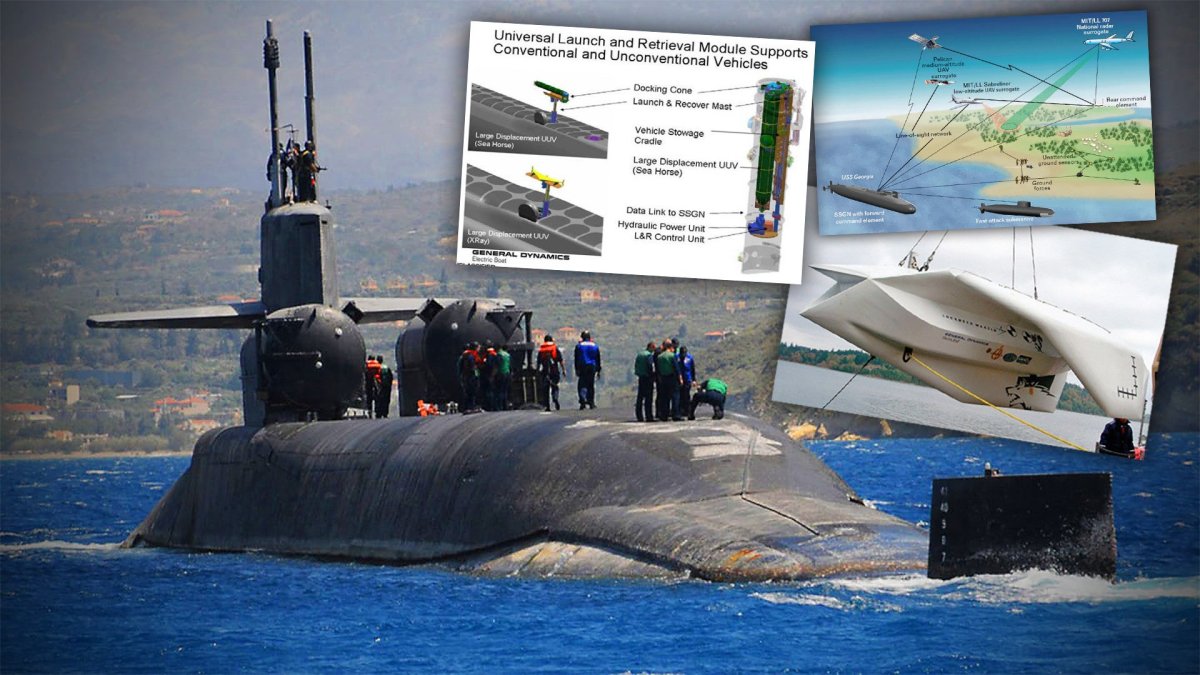
The Universal Launch and Recovery Module
We also know that the Flexible Payload Module (FPM) evolved, at least in part, into the Universal Launch and Recovery Module (ULRM), also known as the Universal Launch and Retrieval Module. General Dynamics Electric Boat has described this system as primarily being intended to launch and recover various types of UUVs, including Seahorse, Seaglider , and the Bluefin 21 .
The Bluefin 21 became well known world-wide after taking part in the search for the remains of Malaysia Airlines Flight 370 in 2014. The U.S. Navy subsequently adopted a derivative of this UUV, the Knifefish , primarily for mine hunting missions.
The modified Trident missile tubes would be able to accommodate racks that could launch and recover a number of these relatively small UUVs at once. General Dynamics Electric Boat envisioned the possibility of an SSGN deploying entire swarms of networked underwater drones to conduct persistent surveillance missions across a broad area as one possible application. There were also plans to eventually integrate larger underwater drones into the system.
General Dynamics Electric Boat did not specifically say that this system could launch unmanned aircraft from submarines, but it is possible that it could have been adapted to deploy encapsulated drones. The same system might similarly be able to deploy other payloads, as well, such as mines or decoy balloons.
As it was working on the ULRM, the company also said that it was developing an improved storage module that would be more readily transportable and installable. This, in principle, would have allowed more tailored special operations force packages to rapidly deploy to a forward port to rendezvous with one of the submarines for a specific mission.
There was also talk about another module that could contain additional masts with sensors or potentially for deploying additional payloads, such as drones. The modular nature of these systems combined with the large number of missile tubes on the SSGNs offered the potential to readily mix and match capabilities that would be best suited to the boat’s operational needs.
In 2013, the Navy said that it would test a prototype ULRM onboard one of the Ohio class SSGNs the following year. The goal at that time was to have examples available for actual operational use by 2019, but it’s unclear if this has occurred or not.
Upward Falling Payloads And Hydra
In 2013, DARPA itself initiated a new program to explore the possibility of launch small unmanned aircraft from capsules that could lie on the seabed, dormant and potentially unknown to potential opponents, for years at a time. A submarine could potentially deploy them covertly, as well, a mission that seems well suited to the SSGN concept of operation.
Known as Upward Falling Payloads (UFP), this project envisioned a system that American forces could activate remotely, or that might be triggered automatically in some fashion, and then release its payload. “Such a system of pre-positioned, deep-sea nodes could enable a full range of maritime mission sets that are more cost-effective than existing manned or long-range unmanned naval assets,” DARPA’s archived page for the project explains. UFP is also reminiscent of the Broaching Universal Buoyant Launcher (BUBL) system from a decade earlier, but it’s not clear if there is any actual direct relationship between the two projects.
Graphics showing how DARPA envisioned the Upward Falling Payloads system working., DARPA
At the same time, DARPA was working on this seabed payload launcher concept, it was also exploring a modular, standardized payload module that could work with submarines, as well as aircraft and surface ships, called Hydra . This could deploy either unmanned aircraft or UUVs and sounds similar in some respects to the Stealthy Affordable Capsule System (SACS). Again, it is unclear if there was any direct relationship between these two efforts.
Both UFP and Hydra appear to have come to an end sometime between 2016 and 2017. As with Cormorant, it’s not immediately clear if these continued on in some other form, including in the classified realm.
In 2013, the Navy itself had successfully demonstrated the ability to launch an encapsulated unmanned aircraft via a submarine’s torpedo tube. The Los Angeles class USS Providence (SSN-719) deployed the Naval Research Laboratory’s eXperimental Fuel Cell Unmanned Aerial System, or XFC UAS, using a launch system known as Sea Robin, which used a modified Tomahawk missile launch canister. That same year, the service said it was also actively testing AeroVironment’s Blackwing using the standard three-inch countermeasures launchers on its submarines.
The launch concept for the XFC UAS, showing how it would emerge from its launch canister and then deloy its wings., USN
More capable than we know
All told, it seems very possible, if not probable, that the capabilities of the Ohio class SSGNs have significantly expanded since Silent Hammer in 2004, even if the specifics are limited. Even without new systems, such as the Universal Launch and Recovery Module, the Ohio SSGNs have already been using their modified Trident launch tubes to deploy unmanned systems and for other novel purposes, including just acting as valuable storage space within the confines of the submarines.
The intelligence collection and fusion systems that Georgia had in 2004, even before its full conversion into the SSGN configuration, were state-of-the-art. More than a decade of improvements in basic computing technology and processing power, as well as new developments in data links and communications systems , including new ways for submarines to transmit and receive information , can only have drastically expanded those already impressive capabilities.
UUV and drone technology has also come a long way, both in general and within the Navy specifically. The service, by itself, has made significant progress in submarine-launched drones, drone swarm technology , and autonomous capabilities that apply to unmanned platforms in the air, at sea, and underneath the waves. Just this year, the Navy hired Boeing to build a new fleet of large displacement UUVs as part of a program called Orca, which you can read about in more detail in this past War Zone piece . All of this aligns well with the SSGN’s capabilities, and the Navy’s long-standing plans to expand them, as we understand it.
The Navy has also been quietly working on a new and revolutionary electronic warfare architecture, known as the Netted Emulation of Multi-Element Signature against Integrated Sensors, or NEMESIS, since at least 2013. The service has described this effort, which you can read about in-depth in this past War Zone feature , as involving swarms of unmanned platforms, various systems on ships and submarines, countermeasures and electronic warfare suites, and more that could combine to project signatures mimicking large groups of aircraft, surface ships, and subs.
The Ohio SSGNs present an ideal platform for deploying elements of and supporting this cutting-edge and critical initiative. Most notably, they could launch swarms of small electronic-warfare payload-carrying drones deep in enemy territory that can project false fleets and aerial armadas on enemy sensors and act as decoys during a time of war or probe and gather intelligence on enemy air defense networks during a time of peace. Launching radar-reflector carrying balloons, a 60-year-old proven tactic, could also be part of this capability. In fact, we know of no better platform to carry out such a task.
The Ohio SSGNs could also see the integration of new conventional weapons to support their time-sensitive strike mission, and otherwise expand their offensive capabilities, in the future, as well. The Navy is already working on a number of new and upgraded missiles that could have submarine-launched applications, such as the multi-purpose SM-6 Block IB , a highly classified supersonic anti-ship missile known as Sea Dragon , and the future Next Generation Strike Weapon . The Navy has also already test-fired prototype submarine-launched hypersonic boost-glide vehicles from Ohio class submarines under the Conventional Prompt Strike program, though it’s unclear if it may choose to deploy those only on those submarines configured as SSBNs.
Smaller weapons could dramatically increase the boats’ already impressive magazine depth. The extra capacity could give the submarines more diversity in their arsenals, allowing them to engage broader target sets, as well. European missile consortium MBDA’s SPEAR 3 mini-cruise missile and its SPEAR-EW variant, which carries an electronic warfare payload instead of a warhead, are good examples of the kind of miniaturized missiles that could be extremely valuable additions to the Ohio SSGNs.
Ohio when she arrived at the Puget Sound Naval Shipyard & Intermediate Maintenance Facility to begin her refit in 2017., USN
The Navy has also been putting these converted Ohios through major refits, which serve as an opportunity to integrate even more new capabilities. Georgia left the dry dock at Naval Submarine Base Kings Bay in March 2019 and Ohio
finished her stint at the Puget Sound Naval Shipyard & Intermediate Maintenance Facility in Washington State in August. Michigan is set to return to the fleet in 2020. It is not clear when Florida , which is presently deployed in the Mediterranean, will go through the process. These overhauled SSGNs likely represent a whole new level of capability derived from lessons learned over the last decade and a half of operations.
Successors to the Ohio SSGNs
Unfortunately, the Ohios SSGNs won’t be able to serve forever, they are already the oldest Ohio class submarines in existence, and the Navy is already exploring concepts for what comes next. The experience with these four boats has directly informed the development of the Virginia Payload Module (VPM) for the future Block V Virginia class attack submarines.
The VPM has four large multi-purpose tubes that can accept various modules just like the modified Trident missile tubes on the Ohio SSGNs, including the same seven-round Tomahawk launchers. The designs of the existing Block III and future Block IV Virginia class boats also already feature two similarly-sized Virginia Payload Tubes (VPT) in the bow of the submarine.
The Virginia class attack submarine USS John Warner pier-side with one of the Virginia Payload Tubes open., USN
As such, the VPTs already bring some of the multi-mission capability found on the SSGNs to the Block III Virginias and this will only be more pronounced on the Block IV boats. The Navy has already set aside at least four Block II and III Virginia class submarines for special operations support missions, with two more available as alternates, if required.
These six Virginias – USS Hawaii , USS Mississppi , USS New Hampshire , USS New Mexico , USS North Carolina , and USS North Dakota – can also carry the same types of Dry Deck Shelters (DDS) as the Ohio SSGNs. All of these submarines actually share a common pool of DDSs that Navy personnel can install on any of the boats, as necessary.
A briefing slide from 2014 showing the available Dry Deck Shelters (DDS), at right, and the Ohio and Virginia class submarines configured to carry them., SOCOM
The Navy’s present plan is to fully replace the Ohio SSGNs with Block IV Virginias by 2026, though, especially given the recent refits, its possible that the former boats could end up remaining in service longer. It’s not clear whether older Virginias would continue to serve int he special operations support role, as well.
Beyond that, the Navy is already exploring options for what it presently refers to as Large Payload Submarines, which will be a future class of multi-purpose, multi-mission boats derived from the Columbia class SSBN design that will be capable of, as the name implies, deploying a wide variety of large payloads. This could include both UUVs and submarine-launched drones. The submarines could also have the ability to deploy networked swarms of these unmanned platforms above or below the waves.
At present, the Navy plans to buy a minimum of five Large Payload Submarines, but it’s not clear when they might actually enter service. The current schedule would be to buy one every three years starting in 2036, after the initial Columbia class production run, totaling 12 boats, ends.
However, there are already concerns about how expensive and complex the Columbias are , each of which will cost more than $7 billion, and whether General Dynamics Electric Boat and Newport News Shipbuilding will be able to keep to the schedule . This, in turn, could push plans for the Large Payload Submarines further into the future. You can read more about all this in-depth in this past War Zone story .
An artist’s rendition of the future first-in-class USS Columbia., USN
More than 15 years after Georgia wrote the first few chapters in the book on Ohio class SSGN concepts of operations, the U.S. Navy’s four SSGNs remain some of the most unique and capable platforms within the Pentagon’s portfolio, and that is just based on what we know about their abilities. By every indication, these submarines have and continue to serve as testbeds for even more impressive developments that still have yet to become public.
Just think, if the ability to launch various drones, both air and sea types, and especially higher-end ones like the Skunk Works’ Cormorant, was very much in development on multiple fronts 15 years ago, just imagine what is deployed today or on the drawing board. If an SSGN can carry up to 154 Tomahawk missiles, how many small weaponized drones can it carry and how could an enemy ever defend against such an overwhelming onslaught crossing their shores? It is this type of imagination and the room to realize such dreams that have made these submarines so valuable and, for lack of a better term, revolutionary.
It’s safe to say that the Navy’s SSGNs are a case of “more than meets the eye,” as they are much more than the stealthy Tomahawk slingers and SEAL delivery platforms that the public perceives them to be. While their arsenal of cruise missiles and frogmen is certainly formidable, their ability to adapt, spy on the enemy, control the battle from under the waves, and above all else, accommodate new ideas, makes them uniquely ferocious to any enemy nation they may be sitting off of at any given moment.
Contact the author: joe@thedrive.com
Comments couldn’t be loaded. Please refresh the page.
作者:约瑟夫·特雷维西克和泰勒·罗戈韦
更新于美国东部时间2019年12月1日凌晨5:29
如今,美国海军四艘由俄亥俄级核动力导弹潜艇改装而成的SSGN(巡航导弹核潜艇)是美国最强大、最抢手、最灵活的武器之一。这些巨型且神秘的潜艇以其携带多达154枚“战斧”陆攻巡航导弹和数十名特种作战蛙人潜入敌对海域执行秘密任务的能力而闻名,但实际上,它们的价值远不止于此。
十五年前,美国海军正在测试一些令人惊叹的新能力,这些能力随后被整合到其四艘尚未改装的SSGN(巡航导弹核潜艇)上。其中一项高度复杂但鲜为人知的概念验证演习,巩固了SSGN作为海上作战舰艇的概念。本文将讲述这些舰艇的诞生历程,以及它们从无人母舰到指挥控制中心所拥有的独特甚至可以说是超乎寻常的能力。
俄亥俄州SSGN的起源
将俄亥俄级弹道导弹核潜艇(SSBN)改装为巡航导弹核潜艇(SSGN)的决定源于1994年的《核态势评估报告》。该报告认定,18艘俄亥俄级潜艇中仅需14艘即可满足美国的核威慑需求。八年后,海军开始对四艘最老的俄亥俄级潜艇——“佛罗里达”号、“乔治亚”号、“密歇根”号和“俄亥俄”号——进行改装。
俄亥俄号核潜艇(当时为弹道导弹核潜艇)于1998年完成第50次核威慑巡逻任务。照片中,艇员们站在甲板上,用手比划出“五十”字样以示庆祝。(美国海军)
海军曾考虑过多种新型SSGN的潜在配置方案。最终确定的方案保留了俄亥俄级SSBN上的24个导弹发射管中的22个,但对其进行了改造,使其无法发射三叉戟D5型核弹头潜射弹道导弹(SLBM)。取而代之的是,每个发射管可以使用多联装弹筒(MAC)适配器发射最多7枚BGM-109型战斧巡航导弹。潜射弹道导弹的火控系统也相应地更换为战斧巡航导弹的火控系统。
一张示意图,展示了海军最终确定的将四艘俄亥俄级潜艇改装为巡航导弹核潜艇(SSGN)的方案要素。(美国海军)
四艘SSGN潜艇的一号和二号舱管将被完全替换为封闭舱,以便战斗潜水员和海豹突击队员能够在水下进出潜艇。人员还可以在艇体顶部安装一个干式甲板舱(DDS),该舱管可连接到其中一个或两个改装后的舱管(如有需要),并可容纳潜水员运载器(SDV)小型潜艇。顾名思义,DDS提供了一个完全封闭的干燥空间,即使在潜艇处于水下时,也能在甲板上进行作业。
ABC 新闻的 David Muir 最近有机会登上佛罗里达号战列舰,带我们深入了解了这艘改装后的 SSGN 战列舰的内部构造,您可以在下面的视频中看到。
失败的先进海豹突击队运载系统(ASDS)原本也应该能够与这两个锁定舱中的任何一个直接对接。由于成本超支和其他重大挫折,包括前一年一场大火烧毁了最初的原型机,海军于2009年取消了ASDS项目。
安装DDS后,SSGN上的一些额外发射管也会被堵塞,因此海军决定将3号至10号发射管改造成可拆卸的储物空间,以备不时之需。此外,改造后的导弹舱内还增设了一个专用的住宿区,可容纳66名特种作战人员,并可根据需要增至102人。
2008年,美国海军俄亥俄号潜艇停靠在韩国釜山码头时,一名美国海军潜水员坐在潜艇的潜水掩体(DDS)内。在他身后,可以看到一艘Mk 8型海豹突击队运载艇(SDV)小型潜艇停泊在从掩体后部延伸出来的对接平台上。
最新报道显示,这些潜艇的典型载弹量约为100枚战斧巡航导弹。这很可能相当于14到16个满载的发射管,总共约98到112枚导弹。这样一来,还有6到8个发射管可用于储存或其他用途,我们稍后会详细讨论这一点。
除此之外,SSGN配置还配备了全新的专用特种作战任务控制中心和相关的任务规划空间。指挥塔上还增加了更多改进型的传感器和通信天线桅杆。其他一些改进也可能与此次改装有关,这些改进使这些潜艇能够更好地在近岸浅水区作战。
特种任务潜艇的悠久历史
海军在制定俄亥俄级巡航导弹核潜艇(SSGN)的需求时,已经积累了丰富的潜艇使用经验,这些经验不仅体现在将其用作特种作战母舰和战术打击平台,更体现在其作为专业秘密情报搜集平台的应用上。二战结束时,潜艇运送人员和物资、派遣突击队登陆作战以及利用其固有能力规避侦测的能力已得到充分证实。
从20世纪50年代中期到60年代初期,美国海军曾与中央情报局(CIA)和美国空军合作,秘密使用潜艇发射雷达反射气球,以探测敌方的防空能力。您可以在之前的《战区》报道中阅读更多关于这些行动的信息。
到了越南战争时期,海军开始使用特制潜艇来支援特种作战。其中包括加托级潜艇“金枪鱼”号和同级首舰“灰背”号,这两艘潜艇都是柴电潜艇,此前都经过改装,可以发射“雷古勒斯”核巡航导弹。
1982年的“灰背”号航空母舰(USS Grayback)。
这些潜艇甲板上原本用于存放飞机大小的“雷古勒斯”导弹的“机库”非常适合改装成供游泳者使用的隔离舱和小型潜艇的掩体,就像“俄亥俄”号潜艇上的三叉戟导弹发射管一样。1968年,海军甚至将它们命名为LPSS,即两栖运输潜艇。
这些艇只为北越沿海的特种作战行动提供支持,并协助收集情报。“灰背”号尤其参与了1972年的“雷霆行动”,该行动旨在营救美军认为已从臭名昭著的北越“河内希尔顿”监狱逃脱的美国飞行员。恶劣天气和其他因素最终导致海军中止了此次任务,海豹突击队和水下爆破队(UDT)成员最终未能与任何逃犯取得联系。
一名海豹突击队员,美国海军中尉梅尔文·斯宾塞·德莱,在这次任务中牺牲。美军直到2008年才承认这次行动,德莱当时被追授铜星勋章。
在“雷霆行动”开始前,海豹突击队员们登上“灰背”号。梅尔文·斯宾塞·德莱中尉坐在中间,手里拿着文件。(美国海军)
在越南战争后的几十年里,一些鲟鱼级核动力攻击潜艇也承担了类似的特种作战支援任务。作为俄亥俄级SSGN潜艇的前奏,1981年美国和苏联签署的《战略武器限制谈判》(SALT I)协议的一部分,美国海军拆除了部分SSBN潜艇的潜射弹道导弹能力,并将它们正式重新归类为攻击潜艇。
“山姆·休斯顿”号、“约翰·马歇尔”号、“卡美哈美哈”号和“詹姆斯·K·波尔克”号——前两艘属于“伊桑·艾伦”级,后两艘属于“本杰明·富兰克林”级——都进行了进一步的改装,在船体顶部加装了防雷系统,并专门设置了搭载海豹突击队的舱室。这些潜艇一直服役到20世纪90年代,“卡美哈美哈”号是最后一艘退役的,海军直到2002年才将其正式退役。
2001年,美国海军“卡美哈美哈”号两栖攻击舰(USS Kamehameha)停泊在关岛,舰上安装了双层干式甲板掩体。
一种新型潜艇母舰
尽管海军在利用潜艇支援海上和陆上战术行动(包括特种作战)方面拥有数十年的经验,但俄亥俄级SSGN的目标是成为比以往任何改装都更加强大、更加灵活的多任务平台。
截至2004年,海军仍在完善SSGN改装的具体细节,并“编写”如何使用这些潜艇的操作手册。“佐治亚”号成为了这一仍在不断发展的概念的主要试验平台,接受了一系列中期改装,包括重新配置内部任务空间,以及增加数据链路和通信设备。当时,选定的四艘“俄亥俄”级潜艇均未完成全部改装,距离它们以新配置正式服役还有数年时间。
“两年后,当我们打开包装纸,看到崭新的SSGN潜艇‘乔治亚’号时,我们将需要一本使用说明书,”时任美国海军第17潜艇中队指挥官的罗伯特·舒茨准将在2004年12月该潜艇的指挥权交接仪式上说道。“一本尚未编写的说明书;一本将极其详细地描述如何操作这艘新‘玩具’的说明书。”
“乔治亚号的船员们在这方面表现出色,”舒茨继续说道,“他们编写了第一本关于如何操作这艘军舰及其三艘姊妹舰——这些每位作战指挥官都梦寐以求的‘玩具’——的操作手册。”
两个月前,在加利福尼亚州圣地亚哥海岸附近,佐治亚州海军在代号为“沉默铁锤”(Silent Hammer)的试验中,即便远未达到改装计划中概述的全部能力,也已展示了SSGN配置的潜在能力。为了增强演习场景的真实性,海军将此次测试纳入了名为“三叉戟勇士”(Trident Warrior)的更大规模演习中,该演习还涉及其他潜艇、舰艇、飞机、无人机和特种作战部队(SOF)。
“寂静之锤”演习持续一周多,由格鲁吉亚牵头的联合特遣部队负责在陆地和海上定位并消灭模拟恐怖分子。“红队”占据了位于圣地亚哥以西约80英里的圣克莱门特岛上的多个地点,该岛是美军经常用于演习和其他测试的场所。由承包商运营的近海支援船“声学探索者”号也扮演了模拟海上威胁的角色。
此次演习中“蓝队”的总体目标是利用各种情报来源找到并锁定这些假想的武装分子,然后用模拟的战斧导弹打击将其消灭。
在“寂静之锤”演习期间,圣克莱门特岛上的“大规模杀伤性武器”(WME)和全球移动通信系统(GSM)设施均被“恐怖分子”控制,而“声学探索者号”(AX)科考船的各个平台也拍摄了这些图像。(麻省理工学院林肯实验室)
在实验过程中,至少在公开场合,重点更多地放在潜艇作为情报收集平台的能力,以及作为更广泛的“秘密海上基地”的能力上,该基地将提供一个“指挥控制行动和后勤保障的总部节点”,包括为岸上的特种作战人员提供支持。
“我们改装后的三叉戟导弹将能够自主生成情报,这使得舰载指挥官能够在几乎任何情况下做出决策,判断需要哪些信息,并确定应该部署哪些额外的自主传感器,”时任美国海军退役上将弗兰克·“斯基普”·鲍曼在2005年冬季刊的《海底作战》杂志上写道。鲍曼在杂志上发表的这番话,指的是俄亥俄级潜艇,该级潜艇搭载的是三叉戟潜射弹道导弹,其SSBN版本也搭载了这种导弹。《海底作战》是美国海军潜艇部队的官方刊物。鲍曼在海军的最后一个职务是海军核动力推进系统主任。
“‘无声铁锤’行动展示了一支网络化部队(包括来自SSGN的海上特种作战部队)如何通过开展大规模秘密行动,并在先进无人系统的支持下,填补情报、监视、侦察(ISR)和时间敏感打击等联合领域的空白,从而降低风险并提高能力。”领导“无声铁锤”实验的美国海军上校JS·戴维森在同一期《海底战争》杂志的另一篇文章的采访中解释道。
情报神经中心
“寂静之锤”演习中展现的情报融合能力的重要性怎么强调都不为过。在这次演习中,佐治亚州派遣了一支联合军种指挥小组随艇登艇,利用潜艇内部的改造空间运行前沿作战中心,从而控制水下、水面、空中和陆地上的其他作战力量。此举旨在模拟潜艇改装为巡航导弹核潜艇(SSGN)后的能力,改装后的SSGN将为指挥控制人员、情报搜集人员等打造更强大的全新任务空间。
这是海军首次在SSGN作战概念开发过程中采用这种方式,它以一种全新的方式将作战指挥官置于作战核心。与传统的水面指挥舰(例如“蓝岭”号)不同,“佐治亚”号允许这些军官及其参谋人员在水下隐蔽航行的同时指挥前沿作战。潜艇的指挥中心通过卫星与后方指挥中心及其情报网络相连。它还拥有来自其他多个来源的直接数据链。
一张图表展示了“寂静之锤”行动中使用的庞大情报网络。(麻省理工学院林肯实验室)
空中作战飞机包括“鹈鹕”(Pelican),这是一架经过高度改装、可选配备飞行员的塞斯纳337螺旋桨飞机;以及一架经过特殊配置的“佩刀客”(Sabreliner)双引擎公务机。“鹈鹕”隶属于美国海军研究生院跨学科遥控飞行器研究中心(CIRPAS),当时的配置使其性能与MQ-1“捕食者”无人机相匹配。麻省理工学院(MIT)林肯实验室则使用“佩刀客”作为小型、低空无人机的替代品。
一份简要介绍美国海军CIRPAS Pelican系统的幻灯片。
林肯实验室还派出了经过大幅改装的波音707客机,绰号“汉娜”,这架著名的尖端通信和传感器测试平台,在空中扮演机载雷达的角色,具备合成孔径雷达和地面移动目标指示器功能。这在一定程度上使其能够替代美国空军的E-8C联合监视目标攻击雷达系统(JSTARS)战场管理指挥控制飞机。
林肯实验室改装的波音707传感器测试平台,昵称“汉娜”。马萨诸塞州航空航天博物馆
以下是麻省理工学院林肯实验室平台在“寂静之锤”活动期间生成的图像示例。
海军的 EA-6B“徘徊者”电子战飞机和 EP-3E“白羊座II”情报、监视和侦察飞机也参与了“三叉戟勇士”演习,并将信息输送到该信息源网络中。
在舰艇下方,乔治亚号与其他参与“三叉戟勇士”演习的舰艇联网,其中包括两艘洛杉矶级快速攻击潜艇——“拉霍亚”号和“匹兹堡”号。此外,“寂静之锤”实验小组的成员也分别在同级首舰“塔拉瓦”号和黄蜂级两栖攻击舰“好人理查德”号上,这两艘舰艇也参与了此次大规模演习。
在岸上,美国海军海豹突击队以及其他未指明的特种作战人员(可能包括美国空军联合战术空中管制员)与格鲁吉亚方面保持直接联系。他们部署了“无人值守”传感器,用于监测潜在的敌对活动,并将更多数据反馈给潜艇。
我们还了解到,美国国防高级研究计划局(DARPA)为此次演习提供了未指明的有效载荷以及传感器系统。格鲁吉亚方面则在演习中演示了如何发射无人机和无人水下航行器(UUV)以支持情报收集工作。稍后我们将详细讨论这些幕后进展。
数据融合先驱
演习期间收集到的情报信息量惊人。支援飞机、地面传感器和其他机载传感器在演习期间共收集了超过21000张图像。据2007年《林肯实验室期刊》的一篇文章报道,特遣部队总共生成了近11GB的数据,其中包括数千条文本警报和近3000份实际的情报“产品”,例如提炼各种信息的PowerPoint演示文稿。
不幸的是,如此庞大的信息量也可能令人应接不暇。因此,海军和林肯实验室还开发了一套当时最先进的计算机化、高度自动化的网络系统,使“乔治亚”号潜艇上的指挥中心能够快速筛选海量信息,提取最相关的数据,并仅下载所需的完整信息。考虑到15年前潜艇与其各种外部信息源之间数据链路的带宽限制,避免下载不必要的信息显得尤为重要。
麻省理工学院林肯实验室对“沉默铁锤”行动期间格鲁吉亚与各种情报收集机构之间信息流的分析。
乔治亚州操作员看到的实际搜索界面是什么样的?麻省理工学院林肯实验室
“寂静之锤”行动的策划者以及林肯实验室都敏锐地意识到数据共享问题的重要性,这源于2003年一项规模较小的SSGN(巡航导弹核潜艇)研发试验——代号“巨影”——的经验教训。该试验由“佛罗里达”号潜艇参与,在位于巴哈马安德罗斯岛附近海域的秘密大西洋海底试验与评估中心(AUTEC)及其周边地区进行。与“寂静之锤”行动类似,“巨影”行动的核心是摧毁一座模拟恐怖分子在岸上运作的化学武器工厂。
“我们可以将这些(图像)实时传输到潜艇上,”时任“佛罗里达”号潜艇艇长、美国海军上校威廉·托蒂在接受哥伦比亚广播公司新闻节目“60分钟”采访时表示。“海豹突击队员在计划任务时可以实时查看这些图像,从而更好地了解情况。”
事实证明,那次演习的问题在于,潜艇上的人员很快就无法实时筛选和处理过多的信息。“信息提供者而非消费者决定传输哪些信息以及何时传输,这导致分析人员疲于处理大量无关信息,却仍然缺乏足够的信息来支持决策,”2017 年《林肯实验室期刊》的文章指出。
“寂静之锤”演习期间的信息流通有所改善,但仍有提升空间。海量数据意味着情报人员在尽力优先处理各项工作的同时,仍然容易错过重要的最新进展。演习期间,各种平台收集了超过21000张图像,但只有不到7000张被录入网络数据库,“蓝队”人员最终只查看了其中的361张(无论分辨率如何),并且只下载了45张完整图像进行更深入的分析。尽管如此,格鲁吉亚领导的特遣部队最终还是发现了所有模拟威胁,并成功实施了模拟打击以消除它们。
对“寂静之锤”行动期间收集的情报进行全面分析,麻省理工学院林肯实验室
一张流程图,展示了在“寂静之锤”行动期间,来自各种来源的情报最终如何生成针对圣克莱门特岛模拟打击的目标定位信息。(麻省理工学院林肯实验室)
尽管人们对格鲁吉亚参与“无声铁锤”演习的情况以及演习期间使用的情报收集和网络系统的总体范围和规模有所了解,但对于测试潜艇发射水下无人航行器 (UUV) 和无人机的能力却知之甚少。
目前尚不清楚参与“寂静之锤”演习的无人水下航行器(UUV)类型,也不清楚佐治亚州是否部署了此类航行器。然而,在之前的“巨型阴影”演习中,“佛罗里达”号成为首艘通过改装导弹发射管发射和回收“海马”自主水下航行器(AUV)的海军潜艇。这艘水下无人航行器很可能也参与了“寂静之锤”演习。
海马号自主水下航行器,美国海军
宾夕法尼亚州立大学应用研究实验室 (ARL) 于 1999 年开始根据与海军海洋局 (NAVOCEANO) 的合同开发“海马”水下无人系统。这款水下无人系统长 28.5 英尺,重 10,800 磅,比 Mk 48 重型鱼雷长 10 英尺多,重 7,100 多磅。
它的主要任务是利用多种传感器进行海底测绘,包括多波束测深声呐、合成孔径声呐、声学多普勒流速剖面仪(ADCP)以及电导率、温度和深度(CTD)传感器。这些传感器也可用于探测水雷和其他潜在的水下危险。自海军接收“海马”号以来的几十年里,海军已经采购并部署了大量性能日益强大的鱼雷形无人水下航行器(UUV),这些UUV尺寸各异,用于执行测绘和扫雷等任务。
灵活有效载荷模块
据海军称,佐治亚州在“无声铁锤”演习期间实际上并没有发射任何无人机,但确实从安装在潜艇导弹发射管中的灵活有效载荷模块 (FPM) 中释放了两个隐形经济型胶囊系统 (SACS) 罐,每个罐内都包含一个“模拟无人机的惰性测试形状”。
自20世纪90年代以来,美国海军就对将无人机与潜艇结合使用以增强潜艇侦察和情报收集能力的想法非常感兴趣。与潜艇协同工作的无人机还可以充当通信和数据中继,探测并收集敌方防御信息,甚至有可能直接打击目标。例如,1996年3月,洛杉矶级攻击型核潜艇“芝加哥”号参与了一次演示,测试了其与当时被称为RQ-1“捕食者”无人机的早期型号进行通信并主动控制的能力。
未来动力装置(FPM)的研发至少可以追溯到2000年。当时,美国海军委托两个独立的工业联盟,为未来的潜艇设计方案,以及相应的有效载荷和传感器,着眼于未来几年内可能投入使用的技术。海军和国防高级研究计划局(DARPA)合作管理了这个项目,该项目被恰如其分地命名为“潜艇有效载荷和传感器”。
通用动力电船公司
诺斯罗普·格鲁曼公司是“2020团队”(由洛克希德·马丁公司牵头的联合体之一)的成员,该公司开发了FPM。通用动力电船公司是美国首屈一指的潜艇制造商,该公司曾建造过俄亥俄级潜艇等,并且当时也参与了弗吉尼亚级攻击型潜艇的研发,它也是“2020团队”的成员。
FPM实际上是一个可以插入潜艇大直径弹道导弹发射管的插件,但它可以改装以携带多种有效载荷,包括多架无人机,然后由艇员独立发射。通用动力电船公司将其描述为“即插即用”系统。
诺斯罗普·格鲁曼公司设计了第一代FPM导弹发射管,该发射管包含10根14英寸的管子和两根更大的20英寸管子,其尺寸专门针对俄亥俄级战列舰的导弹发射管。第二代FPM原型机,即佐治亚号战列舰在“寂静铁锤”演习中搭载的那架,只有三根直径未知的发射管。每根发射管内都装有SACS(战略空天推进系统),这是诺斯罗普·格鲁曼公司的另一项研发成果。
根据《水下作战》杂志2005年冬季刊“寂静之锤”行动的文章,“FPM和SACS构成了一个封装系统,便于从潜艇发射非船用有效载荷和武器。这使得海军空射或水射有效载荷——以及其他军种的有效载荷——无需重新设计即可在水下环境中发射。”
根据同一篇文章,SACS“适用于长期存储、可变释放深度、在浅水区或水面盘旋条件下发射,并且能够封装小型或大型有效载荷”。
“以潜射无人机(SUAV)为例,SACS(潜射辅助推进器)会浮力上升到水面,舱内的传感器会检测到横向移动,SACS的端盖会被吹走,SUAV的助推器点火以脱离水面并建立垂直速度,”史蒂夫·温斯坦和威廉·麦克甘农在2002年美国国防工业协会(NDIA)联合水下作战技术春季会议上的演讲中解释道。“在适当的时候,SUAV的机翼会从其细长机身两侧展开至水平位置,飞行控制软件会将SUAV倾斜到水平飞行位置,一旦进入稳定飞行状态,SUAV就会转向并爬升到预定高度,开始执行任务。”
当时,韦恩斯坦和麦克甘农受雇于海军海上系统司令部(NAVSEA)潜艇传感器系统部门。
参与潜艇有效载荷和传感器项目的另一个行业合作组织,名为“潜艇前向有效载荷和传感器”(Forward PASS),开发了一种类似的系统,称为“通用浮式发射器”(BUBL),其工作原理大致相同。然而,BUBL 的设计旨在与潜艇上现有的多种发射器兼容,包括鱼雷发射管和对抗装置发射器,甚至可以外挂。当然,外挂方式可能会造成性能问题,或者增加潜艇的声学特征,使其更容易受到攻击。
一份2002年的简报幻灯片,提供有关FPM、SACS和BUBL的基本信息和图表,美国海军
雷神公司是“前沿PASS”项目的团队领导方,团队成员还包括波音公司和宾夕法尼亚州立大学应用研究实验室等。通用动力电船公司同时参与了这两个团队,旨在提供其丰富的知识库,以协助解决潜艇研发和集成方面的问题。没有资料显示佐治亚州在“寂静之锤”行动期间聘用了BUBL公司。
潜射无人机
虽然我们不清楚乔治亚州当时究竟是在模拟从FPM平台发射哪种无人机,但诺斯罗普·格鲁曼公司早在上世纪90年代就已经研发出至少一款名为“海雪貂”(Sea Ferret)的潜射无人机。这款无人机是“雪貂”(Ferret)的改进型,而“雪貂”最初是该公司为美国陆军研发的。
桑德斯特兰TJ50涡轮喷气发动机驱动的“雪貂”和“海雪貂”无人机,在今天我们称之为巡飞弹。这些重约145磅的无人机携带光电传感器组件和20磅重的弹头,最大航程约370海里,最高速度可达300节,并且能够在目标区域周围盘旋约两小时。
一张质量很差的雪貂图片,公共领域
1996年12月,另一艘洛杉矶级攻击型核潜艇“阿什维尔”号在一次技术演示中模拟发射了“海鼬”无人机。一架塞斯纳206轻型飞机将其中一架无人机挂载在机翼下,模拟无人机的飞行状态。诺斯罗普·格鲁曼公司最初设想的最终系统(但海军最终并未采用)是使用经过改装的UGM-84潜射“鱼叉”反舰巡航导弹发射筒,通过鱼雷发射管发射。
不过,根据韦恩斯坦和麦克甘农在2002年美国国防工业协会(NDIA)的报告中所述,1996年的测试“成功模拟了有机和非有机无人机作战以及特种作战部队的支援”。诺斯罗普·格鲁曼公司在“寂静之锤”演习期间,完全有可能已经研发出了“海鼬”无人机的某种后续型号。
我们还了解到,海军从2000年左右就开始举办研讨会和其他国防工业交流活动,以评估潜射无人机的各种方案,这与潜艇有效载荷和传感器计划的启动时间大致相同。通用动力电船公司在2006年美国国防工业协会(NDIA)系统工程师大会上的一份简报幻灯片(其中也涉及灵活有效载荷模块(FPM)的开发)展示了至少五种不同潜射无人机设计方案的概念图。
2006年的一份简报幻灯片展示了各种潜射无人机概念,以及其他可与未来通用适配器配合使用的潜在有效载荷。通用动力电船公司
到2002年,由通用动力公司、洛克希德·马丁公司、AeroVironment公司和科尔摩根公司组成的团队也展示了一种改进型的通用模块化桅杆,该桅杆可以从潜望镜深度将小型无人机发射升空。该系统的艺术家概念图显示,其无人机设计与AeroVironment公司四年后正式开始为海军开发“黑翼”无人机系统(一种潜射系统)的“黑翼”无人机几乎完全相同。
2005年,时任海军作战部长弗恩·克拉克海军上将在其指导意见中也呼吁进行后续的“寂静之锤II”演习,“除了地面传感器外,还应使用空中传感器(无人机),并演练全方位互联互通链路”。目前尚不清楚克拉克是否希望展示真正的潜射无人机能力,也不清楚该演习最终是否举行过。
洛克希德·马丁公司神秘的鸬鹚
在“寂静之锤”演习前后所有正在研发的潜射无人机中,最引人注目的当属洛克希德·马丁公司神秘的“鸬鹚”(Cormorant)无人机,它是该公司臭鼬工厂先进设计部门的杰作。该项目由美国国防高级研究计划局(DARPA)负责管理,也被称为多用途无人机(MPUAV),旨在研发一种相对较大的隐形喷气式无人机,并可由潜艇进行发射和回收。
专利文件显示,鸬鹚导弹的研发至少始于 2004 年。随后洛克希德·马丁公司发布的官方视频演示清楚地表明,虽然国防采购和研究局 (DAPRA) 正式负责该项目,但其研发至少部分受到了海军关于俄亥俄级 SSGN 导弹核潜艇的要求的影响。
“海军找到我们,希望我们能提供一系列可从航空母舰、水面舰艇甚至潜艇上起飞的无人机概念方案,”时任洛克希德·马丁公司多用途无人机(MPUAV)项目经理兼技术负责人鲍勃·鲁什科夫斯基在视频中说道。“这个想法的独特之处在于,这是首次有人提出在潜艇仍处于水下时发射和回收无人机的设想。”
根据鲁什科夫斯基的说法,鸬鹚号的设计理念是:从俄亥俄级核潜艇上改装的导弹发射管发射,深度可达150英尺(约46米),然后像软木塞一样漂浮在水面上。之后,火箭助推器会将这艘重达四吨、钛合金外壳的飞行器推向空中,并由传统的涡扇喷气发动机驱动。在发射和回收过程中,发动机的进气口和排气口都会与水面完全隔绝。
“这架飞机利用其隐身性能和任务规划能力渗透敌方空域,”鲁什科夫斯基继续说道。“一旦进入敌方空域,它就能执行各种任务,例如收集情报和侦察大规模杀伤性武器基地,或者支援特种作战部队。但无论它执行什么任务,都会利用其隐身性能和任务规划能力来避免被发现。”
洛克希德·马丁公司2004年提交的一项关于“鸬鹚”(Cormorant)无人机的专利申请中包含一幅无人机投放武器的插图,这表明洛克希德·马丁公司、美国国防高级研究计划局(DARPA)和海军可能也曾考虑过利用该无人机执行打击任务。洛克希德·马丁公司2005年的一份简报称,该无人机能够在一个模块化货舱内携带1000磅的有效载荷,其中包括传感器、通信中继系统,甚至可以向指定投放区的人员空投补给品。
这是洛克希德·马丁公司于2004年提交的关于“鸬鹚”(Comorant)无人机的专利图纸,展示了该无人机如何从内部弹舱释放武器。(美国专利商标局)
完成任务后,无人机将返回会合点并打开降落伞,安全落入水中。随后,潜艇将放出自己的系留遥控潜水器,将缆绳连接到无人机上并将其收回。
2004 年专利中的另一幅图展示了降落伞回收概念,以及一种“鞭状失速”状态——飞行器的发动机将关闭,飞行器会在低空利用机翼作为大型空气制动器,然后机头向下俯冲入海。(美国专利商标局)
目前还不清楚该计划进展到了什么程度,但我们确实知道洛克希德·马丁公司进行了一些公开的测试,包括从水下模拟发射管释放测试件、将该测试件投入水中,以及评估鲁什科夫斯基在视频中描述的回收概念。
理论上,鸬鹚导弹也可以使用安装在水面舰艇上的发射器。2004年的专利图展示了艺术家绘制的水面舰艇从侧面释放鸬鹚导弹的示意图。
2008年,DARPA公开宣布取消“鸬鹚”(Cormorant)无人机的研发,表面上的理由是预算削减。目前尚不清楚该系统的研发是否在之后继续进行,或许是在某个机密项目中,以其他项目的形式继续进行。关于这款无人机及其基本概念的讨论几乎完全消失了,就连此前一直大力推广该项目的臭鼬工厂(Skunk Works)也停止了相关讨论。
这是洛克希德·马丁公司在“鸬鹚”战斗机项目期间使用的一种非飞行测试样机。(美国海军)
2009年,洛克希德·马丁公司
提交了另一项与水上可发射和回收的无人机相关的专利申请。该申请描述了一种使用电动涵道风扇进行水上和空中自推进的系统。概念图显示,该飞机外形酷似冷战早期苏联的米格-15战斗机,据报道,这是因为洛克希德·马丁公司曾使用过一架改装过的米格-15遥控模型来测试电动风扇推进系统。
俄亥俄级SSGN潜艇投入使用
尽管海军在21世纪初对如何运用俄亥俄级巡航导弹核潜艇(SSGN)以及改装后和未来可能具备的能力持开放态度,但自该级潜艇在2000年代末期正式服役以来,关于其如何将这一理论付诸实践的信息却相对较少。俄亥俄级是第一艘重新加入舰队的潜艇,通用动力电船公司于2005年12月17日交付了改装后的潜艇。近两个月后,举行了庆祝其回归服役的仪式。
佛罗里达州和密歇根州分别于2006年4月8日和11月22日抵达。由于不明原因,密歇根州直到2007年6月才举行正式的回归仪式。佐治亚州是最后一个抵达的,时间是2007年12月18日。
关于这四艘潜艇的官方新闻报道主要集中在部署、返回母港、港口访问以及参与演习的总体公告上。“我们执行的任务非常激动人心,也极具挑战性,”时任“俄亥俄”号蓝队艇长的美国海军上校默里·杰罗在2009年的一篇典型的部署前采访中说道。
2008年,俄亥俄号在完成SSGN改装后,甲板上安装了两个干式甲板舱。(美国海军)
他继续说道:“我们通常出海携带超过100枚战斧导弹,这基本上相当于三艘水面舰艇的战斧导弹储备。”他着重强调了时间紧迫的打击任务。“这提高了水面舰队的灵活性,因为我们基本上允许他们在进入作战区域后立即重新部署这三艘舰艇。”
舰长补充说,这艘船还能执行其他任务,包括情报收集和特种作战支援,“这些任务非常复杂,需要与包括海豹突击队在内的多个外部机构密切协调。”但他没有提供更多具体细节。
常规威慑与实际战斗
我们知道,这些舰艇已经展示了其打击能力,既用于威慑目的,也用于实际作战行动。2010年,“佛罗里达”号、“密歇根”号和“俄亥俄”号几乎同时分别访问了印度洋的迪戈加西亚岛、韩国釜山和菲律宾苏比克湾,一些观察人士认为这是针对中国的武力展示。
“这表明这些平台具备其他常规导弹系统所不具备的信号传递能力,”兰德公司智库的政治学家福雷斯特·E·摩根在2013年的一项研究中写道。“然而,人们可能会怀疑,在危机期间,当巡航导弹核潜艇在交战区巡逻时,美国领导人是否会允许它们浮出水面,因为这样做可能会使它们面临被攻击的风险。”
2011年,佛罗里达号潜艇还参与了北约领导的“奥德赛黎明行动”的公开阶段,该行动干预利比亚,最终导致长期执政的领导人穆阿迈尔·卡扎菲被推翻并身亡。在行动期间,该潜艇发射了93枚战斧巡航导弹,其中90枚击中目标。
“凭借其隐蔽性和续航能力,SSGN平台迫使我们的对手不得不考虑,他们可能随时随地都在行动,”时任海军潜艇部队司令约翰·理查森中将2011年4月29日在“佛罗里达”号返回位于佐治亚州金斯湾海军潜艇基地的母港时说道。“艇上的传感器套件使舰长能够就地收集信息和情报,并将其传递给指挥官,从而立即做出反应。再加上该艇强大的作战能力——陆攻导弹、特种部队、鱼雷——敌人就不得不提防很多方面了。”
理查森随后担任海军核动力推进系统主任,之后又担任海军作战部长,即海军最高军官。他于2019年8月退休。
2017年,正值美朝关系高度紧张之际,“密歇根”号潜艇再次出现在釜山,此举也被视为向平壤政权发出信号。美国总统特朗普在与菲律宾总统罗德里戈·杜特尔特的一次电话会谈中,也披露并强调了该潜艇在该地区的存在,以此作为对抗朝鲜侵略的手段。此次通话内容随后被泄露给媒体。“密歇根”号随后与部署在该地区的其他潜艇——“尼米兹”级航空母舰“卡尔·文森”号及其所属航母打击群进行了联合演习。
2019年11月初,美国广播公司新闻节目“夜线”(Nightline)播出了一段节目,主持人戴维·缪尔(David Muir)有机会登上“佛罗里达”号核潜艇,该潜艇目前正在地中海执行一项“机密任务”。缪尔采访了美国海军少将威廉·休斯顿(William Houston)和塞思·伯顿(Seth Burton)上校,进一步揭示了这艘核潜艇的作战情况。休斯顿目前身兼三职:美国海军驻欧洲部队/美国第六舰队计划与作战主任、第六舰队副司令以及第八潜艇群司令。伯顿则是“佛罗里达”号的现任舰长。
这是今年早些时候佛罗里达号在地中海航行时,从其桅杆顶部拍摄的照片。照片中可以看到升起的导航雷达桅杆、左侧的声呐装置以及用于近距离防御的Mk 48机枪。(美国海军)
休斯顿告诉缪尔:“我们把这艘潜艇部署在地中海东部这片区域,是为了制衡俄罗斯在叙利亚的军事集结。我们正在非常密切地监视他们(俄罗斯人)。我们真的没有一天不监视他们,每一天都是如此。”
“如果你看看这个地区,看看北非的ISIS,看看现在土耳其和叙利亚边境的局势,再加上你们身处地中海,这是否就等于为美国提供了一双隐形的眼睛?”穆尔问伯顿。“当然。这让他们得以在无人知晓的地方进行监视,”他回答道。
我们还知道,俄亥俄级SSGN潜艇在巡逻期间经常执行情报收集任务,并与海豹突击队和其他特种作战部队在全球范围内进行例行合作。正如默里·杰罗上校在2009年指出的那样,这些潜艇为艇员提供了独特的体验,也是舰队中最令人向往的艇种之一。
如果说有关俄亥俄级SSGN的作战信息有限,那么关于这些潜艇的升级和新技术细节则更加匮乏。这与海军早期对这些改装潜艇能力的公开透明形成了鲜明对比,也与海军此前积极讨论未来发展方向(包括无人机和无人水下航行器)的做法截然不同。过去十五年间,无人机和无人水下航行器的能力都得到了飞跃式提升。
我们知道,到了2000年代末期,海军已将一套名为“光辉宝石”(Radiant Gemstone)的信号情报收集系统集成到至少部分洛杉矶级攻击型核潜艇上,您可以在之前的“战区”(War Zone)文章中了解更多相关信息。该系统还配备了必要的数据链路和软件后端,名为“光辉水星”(Radiant Mercury),用于与国家安全局快速交换信息。
这是宾夕法尼亚州立大学应用研究实验室 (ARL) 提供的关于“璀璨宝石”的简报幻灯片。ARL 曾参与“海马”自主水下航行器 (AUV) 的研发,并且是“前沿 PASS”团队的成员,该团队致力于为潜艇开发先进的有效载荷概念。(宾夕法尼亚州立大学,通过 Phase Zero 项目提供)
“RADMERC(Radiant Mercury)计划旨在促进跨安全领域以及盟军、联盟和跨部门合作伙伴之间关键信息的共享,”海军太空与海战系统司令部(SPAWAR)2017年的官方项目清单解释道。“Radiant Mercury产品提供跨领域信息共享能力,涵盖从绝密/敏感信息隔离(TS/SCI)到通用信息(GENSER),以及从通用信息到非密信息。”
这听起来很像是佐治亚州在“沉默铁锤”行动中率先采用的数据共享系统和作战理念的演进。如果佐治亚州的巡航导弹核潜艇(SSGN)尚未具备相关能力,那么这似乎也是一个理想的补充,能够与其已知的情报收集和融合能力完美契合。此外,这很可能是最初在改装后的俄亥俄级潜艇上出现的技术的延伸。
通用发射和回收模块
我们还知道,灵活有效载荷模块(FPM)至少部分地演变成了通用发射回收模块(ULRM),也称为通用发射回收模块。通用动力电船公司曾表示,该系统的主要用途是发射和回收各种类型的无人水下航行器(UUV),包括海马(Seahorse)、海滑翔机(Seaglider)和蓝鳍21(Bluefin 21)。
Bluefin 21 在 2014 年参与搜寻马来西亚航空 370 航班残骸后,享誉全球。随后,美国海军采用了该无人水下航行器 (UUV) 的衍生型号 Knifefish,主要用于扫雷任务。
改进后的三叉戟导弹发射管可以容纳多个发射架,一次性发射和回收多艘这种相对较小的无人水下航行器(UUV)。通用动力电船公司设想,一种可能的应用场景是,一艘巡航导弹核潜艇(SSGN)可以部署大量联网的水下无人机,在广阔区域内执行持续监视任务。此外,该公司还计划最终将更大的水下无人机集成到该系统中。
通用动力电船公司并未明确表示该系统可以从潜艇上发射无人机,但它有可能经过改装后可以部署封装式无人机。同样的系统或许也能部署其他有效载荷,例如水雷或诱饵气球。
在研发超大型导弹防御系统(ULRM)的同时,该公司还表示正在开发一种改进型存储模块,该模块更便于运输和安装。原则上,这将使更多定制化的特种作战部队能够快速部署到前沿港口,与其中一艘潜艇会合,执行特定任务。
还有人提到,另一种模块可以包含额外的桅杆和传感器,或者用于部署额外的有效载荷,例如无人机。这些系统的模块化特性,加上SSGN上大量的导弹发射管,使得它们能够根据舰艇的作战需求,灵活组合搭配各种功能。
2013年,美国海军表示将于次年在一艘俄亥俄级SSGN潜艇上测试超低速导弹导弹(ULRM)原型。当时的计划是到2019年提供可供实际作战使用的样机,但目前尚不清楚这一目标是否已经实现。
向上坠落的有效载荷和九头蛇
2013年,美国国防高级研究计划局(DARPA)启动了一项新计划,探索从沉睡于海底、不易被潜在对手发现的舱体中发射小型无人机的可能性,这些舱体可以长时间处于休眠状态。潜艇也可以秘密部署这些无人机,这项任务似乎非常符合巡航导弹核潜艇(SSGN)的作战理念。
该项目名为“向上投放有效载荷”(UFP),设想了一种美军可以远程激活或以某种方式自动触发的系统,该系统随后会释放有效载荷。美国国防高级研究计划局(DARPA)在其项目存档页面上解释道:“这种预置深海节点系统能够执行一系列海上任务,其成本效益比现有的有人或远程无人海军装备更高。” UFP 也让人联想到十年前的“横向通用浮力发射器”(BUBL)系统,但目前尚不清楚这两个项目之间是否存在任何直接联系。
图示展示了DARPA设想的向上坠落有效载荷系统的工作原理。
与此同时,DARPA在研发海底有效载荷发射器概念的同时,也在探索一种名为“九头蛇”(Hydra)的模块化、标准化有效载荷模块,该模块可与潜艇、飞机和水面舰艇配合使用。它既可以部署无人机,也可以部署无人水下航行器(UUV),在某些方面与隐形经济型舱体系统(SACS)类似。然而,目前尚不清楚这两项研究之间是否存在直接联系。
UFP 和 Hydra 似乎都在 2016 年至 2017 年期间解散了。与 Cormorant 一样,目前还不清楚它们是否以其他形式继续存在,包括在机密领域。
2013年,美国海军成功演示了通过潜艇鱼雷发射管发射封装式无人机的能力。洛杉矶级核潜艇“普罗维登斯”号(SSN-719)部署了海军研究实验室的实验性燃料电池无人机系统(XFC UAS),该系统使用名为“海罗宾”(Sea Robin)的发射装置,该装置采用改装后的“战斧”导弹发射筒。同年,海军表示,他们也在积极测试AeroVironment公司的“黑翼”(Blackwing)无人机,测试方法是使用潜艇上标准的3英寸反制导弹发射器。
XFC无人机系统的发射概念图,展示了它如何从发射筒中弹出并展开机翼。(美国海军)
比我们所知的更有能力
总而言之,俄亥俄级SSGN自2004年“寂静之锤”演习以来,其性能很可能已经显著提升,即便具体细节尚不明确。即使没有通用发射回收模块等新系统,俄亥俄级SSGN也已开始利用其改进后的三叉戟导弹发射管部署无人系统,并用于其他创新用途,例如作为潜艇内部宝贵的存储空间。
格鲁吉亚在2004年,甚至在其完全转型为巡航导弹核潜艇(SSGN)之前,就已拥有最先进的情报收集和融合系统。十多年来,基础计算技术和处理能力的提升,以及数据链路和通信系统(包括潜艇信息收发方式的革新)的进步,无疑极大地增强了其原本就已十分强大的能力。
无人水下航行器(UUV)和无人机技术取得了长足进步,无论是在整体领域还是在海军领域。海军自身在潜射无人机、无人机集群技术以及适用于空中、海上和水下无人平台的自主能力方面都取得了显著进展。就在今年,海军聘请波音公司建造一支新型大排水量UUV舰队,作为名为“虎鲸”(Orca)项目的一部分,您可以在之前的“战区”(War Zone)文章中了解更多详情。据我们了解,所有这些都与SSGN(巡航导弹核潜艇)的能力以及海军长期以来扩展其能力的计划高度契合。
自 2013 年以来,美国海军一直在悄悄研发一种名为“针对集成传感器的多元素特征网络模拟”(NEMESIS)的全新革命性电子战架构。海军方面将这项工作(您可以在之前的“战区”专题报道中详细阅读)描述为涉及大量无人平台、舰艇和潜艇上的各种系统、对抗措施和电子战套件等等,这些要素可以结合起来投射出模拟大型飞机、水面舰艇和潜艇群的特征信号。
俄亥俄级巡航导弹核潜艇(SSGN)是部署和支持这项前沿关键计划的理想平台。尤其值得一提的是,它们可以向敌方纵深发射大量携带小型电子战载荷的无人机,这些无人机能够向敌方传感器投射虚假舰队和空中编队,在战时充当诱饵;在和平时期,它们则可以探测并收集敌方防空网络的情报。发射携带雷达反射器的气球——这项已有60年历史的成熟战术——也可以成为该能力的一部分。事实上,我们目前还没有发现比俄亥俄级更适合执行此类任务的平台。
未来,俄亥俄级SSGN潜艇也可能整合新型常规武器,以支持其时效性强的打击任务,并拓展其进攻能力。海军目前正在研发多种新型和升级版导弹,这些导弹可能具备潜射应用能力,例如多用途SM-6 Block IB导弹、高度机密的超音速反舰导弹“海龙”(Sea Dragon)以及未来的下一代打击武器(NGSW)。此外,海军已根据“常规快速打击”(CRP)计划,从俄亥俄级潜艇上试射了原型潜射高超音速助推滑翔飞行器,但目前尚不清楚海军是否会选择仅将这些飞行器部署在改装为弹道导弹核潜艇(SSBN)的潜艇上。
小型武器可以显著提升潜艇本已十分可观的弹药库容量。额外的弹药容量还能使潜艇的武器库更加多样化,从而能够打击更广泛的目标。欧洲导弹集团MBDA的SPEAR 3小型巡航导弹及其SPEAR-EW改进型(后者携带电子战载荷而非弹头)就是小型化导弹的典型例子,它们对于俄亥俄级SSGN潜艇来说将是极其宝贵的补充。
2017年,俄亥俄号抵达普吉特海湾海军造船厂和中级维修设施,开始进行改装。(美国海军)
海军也一直在对这些改装后的俄亥俄级潜艇进行大规模改装,这为整合更多新功能提供了机会。“佐治亚”号于2019年3月离开金斯湾海军潜艇基地的干船坞,“俄亥俄”号也已完成改装。
“密歇根”号于8月在华盛顿州普吉特海湾海军造船厂及中级维修设施完成了检修。该舰计划于2020年重返舰队。目前尚不清楚部署在地中海的“佛罗里达”号何时进行检修。这些经过全面检修的SSGN(巡航导弹核潜艇)很可能代表着一种全新的作战能力,这种能力源于过去十五年作战经验的积累。
俄亥俄SSGN的后继者
遗憾的是,俄亥俄级SSGN潜艇不可能永远服役下去,它们已经是现存最老的俄亥俄级潜艇,海军已经在探索下一代潜艇的设计方案。这四艘潜艇的经验直接影响了未来Block V型弗吉尼亚级攻击型核潜艇的弗吉尼亚有效载荷模块(VPM)的研发。
VPM(弗吉尼亚级核潜艇)拥有四个大型多用途发射管,可像俄亥俄级核潜艇上改进的三叉戟导弹发射管一样,容纳各种模块,包括相同的七联装战斧巡航导弹发射器。现有的Block III型和未来的Block IV型弗吉尼亚级潜艇的设计中,艇艏也已配备了两个尺寸相近的弗吉尼亚级有效载荷发射管(VPT)。
弗吉尼亚级攻击型核潜艇“约翰·华纳”号停靠在码头,其中一个弗吉尼亚级有效载荷发射管打开。(美国海军)
因此,VPT系统已经将SSGN潜艇的部分多任务能力引入到Block III型弗吉尼亚级潜艇,而Block IV型潜艇在这方面的能力将更加显著。海军已预留至少四艘Block II和Block III型弗吉尼亚级潜艇用于特种作战支援任务,另有两艘作为备用艇,以备不时之需。
这六艘弗吉尼亚级潜艇——夏威夷号、密西西比号、新罕布什尔号、新墨西哥号、北卡罗来纳号和北达科他号——也能搭载与俄亥俄级巡航导弹核潜艇相同类型的干式甲板舱(DDS)。事实上,所有这些潜艇共享一套干式甲板舱,海军人员可以根据需要将其安装在任何一艘潜艇上。
2014年的一份简报幻灯片,右侧显示了可用的干式甲板舱(DDS),以及配置用于搭载这些舱室的俄亥俄级和弗吉尼亚级潜艇。(美国特种作战司令部)
海军目前的计划是在2026年前用第四批次的弗吉尼亚级巡洋舰全面替换俄亥俄级SSGN,但考虑到最近的改装,这些旧舰艇有可能服役更长时间。目前还不清楚较老的弗吉尼亚级巡洋舰是否也会继续承担特种作战支援任务。
除此之外,海军已经在探索目前称为“大型有效载荷潜艇”的各种方案。这种潜艇将是基于哥伦比亚级弹道导弹核潜艇(SSBN)设计而研发的未来多用途、多任务潜艇,顾名思义,能够部署各种大型有效载荷,包括无人水下航行器(UUV)和潜射无人机。这些潜艇还可以部署联网的无人平台集群,在水面或水下执行任务。
目前,美国海军计划至少采购五艘大型有效载荷潜艇,但尚不清楚它们何时能够真正服役。目前的计划是从2036年开始,每三年采购一艘,届时首批12艘哥伦比亚级潜艇的生产将结束。
然而,人们已经开始担忧哥伦比亚级潜艇的造价和复杂程度,每艘造价将超过70亿美元,而且通用动力电船公司和纽波特纽斯造船厂能否按时完工也令人担忧。这反过来可能会进一步推迟大型有效载荷潜艇的建造计划。您可以在之前的《战区》报道中了解更多详情。
这是艺术家绘制的未来首艘“哥伦比亚”号航空母舰(美国海军)的效果图。
在乔治亚州撰写俄亥俄级SSGN作战概念的最初几章15年后,美国海军的四艘SSGN仍然是五角大楼旗下最独特、最强大的平台之一,而这仅仅是基于我们目前对其性能的了解。种种迹象表明,这些潜艇过去是、现在仍然是更多令人瞩目的研发成果的试验平台,而这些成果目前尚未公开。
试想一下,如果15年前,发射各种无人机(包括空基和海基无人机,尤其是像臭鼬工厂的“鸬鹚”无人机这样的高端机型)的能力已经在多个领域得到广泛研发,那么如今部署的或正在设计中的无人机又有多少呢?如果一艘SSGN(巡航导弹核潜艇)可以携带多达154枚“战斧”巡航导弹,那么它又能携带多少小型武装无人机?敌人又该如何防御如此压倒性的海上攻击?正是这种想象力以及实现梦想的空间,使得这些潜艇如此宝贵,甚至可以说具有革命性意义。
可以说,海军的SSGN(巡航导弹核潜艇)远不止表面看起来那么简单,它们远非公众所认为的隐形战斧导弹发射舰和海豹突击队运载平台。虽然它们的巡航导弹和蛙人部队的实力确实不容小觑,但它们强大的适应能力、侦察敌情的能力、水下指挥作战的能力,以及最重要的——接受新理念的能力,使得它们在任何时刻都对任何敌国构成独特的威胁。
联系作者:joe@thedrive.com
评论加载失败,请刷新页面。