Scientist Behind The Navy’s “UFO Patents” Has Now Filed One For A Compact Fusion Reactor曾为海军申请“UFO专利”的科学家,如今又提交了一份小型聚变反应堆的专利。
The latest in a series of bizarre Navy patents isn't just for a revolutionary reactor that could power cities, but also potentially a craft.
By Brett Tingley and Tyler Rogoway
Updated Dec 1, 2019 6:03 AM EST
The War Zone has been reporting on a set of bizarre patents assigned to the U.S. Navy that describe radical new technologies that could absolutely revolutionize the aerospace field, and frankly, the very way we live our lives. These include high-energy electromagnetic fields used to create force fields and outlandish new methods of aerospace propulsion and vehicle design that basically read as UFO-like technology. You can learn all about these patents, their viability, and the issues surrounding them in these exclusive features of ours . Now, the same mysterious Naval Air Warfare Center Aircraft Division engineer behind those patents has produced another patent—one for a compact fusion reactor that could pump out absolutely incredible amounts of power in a small space—maybe even in a craft.
Energy dominance has become a cornerstone of American military policy as laboratories seek to develop the ‘Holy Grail’ of power generation: nuclear fusion. These attempts at developing stable fusion reactors utilize incredibly powerful magnetic fields in order to contain the nuclear reactions occurring inside. Creating a stable fusion reaction is difficult enough, but some laboratories are going even further by attempting to create compact reactors small enough to fit inside shipping containers or even possibly vehicles.
The form of nuclear power generation employed in nuclear reactors today is fission, in which unstable isotopes of uranium and other radioactive materials are bombarded with particles, splitting them apart and releasing energy. Fusion, on the other hand, involves uniting atoms of hydrogen isotopes like Tritium and Deuterium under extreme pressure and temperature to produce helium isotopes and neutrons, a process that releases large amounts of energy.
If it can be achieved, nuclear fusion would be a massive improvement over fission in that it produces much lower levels of radioactive waste and greenhouse gases, does not require enriched nuclear material that could be used to produce weapons, has a far lower risk of meltdown, and can be powered by more sustainable fuel sources. Fusion has long been hailed as a long-term solution to humankind’s energy needs.
While nuclear physicists and engineers have been conducting experiments with fusion reactor designs for decades, it remains challenging, to say the least, to engineer systems that can contain temperatures of hundreds of millions of degrees Fahrenheit and extremely high pressures. Most of the world’s ‘successful’ fusion reactors are currently only able to maintain plasma discharges for periods of time measured in minutes or even seconds.
Even more challenging is designing nuclear fusion reactors that are mobile, such as ones that might fit inside a shipping container or a ship. Currently, most of the world’s experimental fusion reactors are the size of large buildings and the ultimate goal of much current research is to develop compact fusion reactor systems, or CFRs, small enough to work on a ship or possibly even an aircraft.
In spite of these hurdles, think tanks, such as the American Security Project, believe that fusion reactors in the 21st Century will provide low cost, carbon-free energy to the world, and predict that the United States can lead the world in finally realizing safe and stable nuclear fusion reactors.
The War Zone has been reporting on Lockheed Martin’s Skunk Works work to create a game-changing compact fusion reactor. The elite aerospace design unit has been constructing a new, more powerful experimental reactor as recently as July 2019.
Aside from Lockheed Martin, several private firms have been developing their own compact fusion reactors in recent years, and the government-run Chinese Academy of Sciences has claimed to have made significant progress in developing fusion reactors that could one day be capable of producing revolutionary levels of energy.
Skunk Works team members at work on their experimental compact fusion reactor., Lockheed Martin
While Lockheed Martin’s CFR designs have garnered quite a bit of media attention and internet buzz in recent years, it appears one of the Skunk Works’ major clients is also hard at work in this field. The U.S. Navy has filed a potentially revolutionary patent application for a radical new compact fusion reactor that claims to improve upon the shortcomings of the Skunk Works CFR, and judging from the identity of the reactor’s inventor, it’s sure to raise eyebrows in the scientific community.
This latest design is the brainchild of the elusive Salvatore Cezar Pais, the inventor of the Navy’s bizarre and controversial room temperature superconductors , high energy electromagnetic field generators, and sci-fi-sounding propulsion technologies that The War Zone has previously reported on. The patent for Pais’ “Plasma Compression Fusion Device” was applied for on March 22, 2018, and was just published on September 26, 2019. The claim states, in part:
“At present there are few envisioned fusion reactors/devices that come in a small, compact package (ranging from 0.3 to 2 meters in diameter) and typically they use different versions of plasma magnetic confinement. Three such devices are the Lockheed Martin (LM) Skunk Works Compact Fusion Reactor (LM-CFR) , the EMC2 Polywell fusion concept, and the Princeton Field-Reversed Configuration (PFRC) machine. […] These devices feature short plasma confinement times, possible plasma instabilities with the scaling of size, and it is questionable whether they have the ability of achieving the break – even fusion condition, let alone a self-sustained plasma burn leading to ignition.”
It is claimed in the patent application that this plasma compression fusion device is capable of producing power in the gigawatt (1 billion watts) to terawatt (1 trillion watts) range and above with input power only in the kilowatt (1,000 watts) to megawatt (1,000,000 watts) range. By comparison, America’s largest nuclear power plant, the Palo Verde nuclear power plant in Arizona, generates around 4,000 megawatts (4 gigawatts), and the A1B nuclear reactors designed for the Navy’s Gerald R. Ford -class aircraft carriers generate around 700 megawatts . The patent even claims that the device can “possibly lead to ignition plasma burn, that is self-sustained plasma burn without need for external input power.”
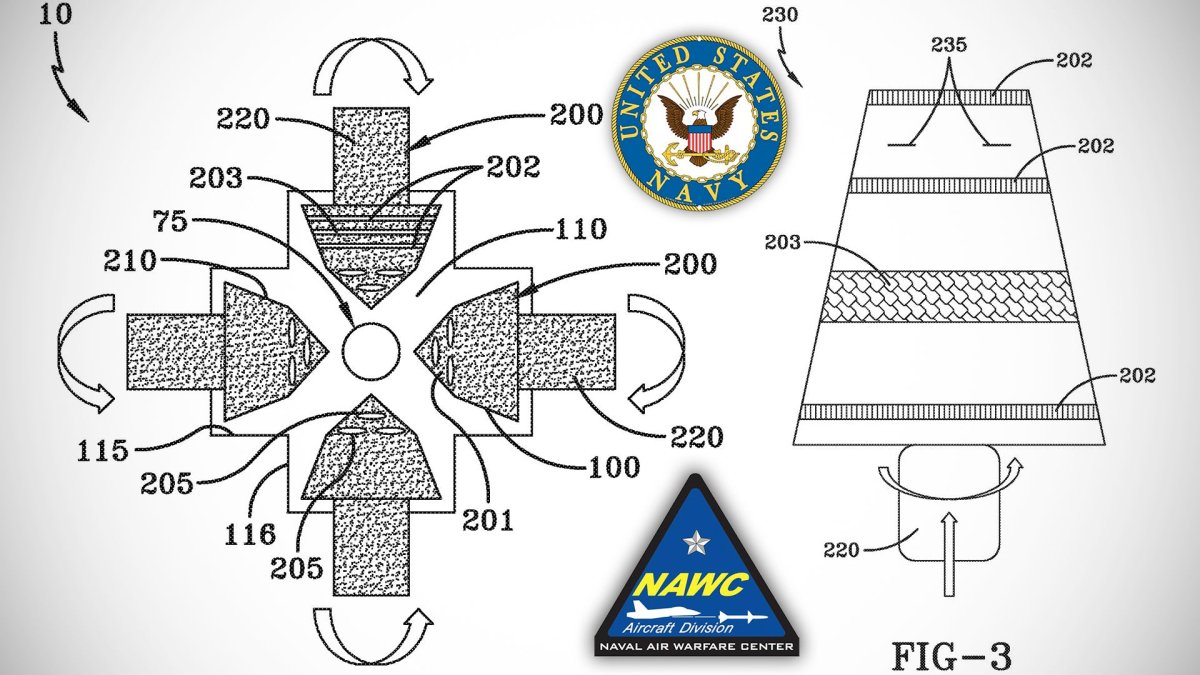
Patent documentation showing the spinning, electrically-charged fusors (200) which are claimed to be able to contain nuclear plasma (75) in a high-energy magnetic field., USPTO
Most fusion reactor designs employ magnetic confinement to contain fusion reactions. This involves torus-shaped coils of superconductors to produce powerful magnetic fields that confine a reactor’s plasma core.
The Navy’s new plasma compression fusion device, however, claims as its key feature the same principle as in Salvatore Pais’ other inventions: the “controlled motion of electrically charged matter via accelerated vibration and/or accelerated spin subjected to smooth yet rapid acceleration transients, in order to generate extremely high energy/high intensity electromagnetic fields.” Pais cites some of his prior publications as evidence that this type of spinning, vibrating electromagnetic system can create the high magnetic fields required to contain powerful fusion reaction in a stable form.
The patent describes how those magnetic fields are generated within a hollow plasma chamber which includes one or more opposing pairs of conical or domed “counter-spinning dynamic fusors” that feature an electrically charged outer surface containing ducts that inject fuel gases, such as Deuterium or Deuterium-Xenon, into the plasma chamber. As these electrically-charged fusors spin, Pais claims, they “create a concentrated magnetic energy flux and electromagnetic radiation within the vacuum chamber,” compressing and heating the gasses within. These fusors vibrate at a high rate as they spin thanks to piezoelectric films such as lead zirconate titanate (PZT) – the same piezoelectric metamaterial Pais claims enables his room-temperature superconductor patent .
Cross-section of one of the conical fusors. Shown are orifices (235) used to inject fuel into the plasma core and the toroidal magnetic coils (203) which generate magnetic fields., USPTO
Like the other bizarre Salvatore Pais patents we’ve covered previously, the extent to which this patent represents an operable, functioning, or even feasible technology isn’t clear. The Navy has vouched for some of his designs in the past, however, going so far as to claim these inventions actually exist in an operable form and that they are needed for national security purposes, most notably to keep pace with adversaries like China . But unlike some of Pais’ patents, this application sailed through the United States Patent and Trademark Office without rejection and subsequent appeal.
Curiously, the patent states that “the invention will be discussed in a space, sea, or terrestrial environment” but notes that “this invention can be utilized for any type of application that requires the use of energy generation.” It is unclear what type of application may exist other than space, sea, or land.
Salvatore Pais is clearly a busy man finding novel applications for high energy electromagnetic fields, and the Navy is patenting some truly science-fiction-like next-generation technologies that if realized, have the potential to change the course of technological development as we know it. Yes, some will likely wonder if this could be the power source that goes along with his other recent “UFO patents”—the engine needed to complete a seemingly otherworldly craft of some sort. The procession of these patents and their potential relation to one another is certainly intriguing, to say the least.
To be frank, we at The War Zone have no idea what is going on here. We have tried to get the Navy to give us some perspective on why these patents were filed, whether they are based on legitimate technology, and why they were ever made public. The Navy remains unwilling to discuss them. At the same time, nearly every physicist we have talked to thinks all of these patents are beyond the realm of known physics and are almost laughable in terms of viability. At the same time, all this is occurring as the Navy, and the Navy alone out of all of the branches of the U.S. military, continues to discuss the fact that its pilots are encountering unexplained aerial phenomena at an alarming rate .
With all this in mind, is the Navy building some sort of incredible craft based on science that remains foreign to the larger scientific community? Did they already do this years ago and are just slowly lifting the veil now? Are they clumsily trying to emulate what their pilots are seeing in the field, but can not yet fully explain? Could these patents just represent gross mismanagement of resources on the Navy’s behalf? Or is this all some sort of elaborate disinformation play by the Navy—one that seems to have emerged right in step the rise of major peer-state competition from the likes of Russia and China, and the biggest expansion of advanced aerospace development programs in decades?
At this time we have no way to give you a definitive answer, but we will continue to investigate in hopes of one day being able to do just that.
We’ve reached out to physicists for comment on this patent and will update this story once we receive their opinions.
Contact the editor: Tyler@thedrive.com
Comments couldn’t be loaded. Please refresh the page.
作者:Brett Tingley 和 Tyler Rogoway
更新于美国东部时间2019年12月1日上午6:03
“战区”栏目一直在报道美国海军获得的一系列奇特专利,这些专利描述了可能彻底革新航空航天领域乃至我们生活方式的革命性新技术。其中包括用于产生力场的高能电磁场,以及一些奇特的航空航天推进和飞行器设计方法,这些方法基本上可以被视为类似UFO的技术。您可以在我们的独家专题报道中了解这些专利的全部内容、可行性以及相关问题。现在,那位神秘的海军航空作战中心飞机部门工程师又提出了一项新的专利——一项关于小型聚变反应堆的专利,该反应堆可以在很小的空间内(甚至可能安装在飞行器上)输出惊人的能量。
能源优势已成为美国军事政策的基石,各大实验室正致力于研发能源领域的“圣杯”——核聚变。这些旨在开发稳定聚变反应堆的尝试,需要利用极其强大的磁场来约束反应堆内部发生的核反应。制造稳定的聚变反应已属不易,但一些实验室更进一步,试图制造小型化反应堆,使其体积小到足以装入集装箱甚至车辆。
目前核反应堆采用的核能发电方式是裂变,即用粒子轰击不稳定的铀同位素和其他放射性物质,使其分裂并释放能量。而聚变则是在极高的压力和温度下,将氚、氘等氢同位素的原子结合在一起,生成氦同位素和中子,这一过程会释放大量能量。
如果能够实现,核聚变将比核裂变有巨大的进步,因为它产生的放射性废物和温室气体要少得多,不需要可用于制造武器的浓缩核材料,熔毁风险也低得多,而且可以使用更可持续的燃料。长期以来,核聚变一直被誉为解决人类能源需求的长期方案。
尽管核物理学家和工程师几十年来一直在进行聚变反应堆设计方面的实验,但要设计出能够承受数亿华氏度高温和极高压力的系统,仍然极具挑战性。目前,世界上大多数“成功”的聚变反应堆只能维持几分钟甚至几秒钟的等离子体放电时间。
设计可移动的核聚变反应堆更具挑战性,例如能够装入集装箱或船舶的反应堆。目前,世界上大多数实验性聚变反应堆的体积都堪比大型建筑物,而当前许多研究的最终目标是开发紧凑型聚变反应堆系统(CFR),使其足够小,可以在船舶甚至飞机上运行。
尽管存在这些障碍,但像美国安全项目这样的智库认为,21 世纪的聚变反应堆将为世界提供低成本、无碳能源,并预测美国可以引领世界最终实现安全稳定的核聚变反应堆。
《战区》栏目一直在报道洛克希德·马丁公司臭鼬工厂研发颠覆性紧凑型聚变反应堆的工作。这家顶尖的航空航天设计部门一直在建造一种新型的、功率更大的实验性反应堆,时间截至2019年7月。
除了洛克希德·马丁公司之外,近年来还有几家私营公司一直在开发自己的小型聚变反应堆,而政府运营的中国科学院声称在开发聚变反应堆方面取得了重大进展,这些反应堆有朝一日可能能够产生革命性的能量水平。
臭鼬工厂团队成员正在研发他们的实验性小型聚变反应堆。(洛克希德·马丁公司)
近年来,洛克希德·马丁公司的CFR设计吸引了大量媒体关注和网络热议,而臭鼬工厂的一位主要客户似乎也在该领域积极开展工作。美国海军已提交一项可能具有革命性意义的新型紧凑型聚变反应堆专利申请,该反应堆声称能够改进臭鼬工厂CFR的不足之处。从该反应堆发明者的身份来看,这项技术必将在科学界引起轰动。
这项最新设计出自行踪神秘的萨尔瓦托·塞萨尔·帕伊斯之手,他曾发明了海军那些奇特且备受争议的室温超导体、高能电磁场发生器以及听起来颇具科幻色彩的推进技术,《战区》此前曾对此进行过报道。帕伊斯的“等离子体压缩聚变装置”专利于2018年3月22日提交申请,并于2019年9月26日正式公布。该专利部分内容如下:
目前,设想中的小型紧凑型聚变反应堆/装置(直径0.3至2米)寥寥无几,而且它们通常采用不同版本的等离子体磁约束技术。其中三种装置分别是洛克希德·马丁公司(LM)臭鼬工厂的紧凑型聚变反应堆(LM-CFR)、EMC2公司的Polywell聚变概念装置以及普林斯顿大学的场反位形(PFRC)装置。[…] 这些装置的等离子体约束时间较短,随着尺寸的增大,可能出现等离子体不稳定性,而且它们能否达到临界聚变条件,更不用说实现自持等离子体燃烧并最终点火,都值得怀疑。
该专利申请声称,这种等离子体压缩聚变装置仅需千瓦(1000瓦)至兆瓦(100万瓦)范围内的输入功率,即可产生吉瓦(10亿瓦)至太瓦(1万亿瓦)甚至更高的功率。相比之下,美国最大的核电站——位于亚利桑那州的帕洛维德核电站——发电量约为4000兆瓦(4吉瓦),而为美国海军“杰拉尔德·R·福特”级航空母舰设计的A1B型核反应堆的发电量约为700兆瓦。该专利甚至声称,该装置“可能实现点火等离子体燃烧,即无需外部输入功率即可实现的自持等离子体燃烧”。
专利文件展示了旋转的带电聚变器(200),据称该聚变器能够在强磁场中容纳核等离子体(75)。(美国专利商标局)
大多数聚变反应堆设计都采用磁约束来控制聚变反应。这涉及到使用环形超导线圈来产生强大的磁场,从而约束反应堆的等离子体核心。
然而,海军的新型等离子体压缩聚变装置声称其关键特性与萨尔瓦托·派斯的其他发明原理相同:即“通过加速振动和/或加速自旋,在平稳而快速的加速瞬态作用下,控制带电物质的运动,从而产生极高能量/高强度的电磁场”。派斯引用了他之前发表的一些论文作为证据,证明这种旋转振动的电磁系统可以产生维持强大聚变反应所需的高磁场,使其保持稳定。
该专利描述了如何在空心等离子体腔室内产生这些磁场。该腔室包含一对或多对反向旋转的锥形或穹顶状“反向旋转动态聚变体”,这些聚变体具有带电的外表面,其内部设有管道,可将燃料气体(例如氘或氘氙)注入等离子体腔室。Pais 声称,当这些带电聚变体旋转时,它们会在真空腔室内“产生集中的磁能通量和电磁辐射”,从而压缩并加热腔室内的气体。由于压电薄膜(例如锆钛酸铅 (PZT))的作用,这些聚变体在旋转时会以极高的频率振动——Pais 声称,正是这种压电超材料使他获得了室温超导专利。
锥形聚变器的横截面图。图中显示了用于向等离子体核心注入燃料的喷嘴 (235) 和产生磁场的环形磁线圈 (203)。(美国专利商标局)
就像我们之前报道过的其他几项萨尔瓦托·派斯(Salvatore Pais)的奇葩专利一样,这项专利究竟代表了多少可操作、可运行,甚至可行的技术,目前尚不清楚。不过,美国海军过去曾为他的一些设计背书,甚至声称这些发明实际上已经以可操作的形式存在,并且出于国家安全目的,尤其是为了与中国等对手保持同步,这些发明必不可少。但与派斯的其他一些专利不同,这项申请在美国专利商标局顺利通过,没有遭到驳回,也没有后续的上诉。
奇怪的是,该专利声称“本发明将在太空、海洋或陆地环境中进行探讨”,但同时又指出“本发明可用于任何需要能源产生的应用”。目前尚不清楚除了太空、海洋或陆地之外,还存在哪些其他类型的应用。
萨尔瓦托·派斯显然是一位忙于探索高能电磁场新用途的人物,而海军正在为一些堪称科幻小说般的下一代技术申请专利。这些技术一旦实现,将有可能彻底改变我们所知的技术发展进程。的确,有些人可能会猜测,这是否就是他近期其他“UFO专利”的动力来源——某种看似来自外太空的飞行器所需的引擎。这些专利的出现及其潜在的关联,至少可以说,确实引人入胜。
坦白说,我们“战区”栏目对这里发生的事情一无所知。我们曾试图让海军解释一下这些专利的申请原因、它们是否基于合法技术,以及它们为何会被公开。但海军始终不愿对此进行讨论。与此同时,我们采访过的几乎所有物理学家都认为,所有这些专利都超出了已知物理学的范畴,其可行性几乎令人啼笑皆非。与此同时,所有这一切都发生在海军——而且是美军所有军种中唯一一个——持续讨论其飞行员遭遇不明空中现象的频率高得惊人的事实之际。
考虑到所有这些因素,海军是否正在建造某种基于科学界尚未完全了解的尖端科技的惊人飞行器?他们是否多年前就已经完成了这项工作,现在才慢慢揭开神秘面纱?他们是否笨拙地试图模仿飞行员在实战中观察到的现象,但目前还无法完全解释?这些专利是否仅仅代表海军对资源的严重滥用?或者,这一切是否是海军精心策划的一场虚假宣传——这场宣传似乎恰好与俄罗斯和中国等主要竞争对手的崛起以及数十年来最大规模的先进航空航天研发项目扩张同步进行?
目前我们无法给您一个确切的答案,但我们会继续调查,希望有一天能够做到这一点。
我们已联系物理学家征求对这项专利的意见,一旦收到他们的意见,我们将更新这篇报道。
联系编辑:Tyler@thedrive.com
评论加载失败,请刷新页面。