We Talk To The Scientist Whose Revolutionary Power Beaming Experiment Is Flying On The X-37B我们采访了那位正在进行革命性能量束实验的科学家,他的实验正在X-37B飞机上进行。
Harvesting solar energy from space has been a topic of research for decades. The Naval Research Lab now has a plan to beam that energy down to Earth.
新闻视频
Updated Jul 30, 2020 2:50 PM EDT
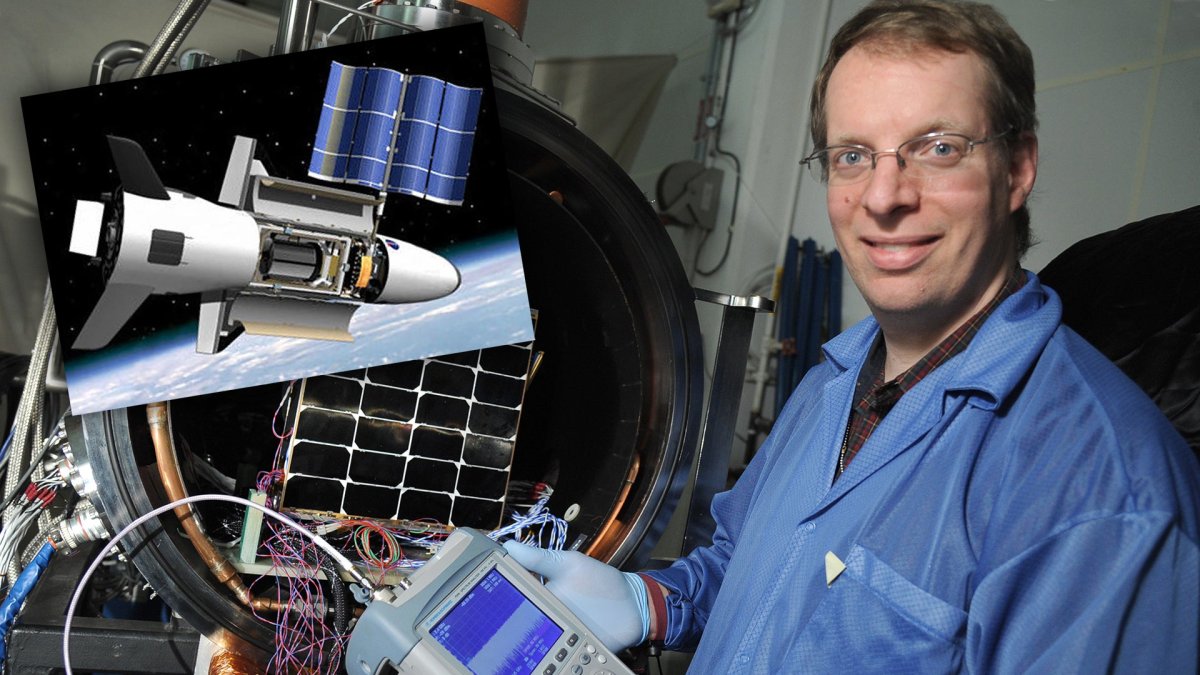
When the U.S. Air Force’s shadowy X-37B space plane was launched on top of a United Launch Alliance Atlas V rocket on May 17, 2020 from Cape Canaveral Air Force Station, it carried with it a revolutionary new system designed by Dr. Paul Jaffe of the Naval Research Laboratory (NRL). The device, known as a Photovoltaic Radio-frequency Antenna Module (PRAM), will eventually be able harvest power using solar panels and beam that power back down to Earth in the form of microwaves.
While the module currently in orbit isn’t transmitting power to Earth, Jaffe and NRL investigators hope to someday be able to leverage space-based solar technologies to provide a revolutionary new source of power to nearly anywhere on the globe regardless of a lack of existing energy infrastructure. The War Zone recently spoke with Jaffe to learn more about the PRAM, power beaming, and space solar in general.
Before we get into our interview, here is a quick primer on Paul Jaffe’s research and just how revolutionary microwave energy beaming from space could be.
Space-Based Solar And Microwave Power Beaming
Paul Jaffe has been an Electronic Engineer at the Naval Research Lab since 1994. He began working on the original PRAM project in 2009. Jaffe would go on to earn his PhD as a result of a Doctoral Research Program while working on PRAM research. His 2013 dissertation described a “ sunlight to microwave power transmission module ” similar to the test module recently launched into orbit aboard the X-37B. Jaffe also holds a patent for “thermally efficient power conversion modules for space solar power,” granted in 2016 and assigned to the Secretary of the Navy.
In 2016, Jaffe and his team were named the winners of the first-ever Department of Defense (DOD) Diplomacy, Development, and Defense (D3) Innovation Summit Pitch Challenge, an initiative designed to foster innovation and collaboration on pressing national security issues far from the battlefield. In an NRL press release announcing the award, Jaffe stated that, if found to be successful and feasible, space-based solar-to-microwave power beaming has the potential to radically change the way power is generated and distributed on Earth. “It’s hard to overstate the significance and benefits of this concept if it comes to fruition,” Jaffe said.
In the same press release, Jaffe also stated that “other major powers around the world, particularly in Asia, are also investigating this idea in earnest.” Indeed, China’s state-run Academy of Space Technology tested such a system in 2019 and boasted that a fully-functional Chinese microwave beaming power station in space could be in orbit by 2050 . Such a system could potentially beam power to rectifying antennas, or rectennas, on the Earth’s surface, providing power to existing installations or to remote areas without existing power infrastructure.
There are many other defense-oriented applications envisioned by the NRL. In 2010, Jaffe published the study “ Defense Applications of Space Solar Power ” in the Space, Propulsion & Energy Sciences International Forum hosted by the American Institute of Physics. In the paper, Jaffe presents a wide variety of defense applications that space-based solar power (SBSP) could augment, including providing power to a number of different installations, vessels, or distributed sensor networks, and even serving as a bistatic radar illuminator. As we cited in our previous reporting , Jaffe’s 2010 research also claimed that SBSP could be used in satellite-to-satellite power transmission or to provide UAVs with greatly extended endurance.
Jaffe lists potential applications of space-based solar in his 2010 publication “A Study of Defense Applications of Space Solar Power” , American Institute of Physics
More recently, Jaffe stated that the power beaming technologies involved with the PRAM module could potentially enable near-unlimited flight times on UAVs. “If we had a way to keep those drones and UAVs flying indefinitely, that would have really far-reaching implications, Jaffe said in a 2019 NRL press release . “With power beaming, we have a path toward being able to do that.” Keeping UAVs in the air indefinitely was also mentioned as a goal in 2014 by Thomas Mehlhorn, superintendent of the Naval Research Laboratory’s Plasma Physics Division.
Other branches of the Armed Forces are pursuing similar technologies and concepts. Since as early as 1964, the USAF has been experimenting with power beaming and UAVs. In that year, Air Force-sponsored researchers were able to keep a small tethered helicopter aloft for ten hours powered only by a microwave power beam . NASA’s Jet Propulsion Laboratory tested the concept of beaming power to Earth from space using microwaves in 1975.
More recently, in 2019, the Air Force Research Laboratory (AFRL) awarded Northrop Grumman a contract valued over $100 million to develop space solar hardware that could provide “uninterrupted, assured, and agile power to expeditionary forces operating in unimproved areas,” such as forward operating bases far from traditional energy infrastructure or fuel supply lines.
“Energy is a strategic enabler and potential vulnerability for our nation and our Department of Defense,” U.S. Air Force Col. Eric Felt, director of AFRL’s Space Vehicles Directorate, said in a 2019 Air Force press release . “To ensure DoD mission success we must have the energy we need at the right place at the right time. The Space Solar Power Incremental Demonstrations and Research (SSPIDR) Project is a very interesting concept that will enable us to capture solar energy in space and precisely beam it to where it is needed,” Felt said. “SSPIDR is part of AFRL’s ‘big idea pipeline’ to ensure we continue to develop game-changing technologies for our Air Force, DoD, nation, and world.”
Now that you have an idea of what this potentially groundbreaking technology is all about, let’s get to our interview with Dr. Paul Jaffe of the Naval Research Laboratory.
Paul Jaffe Talks Space-Based Solar Power
To help us understand this groundbreaking technology and its implications, The War Zone spoke with Dr. Paul Jaffe and the Naval Research Laboratory to discuss how the PRAM experiments are going thus far and what the future may hold for space-based solar and power beaming.
Brett : Why has it taken until now to get the first hardware specifically for solar power satellites in orbit?
Paul : These things definitely take time, and most of it is definitely a function of budget, like if we had 10 times as much money, obviously things would be able to go more quickly. But there is, I think, a very reasonable approach, which is “let’s start with a small amount and if that proves fruitful then we’ll add and expand from there and if it’s not as successful then we’ll investigate something else.”
The original PRAM that started in 2009 was intended as a four-year program, which it was, and with that we started essentially with nothing and then ended up with a module, actually multiple modules, of two different designs, one of which we had to pass on. For the microwave conversion, we also tested those in actual space-like conditions.
Now, getting from there to space is a whole other story. Between 2013 and I guess it was probably 2015, when we started this process that led to where we got to the launch [in May], there’s a whole lot that has to happen where we get more cycles of Shark Tank -like proposal and competition against other researchers and experiments. And also just like working to get something manifested, right, so we’re effectively a passenger on X-37B.
We had many discussions back and forth with them about how we would be hosted and what they would provide for us and how we would behave. We are not radiating any power into space partially because it would be prospectively disruptive to the host. Right now we are radiating into an RF load, a radiofrequency load, and this allows us to measure very precisely how much energy the module is actually producing, which is obviously important for the experiment. We want to make sure that we are measuring and characterizing the efficiency accurately.
To send power to the ground at microwave frequencies from lower orbit would require much larger antenna apertures than are practical to put on X-37B or on most satellites. You would probably have to do like a whole custom satellite for that and that’s much more expensive than being a passenger on a host spacecraft like we are doing for this experiment.
Jaffe and the Photovoltaic Radio-frequency Antenna Module (PRAM), U.S. Navy/Jamie J. Hartman
Brett : So that makes sense why you would use the X-37B for something like this than a more traditional space flight.
Paul : Just to be clear, we didn’t pick the X-37B especially. We started the manifesting process in the mid-2010s, it wasn’t like, “Alright, we’re going to go in X-37B.” We briefed to the space test program, and what they do is match payloads and hosts. And they say this one would be a good fit for this because of how big it is and how much it weighs and when this one is going to launch, and how much accommodation this has. So we could have ended up conceivably on another spacecraft or even on the space station, or we looked at actually geosynchronous spacecraft, we looked at some of the ISS resupply ones. But as we got close they’re like, “Hey, we could put you on here, does that work for you?” And we looked at the trade-off and we said, “Yeah, you know, that’ll accomplish what we’re trying to do with this experiment.”
The PRAM module currently in orbit., U.S. Naval Research Laboratory
Brett : Do you have any data back yet from the experiments?
Paul : We’ve gotten preliminary data on the order of, I think, several thousand records at this point, and we are in the process of putting it into spreadsheets and analyzing it, trying to see what’s happening. So far, things are looking really good. They’re comparable to the testing we did on the ground. One of the things that you might have seen, I don’t know how much you would’ve delved into my 2013 thesis, but it’s important for solar-powered satellites to generally be pretty efficient.
The most important metric is what’s called specific power or watts per kilogram, and that intuitively makes sense, because if you’re going to be putting something into space, you want to get as much power down as you can, with putting the least amount of stuff in space. So if you think about the specific power watts per kilogram, it’s very important for that to be high. If your hardware is more efficient, it’s easier for that specific power to be high. And to have the specific power and efficiency both be optimized, you want to operate your electronics where they are most efficient under the temperature and illumination conditions that result in that.
Because the amount of power coming out of the solar panel changes, and we’re driving the radio frequency electronics so there’s actual power transmission, you want to try to match everything together so that the maximum power is coming out of the solar ray at the same level that the RF electronic can convert at most efficiently. All these things have to be matched, and they all have to stay matched at the equilibrium temperature.
This is one of the big things for PRAM, is like finding that equilibrium point, understanding it, understanding the thermal performance, understanding how hot the solar panel’s getting, how hot the RF electronics are getting, how hot the antenna aperture would be getting if we had one and trying to match those things all up.
A lot of the testing we did on the ground was to find this point, but we could only simulate the space environment and the solar conditions to a certain degree of fidelity. So one of the biggest things we’re getting out of the X-37B experiment, is since we’re actually testing this in space, we’re going to validate our operating point, and the assumptions we made of the equilibrium temperatures. For any future solar power satellite system, it’s going to be super important to understand these points and to be able to engineer to them and to be able to show that you can operate at this and you can actually get the system power and efficiency this way.
Brett : How much dwell time relative to a point on the ground do you have per orbit?
Paul: If you’re thinking about a solar power satellite system in the future, the answer to that question is going to depend totally on the orbit that the satellite is. So if it’s in geosynchronous orbit, which is where most of the solar power satellite systems that have been proposed to exist in, it’s going to be in sunlight for more than 99% of the time during the year and it will have continuous 24/7 ground coverage obviously, while in sunlight, of a pretty large swath of the Earth, like in excess of a quarter of the Earth is where it could send the power beam.
Now a power beam won’t cover a quarter of the Earth, it’ll send it probably to a specific location. But that would be available close to 24/7, 365. There are periods around the equinoxes at local midnight when the satellite would go into eclipse for some period of minutes, I think it might be slightly longer than an hour. There’s a number of analyses and stuff have been done on these things. This is all for a single satellite, so if you have a single satellite in a lower orbit, the coverage will vary. And there’s many different orbits lower or otherwise, but you can envision that instead of focusing just on a single satellite, that you would likely build a constellation. If you do judicious constellation design, you can ensure that no matter where you are at any point in time, that you could have power provided by a given satellite.
Brett: You mentioned that keeping UAVs in the air indefinitely is one of the potential applications of this technology. Is that something you’re looking at specifically with the PRAM module?
Paul: Power beaming and space solar are constantly conflated. Power beaming is just moving energy without using wires or moving mass. So you could power UAV from the ground using power beaming, you could power a UAV from another aircraft using power beaming. You can power a UAV from space using power beaming. You could use power beaming to get energy to the permanently shadowed craters on the moon, or a whole range of different places. So the connection between PRAM and power UAVs is really only through the fact that PRAM is part of the system that is envisioned to use power beaming.
Space solar depends on power beaming in almost all of its incarnations, but power beaming is a totally separate technology that has many applications that have nothing to do with space solar, or even with space necessarily. Because you can’t have space solar without power beaming, it makes a lot of sense to do the power beaming research first, right? Power beaming makes a lot of sense as a place to focus because without that being more mature, space solar is just harder to justify; and it’s harder to design a system, a concept that makes sense because there are just too many unknowns.
Brett: What does the future of space solar look like?
Paul: The data we get from that is going to inform these efforts moving toward the next generation that will be built, and then the power beaming work, likewise, will inform whether it makes sense to pursue these other applications, the ones that use laser power beams or some other power beam. And along the way, we’re always looking carefully at the nearer term applications, of which there are many for power beaming. 20 years ago, you wouldn’t have thought about wirelessly charging your phones using the Qi standard or charging pad or something. As power beaming starts to become more of a technology unto its own, I think we’ll see a lot more applications.
And there’s a lot of startups even within the last year or so that think they have the secret sauce that’s going to make space solar economically viable. A lot of whom don’t want their existence known just yet.
I think that if solar powered satellites become a thing, there’s a couple paths they could take. This is another thing where history is kind of useful to look at, where if we were in 1950 and I was like, “Hey, we should be able to make it so that people can have a little handheld thing and we’ll have this constellation of a dozen satellites, each of which will have its own atomic clock and they’ll beam signals down to the ground, and we’ll do a bunch of math on the device, and they’ll tell people no matter where they are in the world, where they are,” you would think that I was crazy. In 1960, not only was even getting a satellite into space very difficult, but no one had put an atomic clock on a satellite at that point. And all of those things incrementally were advanced until the point where we are today, where we take GPS navigation kind of for granted.
Development for solar powered satellites might unfold like GPS, but it also might unfold like communication satellites where Congress recognized like, “Hey, there’s a lot of utilities to be had here, and we’ll pass the Comsat Act and set up the development framework that will let industry take the lead on this.” GPS was all government developed and now, other governments around the world are trying to play catch up.
Dr. Paul Jaffe is presenting a webinar on Power Beaming & Space Solar Innovation hosted by the Homeland Defense & Security Information Analysis Center on Thursday, July 30. More information can be found at https://www.hdiac.org/podcast/power-beaming/ .
Contact the author: Brett@TheDrive.com
Comments couldn’t be loaded. Please refresh the page.
更新于美国东部时间2020年7月30日下午2:50
2020年5月17日,美国空军神秘的X-37B太空飞机搭乘联合发射联盟的阿特拉斯五号火箭从卡纳维拉尔角空军基地发射升空。飞机携带了一套由海军研究实验室(NRL)的保罗·贾菲博士设计的革命性新系统。这套名为光伏射频天线模块(PRAM)的装置最终将能够利用太阳能电池板收集能量,并以微波的形式将能量传回地球。
虽然目前在轨运行的模块尚未向地球传输电力,但贾菲和美国海军研究实验室的研究人员希望有朝一日能够利用太空太阳能技术,为全球几乎任何地方提供一种革命性的新型能源,而无需考虑现有能源基础设施的匮乏。《战区》杂志近期采访了贾菲,以了解更多关于PRAM模块、电力传输以及太空太阳能技术的信息。
在我们正式开始采访之前,先快速了解一下保罗·贾菲的研究,以及从太空发射微波能量可能带来的革命性影响。
空间太阳能和微波功率传输
保罗·贾菲自1994年起担任海军研究实验室的电子工程师。他于2009年开始参与PRAM的早期项目。在从事PRAM研究的同时,贾菲通过博士研究项目获得了博士学位。他2013年的博士论文描述了一种“太阳光到微波功率传输模块”,类似于最近随X-37B发射入轨的测试模块。贾菲还拥有一项名为“用于太空太阳能的热高效功率转换模块”的专利,该专利于2016年获得授权,并已转让给海军部长。
2016年,贾菲和他的团队赢得了首届美国国防部外交、发展与国防(D3)创新峰会提案挑战赛的冠军。该峰会旨在促进在远离战场的紧迫国家安全问题上开展创新与合作。在海军研究实验室(NRL)发布的获奖新闻稿中,贾菲表示,如果太空太阳能微波能量传输技术被证实成功且可行,它将有可能彻底改变地球上的能源生产和分配方式。“如果这项技术最终得以实现,其意义和益处怎么强调都不为过,”贾菲说道。
在同一份新闻稿中,贾菲还表示,“世界其他主要大国,特别是亚洲国家,也在认真研究这一想法。” 事实上,中国国家空间技术研究院在2019年测试了这样一套系统,并宣称到2050年,中国就能在太空部署一座功能齐全的微波发射电站。这样的系统可以将电力传输到地球表面的整流天线(或称整流天线),为现有设施或缺乏电力基础设施的偏远地区供电。
美国海军研究实验室(NRL)还设想了许多其他面向国防的应用。2010年,杰夫在美国物理学会主办的空间、推进与能源科学国际论坛上发表了题为《空间太阳能发电的国防应用》的研究报告。在报告中,杰夫列举了空间太阳能发电(SBSP)可以增强的多种国防应用,包括为各种不同的设施、舰船或分布式传感器网络供电,甚至可以用作双基地雷达照射器。正如我们在之前的报道中提到的,杰夫2010年的研究还指出,空间太阳能发电可用于卫星间的电力传输,或大幅延长无人机的续航时间。
贾菲在其2010年发表的《太空太阳能在国防领域的应用研究》(美国物理学会)一文中列举了太空太阳能的潜在应用。
最近,贾菲表示,PRAM模块所涉及的能量传输技术有可能使无人机实现近乎无限的飞行时间。“如果我们有办法让这些无人机无限期地飞行,那将产生非常深远的影响,”贾菲在2019年美国海军研究实验室(NRL)的新闻稿中说道。“有了能量传输技术,我们就有办法实现这一目标。” 2014年,美国海军研究实验室等离子体物理部主任托马斯·梅尔霍恩也曾提到,让无人机无限期地飞行是他们的目标之一。
其他军种也在研究类似的技术和概念。早在1964年,美国空军就开始试验能量传输和无人机技术。那一年,空军资助的研究人员成功地让一架小型系留直升机仅靠微波能量束维持飞行十个小时。1975年,美国宇航局喷气推进实验室测试了利用微波从太空向地球传输能量的概念。
最近,在 2019 年,美国空军研究实验室 (AFRL) 授予诺斯罗普·格鲁曼公司一份价值超过 1 亿美元的合同,用于开发太空太阳能硬件,该硬件可以为“在未开发地区作战的远征部队”提供“不间断、可靠和灵活的电力”,例如远离传统能源基础设施或燃料供应线的前沿作战基地。
“能源既是我国和国防部的战略推动因素,也是潜在的薄弱环节,”美国空军研究实验室(AFRL)航天器理事会主任埃里克·费尔特上校在2019年空军新闻稿中表示。“为了确保国防部任务的成功,我们必须在正确的时间、正确的地点获得所需的能源。太空太阳能增量演示与研究(SSPIDR)项目是一个非常有趣的概念,它将使我们能够在太空捕获太阳能,并将其精确地传输到需要的地方,”费尔特说。“SSPIDR是AFRL‘重大创新项目储备’的一部分,旨在确保我们能够继续为空军、国防部、国家乃至全世界开发具有变革意义的技术。”
现在您已经对这项可能具有突破性意义的技术有了一定的了解,接下来让我们采访海军研究实验室的保罗·贾菲博士。
保罗·贾菲谈太空太阳能发电
为了帮助我们了解这项突破性技术及其影响,《战区》采访了保罗·贾菲博士和海军研究实验室,讨论了 PRAM 实验迄今为止的进展情况,以及太空太阳能和电力传输的未来发展方向。
Brett:为什么直到现在才将第一台专门用于太阳能发电卫星的硬件送入轨道?
保罗:这些事情肯定需要时间,而且大部分都取决于预算,比如如果我们有十倍的资金,事情显然会进展得更快。但我认为有一个非常合理的办法,那就是“先从小规模开始,如果效果好,我们就增加投入,逐步扩大规模;如果效果不佳,我们就探索其他方法。”
最初的PRAM项目始于2009年,计划为期四年,也确实如此。我们几乎是从零开始,最终开发出了一个模块,实际上是多个模块,采用了两种不同的设计,其中一种我们不得不放弃。对于微波转换,我们也在类似太空的实际环境中进行了测试。
现在,从那里进入太空又是另一回事了。从2013年到2015年(我猜是2015年),我们启动了这个项目,最终在5月份成功发射。这期间还有很多事情要做,我们需要经历更多轮类似“创智赢家”(Shark Tank)的提案评审,与其他研究人员和实验项目竞争。而且,我们还需要努力将想法付诸实践,对吧?所以,我们实际上只是X-37B的乘客。
我们与他们就如何接待我们、他们会为我们提供什么以及我们的行为规范进行了多次讨论。我们没有向太空辐射任何能量,部分原因是这可能会对接待方造成干扰。目前,我们正在向射频负载(RF负载)辐射能量,这使我们能够非常精确地测量模块实际产生的能量,这对于实验显然至关重要。我们希望确保能够准确地测量和表征效率。
要从低轨道以微波频率向地面传输电力,所需的天线孔径要比X-37B或大多数卫星实际能安装的要大得多。这可能需要专门定制一颗卫星,而这比像我们这次实验一样搭乘宿主航天器要昂贵得多。
杰夫和光伏射频天线模块(PRAM),美国海军/杰米·J·哈特曼
Brett:所以这就解释了为什么你会选择使用 X-37B 来进行这样的任务,而不是进行更传统的太空飞行。
保罗:澄清一下,我们并非特意选择X-37B。我们在2010年代中期就开始着手准备,并不是一开始就决定“我们要用X-37B”。我们向太空测试项目组做了简报,他们的工作是匹配有效载荷和搭载平台。他们认为X-37B很适合我们的项目,因为它的尺寸、重量、发射时间和舱位都符合要求。所以,我们原本有可能选择其他航天器,甚至是国际空间站,我们也考虑过地球同步轨道飞行器,比如国际空间站的补给飞船。但临近最终确定方案时,他们说:“嘿,我们可以把你们送上去,你们觉得怎么样?”我们权衡利弊后表示:“是的,你知道,这能实现我们这次实验的目标。”
目前在轨运行的PRAM模块,美国海军研究实验室
Brett:你们实验那边有数据了吗?
保罗:目前我们已经收集到了大约几千条记录的初步数据,正在将其整理到电子表格中进行分析,试图了解情况。到目前为止,一切进展顺利,与我们在地面进行的测试结果相当。你可能已经注意到,我不知道你是否仔细研究过我2013年的论文,但对于太阳能卫星来说,保持较高的效率至关重要。
最重要的指标是比功率,也就是每千克的功率(瓦特/千克),这很容易理解,因为如果你要把东西送入太空,你肯定希望尽可能多地利用能量,同时尽可能减少太空中的物质重量。所以,比功率(瓦特/千克)越高越好。如果你的硬件效率更高,就更容易获得更高的比功率。为了同时优化比功率和效率,你需要让电子设备在最适宜的温度和光照条件下运行,从而达到最佳效率。
由于太阳能电池板的输出功率会变化,而我们又需要驱动射频电子设备进行实际的功率传输,因此我们需要尽可能地使所有部件匹配,确保太阳光线输出的最大功率与射频电子设备能够最高效转换的功率水平相匹配。所有这些因素都必须匹配,并且在平衡温度下保持匹配状态。
对于 PRAM 来说,这就像找到平衡点,了解它,了解热性能,了解太阳能电池板的温度,了解射频电子设备的温度,了解如果有天线孔径会有多热,并试图将所有这些因素匹配起来。
我们在地面上进行的许多测试都是为了找到这个关键点,但我们只能在一定程度上模拟太空环境和太阳条件。因此,X-37B实验最大的收获之一,就是因为我们是在太空中进行实际测试,所以我们将验证我们的工作点以及我们对平衡温度的假设。对于任何未来的太阳能发电卫星系统来说,理解这些关键点并能够据此进行工程设计至关重要,这样才能证明系统能够在这些条件下运行,并真正获得所需的功率和效率。
Brett:相对于地面上的某一点,每次轨道飞行中,你的飞行器会有多少停留时间?
保罗:如果你在考虑未来的太阳能卫星发电系统,那么这个问题的答案将完全取决于卫星的轨道。如果它位于地球同步轨道(目前大多数太阳能卫星发电系统都计划运行在这个轨道上),那么它一年中超过99%的时间都将处于阳光照射下,显然可以实现全天候不间断的地面覆盖。在阳光照射下,它可以将能量束投射到地球相当大的区域,比如超过地球四分之一的区域。
现在,一束电力光束不会覆盖地球的四分之一,它只会将电力输送到特定地点。但这样就能实现近乎全天候、全年无休的供电。在春分、秋分和秋分前后,当地时间午夜时分,卫星可能会被遮挡几分钟,我想大概会超过一个小时。关于这些方面已经有很多分析和研究。以上都是针对单颗卫星的情况,所以如果单颗卫星运行在较低的轨道上,覆盖范围就会有所不同。轨道有很多种,有的低,有的则高,但你可以设想,与其只关注单颗卫星,不如构建一个卫星星座。如果星座设计得当,就能确保无论何时何地,都能获得来自特定卫星的电力供应。
Brett:你提到让无人机无限期地保持在空中是这项技术的潜在应用之一。你们是否正在专门研究如何利用PRAM模块来实现这一点?
保罗:能量传输和太空太阳能经常被混淆。能量传输其实就是无需电线或移动质量即可传输能量。所以,你可以用能量传输从地面给无人机供电,也可以用能量传输从另一架飞机给无人机供电。你甚至可以用能量传输从太空给无人机供电。你还可以用能量传输将能量输送到月球上永久阴影的陨石坑,或者其他各种不同的地方。因此,PRAM 和为无人机供电之间的联系实际上仅仅在于,PRAM 是设想中利用能量传输的系统的一部分。
几乎所有形式的太空太阳能都依赖于能量传输技术,但能量传输本身是一项完全独立的技术,它有许多与太空太阳能甚至太空本身都无关的应用。既然没有能量传输技术就无法实现太空太阳能,那么首先进行能量传输技术的研究就显得非常合理,对吧?将能量传输技术作为研究重点是非常明智的,因为如果这项技术不够成熟,太空太阳能就很难站得住脚;而且,由于存在太多未知因素,设计一个合理的系统或概念也更加困难。
Brett:太空太阳能的未来前景如何?
保罗:我们从中获得的数据将指导我们向下一代产品的研发,同样,能量束传输的研究成果也将帮助我们判断是否有必要继续探索其他应用,例如使用激光束或其他能量束的应用。与此同时,我们也在密切关注近期应用,而能量束传输技术在这方面有着诸多潜力。20年前,你根本不会想到用Qi标准或无线充电板之类的设备给手机无线充电。随着能量束传输技术逐渐发展成为一项独立的技术,我相信我们会看到更多应用。
甚至在过去一年左右的时间里,涌现出许多初创公司,他们认为自己掌握了使太空太阳能发电在经济上可行的秘诀。其中许多公司目前还不希望被人知晓。
我认为,如果太阳能卫星真的成为现实,它们可能会走上两条不同的发展道路。在这方面,历史经验也很有用。试想一下,如果在1950年,我说:“嘿,我们应该能制造出一种小型手持设备,然后我们就能构建一个由十几颗卫星组成的星座,每颗卫星都配备自己的原子钟,向地面发射信号,我们再对设备进行一系列计算,就能告诉世界上任何一个人他们的位置。”你肯定会觉得我疯了。到了1960年,不仅把卫星送入太空非常困难,而且当时还没有人把原子钟装到卫星上。所有这些技术都是逐步发展起来的,直到今天,我们才开始理所当然地使用GPS导航。
太阳能卫星的研发进程或许会像GPS那样展开,但也可能像通信卫星那样,国会意识到“这里面蕴藏着巨大的商机,我们将通过《通信卫星法案》,建立发展框架,让业界主导这项技术”。GPS完全由政府研发,如今,世界各国政府都在努力追赶。
Paul Jaffe 博士将于 7 月 30 日星期四在国土安全防御与安全信息分析中心主办的网络研讨会上发表关于能量传输和空间太阳能创新的演讲。更多信息请访问 https://www.hdiac.org/podcast/power-beaming/ 。
联系作者:Brett@TheDrive.com
评论加载失败,请刷新页面。