The 10 Best Military Arcade Games of the 80s80年代十大最佳军事街机游戏
Battle is a hell of a thing in 8-bits.
Updated Jul 2, 2020 3:14 PM EDT
The graphics and the soundtracks of 1980s arcade games were crude. The storylines? Spartan. Yet, duking it out in the 1980s was just brilliant: Somehow even more stressful than the very best of our modern shooters. It was a wonderful time.
For this list, only military games make the cut. That rules out space games like “Asteroids,” “Defender,” “Galaga” and “Star Wars,” and favorites like “Major Havoc” and “Moon Patrol.” Even Spyhunter, a classic with lots of weapons and dodging and shooting has to sit this one out. But no sweat. The arcades of the 1980s had almost an almost boundless number of fantastic military games. And the best of them, the games that hold up all these years later? They’re right here:
“Twin Eagle: Revenge Joe’s Brother” (1988)
Known almost as much for its awesome mistranslation as for its scrolling gameplay, Seta’s 1988 helicopter attack game was both a graphics juggernaut and bit of a gameplay jumble—especially in two-player mode, where the second player’s virtually identical chopper can easily be mistaken for yours. Which inevitably leads to augering in because, while the warbird in Twin Eagle can dish a ton of damage, it’s a fragile little thing and can only take one hit before it’s finished.
“Armor Attack” (1980)
It never had the popularity of its contemporaries from 1980, Missile Command and Battlezone, but Armor Attack was a brilliant arcade game. A monitor overlay added depth to the bitmap graphics, and ever-increasing game speed kept things challenging. The best Armor Attack cabinets were of the flat, table-like, PacMan variety; great for straining your neck and even better for holding a drink and a slice of pizza.
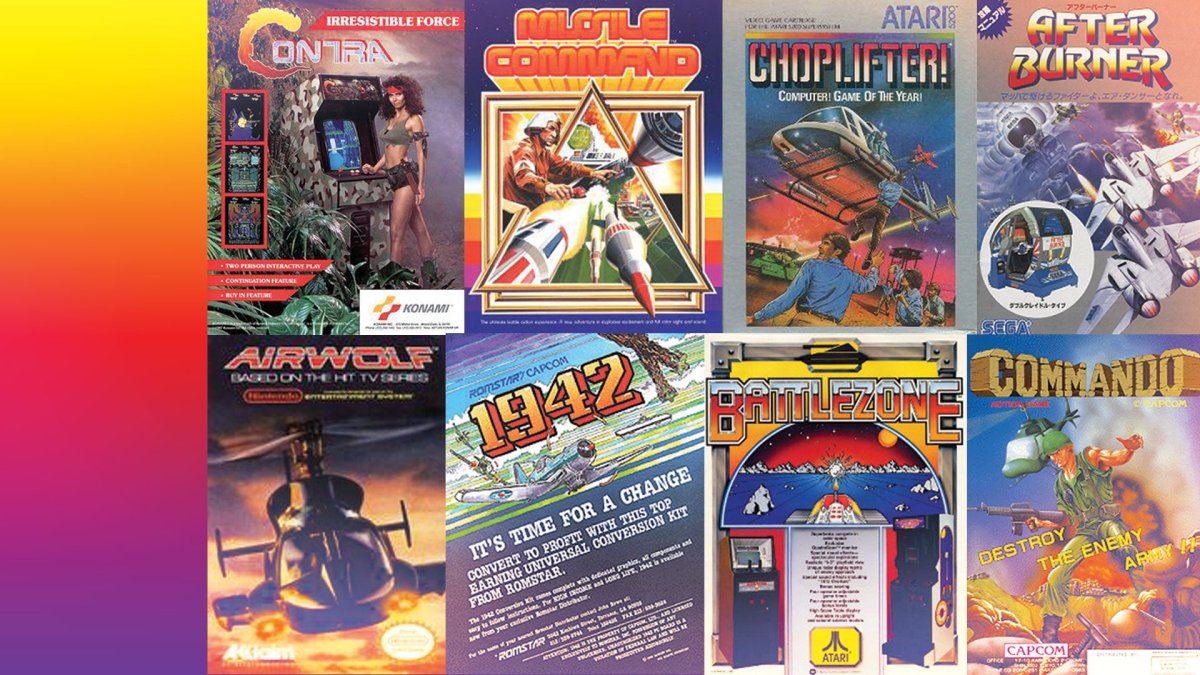
Dropped off in the tropics by a helicopter, Super Joe battles his way through palm trees and enemy soldiers, attacking ever upward on “Commando”’s scrolling screen. An eight-way controller means Super Joe had to unleash a somewhat unscientific barrage of gunfire and grenades to get it done. The bullets? Those were unlimited, but the grenade supply had a knack for running thin real quick. Combined, it was a test of hand-eye coordination for sure, but “Commando” was good fun, and more than enough to land the number eight spot.
“Missile Command” (1980)
Who knew something so simple could be so infuriatingly challenging? Or so ominous. The player defended cities from the rain of nuclear missiles with an ever-dwindling supply of surface to air missiles. They started slow of course, and turned into an interminable rain of MIRVs. Or, you know, tiny pixelated streaks across the screen that would reduce your tiny pixelated cities to tiny pixelated rubble.
An unusual port from console to the arcade makes “Choplifter” a bit of a curiosity. And the funky controls? Well, those made “Choplifter” a sonofabitch. But the game was as addictive as they come. Fighting through tanks and jets was all well and good, but “Choplifter” was all about a daring rescue mission. That’s what made the game so delightful–dancing along that precarious edge between shooting up the baddies, and hard maneuvering just above the ground that might make for a better rescue attempt.
It was a match made in heaven: The very best of 1980s television mixed with the very best of side-scrolling 1980’s helicopter-based gameplay. Elements of “Choplifter,” “1942,” and “Twin Eagle,” all came together with “Airwolf”’s badass theme song. It’s very nearly a perfect blend. One that would, if not for the cruel hand of history, have landed “Airwolf” much higher up the list.
Capcom’s first saw an American aviator flying a twin-tailed P-38 through the fearsome air forces of the Japanese Imperial Navy. Mastering machine guns and the vertical loop, fearless flyers would battle through swarm after swarm of swooping and attacking Zero and Hein fighters, then duke it out with a big boss Nakajima bomber, all the way to Tokyo. “1942” was the first in a series of vertically scrolling shooters from Capcom. While sequels upped the ante for graphics and weapons payloads, the original gets the nod here for its originality and quality of game play.
Like “Missile Command,” “Battlezone”’s simplistic wireframe graphics didn’t boast much detail. But it didn’t matter, the depth and action that Atari was able to create within those pencil-thin lines is brilliant to this day. While the occasional alien saucer means “Battlezone” treads a thin line with the space game rule, the tank-on-tank and guided-missile dueling is enough to secure it a place on our list; and the delightfully frustrating first-person gameplay boosts it even higher. But most compelling? It’s “Battlezone”’s hard-earned legitimacy. Slightly modified, stripped of its UFO’s and equipped with a yoke from the tank itself, the game was adapted to train American Bradley Fighting Vehicle crews. The shooting action clearly carries with it some nostalgia as well, as “Battlezone” has recently been rebooted for virtual reality and the PlayStation 4.
Lance and Bill strafe their way across the screen, somersaulting their way through the jungles of the future. “Contra” set the standard for run-and-gun gameplay. Its graphics were bold, and perhaps the best of the era. But the best part of “Contra”? The teamwork: fighting, heads-up, against a busy and challenging enemy with a capable partner only improves an already fantastic game.
“After Burner” (1987)
A classic third-person air-to-air shooter framed around the legendary F-14 Tomcat. From takeoff to your inevitable fiery demise, “After Burner”’s action was bright and colorful and just relentless. Every version of “After Burner” had kickass fighter-style controls, and would-be pilots fired its weapons from the joystick, just like the real deal. The best of the arcade versions had moving cockpits with stereo sound, and even the plain-Jane iterations of the game were good enough to totally ruin your quarter supply come laundry day.
Comments couldn’t be loaded. Please refresh the page.
更新于美国东部时间2020年7月2日下午3:14
20世纪80年代街机游戏的画面和音效都很粗糙,故事情节更是简陋。然而,在80年代玩街机游戏却是一种享受:它甚至比我们今天玩过的最棒的射击游戏还要刺激。那真是一个美好的时代。
这份榜单只收录军事游戏。这就排除了《小行星》、《捍卫者》、《小蜜蜂》和《星球大战》等太空游戏,以及《大浩劫》和《月球巡逻队》等热门游戏。就连拥有众多武器、躲避和射击元素的经典游戏《间谍猎手》也无缘入选。不过别担心。上世纪80年代的街机厅里有数不胜数的精彩军事游戏。而其中最优秀的、经久不衰的佳作呢?它们就在这里:
《双鹰:复仇乔的兄弟》(1988)
Seta工作室1988年推出的这款直升机攻击游戏,其令人捧腹的翻译错误几乎与它的横版卷轴玩法一样出名。它画面精美绝伦,但玩法却略显混乱——尤其是在双人模式下,第二个玩家的直升机几乎与你的一模一样,很容易被误认为是你的。这不可避免地会导致误伤,因为虽然《双鹰》中的战机火力强大,但它本身却十分脆弱,一击便会报废。
《装甲攻击》(1980)
虽然《装甲攻击》从未像1980年代的《导弹指挥官》和《战斗地带》那样风靡一时,但它仍然是一款杰出的街机游戏。显示器叠加层为位图图形增添了深度,不断提升的游戏速度也让游戏充满挑战性。最好的《装甲攻击》街机是那种扁平的、类似吃豆人的桌面式机台;非常适合长时间玩,而且放在桌上还能顺便吃杯饮料和一片披萨。
超级乔被直升机空投到热带地区,在《突击队员》的滚动屏幕上,他一路披荆斩棘,穿过棕榈树和敌军,不断向上进攻。由于需要使用八向控制器,超级乔只能胡乱地发射子弹和手榴弹才能完成任务。子弹无限,但手榴弹却总是很快就用完。这无疑考验玩家的手眼协调能力,但《突击队员》玩起来非常有趣,足以跻身第八名。
《导弹指挥官》(1980)
谁能想到如此简单的游戏竟会如此令人抓狂?或者说如此不祥?玩家要用日益减少的地对空导弹保卫城市,抵御如雨点般落下的核导弹。导弹一开始数量稀少,后来逐渐演变成无休止的MIRV(多弹头分导式导弹)轰炸。或者,你知道的,屏幕上那些细小的像素条纹,会将你那小小的像素城市夷为平地。
从主机移植到街机平台,《直升机救援》(Choplifter)这款游戏本身就颇具特色,也因此显得有些另类。至于那古怪的操作?嗯,简直让人抓狂。但这款游戏却有着令人欲罢不能的魔力。与坦克和喷气式飞机战斗固然刺激,但《直升机救援》的精髓在于一场惊心动魄的救援任务。而这正是游戏的魅力所在——在射击敌人和高空飞行之间游走,力求找到最佳救援时机。
这简直是天作之合:将 80 年代最优秀的电视节目与 80 年代最精彩的横版直升机射击游戏完美融合。《直升机救援》、《1942》和《双鹰》的元素,再加上《飞狼》那首酷炫的主题曲,完美地结合在一起。这几乎是一次完美的融合。如果不是历史的残酷捉弄,《飞狼》的排名本应更高。
卡普空的首款作品中,一位美国飞行员驾驶着双垂尾的P-38战斗机,穿梭于日本帝国海军令人闻风丧胆的空军之间。这位无畏的飞行员精通机枪和垂直翻滚技巧,与一波又一波俯冲攻击的零式和海因战斗机展开激战,最终与强大的中岛轰炸机决一死战,一路杀到东京。“1942”是卡普空纵向卷轴射击游戏系列的开山之作。虽然续作在画面和武器装备方面都进行了大幅提升,但初代作品凭借其独创性和高质量的游戏体验,依然脱颖而出。
与《导弹指挥官》(Missile Command)一样,《战斗地带》(Battlezone)的简洁线框画面细节并不丰富。但这并不重要,雅达利(Atari)在这些纤细的线条中创造出的深度和动作效果,即使在今天看来也堪称精妙绝伦。虽然偶尔出现的外星飞碟让《战斗地带》在太空游戏规则的边缘游走,但坦克对战和导弹对决足以让它在我们的榜单上占有一席之地;而令人又爱又恨的第一人称视角更是锦上添花。但最引人注目的是什么?是《战斗地带》来之不易的权威性。经过一些修改,去掉了UFO,并配备了坦克本身的操纵杆,这款游戏被改编用于训练美国布雷德利步兵战车的乘员。射击动作显然也承载着一些怀旧情怀,因为《战斗地带》最近已被重新开发,登陆了虚拟现实和PlayStation 4平台。
兰斯和比尔在未来丛林中横冲直撞,翻腾跳跃。《魂斗罗》为横版射击游戏树立了标杆。它的画面大胆创新,或许是那个时代最优秀的作品。但《魂斗罗》最精彩的部分是什么?是团队合作:与一位得力的伙伴并肩作战,正面迎战忙碌而强大的敌人,这无疑让这款原本就非常出色的游戏更加精彩。
《冲破火网》(1987)
一款以传奇F-14“雄猫”战斗机为主角的经典第三人称空对空射击游戏。从起飞到最终的坠毁,《冲破火网》(After Burner)的战斗画面明亮绚丽,节奏紧凑刺激。每个版本的《冲破火网》都拥有令人热血沸腾的战斗机式操控,玩家可以像驾驶真正的F-14一样,通过操纵杆发射武器。街机版中的佼佼者甚至配备了带有立体声效果的动态座舱,而即使是最简陋的版本,也足以让你在洗衣日那天把所有硬币都花光。
评论加载失败,请刷新页面。