This Bird Strike Reminds Us it Doesn’t Take a Missile to Down a Fighter这次鸟击事件提醒我们,击落战斗机并不一定需要导弹。
Tactical military aircraft, and especially fighters, are particularly vulnerable to bird strikes.
新闻视频
Updated Jul 3, 2020 3:34 AM EDT
The possibility of taking a bird strike, especially during the terminal phases of flight around airports, or while flying at low level, is just a fact of life for aviators. Different types of aircraft that travel at different speeds, in different flight environments and with various forms of propulsion have their own unique vulnerabilities when it comest to run-ins with birds. This has resulted in specific design elements built into modern aircraft that work as countermeasures against bird strikes and engine ingestions.
For instance, fighter jets often have reinforced windscreens capable of lessening the severity of a bird strike at lower speeds, while airliners, with their big high-bypass turbofan engines, are designed to be able to ingest birds up to a particular size without flaming out. But even the most advanced engines can only ingest so much mass before realizing a catastrophic loss of power. Maybe the most famous example of this was the “Miracle On The Hudson” when Captain Sully made a successful gliding descent into the Hudson in an A320 full of passengers after ingesting geese in both of the aircraft’s engines shortly after takeoff.
High performance fighter engines, with lower bypass ratios, are more susceptible to catastrophic bird ingestions than their big high-bypass turbofan cousins. As such, fighter pilots take a particular interest in avoiding birds, especially flocks of them. But considering the speeds that these aircraft are moving at, and how busy their pilots are in the cockpit, sometimes birds cannot be avoided, as seen in the video below. In fact, even if the bird doesn’t take down the jet, the pilot’s reaction to the strike could.
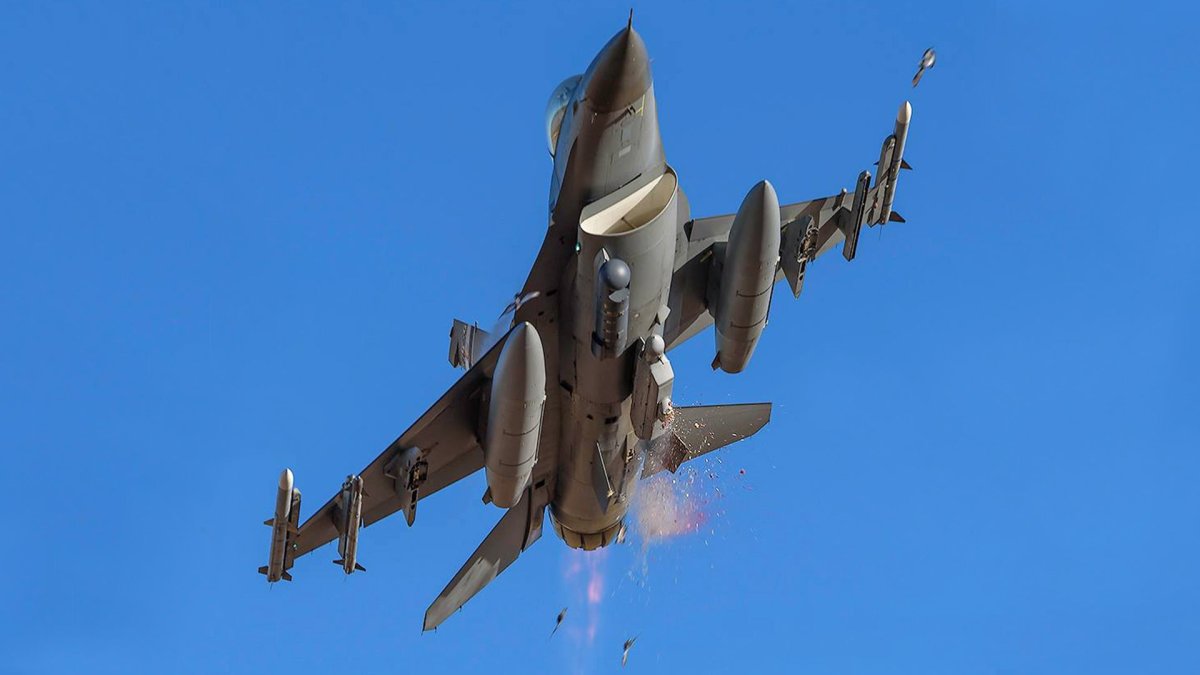
An amazing example of this is the photo seen above, taken by aviation photographer, air traffic controller, and veteran AWACS crewman, Louis DePaemelaere ( check out his site here ), at Buckley Air Force Base in Colorado.
The picture shows one of the 120th Fighter Squadron F-16C’s blasting out of Buckley and right into a small gathering of birds, one of which had a dramatic collision with the Viper’s ALQ-131 electronic countermeasures pod mounted on its centerline station. A bit higher and the result of such a collision could have been far more severe.
The result of an F-16’s canopy meeting a bird in flight. , DoD
Although the F-16’s single-piece bubble canopy was engineered to withstand a strike from a four pound bird while traveling at 350 knots, and the Block 30 F-16C’s GE-F110 engine was designed with bird ingestion failure resistance in mind, encounters with birds can lead to quick and dramatic flight terminations for the single engine fighter, as seen in the amazing video below. And even in the case of the photo above, maybe ingesting one of these bird would not have resulted in the total loss of the aircraft, but multiple ones surely could have.
The USAF takes bird strikes very seriously, and along with air bases and co-located civilian airports that their aircraft are based at, Bird Aircraft Strike Hazard (BASH) prevention programs have been put into place.
Th e DoD describes its BASH initiative and the need for it as such:
“Each year, civil and military aircraft strike thousands of birds. The Federal Aviation Administration annually reports at least 2,300 wildlife related strikes involving civil aircraft; the Air Force and Navy/Marine Corps report at least an additional 3,000. Strikes involving military aircraft cause in excess of $75 million in damage every year. Yet only an estimated 20 percent of actual bird strikes are reported. Because pilots and crews use the same low altitude airspace as large concentrations of birds, the prevention of bird strikes is of serious concern to the military.
DoD continually implements and improves aviation safety programs in an effort to provide the safest flying conditions possible. One of these programs is the Bird/Wildlife Aircraft Strike Hazard (BASH) prevention program. Throughout the military, air operations, aviation safety, and natural resources personnel work together to reduce the risk of bird and wildlife strikes through the Operational Risk Management process. Development and implementation of an effective BASH program requires constant interaction between air station’s natural resources, aviation safety, and air operations communities as well as the pilots and aircrews. Habitat modifications and scaring birds away from the runways is an integral part of the answer, but understanding the behavior and movements of birds in relation to the airfield environment and military training routes by pilots and aircrews is also a critical factor in reducing bird strikes.”
“Knowing what types of birds and animals are using the airfield environment throughout the year is critical to reducing BASH risks. A Wildlife Hazard Assessment will identify areas of the airfield that are attractive to wildlife and provide recommendations to remove or modify the attractive feature. Corrective recommendations may include removing unused airfield equipment to eliminate perch sites, placing anti-perching devices on equipment to remain, wiring streams and ponds, brush/tree removal, the use of pyrotechnics, or changing the grass mowing program.
By identifying the bird species involved and the location of the strike, researchers and airport managers can better understand why the species is attracted to a particular area of the airport or training route. To identify birds involved in strike events, remains of the birds must be collected and turned in for analysis. If the remains are only snarge (blood, bits of tissue, and goo) or feather fragments, these are sent to the Smithsonian Institution.
The Smithsonian Feather Identification Lab can do DNA analysis on blood samples as well as microscopic feather analysis. Using a feather bank developed for the military and civilian aviation communities, the Smithsonian Institution can analyze the micro-structure of the barbs from the sample to narrow down a bird involved in a birdstrike event to species. In knowing the species of bird involved in a birdstrike event, managers can investigate the habitat and food habits of the species and begin the process of reducing or eliminating the attractants.”
Technology is also advancing BASH risk reduction effectiveness. Radar ornithology uses radar images obtained from the National Weather Service’s WSR-88D Doppler radar or mobile radar units to track migrating birds and important stopover areas. GIS layers of bird radar activity can be layered with actual low level route information along with historic birdstrike data. Some of the tools using radar technology include the Bird Avoidance Model (BAM), Avian Hazard Advisory System (AHAS), and mobile marine radars that are implemented at the airfield.”
So yeah, BASH is not just about telling pilots to watch out because it’s migrations season, it is much more scientific than that and the technology being garnered from it will continue to have a positive impact on both military aircraft and civilian aircraft operational safety.
Contact the author Tyler@thedrive.com
Comments couldn’t be loaded. Please refresh the page.
更新于美国东部时间2020年7月3日凌晨3:34
对于飞行员来说,遭遇鸟击的可能性,尤其是在机场附近飞行末段或低空飞行时,是飞行中不可避免的一部分。不同类型的飞机,飞行速度不同,飞行环境各异,动力系统也各有不同,因此在遭遇鸟击时,它们各自的弱点也各不相同。正因如此,现代飞机在设计中融入了专门的元素,以应对鸟击和发动机吸入鸟粪等风险。
例如,战斗机通常配备加固型挡风玻璃,能够在低速飞行时减轻鸟击的严重程度;而客机配备的大型高涵道比涡扇发动机,其设计能够吸入一定大小的鸟类而不熄火。但即使是最先进的发动机,在吸入过多的鸟类后也会出现灾难性的动力损失。这方面最著名的例子或许就是“哈德逊河奇迹”:萨利机长驾驶一架满载乘客的A320客机,在起飞后不久双引擎吸入鹅群后,成功滑翔降落在哈德逊河上。
高性能战斗机发动机由于涵道比较低,比高涵道比涡扇发动机更容易因鸟击而发生灾难性事故。因此,战斗机飞行员格外注意避开鸟类,尤其是鸟群。但考虑到这些飞机的飞行速度以及飞行员在座舱内的繁忙程度,有时鸟类是无法避免的,如下方视频所示。事实上,即使鸟类没有直接击落飞机,飞行员对鸟击的反应也可能造成严重后果。
上面这张照片就是一个绝佳的例子,它是由航空摄影师、空中交通管制员兼资深预警机机组人员路易斯·德帕梅拉尔(Louis DePaemelaere,点击此处访问他的网站)在科罗拉多州巴克利空军基地拍摄的。
照片显示,第120战斗机中队的一架F-16C战斗机从巴克利机场起飞,径直冲向一群鸟,其中一只鸟与这架“蝰蛇”战斗机安装在机身中线挂架上的ALQ-131电子对抗吊舱发生了剧烈碰撞。如果高度再高一些,这样的碰撞后果可能会更加严重。
F-16战斗机的座舱盖与飞行中的鸟类相撞的后果。,美国国防部
尽管F-16的一体式气泡座舱盖经过精心设计,能够承受以350节速度飞行时被一只四磅重的鸟撞击,而且Block 30 F-16C的GE-F110发动机在设计时也考虑到了防止吸入鸟击导致的故障,但正如以下这段令人震惊的视频所示,与鸟的遭遇仍然可能导致这架单引擎战斗机迅速而剧烈地坠毁。即使是上图中的案例,吸入一只鸟或许不会导致飞机完全损毁,但如果吸入多只鸟,后果则不堪设想。
美国空军非常重视鸟击问题,并已在其飞机驻扎的空军基地和毗邻的民用机场实施了鸟击危险 (BASH) 预防计划。
美国国防部对其BASH计划及其必要性作了如下描述:
每年,民用和军用飞机都会撞击数千只鸟类。美国联邦航空管理局每年报告的民用飞机与野生动物相关的撞击事件至少有2300起;空军和海军/海军陆战队报告的此类事件至少还有3000起。军用飞机与鸟类之间的撞击事件每年造成的损失超过7500万美元。然而,据估计,实际发生的鸟击事件只有20%被报告。由于飞行员和机组人员经常使用与大量鸟类聚集相同的低空空域,因此预防鸟击事件是军方高度重视的问题。
美国国防部持续实施并改进航空安全计划,力求提供尽可能安全的飞行环境。其中一项计划是鸟类/野生动物撞击飞机风险(BASH)预防计划。在整个军事体系中,空中作战、航空安全和自然资源部门的人员通力合作,通过运行风险管理流程降低鸟类和野生动物撞击飞机的风险。制定和实施有效的BASH计划需要空军基地的自然资源、航空安全和空中作战部门以及飞行员和机组人员之间持续的互动。栖息地改造和驱赶跑道附近的鸟类是解决方案的重要组成部分,但飞行员和机组人员了解鸟类在机场环境和军事训练航线上的行为和活动规律,也是减少鸟击事件的关键因素。
了解全年哪些鸟类和动物会利用机场环境对于降低鸟类和动物袭击机场的风险至关重要。野生动物危害评估将识别机场中对野生动物具有吸引力的区域,并提出移除或改造这些吸引因素的建议。纠正措施可能包括移除废弃的机场设备以消除栖息点,在保留的设备上安装防栖息装置,对溪流和池塘进行布线,清除灌木/树木,使用烟火,或改变草坪修剪方案。
通过识别涉事鸟类的种类和撞击地点,研究人员和机场管理人员可以更好地了解该物种为何会被机场或训练航线的特定区域吸引。为了识别撞击事件中的鸟类,必须收集鸟类残骸并送交分析。如果残骸仅为污物(血液、组织碎片和粘液)或羽毛碎片,则会被送往史密森学会。
史密森尼羽毛鉴定实验室可以对血液样本进行DNA分析,并进行羽毛的显微分析。该实验室利用为军方和民用航空界建立的羽毛库,分析样本中羽毛小枝的微观结构,从而将鸟击事件中涉及的鸟类缩小到具体物种。通过确定鸟击事件中涉及的鸟类物种,管理人员可以调查该物种的栖息地和食物习性,并着手减少或消除诱饵。
科技也在提升降低鸟类撞击风险的有效性。雷达鸟类学利用美国国家气象局WSR-88D多普勒雷达或移动雷达装置获取的雷达图像来追踪迁徙鸟类及其重要的停歇地。鸟类雷达活动的地理信息系统(GIS)图层可以与实际的低空飞行路线信息以及历史鸟击数据叠加。一些利用雷达技术的工具包括鸟类规避模型(BAM)、鸟类危险预警系统(AHAS)以及机场部署的移动式海洋雷达。
所以,BASH 不仅仅是告诉飞行员因为现在是迁徙季节要小心,它比这更科学,从中获得的技术将继续对军用飞机和民用飞机的运行安全产生积极影响。
联系作者:Tyler@thedrive.com
评论加载失败,请刷新页面。