Will airmen trust AI? The Air Force’s future plans depend on it空军人员会信任人工智能吗?空军的未来计划取决于此。
Getting leaders and operators comfortable with agents will require new doctrine, training, and permissions.
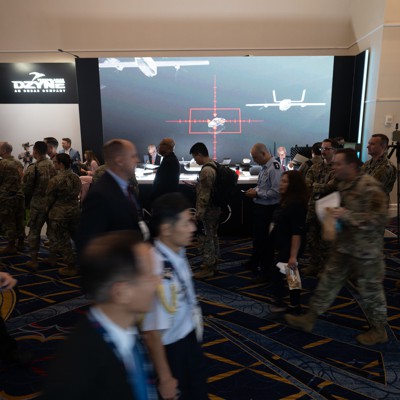
Air & Space Forces Association / Craig Hudson
Getting leaders and operators comfortable with agents will require new doctrine, training, and permissions.
Artificial Intelligence
Air, Space & Cyber Conference
NATIONAL HARBOR, Md. —As Air Force leaders prepare to hand AI more decision-making power in the years ahead, they're also working to get airmen comfortable with that.
“A little bit scary, but we need to lean into it,” Air Force Secretary Troy Meink said at the Air and Space Association’s Air, Space & Cyber conference this week. “Autonomy is one of, if not the key technology enabling cost-effective combat power.”
Although Meink didn’t say so explicitly, “leaning in” will require new thinking on building trust between human airmen and the AI assistants, chatbots, and autonomous drones that will surround them. But other parts of the Air Force have spent a lot of time thinking about it, especially as the service works to field 500 highly-autonomous collaborative combat aircraft, or CCAs, by 2032.
“There’s a trust and autonomy question,” said Michael Gregg, director of aerospace systems at the Air Force Research Laboratory. “We have psychologists and behavioral scientists in our 711th Human Performance Wing that are actually studying this problem: How do you actually team machines with humans to make the human really really good at what they do and aid their decision-making? That is the future.”
And for some missions, like protecting air bases from drone attacks, the Air Force is exploring the possibility of not augmenting but replacing human decision-making. The waves of drones striking Ukrainian cities and ravaging U.S. bases in the Middle East have service leaders exploring the use of agents—AI tools that can take action—to work the process of obtaining approvals to launch counter-attacks.
That will require humans to define acceptable risk for allowing AI agents to make decisions.
“There is an increased push on how we use agents and agentic workflow into everything from fires to our back-office activities, and like you'll see a lot more of that coming this year,” said Ben Van Roo, the CEO of Legion Intelligence, a company that develops agentic AI agents for national-security purposes.
The question of AI directing “fires” is controversial, as the term suggests allowing a software program to launch a missile, fire a gun, or launch a deadly weapon. While there are some exceptions, military doctrine states a strong preference for meaningful human control over potentially lethal effects.
But cyber, directed energy, and other non-lethal technologies are giving the military more fires it might deploy without human oversight, said Mike Hiatt, the chief technology officer at Epirus, a company that makes microwave and other directed-energy counter-drone defenses.
“If you can have an option that has lower collateral effects and no collateral damage, you know, which is what the directed-energy weapons offer, you start to be able to change your risk calculation. You start to be able to make decisions where you say ‘OK, I'm a little more comfortable with putting this part of the system on a fully autonomous mode,” Hiatt said.
Van Roo said the decision processes to allow autonomous cyberattacks or nonlethal effects could eventually be accelerated with AI, or even automated completely.
“We're really still in the infancy right now of how we think about where we're going to use agents, what are we going to allow them to decide on? How do they work their way into our tactics, techniques, and procedures, into our doctrine?” he said.
Getting leaders and operators to be comfortable with AI agents will require new doctrine, training, and permissions, as well as a high degree of confidence that AI tools will perform in predictable ways.
“This is going to happen right now in front of us before AI and killer robots take over the world,” he said.
This year’s conference occurred amid a national debate over the dangers of AI, how it should be regulated, and who should decide.
The summer’s disclosures by Anthropic and OpenAI of surprising and dangerous model behavior were followed on Sept. 9 by the high-profile resignation of an Anthropic engineer who claimed a 10-percent probability that AI “could kill all humans.” The following day, representatives of those companies and Google intensified efforts to create an industry-safety body while signaling openness to Congressional action. But regulation is opposed by President Donald Trump, who posted this week, “The only control or ‘guardrail’ that AI needs is a STRONG AND SMART (High IQ!) PRESIDENT, and the U.S.A. has that, in spades!”
Pentagon leaders’ willingness to accept AI may stem from the fact that their current systems failed to keep key U.S. bases safe. But it may also reflect several years of Defense Department efforts to grapple with concerns about intent, alignment, and safe use that frontier AI labs are just now grappling with. Since 2019 , the military has had a list of ethical principles to guide AI development, experimentation and use. It also reviews processes, experiments, and testing procedures for new technology, including software and, of course, the most dangerous weapons on Earth.
But the pace of AI advancement is quickly changing concepts of how to develop and test weapons. Ryan Tseng, president and co-founder of Shield AI, told the crowd at AFA that his company had worked with Ukrainians to improve the strike capability of one of the company’s drone weapons by 70 percent through “advanced autonomous behaviors.”
If autonomous drones are the signature feature of the war in Ukraine, many military officials expect the next conflict to be defined by rapid collaboration between agents, humans, and drones that will speed up strikes and counter-strikes. That will require continuous evolution on building trust between humans and AI entities as well.
“When we think about a future that's going to have very large-scale deployments of systems that need to interoperate with each other,” said Tseng. “It's a much larger decision space. A lot more things can happen.”
NEXT STORY: Air Force contemplates unmanned tankers
空军与太空部队协会/克雷格·哈德森
要让领导者和运营人员对代理人感到放心,需要新的理论、培训和授权。
人工智能
航空航天网络会议
马里兰州国家港——随着空军领导人准备在未来几年赋予人工智能更多决策权,他们也在努力让空军人员适应这一点。
“这有点吓人,但我们必须迎难而上,”空军部长特洛伊·梅因克本周在航空航天协会的航空航天与网络会议上表示。“自主性是实现经济高效作战能力的关键技术之一,甚至可以说是关键技术。”
尽管梅因克没有明确指出,但“积极参与”需要重新思考如何在飞行员和他们周围的人工智能助手、聊天机器人和自主无人机之间建立信任。空军其他部门已经花费大量时间思考这个问题,尤其是在空军致力于在2032年前部署500架高度自主的协同作战飞机(CCA)之际。
“这里涉及到信任和自主性的问题,”空军研究实验室航空航天系统主任迈克尔·格雷格说。“我们第711人类绩效联队的心理学家和行为科学家正在研究这个问题:如何才能真正将机器与人类结合起来,使人类在各自的领域中表现出色,并辅助他们的决策?这才是未来。”
对于某些任务,例如保护空军基地免受无人机袭击,空军正在探索用人工智能而非辅助手段来取代人类决策的可能性。无人机袭击乌克兰城市和肆虐中东美军基地的浪潮,促使军方领导人开始研究使用人工智能代理(能够采取行动的工具)来协助获取反击授权。
这就需要人类来界定人工智能代理做出决策可接受的风险。
“我们正在加大力度探索如何将智能体和智能体工作流程应用到从灭火到后台办公等各个方面,而且今年你会看到更多这样的应用,” Legion Intelligence 的首席执行官 Ben Van Roo 表示,该公司致力于为国家安全目的开发智能体 AI。
人工智能指挥“火力”的问题一直备受争议,因为这个词意味着允许软件程序发射导弹、开火或发射致命武器。虽然也有一些例外情况,但军事理论强烈倾向于由人类进行有效的控制,以避免潜在的致命后果。
Epirus 是一家生产微波和其他定向能反无人机防御系统的公司,其首席技术官 Mike Hiatt 表示,网络、定向能和其他非致命技术正在为军方提供更多无需人工监督即可部署的火力。
“如果你能有一种附带效应更小、甚至没有附带损害的选择,就像定向能武器所提供的那样,你就可以开始改变你的风险评估。你就可以开始做出这样的决定:‘好吧,我可以更放心地将系统的这一部分置于完全自主的模式下,’”海亚特说道。
范·鲁表示,人工智能最终可以加快允许自主网络攻击或非致命性影响的决策过程,甚至完全实现自动化。
他说:“我们现在对于如何使用特工、允许他们做出哪些决定、如何让他们融入我们的战术、技术和程序以及我们的理论,都还处于起步阶段。”
要让领导者和操作人员适应人工智能代理,需要新的理论、培训和权限,以及对人工智能工具能够以可预测的方式运行的高度信心。
“在人工智能和杀手机器人统治世界之前,这一切将在我们眼前发生,”他说。
今年的会议正值全国范围内就人工智能的危险性、监管方式以及决策者展开辩论之际。
今年夏天,Anthropic 和 OpenAI 披露了其模型令人震惊且危险的行为。9 月 9 日,Anthropic 一位工程师高调辞职,他声称人工智能有 10% 的概率“可能毁灭全人类”。第二天,这些公司和谷歌的代表加紧努力,试图成立一个行业安全机构,同时表示愿意接受国会的监管。但唐纳德·特朗普总统反对监管,他本周发帖称:“人工智能唯一需要的控制或‘护栏’就是一位强大而睿智(高智商!)的总统,而美国在这方面人才济济!”
五角大楼领导人愿意接受人工智能,或许是因为现有的系统未能保障美国关键基地的安全。但这也可能反映了国防部多年来致力于解决人工智能意图、一致性和安全使用等问题的努力,而这些问题正是前沿人工智能实验室目前才开始着手解决的。自2019年以来,军方制定了一系列伦理原则,用于指导人工智能的开发、实验和使用。军方还会审查新技术(包括软件,当然也包括地球上最危险的武器)的流程、实验和测试程序。
但人工智能的飞速发展正在迅速改变武器研发和测试的理念。Shield AI公司总裁兼联合创始人瑞安·曾(Ryan Tseng)在AFA展会上告诉与会者,该公司与乌克兰方面合作,通过“先进的自主行为”技术,将该公司一款无人机武器的打击能力提高了70%。
如果说自主无人机是乌克兰战争的标志性特征,那么许多军方官员预计,下一场冲突的特征将是特工、人类和无人机之间快速协作,从而加快打击和反击的速度。这也需要不断改进人类与人工智能实体之间的信任建设。
曾先生说:“当我们展望未来,设想未来将要大规模部署需要相互协作的系统时,就会发现决策空间更大,可能发生的情况也更多。”
下一篇报道:空军正在考虑研发无人加油机