Wait, This Mysterious Heavily-Armored Blue Train Caboose Belongs To The Navy?等等,这节神秘的蓝色重型装甲火车车厢是海军的吗?
The Navy is a prolific user of nuclear power and needs to protect nuclear material when traveling by rail. That's where the armored caboose comes in.
新闻视频
By Joseph Trevithick
Published Mar 8, 2021 5:42 PM EST
When one thinks of the U.S. Navy, ships , submarines , and fast fighter jets probably quickly spring to mind. Armored railcars probably not so much. Those sound more like the stuff of spaghetti westerns, WWII history books, and Steven Seagal movies. But after our investigation, spurred by rail spotters not being able to make sense of a mysterious blue-painted armored caboose, we learned that this year, the Navy, in cooperation with the Department of Energy, is set to begin using a new “fleet” of heavily armored cabooses specially outfitted to escort trainloads of sensitive nuclear material.
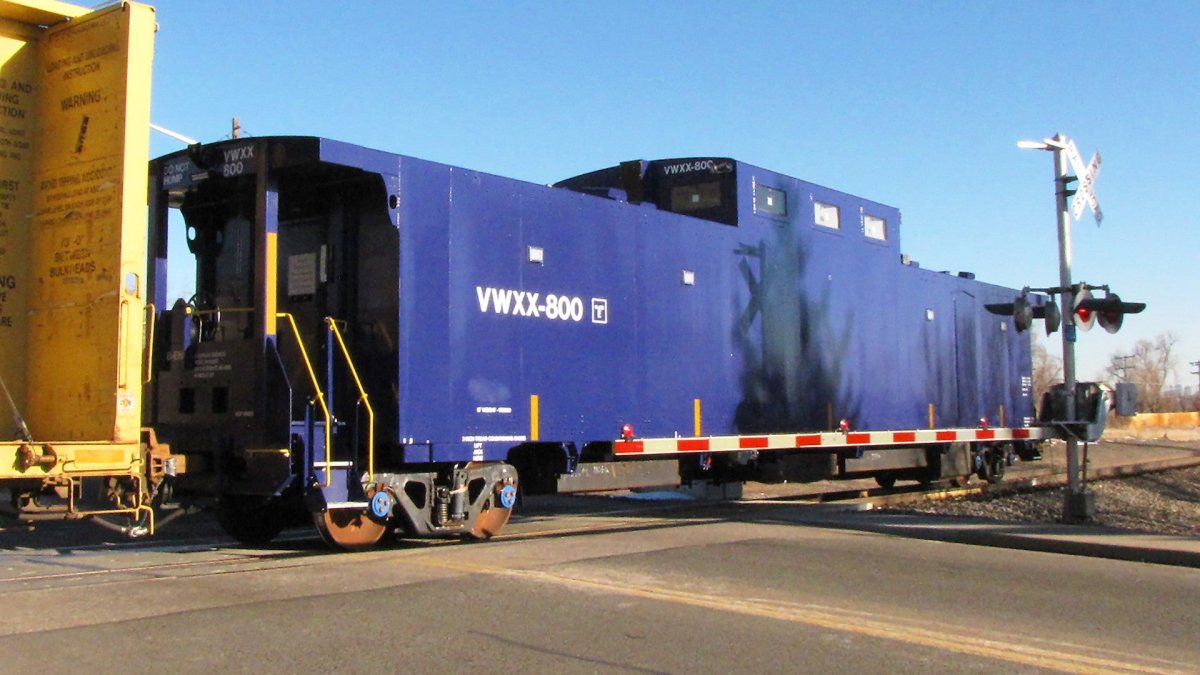
A reader of The Drive , Rafi Ward, first alerted us to pictures that have been circulating on social media of one of these mysterious cabooses, which has an alpha-numeric identification code, VWXX-800, a prefix that is known in the railroad world as a reporting mark. We subsequently acquired pictures of this car from photographer Anthony Delgado. Based on our own digging, The War Zone can now confirm that this railcar, and others like it, are being built under a U.S. government contract to support the Naval Nuclear Propulsion Program (NNPP), more commonly known simply as Naval Reactors.
A picture of VWXX-800, an armored caboose that is set to enter service this year guarding trains carrying Naval Reactors’ cargoes., Vigor Industrial
“The railcar series you describe (VWXX-800) is currently being built, outfitted, and certified by Vigor Works LLC under contract to the U.S. Government and will be used as a courier escort vehicle by the Naval Nuclear Propulsion Program to support spent nuclear fuel and other national security shipments,” a spokesperson for Naval Reactors told The War Zone . “The first railcar is expected to be delivered at the end of 2021 and placed into service shortly thereafter. The railcar replaces similar escort vehicles the Navy uses that are near the end of their service life.”
In its present form, Naval Reactors, which is responsible for the design, development, and sustainment of reactors for America’s nuclear-powered warships and submarines, as well as various associated work, is a joint Navy-Department of the Energy office led by a four-star admiral. Today, nuclear propulsion is used on America’s most important naval vessels, its aircraft carriers and submarines. This includes the Ohio class ballistic missile submarines that form one of the legs of the country’s nuclear deterrent triad , as well as the four Ohios converted to highly-specialized guided-missile boats . The successors to the Ohios , the forthcoming Columbia class , will also be nuclear-powered.
A brief overview of the Navy’s use of nuclear propulsion as of 2016., NNPP
The Naval Nuclear Laboratory (NNL) is the main component of the NNPP and encompasses four separate facilities, the Bettis Atomic Power Laboratory in Pittsburgh, Pennsylvania; the Knolls Atomic Power Laboratory (KAPL) in Schenectady, New York; the Kenneth A. Kesselring Site in West Milton, New York; and the Naval Reactors Facility within the Idaho National Laboratory. Naval Reactors operates various other support and training sites and coordinates with naval shipyards and other industrial facilities.
An infographic giving a very broad overview of what Naval Reactors does., DOE
The exact specifications of VWXX-800 are unclear. A spokesperson for Vigor Industrial confirmed that Vigor Works, a wholly-owned subsidiary previously known as Oregon Iron Works, had designed and built VWXX-800, but could not offer any additional details. They also did not say if any division of the company had previously built any similar kinds of specialized railcars in the past. A picture of this particular car is featured on the company’s nuclear products page .
Vigor Works is best known for designing and building a number of stealthy special operations boats for the Navy, which you can read about more in this past War Zone piece , but has also previously developed an unmanned seaplane for the Navy, built streetcars in cooperation with Czech firm Skoda, and crafted a buoy designed to test the possibility of turning waves into energy . Vigor Industrial also includes other large shipbuilding and marine repair enterprises that provide services to the Navy, among others.
An online database available through railroad company CSX says that VWXX-800 is just under 69 feet long, nearly 16 feet high at its tallest, and about 10 and a half feet wide. It has an unloaded weight of around 175,000 pounds and a maximum loaded weight of 185,000 pounds, per that same source. These weights are closer to the figures commonly associated with similarly cargo-carrying boxcars than cabooses, which are generally smaller all around .
A shot of the rear of VWXX-800., Anthony Delgado
Pictures show it has a typical caboose configuration, in general, with a cupola on top and access doors and the front and rear. There is also what may be a large door at least on one side of the car, which could allow personnel inside to rapidly disembark in an emergency or some other kind of contingency.
There are no traditional windows on the body of the car, but there are 10 windows with firing ports on the cupola, two each at the front and rear and six on each side. These would allow individuals to fire small arms at hostile individuals outside while remaining protected inside the railcar’s armored shell. What might appear at first glance to be additional firing ports on the body of the car look more likely to be floodlights, which would offer valuable illumination on either side during any incidents at night.
A side view of VWXX-800 showing some of the firing ports on the main body of the car and on the cupola. , Anthony Delgado
Another side view of VWXX-800 showing what could be a large door., Anthony Delgado
“The couriers escorting the Navy shipments are Federal Officers, provide constant surveillance, and act as first responders in the event of an issue with the transport,” the Naval Reactors spokesperson said.
The design appears to be substantially larger and more capable than the armored escort cabooses that the NNPP has now, which notably have no visible firing ports. It’s unclear how many of those escort railcars exist now, but a 2016 Naval Reactors presentation said that the plan, at least at that time, was to acquire five of the new examples from Vigor Works. It is certainly very possible that this represents a one-for-one replacement plan.
A slide from a presentation in 2016 showing one of the existing escort cabooses and providing additional information about Naval Reactors’ use of rail transport., NNPP
That same presentation said that the design work was 90% complete at that time and the NNPP would receive the first of the new escort cars for testing in January 2020. The procurement plan at that point was to buy two additional examples in both 2020 and 2021.
No matter the exact specifications of VWXX-800-series cars or exactly how they will be crewed and operated, having carloads full of armed federal officers accompanying any trains carrying nuclear material or other sensitive related items belonging to Naval Reactors between NNL sites, shipyards, and other facilities makes good sense. Even spent fuel rods and other nuclear waste could be attractive targets for thieves and other malign actors, including those looking to build so-called “ dirty bombs .” A dirty bomb uses conventional explosives to disperse dangerous radioactive material. While experts debate just how real the threat from such a weapon might be, it certainly has the potential to spark mass panic, especially if detonated in a densely populated urban area .
NNPP trains carry components in boxcars and, for larger items, in specialized shipping containers on flatcars. Two different types of sealed containers are used to transport spent nuclear fuel.
A Naval Reactors boxcar used to carry sensitive components., NNPP
A flatcar for carrying larger components inside shipping containers., NNPP
The two types of rail transportation methods for spent fuel from the Navy’s reactors., NNPP
Trains carrying components typically include one flatcar or three to six boxcars, according to NNPP. Common routes for those trains run between facilities in New York and Virginia and shipyards on the East and West Coasts of the United States.
When it comes to spent fuel, those ships generally run from shipyards on the coasts to the Naval Reactors Facility in Idaho, where this waste is stored, at least temporarily.
Common component shipping routes as of 2016., NNPP
Routes used to transport spent fuel via rail to the Naval Reactors Facility., NNPP
It is somewhat interesting that Naval Reactors continues to use rail transport for its nuclear movements, at all. More than three decades ago, the Department of Energy end the practice of moving nuclear weapons via specialized trains, known variously as “atomic trains” or “white trains,” the latter referring to their initial plain white paint schemes.
“They featured multiple heavily armored boxcars sandwiched in between ‘turret cars,’ which protruded above the rest of the train. The turrets had slit windows through which armed DOE guards peered out, prepared to shoot if they needed to defend the train. Some guards had simple rifles, while others reportedly had automatic machine guns and hand-grenade launchers,” according to a 2018 piece from History.com . “Known in DOE [Department of Energy] parlance [as] ‘safe, secure railcars,’ or SSRs, the white trains were highly resistant to attack and unauthorized entry. They also offered ‘a high degree of cargo protection in event of fire or serious accident,’ the DOE assured a wary Congress in 1979.”
Protests and public outcry , driven in large part by growing opposition to nuclear weapons, in general, toward the end of the Cold War, prompted changing the paint scheme of the trains from white to various colors in the early 1980s. There were still concerns, both inside the U.S. government and out, as well as elsewhere around the world, about the safety and security surrounding these trains, the simple accidental derailment of which presented the potential risk of a major nuclear or radiological incident.
The video below shows a dramatic live test, dubbed Operation Smash Hit , that British Energy in the United Kingdom carried out in 1984 in an attempt to demonstrate the safety of transporting nuclear material via rail, even in the event of a derailment.
“The painting of these railcars will not stop dedicated protesters from identifying our special trains,” but “will make tracking our trains more difficult, and we believe, enhances the safety and security,” a 1984 Department of Energy memo said. By 1987, however, the decision had been made to bring the operation of these trains to a halt and replacement with specially modified tractor-trailer trucks loaded with James Bond-esque booby traps, which you read about in more detail in this previous War Zone story . These semis, a third generation of which is now under development , are also designed to be highly inconspicuous, but are not immune to detection or accidents themselves .
“The Department of Energy quit using railcars for weapon shipments in 1987,” a spokesperson for the National Nuclear Security Administration (NNSA), which oversees America’s nuclear weapons stockpile, had confirmed was still the case to The War Zone as we sought information about VWXX-800. “Since then, DOE/NNSA has transported national security cargoes in highly modified secure tractor-trailers escorted by armed Federal Agents .”
A prototype of the NNSA’s next-generation tractor-trailer truck for hauling nuclear weapons is seen in front of another truck being propelled at it using large rockets as part of a test to see how it would hold up against a high-speed collision., NNSA
Separate plans had also emerged in the 1980s to use discreet trains as mobile launch platforms for LGM-118A Peacekeeper intercontinental ballistic missiles (ICBM), a concept known as the Peacekeeper Rail Garrison , which would make it more difficult for the Soviet Union to target them. The Soviets had fielded their own train-based ICBMs and the Russians had looked to revive the idea in the mid-2010s, before shelving it again to focus on other higher-priority strategic weapons in 2017.
Specialized railcars to carry security personnel were to have been components of the Peacekeeper Rail Garrisons, as well. However, in 1991, with the end of the Cold War, the program was canceled. The LGM-118As instead ended up in traditional silos, before being removed from service entirely in 2005 as a result of the Strategic Arms Reduction Treaty II (START II) agreement.
An artist’s conception of an LGM-118A Peacekeeper intercontinental ballistic missile on a launcher concealed inside what would otherwise appear to be a standard boxcar., Convair/General Dynamics via the San Diego Air and Space Museum
It’s important to note, of course, that rail transport remains in use for the movement of commercial reactor components and nuclear waste . At the same time, reactors for naval vessels, in general , are significantly different from civilian power-generating types. Most notably, in part to help keep the reactors compact, but powerful, they often use weapons-grade highly enriched uranium (HEU). As of 2016, the Navy alone accounted for approximately 60 percent of HEU use in naval applications worldwide, according to the Arms Control Association . It’s worth pointing out that the head of Naval Reactors is also one of a number of Deputy Administrators at NNSA, underscoring both the importance and the sensitivity of the NNPP.
Naval Reactors’ position is that the exact construction of the fuel used in the Navy’s reactors makes it very safe , by fissile material standards, when it comes to accidents. The fuel rods are solid metal with the nuclear material being fully encapsulated inside, a design decision already driven by the need to make it safe for sailors to work around them on a regular basis and to ensure they are resistant to battle damage during actual combat. “Naval fuel is built to withstand combat battle shock forces well in excess of 50 times the force of gravity (more than 100 times the force of a severe earthquake),” an NNPP document from 2017 says.
Still, there have been efforts to reduce the use of HEU in the Navy’s reactors for safety and security reasons, but this has faced opposition over the years from various ends of the U.S. government. Plans to shift naval nuclear propulsion to primarily use non-weapons-grade low enriched uranium (LEU) are, at best, decades away from becoming a reality.
Regardless, at least in the meantime, Naval Reactors will continue to use rail as a means to transport nuclear and nuclear-related cargoes around the country. If the Navy keeps to its schedule, VWXX-800 will be in service helping to guard those trains by the end of this year.
Contact the author: joe@thedrive.com
Comments couldn’t be loaded. Please refresh the page.
作者:约瑟夫·特雷维西克
发布于 2021 年 3 月 8 日下午 5:42(美国东部时间)
提到美国海军,人们脑海中浮现的可能是舰艇、潜艇和高速战斗机,而不是装甲铁路车厢。装甲车厢听起来更像是意大利西部片、二战历史书籍和史蒂文·西格尔电影里的情节。然而,在铁路爱好者们对一节神秘的蓝色装甲守车百思不得其解之后,我们展开了调查。调查发现,今年,美国海军将与能源部合作,启用一支新型重型装甲守车“车队”,专门用于护送满载敏感核材料的列车。
《The Drive》的读者拉菲·沃德(Rafi Ward)首先向我们透露了社交媒体上流传的一组神秘守车照片。这节守车带有字母数字组合的识别码VWXX-800,在铁路界,这个前缀被称为报告标记。随后,我们从摄影师安东尼·德尔加多(Anthony Delgado)那里获得了这节车厢的照片。根据我们自己的调查,《战区》(The War Zone)现在可以确认,这节车厢以及其他类似的守车是根据美国政府的合同建造的,用于支持海军核动力推进计划(NNPP),也就是人们常说的海军反应堆。
图中所示为VWXX-800型装甲守车,该车将于今年投入使用,用于护卫运送海军反应堆货物的列车。(图片来源:Vigor Industrial)
“您提到的VWXX-800系列铁路货车目前正由Vigor Works LLC公司根据与美国政府签订的合同进行建造、改装和认证,并将由海军核动力推进计划用作运输乏核燃料和其他国家安全物资的护送车辆,”海军反应堆发言人告诉《战区》网站。“首辆铁路货车预计将于2021年底交付,并随后投入使用。该铁路货车将取代海军目前使用的、已接近使用寿命的类似护送车辆。”
目前,负责美国核动力军舰和潜艇反应堆设计、开发和维护以及相关工作的海军反应堆办公室,是由海军和能源部联合设立的机构,由一位四星上将领导。如今,核动力被应用于美国最重要的海军舰艇——航空母舰和潜艇。这其中包括构成美国核威慑三位一体之一的俄亥俄级弹道导弹潜艇,以及四艘改装成高度专业化导弹艇的俄亥俄级潜艇。即将服役的哥伦比亚级潜艇,作为俄亥俄级的后继舰,也将采用核动力。
海军核动力推进技术使用情况概述(截至2016年)。
海军核实验室(NNL)是海军核电站(NNPP)的主要组成部分,由四个独立的设施组成:位于宾夕法尼亚州匹兹堡的贝蒂斯原子能实验室;位于纽约州斯克内克塔迪的诺尔斯原子能实验室(KAPL);位于纽约州西米尔顿的肯尼斯·A·凯瑟林基地;以及位于爱达荷国家实验室内的海军反应堆设施。海军反应堆还运营着其他各种支持和培训基地,并与海军造船厂和其他工业设施进行协调。
一张信息图,全面概述了海军反应堆的功能。(美国能源部)
VWXX-800的具体规格尚不明确。Vigor Industrial的一位发言人证实,其全资子公司Vigor Works(前身为Oregon Iron Works)设计并制造了VWXX-800,但无法提供更多细节。该发言人也未透露公司其他部门此前是否制造过类似类型的专用铁路车辆。该公司核产品页面上展示了这款车辆的图片。
Vigor Works公司最出名的是为美国海军设计和建造了一系列隐形特种作战艇,您可以在之前的“战区”专题文章中了解更多详情。此外,该公司此前还为美国海军开发过无人水上飞机,与捷克斯柯达公司合作建造过有轨电车,并设计制造了一个用于测试波浪能转化可能性的浮标。Vigor Industrial集团旗下还包括其他大型造船和船舶维修企业,为包括美国海军在内的多个国家提供服务。
根据铁路公司CSX提供的在线数据库显示,VWXX-800型货车长约69英尺(约21米),最高处近16英尺(约4.9米),宽约10.5英尺(约3.2米)。该货车空载重量约为175,000磅(约79,000公斤),最大载重为185,000磅(约84,000公斤)。这些重量数据更接近于其他同类型货车的重量,而非守车的重量,因为守车的尺寸通常都比较小。
VWXX-800 的后部照片,安东尼·德尔加多
图片显示,这节车厢大致采用典型的守车结构,顶部设有瞭望塔,前后均设有车门。此外,车厢至少一侧似乎还有一扇较大的门,以便在紧急情况或其他突发事件中,车内人员能够迅速下车。
车体上没有传统意义上的窗户,但穹顶上有10个带射击孔的窗户,前后各两个,两侧各六个。这些射击孔可以让车内人员在装甲车厢的保护下,向车外的敌对人员发射小型武器。乍一看,车体上似乎也有射击孔,但实际上更像是探照灯,可以在夜间发生任何事件时提供两侧的照明。
VWXX-800 的侧视图,图中显示了车体主体和指挥塔上的一些射击孔。(安东尼·德尔加多摄)
VWXX-800 的另一张侧视图,图中可以看到一个疑似大门的部件。——安东尼·德尔加多
海军核反应堆发言人表示:“护送海军货物的信使是联邦官员,他们会进行持续监视,并在运输出现问题时作为第一响应者。”
该设计似乎比核电站目前使用的装甲护卫车厢更大、性能更强,值得注意的是,后者没有可见的射击孔。目前尚不清楚有多少辆这样的护卫车厢,但2016年海军反应堆部门的一份报告显示,当时的计划是从Vigor Works公司采购五辆新型护卫车厢。这很可能代表着一项一对一的替换计划。
这张幻灯片来自2016年的一次演示,展示了现有的一节护航守车,并提供了有关海军核反应堆使用铁路运输的更多信息。
该演示文稿还指出,当时设计工作已完成90%,NNPP将于2020年1月接收第一辆新型护航车进行测试。当时的采购计划是在2020年和2021年各采购两辆。
无论VWXX-800系列车辆的具体规格如何,也无论其乘员和操作方式如何,在往返于海军核实验室(NNL)各设施、造船厂和其他设施之间,运送核材料或其他海军反应堆敏感物品的列车都应配备满载武装联邦执法人员的车辆,这无疑是明智之举。即使是乏燃料棒和其他核废料也可能成为窃贼和其他不法分子的目标,包括那些企图制造所谓“脏弹”的人。脏弹使用常规炸药来散布危险的放射性物质。尽管专家们仍在争论这种武器的威胁究竟有多大,但它无疑有可能引发大规模恐慌,尤其是在人口稠密的城市地区引爆。
核电站的运输列车使用货车运输部件,而较大的物品则使用平板车上的专用集装箱运输。运输乏核燃料则使用两种不同的密封集装箱。
一节用于运输敏感部件的海军反应堆专用货车,NNPP
用于运输集装箱内大型部件的平板车。
海军核电站乏燃料的两种铁路运输方式。
据NNPP称,运送零部件的列车通常包括一节平板车或三到六节棚车。这些列车的常见路线往返于纽约和弗吉尼亚的工厂以及美国东西海岸的造船厂之间。
就乏燃料而言,这些船只通常从沿海的造船厂开往爱达荷州的海军反应堆设施,这些废物至少会暂时储存在那里。
截至2016年,常用部件运输路线如下,NNPP
用于通过铁路向海军核反应堆设施(NNPP)运输乏燃料的路线。
海军核反应堆至今仍使用铁路运输核武器,这多少有些耐人寻味。三十多年前,能源部就已停止使用专用列车运输核武器,这些列车曾被称为“原子列车”或“白色列车”,后者指的是它们最初的纯白色涂装。
据History.com网站2018年的一篇文章报道,“这些列车由多节重型装甲车厢夹在突出于车厢顶部的‘炮塔车厢’之间组成。炮塔上设有狭长的窗口,美国能源部(DOE)的武装警卫透过窗口向外窥视,随时准备在需要时开火保卫列车。一些警卫配备的是简易步枪,而另一些据称则配备了自动机枪和手榴弹发射器。” “这些白色列车在美国能源部被称为‘安全可靠铁路车厢’(SSR),它们具有极强的防御能力,能够有效抵御攻击和未经授权的闯入。能源部在1979年向忧心忡忡的国会保证,这些列车还能‘在发生火灾或严重事故时为货物提供高度保护’。”
冷战末期,公众对核武器的反对声浪日益高涨,抗议和抗议活动促使美国政府在20世纪80年代初将列车的涂装从白色改为其他颜色。当时,无论是美国政府内部还是外部,以及世界其他地区,仍然对这些列车的安全保障感到担忧,因为即使是简单的意外脱轨事故也可能引发重大的核事故或放射性事故。
下面的视频展示了英国能源公司于 1984 年进行的一项名为“粉碎行动”的重大现场测试,旨在证明即使发生脱轨事故,通过铁路运输核材料也是安全的。
“给这些车厢涂上油漆并不能阻止执着的抗议者识别我们的特殊列车,”但“这将使追踪我们的列车更加困难,我们相信,这将提高安全性和保障性,”一份1984年的能源部备忘录写道。然而,到了1987年,当局决定停止这些列车的运营,并用经过特殊改装的半挂卡车取而代之,这些卡车装载着类似詹姆斯·邦德电影中的诡雷,您可以在之前的“战区”报道中读到更详细的内容。这些半挂卡车(目前正在研发第三代)的设计也力求高度隐蔽,但并非不会被发现或发生事故。
“能源部于1987年停止使用铁路运输武器,”负责监管美国核武器储备的国家核安全管理局(NNSA)的一位发言人向《战区》证实了这一消息,当时我们正在就VWXX-800导弹寻求相关信息。“自那时起,能源部/国家核安全管理局一直使用经过高度改装的安全拖车运输国家安全货物,并由武装联邦特工护送。”
美国国家核安全管理局(NNSA)的下一代核武器运输用半挂卡车原型车,被另一辆卡车用大型火箭弹射向其前方,这是测试其在高速碰撞中的表现。
上世纪80年代,曾出现过利用隐蔽列车作为LGM-118A“和平卫士”洲际弹道导弹(ICBM)移动发射平台的独立计划,这一概念被称为“和平卫士铁路驻防”,旨在增加苏联打击这些导弹的难度。苏联已经部署了自己的列车式洲际弹道导弹,俄罗斯在2010年代中期曾试图重启这一计划,但在2017年再次搁置,转而专注于其他优先级更高的战略武器。
用于运送安保人员的专用铁路车辆原本也是“维和铁路驻军”计划的组成部分。然而,随着1991年冷战的结束,该计划被取消。LGM-118A型导弹最终被封存在传统的导弹发射井中,并于2005年因《第二阶段削减战略武器条约》(START II)的签订而彻底退役。
这是艺术家绘制的LGM-118A“和平卫士”洲际弹道导弹的发射装置示意图,该装置隐藏在看似普通的货车车厢内。图片来自圣地亚哥航空航天博物馆,由康维尔/通用动力公司提供。
当然,值得注意的是,铁路运输仍然用于商业反应堆部件和核废料的运输。同时,海军舰艇的反应堆通常与民用发电反应堆有显著区别。最显著的是,为了保持反应堆的紧凑性和强大的功率,它们通常使用武器级高浓缩铀(HEU)。据军备控制协会统计,截至2016年,仅海军就占全球海军应用中高浓缩铀使用量的约60%。值得一提的是,海军反应堆负责人同时也是美国国家核安全管理局(NNSA)的几位副局长之一,这凸显了海军核电站的重要性和敏感性。
海军核反应堆管理局的立场是,海军反应堆所用燃料的特殊构造使其在事故发生时,按照裂变材料的标准来看,安全性极高。燃料棒为实心金属,核材料完全封装在内部。这一设计决策的初衷是为了确保水兵在日常工作中能够安全接触燃料棒,并确保其在实战中能够承受战斗损伤。“海军燃料的设计能够承受超过重力50倍(超过强震100倍)的战斗冲击力,”海军核电站管理局2017年的一份文件指出。
尽管如此,出于安全考虑,美国海军一直在努力减少反应堆中高浓缩铀(HEU)的使用,但多年来一直遭到美国政府各部门的反对。将海军核动力推进系统主要转向使用非武器级低浓缩铀(LEU)的计划,即便在最好的情况下,也至少需要数十年才能成为现实。
无论如何,至少目前海军核反应堆仍将继续使用铁路运输核能及相关货物。如果海军按计划进行,VWXX-800 将于今年年底前投入使用,协助护卫这些列车。
联系作者:joe@thedrive.com
评论加载失败,请刷新页面。